Saturday, December 26, 2020

And now Great-Aunt Minna hits the web ...!


Our family is suddenly popping up all over the web. Dear little Auntie Minna is the latest ... 


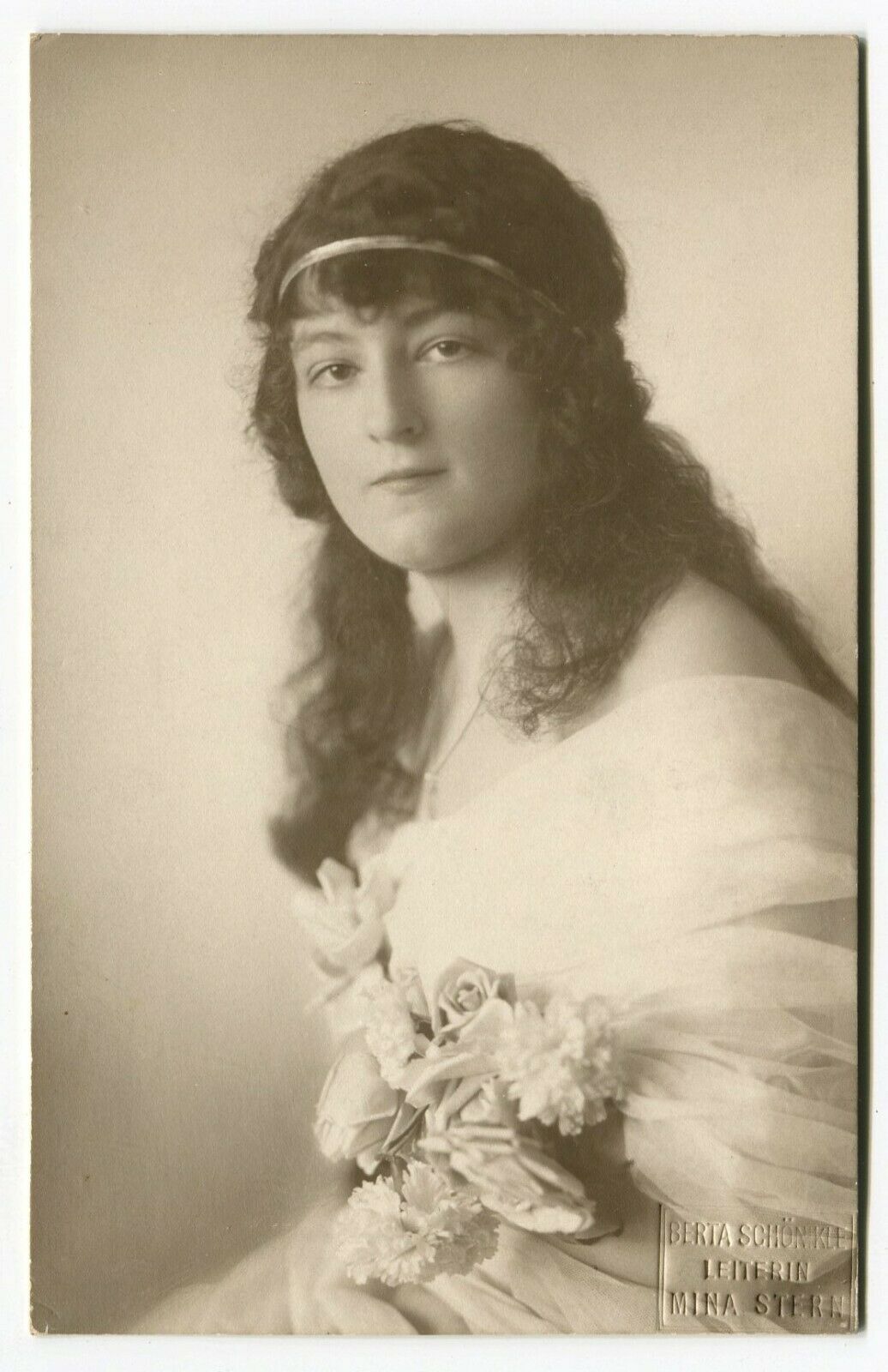
Of course, I don't have many photos of Minna, because as a sometime professional photographer, she was always on the other side of the camera! But my father's early years, often in the company of cousin Tom Stern, were minutely recorded by Auntie Minna, and fill a large box!. 

1922: Gánsls, Sterns .. the sisters Stojetz with their sons, Minna's husband and the ubiquitous female named Mizzi who was apparently a cousin...


Tom Stern and Fritz Ganzl c 1924


'Minna Stern wurde am 8 Juli 1890 Wien als Tochter des Buchbinders Eduard Stojetz (*1869 Wien, gest. 1942 Wien) und [Hermine] Marie (*1862 Wien, gest. 1932 Wien), geborene Baumgartner, geboren. Sie war nicht jüdischer Herkunft. 1913 heiratete sie Richard Michael Stern (*22.11.1884 Wien, gest. 1955 Sydney/Australien), der jüdischer Herkunft war, und mit dem sie gemeinsam einen Sohn, Johann Thomas Hans Stern (*1918 Wien, gest. 1980 Sydney/Australien), hatte.


Minna and Richard Stern. 1946.

Stern veröffentlichte ihre Arbeiten in den ersten Jahren ihrer Ehe noch unter den Namen „Stern-Stojetz, Wien-Floridsdorf“, unter anderem Fotografien zu den Texten ihres Vaters, einem Funktionär in der Organisation der „Naturfreunde“ der Sozialdemokratischen Arbeiterpartei Österreichs (SdAPÖ), in der Zeitschrift „Der Naturfreund“.


Der Naturfreund. Mitteilungen des Touristen-Vereins „Die Naturfreunde“, Jg. 1928, S. 11.


Seit spätestens 1920 arbeitete sie mit der Fotografin Bert[h]a Maria Schönikle zusammen, die seit zirka 1918 in Wien 13, Hietzinger Hauptstraße 34B ein Atelier besaß, das seit ungefähr 1923 den Namen „Atelier Berta Schönikle u. Minna Stern“ trug, und in dem Stern ab 1925 als Leiterin des Ateliers fungierte. 1920 nahmen beide an der Ausstellung der Photographischen Gesellschaft in Wien teil. Sie selbst veröffentlichten ihre Arbeiten in Zeitschriften wie dem „Wiener Salonblatt“ (1923, 1926, 1934, 1936). Die Familie Stern lebte 1938 in Wien 13, Auhofstraße 32.


Schönikle-Stern portraits (1920-1925)

Richard Stern war jüdischer Herkunft und der NS-Verfolgung ausgesetzt. Sein Vermögen wurde ihm aufgrund der 11. Verordnung zum Reichsbürgergesetz vom 25.11.1941 entzogen. Die Familie Stern erreichte nach ihrer Flucht vor den Nationalsozialisten am 18.11.1938 Australien, wo sie sich in Sydney niederließ. Richard Stern stellte im November 1948 nach dem Ersten Rückstellungsgesetz (BGBl 156/1946) einen Rückstellungsantrag hinsichtlich der entzogenen Liegenschaft in Lainz in Wien. Die Rückstellung erfolgte mit Bescheid der Finanzlandesdirektion für Wien, Niederösterreich und dem Burgenland im August 1950. Minna Stern verstarb [11.11.] 1968 in Sydney.'

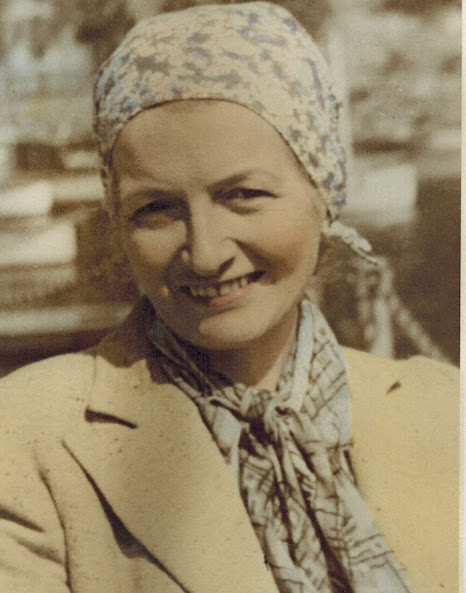
Minna as I remember her

This photo is on eBay Germany. It is labelled 'little girl with toys' by Berta Schönikle. Actually, it isn't a little girl. It's my Uncle Tom Stern, photographed in ?1925 at his mother's studio around the same time as the photo (above) with mein Vater ... and most probably not by Berta (who gets credited everywhere, alone, for the partnership's work) but by Minna. Who, at this stage, was billed as 'Mina Stern'.


I see also that they photographed Stefan Zweig ...


Quellen:
Archiv der WKÖ, Gewerbeakt Schönikle Bertha Maria (verehelichte Kette).
ÖStA, AdR, E-uReang, VVSt, VA, Zl. 23.090, Stern Richard.
ÖStA, AdR, E-uReang, FLD, Zl. 17.009, Stern Richard.
Matricula Erzdiözese Wien, Taufbuch 1890 – Alservorstadt-Pfarre, Stojetz Hermine M.
Matriken der IKG Wien, Trauungsbuch 1913, Stern Richard M., Stojetz Hermine M.
Matriken der IKG Wien, Geburtsbuch 1884, Stern Richard Michael.
WStLA, M.Abt. 119, A41, VEAV, Zl. 652, Bezirk: 13, Stern Richard.
ÖStA, AdR, E-uReang, FLD, Zl. 19.340, Stern Minna.
Zeitungen und Zeitschriften:
Der Naturfreund. Mitteilungen des Touristen-Vereins „Die Naturfreunde“, Jg. 1910-1928.
Photographische Correspondenz, Nr. 714, 1920, S. 107.

(Das Projekt wird gefördert vom Zukunftsfonds der Republik Österreich).

Text, copyright: Walter Mentzel


Friday, December 25, 2020

Victorian Charity or, an expensive night on the Welsh tiles


If I were still collecting wonderful pieces of Victorian ephemera, I would have my hand in my pocket today.


The Most Honourable and Loyal Society of Ancient Britons, founded in 1715,  was one of those 'charitable' groups of wealthy and sociable gentlemen who got together, annually, for a 'Festival', ie an extravagant dinner, liberally laced with best of wines, a concert, lots of cheerfully self-congratulatory speeches (with toasts), and who paid largely (and well-publicisedly) for the 'charitable' pleasure.

1725: first catch your Prince

The Ancient Brits were however a bit different to the Guild of Girdlemakers and other such 'Festivallers' and City Diners, in that they were what would now be doubtless dubbed 'racist', and which I prefer to call 'geographically circumscribed'. Their charity extended only the wandered children of Wales: Welshfolk who had left Wales for London, and there found poverty. The Ancient Brits founded a free school for the children of these foolish unfortunates, and their annual beanfast produced the wherewithal to house them and/or sponsor their education.

The school in Gray's Inn Road

However, there was a little more to it than that. A scholar has adeptly described '[it] was a complex and multi-faceted patriotic phenomenon. It was simultaneously a mouthpiece for royalist propaganda and a haven for political radicals, a piously charitable foundation and an excuse for having a good time. In a period when distinctly Welsh institutions had largely ceased to exist, the Society’s annual celebration of St. David’s Day in the English capital offered a rare example of eighteenth-century Welsh people deliberately imagining into existence an identifiably Welsh nation, using ceremony, sociability, poetry, and politics to fill the institutional void'.


So, our ticket is for the 139th annual, at London's most popular venue for such events, the Freemason's Tavern, in 1854. These 'Festivals' were often reported in huge detail, with all the notable names, and toasts, and answers to toasts listed and described. We are actually rather lucky in that, in 1854, the Welsh paper's shorthand-writer 'had an accident' so the spoken part of the proceedings could not be (shame!) reported verbatim, but they did their best ...


Of course, my interest in the proceedings turns towards the music, and Brinley Richards had gathered a fine group of colleagues for the occasion, headed by the top-notch English soprano, Sophia Messent, the Ransfords -- father Edwin ('I'm a jolly gipsy king, ho! ho!') with his characteristic old-fashioned ballads and character songs, and his talented daughter, Mary Ann -- plus the singer-songwriter W T Wrighton. Of course, a harpist was a must, and John Cheshire was one of the best in the kingdoms. But none of them was Welsh. 
Lucy Williams was indeed Welsh. She even called herself 'the Welsh Nightingale'. I have told her story in another post https://kurtofgerolstein.blogspot.com/2019/10/the-welsh-nightingale-miss-lucy-williams.html. However, to put her up alongside Sophia Messent was, well, a bit like teaming Gwynneth Jones with Kathryn Jenkins. But look who got the review! Lucy, even at this early stage of her career, knew her audiences!

Sounds like a good time was had by all, the 200 deprived children were funded for another year, Earl Grosvenor MP, the evening's 'host', got his name credited as giving as much money as the Queen (100 guineas) to the cause -- he wouldn't dare give more! -- and everyone was happy. Except the poor short-hand writer? 

Thursday, December 24, 2020

Pandemic 1855


Sitting here, sheltered from the current pandemic, I came upon a pair of documents that made me think how lucky we have been, in the last century, to have not struck such a thing before ...

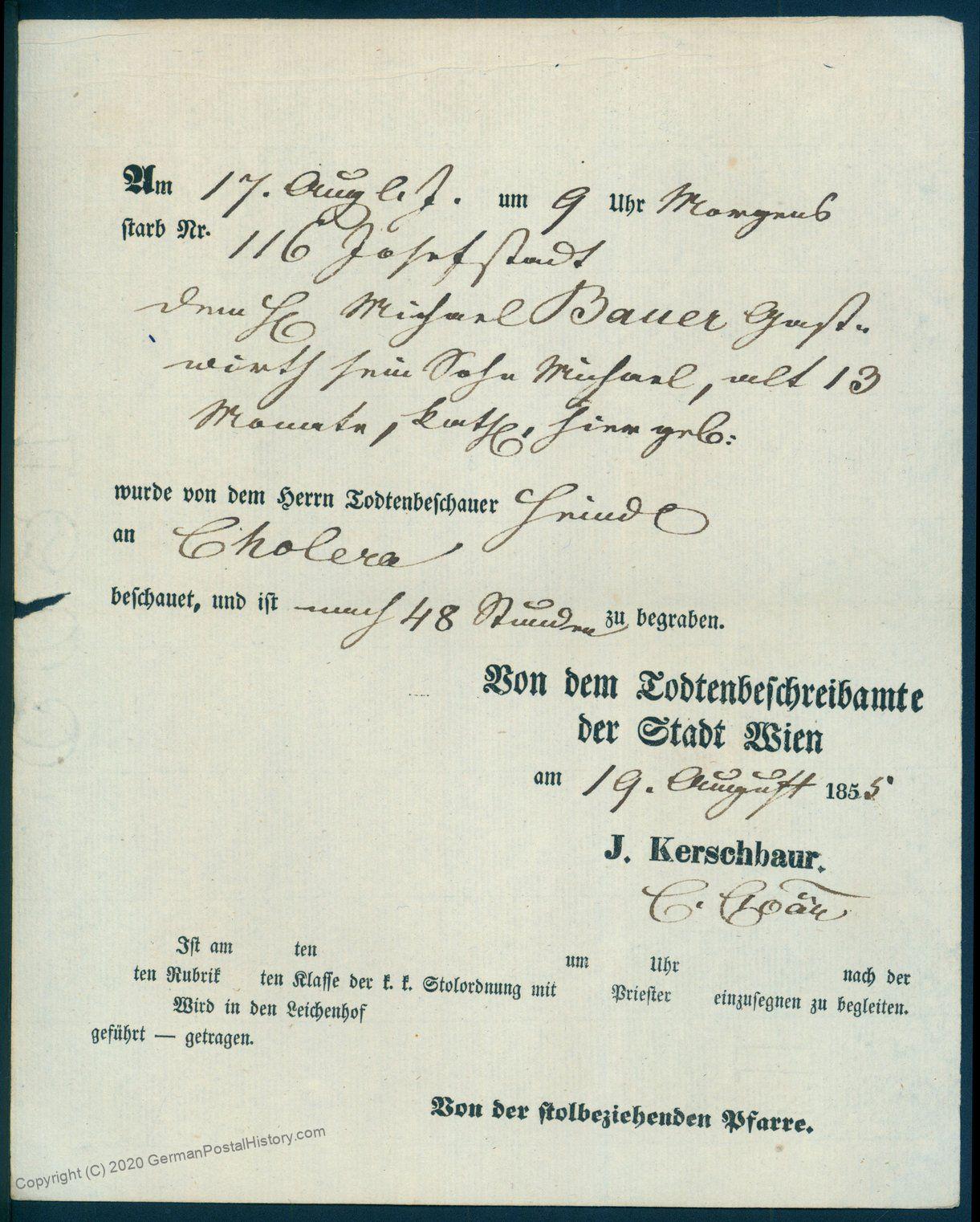
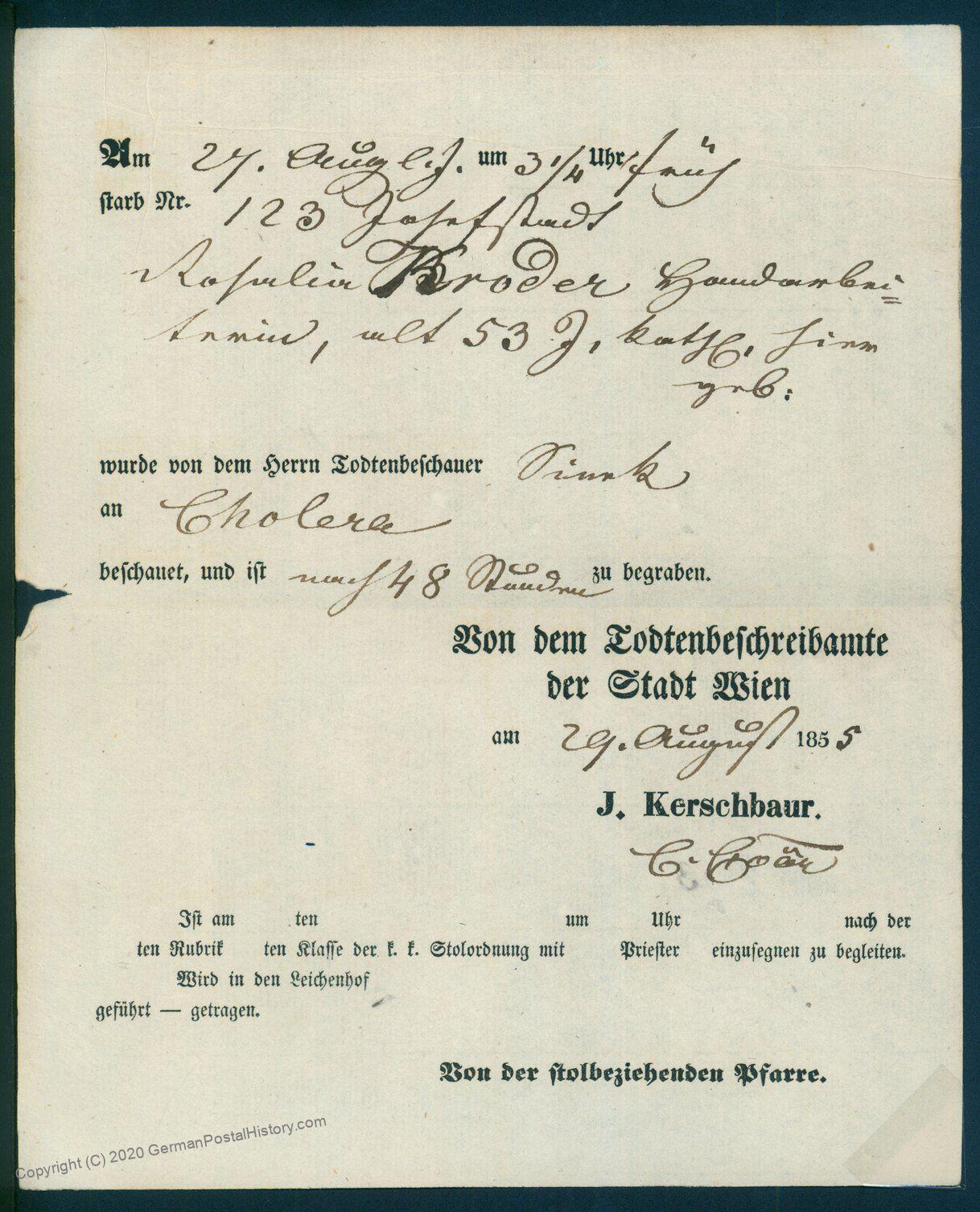
These two papers are from Vienna, 1855. From the Josefstadt area where my family lived ...


Two death certificated. Dated ten days apart. From nearly adjacent houses. Micheal Bauer and Rosalia Kroder ...

Cholera.

Bodies to be buried within 48 hours.

The local press listed the dead ...


Yes, there is Rosalia. 53 years old. Manual worker. 123 Josefstadt ... Cholera.  There are still the usual deaths from Lungentuberculose and Krebs and Brechdurchfall (gastro-enteritis etc), but again and again and again... Cholera. 

A pandemic to end all pandemics.


The great-great-uncles are on e-bay!


Great-grandmother Julie's brothers had a classy Vienna printing and publishing house, in the years before Hitler ... I found one or two books printed by them in the family Nachlasse which has descended to me. And today, on e-bay, I stumbled on this ...

https://www.ebay.com/itm/Aviso-De-Paso-Rosenbaum-Freres-Viena-Papel-De-Lujo-Imperial-Mill/193007742285?hash=item2cf0286d4d%3Ag%3AabkAAOSw7kVbDsXY&fbclid=IwAR2rE_qbfIK-wGjq0rIWJfEDrGNgH70PUhjeZmAuw1qmX0_0j6Q8QLWHjU0


In French, no less. A very pretty traveller's sample for the firm ...


And another! A folio of prints of Vienna for the Hotel Bristol!


https://www.ebay.co.uk/itm/375126423387?hash=item575746f75b:g:dLYAAOSw3p9lfwXZ&amdata=enc%3AAQAIAAAA4F5gnPO2DHhInX3v43YQtJvG6mnNAK5CelI4fbjfFwSdeOFkkYxr8KyzmlT%2BFu3hmvrRYngjRF4kASsfLtPk4rLj5AQM5X%2Fkou%2BSbiElzoQVnGYdextPHx7I%2Fu1WYAQ3LT%2FCZZaGgz%2FO4c6w7uPtQxSTTXQNIT5P2T%2Bjn5%2FqnqN4ZB42d9DrPo8YgmSBfhc3B7NuZPifHmvoPw0wY6lh16b5sLeaxIyAeKNYpE9wE%2Fei9XhmrOFf%2FolbnI0U17%2B9q4D%2FSDeHkDgjdFIbQk6kCp5%2BDuptMsSwoKflBAiTUxXC%7Ctkp%3ABk9SR9S8sK-SYw


Smith of Yatton Keynell: a vanished family ...


I was chasing a nice photograph through the items in the e-bay shop of 'wewunyan', when I stopped short at another old document. 1854. Administration papers of ... oh no! Eliza Ann Smith. Not getting into Smiths. But I peeped inside and ... oh well, why not have a crack.

Eliza Ann died in a place named Yatton Keynell. No, I didn't know where it was, either. She was 46, a spinster, she hadn't made a will, and her brother Andrew had applied for jurisdiction over her estate of a not negligible 600L. If she had six hundred livres to her name, odd that she hadn't made a will.


Well, I thought, Yatton Keynell, Wilts can't be that big a place. I'll go for a wander up there and see if I can spot Eliza Ann. Easy! There she is (b 1808), with brother Frederick (b 1806), living at a place named Grove Farm (75 acres), and a house servant. Brother Andrew (b Bitton, Gloucs 1811) is across in Church Yatton, with mother Elizabeth (b 1776) and sister Keren (b Bristol 1812), where they have a 75 acre farm employing five men: so it looks as though their money comes from the soil.

Well, I thought, if all those Smiths were farming Yatton Keynell in 1851, maybe they will be in 1861. No. The reason that Andrew, rather than Frederick looked after Liza's 600 was the Frederick himself had died -- intestate! -- and been buried 5 October 1853. And Andrew [Swithin] Smith had followed in 1857. Mother, too, has got lost somewhere along the way ..


Only Keren and another brother, John, remain to execute Andrew's will, and to farm 150 acres next to the Bell Inn. (The Bell Inn is still there today, the farm, doubtless, isn't).

There seem to be a good few documents in National and Wiltshire archives in which the Smith family get a mention. I think they may have been, originally, larger landholders ... I have unearthed the will of Thomas Smith, husband of Elizabeth née Newman (m 13 February 1794), I have unearthed a bundle of baptisms of what seem to have been their locally-born children --  Mary (1795), Thomas (7 February 1797), John (7 February 1799), George (1800), Edward William Sidney (1803), Amelia Sophia (1809) -- but, most significantly I have found the four-page-long testament of Thomas. Its enshrined in the Canterbury archive, and it is very shoddily written in that awful legal-churchy scribal writing, but I picked the names of his wife (Elizabeth) and children therefrom. Those that get into the list are: George, Thomas, Edward, Mary, Emma, John, Edward-William-Sidney, Frederick, Eliza Anna, an as yet unnamed infant daughter, and those not yet born. Thomas was clearly not preparing to clock out just yet!


The will shows traces of former position. He is dubbed, here, 'gentleman', there is reference to a prenuptial agreement with his wife's family, one of the executors is Mr Elver Newman (d 1833) of Castle Combe, there is mention of his 'copyhold lands in Hullavington' ... and there is a heap of hurlyburly about the eventual exclusion of one son ... maybe it was the Newmans who had the money. Anyway, the will was proved 16 May 1813 and the Smith estates seem thereafter have been split up ..


Mrs Smith was promptly downsizing.

Well, Frederick, Eliza Anne and Andrew we have already followed to their grave. Which I would imagine is at this pretty church in Yatton Keynell ... and I wouldn't be surprised to find others there as well...


The others? George, Thomas, Edward, Mary, Emma, John, Edward-William-Sidney, and the 'as yet un-named' Amelia Sophia of the will, and the later Keren?

Ken was the last survivor, and she lived and died (30 October 1889) in Yatton. There is a window dedicated to her in the church above: 'Kerenhappuch Smith'. Sigh, the bible is responsible for some horrid things! In 1861, as we have seen, she and brother John are still farming 150 acres next to the Bell Inn, while one Henry Ferris has taken on Grove Farm; by 1871 John is gone and Keren has cut down to 10 acres with one man to work it, in 1881 she is still alongside the Bell Inn ... 


And, goodness! At her death a huge sale! Some of the paddocks listed in previous auctions clearly didn't get sold .. three-quarters-of-a-century later they are still in the Smith family. No wonder Miss Smith could afford a church window: just add up the annual income from rents!


But there seems to be no Smith family left. Only one of the Smiths whom I have followed seems to have married, that I can find, although ...

It seems that George Smith went off to Lyncombe Vale, Bath to be a gentleman. He died in 1852. I'm sure its he, for he refers in his will to his godchildren Elver Newman son of George Newman, James George Newman son of William Beard Newman (d 1841) ... and says he is 'of Yatton Keynell'. He also leaves his fortune to Edwin, Eliza and Ellen Barrow. Funny: in 1851 they are calling themselves 'Smith' and all living together.

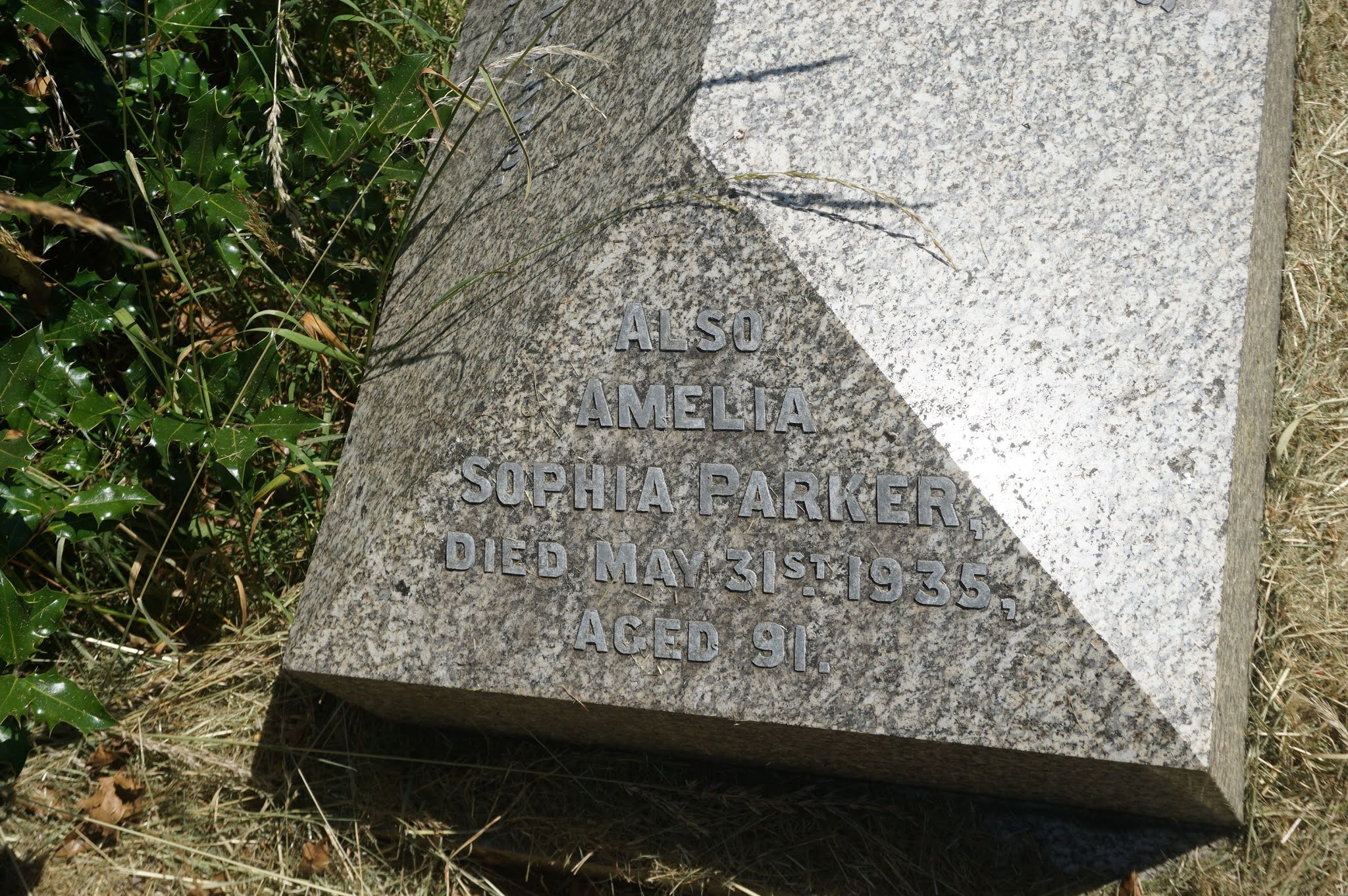
It was the young Amelia Sophia who married (1838) William Parker, yeoman, son of a basketmaker, from down the road at Folly Farm, Corsham ... Thomas and Keren were the witnesses .... she died 11 March 1884 at the same Biddeston where the earlier Smiths had once lived. She left a daughter (b 1844) of the same name who died, in her turn, 31 May 1935 ... a spinster. 


That numerous Smith family seems to have just faded away. I can't find a single one who made it to the 20th century.

Thomas died in 1850, aged 53. Emma seems to have died, unmarried too, aged 50 in 1849. She was listed as 'of Bristol'. I wonder why the Smiths went to those parts for the early 1800s. John apparently died, aged 63, at Yatton Keynell in 1863. Seems he'd fibbed a bit about his age in the 1861 census. Some of them, at least, must be in that churchyard.  

Sigh. I did pretty well to find 'John Smith'. But Mary Smith? No. And those Edwards?  And where is Yatton Keynell in the 1841 census ...  not wholly a success!  But maybe someone in said village will wander up the the local church and ferret in the gravestones ...

Kent's Bottom. The Smiths owned 'two cottages and gardens'

A very strange story. A whole family, gone from wealth to what seems like extinction in just one generation ...


I see, in 1891, Keren's 'Street Farm' is empty. Mr Walter J Robinson is at 'Manor Farm', the blacksmithing Hulands are still there, as are the farming postmen, the Cleverleys. John Tanner is firmly settled at Grove Farm, William Pavy is at Folly Farm, William E Beint 'carpenter and wheelwright' still has the house with the chapel. 79 year-old William Kimber 'retired gardener and agriculturist' is still in one of the Kent's Bottom cottages, Isaac Fry, agricultural labourer as well. The Manor Farm is being farmed by a family seemingly named Eels. The streets have names nowadays, but the census taker has punctiliously filled in the names of the properties as well. I wonder who has the freeholds now ... Manor Farm (213 acres) and others were offered for sale at various times ... but all these folk were renting ..

Here's a photo of the village in 1910 from https://www.postcardsthenandnow.com/2013/10/yatton-keynell-wiltshire-c1910.html


And here's another, slightly earlier 


Monday, December 21, 2020

Cornmell: or, a legal document from the 1890s


Here it is. I don't know why I picked out this one from the bundle on show -- there were others older, more potentially interesting and more difficult, but there we are .. I think I went to put the kettle on and came back and it was on the screen ...


It is nothing dramatic. Just a transfer of 'ownership' of a piece of property in Hackney, following the death of the original leasehold owner ...

The freehold owner of the property is Sir William Fowle Fowle Middleton, Bart, with an interest to Thomas Aggs, and a Thomas Graves. Well, I should say 'the estate' of the man with the peculiar chickenlike name. He (1784-1860) had been dead for thirty years.  A delicious website explains the name: https://pottoingaround.wordpress.com/2013/06/03/how-william-fowle-fowle-middleton-got-his-name/

It also explains how WFFM had money which he invested in property in Hackney and elsewhere. Hackney archive has a copy of the document allowing others to carry on his portfolio after his (childless) death, but alas you have to go to Hackney to see it

WFFM with wife and heiress mother

I am guessing that Thomas Aggs was the principal appointee. He was quite a few wealthy people's choice to act for them, or execute their wills. He was, of course, wealthy himself: a descendant of a Norfolk family which included the Norfolk Bank. I see him carrying on his activities from 1 Bishopsgate Street Within in the 1850s, directing this and that ... things like the Royal Australian Banking and Gold Promoting Company .. I wonder what happened to it ....
Anyway, he clearly deftly handled the Aggs money, the Gurney money and lots of other money, and died at Dorking 17 November 1897 leaving his wife a large fortune.

I haven't followed up Thomas Graves 'of the third party'. Maybe he had a sublease of some sort.

Anyway. Investment property, with no doubt at all. Both for WFFM and Mr Aggs, and for Mr Richard Cornmell, insurance man, underwriter, financier etc who leased the lots from them, for 99 years, in 1855.

So, where is/was the property? It was 'two messuages' which had been situate at 5 & 6 Kennetts Lane, Hackney, until the council (as councils do) decided to change the address to 133 and 135 Richmond Road. 

I spot a Robert Low[e] Esq dying at 133 Richmond Road in 12 May 1867 aged 57. Esquire, indeed! He was an ex-upholsterer. Well, there he is in the 1861 census: 'fundholder' with wife, mother, daughter, daughter's husband, 10 month old grandson, and one teenage 'house servant'. The house seems to be labelled as no 8 Marlborough Villas. Next door on one side are a bunch of merchant seamen, on the other .. ohho! .. a bank manager. And on the other side of the sailors is the Marlborough Arms! A marker! Hmm. Later known as the Duke of Marlborough, demolished for flats in 1996. By which time it was number 212. But it had been no 152 ....howwwwl .. And look, there's a street called Shrublands Grove. Shrublands was the name of Fowle-Fowle's home mansion. Perhaps he owned the whole area! Like a mini-Grosvenor.


Well, I can't find anything about the houses, other than Mr Low and family, but I see that in 1873 no 129, with 77 years of unexpired lease, fetched 500 pounds at auction. In 2020, I see both family homes have been filleted into flats ...

Now the family. Richard Cornmell (b ?1828; d 16 Phillimore Gardens 29 Juy 1890). Well, I have spent several hours on the worthy Richard, and found frustratingly little. His wedding registration (1854) tells us that his father was a William Cornmell. That's all. He married one Caroline Moore from Swanscombe, Kent (Thomas/Mercy, x 24 September 1826; d Somerville, Mount Ephraim, Tunbridge Wells 21 May 1890), and had a seemingly uneventful married life, punctuated by four children. Of them, later. 

When I first see Richard in the 1841 census he is working as an 'clerk/insurance agent' at an office at 9 Copthall Court,Throgmorton Street. Head of the office is Mr David Carruthers Budd (1790-1852), from olton in Devon, broker. As we shall see, the kind of 'insurance' 'brokering' and later 'underwriting' the firm was into was no little fish . And I think this pair were not the originators of 'Carruthers, Cornmell', because I see the firm listed in the Lloyd's registers as active in 1834. And yes! Lloyd's meeting 1832: D Carruthers, 9 Copthall Court! And this 1831 ..


Wow! In 1835 he was elected as Conservative member for ... Hull! And died.

Now, I'm guessing a bit here, with not much to go on, that this rather pushy Mr David Carruthers (?brother to Mrs Budd's mother?) and papa Cornmell had been in business together for a while, brokering, shipping, underwriting, insuring (and taking time off to go to Parliament)...  Hull would be an obvious constituecy for a shipping man. Well, his legacy would come back to fling Richard into the court of Chancery and the law manuals of Great Britain, as a precedent case, for many many years.

I notice, too, that when Richard's brother, William, died at the age of 41 in 1869, he was described as 'of Lloyd's'. Richard was as well. So the Cornmells, it seems. were -- for goodness knows how long -- into the lucrative business of shipping and maritime insurance. (Ah! I see the firm had been, in 1847, 'for a great many years very extensively employed as insurance brokers at Lloyd's').

Over the years, I have tried to follow Richard. In 1851 he and Mr Budd are at new offices at Tyson Place. Mr Budd is 'underwriter' and Richard is 'insurance agent'. In 1854, as we know he got wed. In 1862, Carruthers, Cornmell is still in existence, and Richard seemingly kept his head down and his pockets open, appearing only in shareholder's lists -- the Imperial Bank, the Bank of British North America, the Grand Trunk Railway of Canada -- while Mrs Cornmell supported the German Hospital at Dalston and other such good works. At one stage, there was a Cornmell, Fish & Co  which spread its influence as far as Australia. Oh, and Richard owned the thirteen houses which made up Wrestler's Court in Bishopgate. He was now 'of 68-9 Cornhill' (work) and 16 Upper Phillimore Gardens (home). The 1871 census shows him there with Caroline, the children, a French governess, a butler and four more servants .... And in 1876 .. well children first.

All four lived. Three married. And, for various reasons,  helped keep Richard's name in the papers.

Charles William Cornmell (b 1855; d 4 Eldon Road, Kensington 16 December 1897) was the heir apparent. He went into the firm, seconded his father ... he was in action in the press -- something to do with 'The British Goldfields of South Africa' -- till a week before his death, unmarried, at the age of 42. He named as his executors his brother and his younger sister. Not his elder sister. For good reason.

Caroline Elizabeth Cornmell (b 1857; d September 1916) didn't keep her head down. Let's just say she wed a sprig by name Anthony Wroughton Bathe (7 November 1881), had a live son, Cecil David Dalrymple Bathe (3 April 1884; d 31 January 1973), and soon ended up in the divorce courts. Her husband, she claimed, kicked her in the gut causing her second child to be born dead. Lists of infidelities on both sides were paraded ... and Carrie went home to father. Well, we can't tell, can we, who lied, but little Cecil is with his father in the next census. Strangely (well, we don't know the full story), Richard treated her extra well in his will.


Richard Budd Cornmell (b Hackney 1855; d 4 Eldon Rd, Kensington 28 March 1902) went into the family trade. He married Helen Cleland Dalrymple Bruce (d Hackney 27 January 1919), a Colonel's daughter who enjoyed amateur dramtics and sang rather well.

And Anna Maria Cornwell? She who is to get, at the brother's saying, the two houses in Hackney. Why, Anna Maria married (9 August 1887) a nephew of Mr Budd the broker, Major (!) Claude Currie Budd (b Bath 1847; d Bournemouth 16 January 1929). Mrs Currie Budd can be seen breeding show horses and being social in Bath in the early years of the century ... the Major seems to be elsewhere. Ho hum.

Well, that, I thought was the end of that. A bit unsatisfactory. And then I came upon this. Mrs Currie Budd got rid of her interest in the Hackney houses pretty smartly


No, I can't read it either. I guess we're not supposed to. Anyway its the document of sale of the two houses, in 1897 to another 'investor'.  I won't be buying this piece of parchment, but if anyone's enthused, it's on http://familychest.co.uk/FamilyChestDocs/documents/0903033.htm

Now, at last, 1876. The event which enshrined Mr Richard Cornmell in the British legal archives. Yes it was a testamentary dispute, and yes, heaps and heaps of money was involved. And the family. Dead ones. Richard was involved as an executor of the will of Charles Bladen Carruthers (d Norwood 28 September 1869, 'only surviving son' of Carruthers MP), who I see was, up to 1848, the partner of his subsequent partner, D C Budd, at the Copthall Street, and the 'defendants' were the trustees for another dead person ... anyway, it was all about trusts and stuff, heaps of consols were involved, and the case made a legal point which resulted in Cornmell v Keith getting itself a mention in book after learned book concerning Trusts. Amongst all the mentions, I have failed to find the actual result, but, of course, the result isn't often the point in Chancery suits ...

And the will? Richard left an enormous 58,000L. I wonder who Catherine Baddiley was .. b Bishopsgate 1812; d Hackney 1897 .. buried in Abney Park, Hackney ... looks as if she is the elderly widow boarding in the Clapton High Rd: 'no occupation, shops, houses' in 1881. Ah yes, boarding with the family of George Sluce, commercial clerk .. lots of little Sluces. What's the connection, then, that they inherit a nice blodge of money? No .. I sha'n't go there! 
Well, I did. Catherine Perry married Alfred Robert Baddiley (1824-1863) in 1844. And she's family. Somehow. Because, in 1855, Richard Cornmell placed an ad in the Australian papers, searching for his nephew: George Richard Perry.  


Father: stockbroker. Might have known! Cash flows in the veins of that family! But .... 1851 


'cow keeper'? bankrupt cow keeper. And it gets worse. Two years later, he's up for GBH? Poor Catherine!
Shall I keep going? .... amazing where one piece of paper can lead you. No enough ... post and be damned!


Sunday, December 20, 2020

KENNEDY: or, who sold the ancestors' portraits?


My friends Robin and Geraldine have a racehorse by the stallion American Ideal. They named it -- I'm not sure whether cynically or sincerely -- 'Kennedy'. Well, 'Kennedy' has been a bit of a problem horse: he's shown flashes of promise, but, on the whole, has generated more despair than rejoicing. Yesterday, he ran at our local track. He went out at 20-1 (I think he might have been 100-1, except NZ's top driver was in the sulky!) and wow! He flashed his brightest yet, finishing a very solid 4th.

So when I sat down this morning for the Longest Day of the Year, and saw a photo of a lovely lady by the name of Kennedy, I thought: it's a sign. I have to 'do' her today.


The verso is inscribed Aunt Maria Hardy Kennedy. Well, the inscriber ... whom I have since set out to identify ... wasn't quite right. She was Anna Maria Hardy Kennedy, and I think may have been the inscriber's great-aunt. Anyway, I instantly checked the vendor's stock and ... whee! ... eight more Kennedys ... this could be fun. So I dug. And having dug, and discovered, I checked the web and found that others had dug in the same patch before. But, although Susanna Long and others had some family photos on the trees ... not these ones. Either the family photos were split up some time ago, ot there was more than one photo album in the Kennedy (etc) family.

So, what did I find, and where did pretty Anna Maria fit in.

Mr Lewis Kennedy, surveyor and land agent of St James's Street, and his wife Harriet Sewell née Mitton (I haven't gone back any further) were married 9 April 1817 and over the next decade produced four sons and two daughters, to wit:

Lewis Drummond Kennedy b St James's Street, 20 September 1818; d 6 Alexander Square 29 January 1885

John Eugene Kennedy b St James's St, 16 December 1819; d 6 Alexander Square 27 July 1901

George Penrose Kennedy b St James's St, 9 November 1821; d Sunnyside, Lewisham 19 April 1894

Anna Maria Hardy Kennedy b Hans Place, Chelsea 9 December 1823; d 38 Norland Square 9 February 1913

Harriet Mitton Kennedy b Easthampstead 1826; d 76 Sutherland Gardens, Maids Vale 3 May 1885

Archibald Kennedy b Hans Place, Chelsea 29 July 1828; d Chelsea October 1851


Well, we've got Anna Maria. And here is Harriet ...


Here is John Eugene .. twice ...


John was a solicitor, and the fellow in the family whom most of the others named as their executor. He lived at number 6 Alexander Square, and the other lived at number 5. John remained a bachelor for his first half-century and took a wife at an age where a gentleman does so for support rather than sport. Mrs Frances Kennedy (née Medex), however, predeceased him. 

So. Start from the top. George and his ancestors have been tidily summed up by the Dictionary of Scottish Architects:

George Penrose Kennedy was born in 1821, the son of Lewis Kennedy, subsequently factor of the Drummond Castle estates of Peter Robert Drummond Burrell, Lord Willoughby d'Eresby, who inherited the Grimsthrope, Gwydyr and Drummond estates in 1828. 
The Kennedys were an important family of landscape gardeners. Kennedy's great-grandfather Lewis Kennedy (1721-82) had set up the Vineyard Nurseries in Hammersmith c.1745. His son John Kennedy, the architect's grandfather, continued the business there. Of his twelve children, Lewis, the sixth child and the architect's father, was sent to Riga to make contacts for the business in 1804, and was in Paris supplying plants to the Empress Josephine in 1812 when he was taken prisoner. On 24 April 1817 he married Harriet Sewell Mitton, their address being 56 St James's Street, Kensington, by which date he had a career as a landscape gardener separately from the family nursery, notably at Dunkeld (1813) where he designed conservatories for the Duke of Atholl, and at Stow, Norfolk (1812), Oddington (1813), Chiswick House (1814), Trent Park (1815) and Buckhurst Park (1819). During the course of this work Peter Burrell, after 1828 Drummond Burrell, who had married the only surviving child of Lord Perth, invited Lewis to take over the management of the Drummond estates, initially from 5 Alexander Square, Brompton but with a Scottish base at Pitkellony House, Muthill, in or before 1822. There the Kennedys brought up six children, the sons being Lewis Drummond (1818-88) who became a Rector in the Lincolnshire estates, John Eugene (1819-1901), who succeeded his father as factor at Drummond Castle in 1868, George Penrose, and Archibald (1828-51) a civil engineer who died young.
Lewis Kennedy appears to have secured for his son George a place in the office of Sir Charles Barry then engaged in proposals for remodelling Drummond Castle as a neo-Norman pile. From the albums sold by Sotheby's in 1890 (to Weinreb from whom acquired by the Canadian Centre for Architecture) it appears that in addition to other major Barry projects, he was involved in the re-creation of the formal gardens at Drumlanrig in 1840; he probably began the restoration of those at Drummond Castle when still in Barry's employ and made the designs for the banqueting tent erected there for Queen Victoria's visit on 2 September 1842. Thereafter he assisted Francis Cranmer Penrose with his archaeological investigations in Athens, being there in March 1845, and by 1849 he was in practice on his own account at Sussex Chambers, St James's.
Sometime before 1855 Kennedy established an office at 119 Hope Street, Glasgow, perhaps initially only as a branch office, but by 1868 the Glasgow office, now at 160 Hope Street, had become his sole address with Robert Dalglish as partner there from at least 1861; his practice had not, however, been exclusively Scottish as the 'Architect's Engineer's and Building Trades' Directory' of that year refers to at least one residence in Liverpool and 'numerous churches, schools, factories, mills, hotels, &c in Scotland and Wales'. This same directory also lists unspecified 'country seats, residences and villas' at Paisley, Johnstone, Cambuslang, Govan, Coatbridge, Glasgow, Kintyre, Loch Katrine, Largs, Arrochar, Ayr, Dumbarton, Rutherglen, Kincardine and Crieff.
The Drummond Estate connection was lost when Kennedy's brother John was dismissed in 1877 and his family was required to leave Pitkillony. By that date Kennedy does not appear to have been a very active partner. It was perhaps a combination of the dismissal from the Drummond Estate and the sharp decline in business after the failure of the City of Glasgow Bank in the following year that led to the partnership with Dalglish being dissolved c.1879. Kennedy remained at 40 Union Street for a time but subsequently retired to Sunnyside, Lewisham, Kent, and died in 1898.

What more can I say? George had a bundle of children by his two wives. Our group of pictures includes one of them [Harriet Louisa] Florence Kennedy (b Monkland, Scotland 22 April 1865) who can be seen with her sister Dorothea Steele Kennedy (b 1862), living/staying with uncle John in Alexander Square in 1901.
This is Florence's 21st birthday photo


Florence seems to have stayed with John and/or Anna Maria for some years until marrying (11 November 1911) Scotsman Mr Allan Ramsay at the age of 46. Anna Maria named her as an executor of her will. Florence had waited for her fun. I see her, with her husband, living in sunny Italy in their sixties. Latterly the couple settled in Margate, where Ramsay died 21 December 1935. Florence died in a Surrey nursing home 7 April 1957.

Eldest brother Lewis became a Reverend. I see, in 1871, he is rector of Theddlethorpe. There is no photo of him here, but he has made it to the National Portait Gallery! Why? How? He looks like one of the thundery pulpit variety of clerics.


However, we (and the NPG) do have a picture of his wife, Maria née Shelley ...


After Maria's death the Rev Lewis remarried Miss Kathleen Staniforth. Unlike most Victorian vicars, who seem to have been reproducing whenever not preaching, however, he seems to have had no offspring.

That's the sons taken care of. Three with no issue. So our collector seems not to have come therefrom. We also know that Anna Maria died a maiden lady ... which leaves Harriet Mitton Kennedy. And here, I am sure, we are on the right track. Because the back of Harriet's portrait is inscribed 'grandmother'.

Harriet married solicitor Mr William Sidney Kinder (Holborn 16 April 1822; d Pitkelloney nr Crieff 7 September 1859)  and they combined in three sons and two daughters. Laura (b 21 September 1846) died aged five, Edward (14 January 1852) aged 8 months, leaving Annie Drummond Kinder (18 John St, Bedford Row b 31 May 1858; d 6 North Hill, Hornsey 15 November 1837), Cecilia Marion Kinder (b 5 Thurloe Sq 18 December 1853; d 24 October 89 Chetwynd Rd, Highgate Rd 1927) and Lewis Kennedy Kinder (b 5 Thurloe Sq 29 January 1856; d Worthing 16 January 1932). The Rev Lewis K Kinder ...


Adm. at CLARE, Feb. 17, 1875. Matric. Lent, 1876; B.A. 1880; M.A. 1883. Ord. deacon (Chester) 1880; priest, 1881; Curate. of Frodsham, Cheshire, 1880-1. C. of Castle Rising, Norfolk, 1881-2. C. of St Mark's, Camberwell, Surrey, 1882-3. V. of Pelynt, Cornwall, 1883-91. V. of Pensnett, Staffs., 1891-8. R. of Peckleton, Leics., 1898-1919. V. of Foxton, Cambs., 1919-28. Subsequently resided at Worthing, where he died Jan. 13, 1932, aged 75. Buried at Brompton. (Crockford; The Times, Jan. 16, 1932.)


Well, Cissie and Annie lived together as maiden ladies 'on private income' all their lives, but the clergy are back in form in this generation. Lewis, in the course of two wives, Eleanor Hannah née Payne and Jemima Margaret née MacGregor) fathered ten children. Ergo: one of those ten has inscribed our photos. As this one: 'Aunt Cissie or Aunt Annie?' One of the two, but they don't know who ...


So. Winifred Audrey Kinder (Mrs T H Nice, 1884-1962), Gwendolen Elizabeth Kinder (1886-1968), Kathleen Drummond Kinder (Mrs A J Payne, 1892-1995), twins Lewis Edward Kinder (1894-1963) and Margaret Irene Kinder (1894-1983), Eleanor Cecilia Kinder (1895-1992), Henrietta Maud Kinder (1898-1991), Redvers Macgregor Kinder (1901-1979), Claude Kennedy Kinder (1903-1993), Muriel Mercia Dickson Kinder (1904-1992) ... which of you was it who 'sold the ancestral portraits'?