Saturday, February 12, 2022

A little drop of rain ....


It has rained today at Gerolstein.

Like, really rained ...

We're used to puddles and lakes and so forth, because our land has a large clay content, but ...

We are bounded on both sides of the farm by what might be called 'waterways'. No, they're not our responsibility, they (and the bit of land on either side of them) belong to the local Council, currently represented by a thoroughly nice chap named Fred.  

Fred has been very helpful over the Council 'river reserve' land that permeates Gerolstein. but he doesn't live here, so he doesn't quite understand ...

Last time he was here (when Council trees and weeds were invading us), he told us we mustn't bank up the top of the river bed crevice, where the ravages of Saltwater Creek in a bad mood have eaten away the deep river's edge, with our available animal (horseshit) and vegetable (grass cuttings) refuse ...

Well, Fred, this is why.

The gap that we mustn't fill was well and truly filled today ...


And the flood doesn't stop there! The unintentional sub-river flows on ...


On it heads (that's their river to the left, behind the trees) past my washing line towards my house. Yes, my bathroom is five metres away ..

And to the cottage ..


That's the septic tank, foreground. I just paid $390 to have it emptied ....  I suppose it will now be full again ... and the deluge may have swept away my outpipes ...

Oh well, the peahens are having a nice paddle ...


I guess one could laugh about it, while sitting in front of a logfire with a whisky ... but ...

Sorry Fred.  We're going to go right on protecting, as best we can, our property from your wayward rivers .....


Friday, February 11, 2022

Elsie Joel: From Mabel to the music halls ... and men.


This week, I came upon a 1905 variety programme from the once lofty Oxford Music Hall.


By the 20th century it was just another Hall rather than the crême de la crême of the genre it had been decades earlier. Rather a lot of comedians, dancers, acrobats of whom I have never heard -- 


Only the to-be-great Harry Tate with his 'Motoring' sketch ...


But wait. There IS one other name that is familiar to me ... spot 5 ... Elsa Joel, ballad vocalist ....  twenty years on, its the Mabel of D'Oyly Carte's children's Pirates of Penzance company, fulfilling a twenty-year career in the middle to lower echelons of Britain's music halls. Why, and what happened in between? 

Elsie Blanche JOEL was born in Birmingham 2 May 1872, the second of the two daughters of a Jewish-Welsh commercial traveller, Michael Joseph Joel (1830-1893) and his wife Catharine Charlotte (née Kemp). 
She seems to have made her first appearances in public at the Royal Aquarium, with her teacher, mezzo-soprano Jenny Pratt (see https://kurtofgerolstein.blogspot.com/2022/01/jenny-contralto-or-fiddlers-bride.html)  in February 1884, and sang on the programmes there, under Dan Godfrey, with Redfern Hollins, Arthur Oswald and various unknowns for a number of weeks. So she was not entirely a novice when chosen to play Mabel, in December of the year, at the Savoy Theatre.

'She was decidedly successful: 'In her pretty little embroidered white satin dress she won all hearts by her engaging ways and modest demeanour while her singing which is of a florid style, full of trills and runs which she executes with perfect ease, was graceful and effective in the extreme ...' (Daily News). Alas, it was not to last. After just weeks of the run, she fell sick, and had to be replaced by Amy Broughton. Apparently it was a genuine illness. It was related later that she had fallen prey to small-pox.

Children's Pirates: I'm pretty sure that's Elsie as Mabel


It seems that it was six years before she returned to public performing. Sam Adams, at the Trocadero, gave her a spot in the small print on his programme. She sang 'Una voce poco fa', 'Bird of Winter' and 'Home Sweet Home' (and 'God save theQueen') and was very well received: 'now a tall and handsome young lady .. without hesitation we may say she is the most brilliant vocalist heard on the music hall stage in recent years'. Elsie looked set for a good career. But real life intervened.

Cuthbert Edward Clark was assistant md at the Empire, Holloway. He was also newly married to music-hall chorine Elizabeth Hoby. He and Elsie emigrated together to Manchester, when Cuthbert took up the musical direction of the local Palace of Varieties and where Elsie gave birth, over the years that followed, to three children - Kate, Cuthbert Victor (21 July 1895) and Gladys - before the relationship subsided. When Elizabeth later came (somewhat tardily) to divorce Mr Clark in 1910, Elsa was quoted as evidence, rather than his subsequent paramour, but that's another story. 
Cuthbert went on to play and write for provincial theatres, Tiller shows, and scored a hit with the song 'Susie -ue' as sung by another Jewish lady, Ada Reeve, while Elsa ...  Elsa married!  The man was 21 year-old mechanical engineer Herbert Tetlow Francis and it was a mistake. Within weeks she was suing for divorce.

She did not, I suspect, stay 'single' for long, but the next documented 'husband' of whom I have proof occurs around 1917. And it was again the music halls that provided her with this partner. He was, of course, married.

Alfred Bernard Joseph Vincent Bayley, known as 'Monte Bayly' (alleged to be entitled to the rank of Count de Krauchy) was a performer, but was later to become better known as an administrator with various music-hall societies. He had been married, in 1902, to Di Bloustein (ka 'Diana Hope') a Jewish performer from Ballarat, Australia, and they had had a daughter, Mathilde Judith Josephine, 4 October 1906. The marriage seems to have been a rocky one, and Monte wrote on his wife's 1911 census entry 'talks too much'. They divorced in 1919, with Elsa again quoted as the scarlet woman, and Diana dragged Mathilde off to Los Angeles, and a new father. Elsa is supposed to have lived with Bayley until 1928, but when he died, in 1928, his partner was an illusionist 'Mdlle Margot' ie Mabel Jarman.

'Mdlle Margot' married someone else soon after. And so did Elsa. Yes, actually 'married'. Charles Valnetine Barker was a young(er) jeweller's assistant. And they seemingly lived happily ever after. Well, until 1944, when Barker died (21 October, Clapham). Elsie seems to have lasted to the age of 80, and her death is registered in the Thant region in 1953.

Her singing? Well, she made up a bill conveniently and agreeably in variety houses through the years. In 1896, she even made a trip to America as a support act to Albert Chevalier ...


European theatres and music halls?  Can find no trace ...  'all the principal..'?  Poppycock.  

So, a modest career, from a child starlet to an adult make-weight ... and an apparently mobile private life ...

The children? After Elsa's death, Cuthbert ('mechanic') and his wife Rose emigrated to Ann Arbor, Michigan, where he died in 1970. A daughter, Jean V Clark, was born in London in 1930.  The girls ...? Well ...

End of story. For now.


Sunday, February 6, 2022

Thirteen daughters ...


A nice, cool grey morning, with a drizzle of rain. Sunday. I don't feel like doing anything intelligent, and the Olympics ar'n't yet worth watching -- deckquoits on ice, qualifying round of skijump -- 50 to qualify out of 53? -- so I decided to play the "who do you think you are" game.

It was supposed to be a quickie, but it spread a bit ... why? Because the lady in the photo had thirteen daughters (and two sons)... 

This is Mrs Edward Clark. Born Adeline Mary Scott, eldest daughter of a Sydenham stockbroker, Henry L Scott (Godstone House, West Hill). The baby is her fourth daughter, Nellie ...


Adeline (b Devizes 1843; d Sydenham 22 August 1929) married (4 May 1865) within the Sydenham stockbroking world, and she and Mr Clarke settled down in Sussex Villa, then at Eardley House, Beckenham, and finally, at child six, at Lapsewood ... the number of their household staff grew too, as Mr Clark seemed to do well at broking stock ..


I chased up the children incredulously ... first of all, seven daughters in a row, then, at last, a son. Four more daughters, and then .. twins ...

I leave aside the sons for the moment to look at those thirteen girls. Well, I haven't been able to follow them all: I lose no2 Ethel Mary (b Sussex Villas, 26 June 1867), and no10 Christine Janet (b Lapsewood 28 January 1880).

No5, Frances Alice died as an infant, no13 Sylvia Joan (b Lapsewood 11 March 1884) as a little child, and Katharine Annie (b Beckenham 1868) at the age of 18 (7 May 1887).


Four of the remaining seven girls remained single: no1 Adeline Maud (b Sussex Villa 6 February 1866; d 5 October 1843), our 'Nellie' otherwise no4 Helen Gertrude (b Eardly House 1870; d Dorset 26 September 1962), no8 Florence Ida (b Lapsewood 19 July 1877; d 2 November 1939), and twin Olive Marion (b 2 January 1883; d 1949) who was, or became, 'mentally incapacitated'.

So, just four of the thirteen girls wed, and, with the boys, carried on the family.

no6 Eveline Louise (b Lapsewood 23 September 1872; d Brentwood 17 October 1917) married William James Graham (9 June 1903) 'gentleman' of Sydenham. She doesn't seem to have had children, and in 1911 she is a patient in a private nursing home.

no7 Dora Septima (b Lapsewood 10 July 1874; b Bromley 5 June 1957) married legal man Colin Reed-Davies who became Chief Justice of the Bermudas, got knighted, making Dora a Lady. They had two children, but son Mervyn hung himself in his rooms at Cambridge University, at the age of 20, for reasons undivulged. Their daughter did not marry.

no9 Lucy Angela (b Lapsewood 29 September 1878; d 5 March 1943) had a false start. She married a soi-disant civil serviceman named Darent Henry McDonald who turned out to be unsatisfactory, and traded him in for a divorced bank manager, George Austin Adolphus who gave her four children.

no11 Violet Howard (b Lapsewood 20 September 1881; d Paddington 31 December 1962) married Mr George Herbert Higgins (31 May 1906), and had two sons and a daughter. Daughter Violet became Mrs George Ridley Debenham.

Untimely death did not leave the male line alone either. Farmer Edward George Urling (b 19 December 1875; d 3 August 1951) had two wives, a son and a daughter. Son, Edward Keats Urling Clark was killed in the war, leaving an infant son. Daughter Doris remained unmarried.

Twin son Henry Laurence Urling Clark (b Lapsewood 2 January 1883; d Reigate 15 April 1975) followed his father's traces in the stockbroking world, and became Chairman of the Council of the Stock Exchange and, in 1950, Sir Henry. I see lots of Urling Clarks around the web (latterly with a hyphen!) so I guess they come from Henry and his wives and from Edward's son ...

Henry lost a 24 year-old son, David, at El Alamein in 1942.


And another to suicide ...


Quite a family.

Well, that's what curiosity an one photo can lead to ... I'm sure there's more ...

The original of the photo (for sale) can be found on e-bay at

https://www.ebay.co.uk/itm/275144409929?hash=item400fe28349:g:eWYAAOSwoR9h9R1S

A week later, this turned up.  No surname, but I recognised the christain names ...


Sunday, January 30, 2022

My Book of the Year 2021


I don't often get to read a book. I'm too busy writing them.

It takes an 'event' such us one of Yamba's frequent powercuts to get me off my Mackintosh and into a lounge, on the sun-deck, with a book in my hands. Not to 'refer to' -- that happens all the time -- but to read, for pleasure, from beginning to end.

Today, Mike the spiderman came to beastie-proof my house, inside and out. Thus, I was turfed outdoors at 8.30am, into the piercing sun, for several hours, while the spray settled and dried. I did my morning kilometre of powerless-walk, pulled a desultory weed, and then sat down with the equally evicted kitten and two bottles of once-chilled water, to read.

It is very, very agreeable to read books on Victorian theatre and music written by people who can actually write enjoyable and readable English. Books of the highest degree of properly-researched and accurate scholarship, with no footnotes, no Academic Paraphenalia, no big stilted University words ... and today I had not one, but two of these. The hours zoomed by!


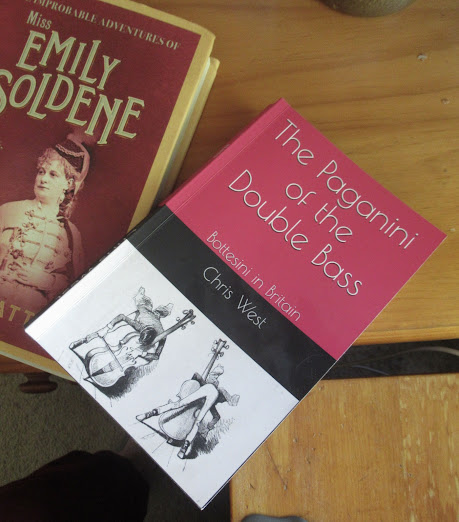
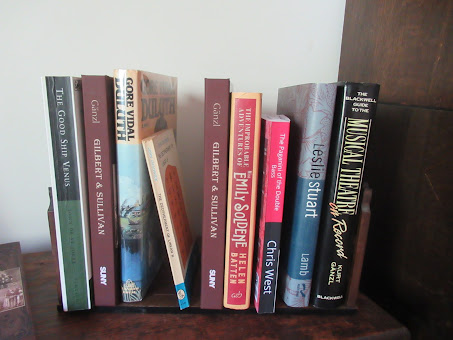
Firstly, I dipped into Helen Batten's biography of Emily Soldene. I must say, that when I published my vast 2-volume book on Emily (Emily Soldene, in Search of a Singer), years ago, I never dreamed that anyone else would thereafter tackle the lady! Mrs Batten and I, perforce, have used much of the same source material, but -- guess what -- she is a distant descendant of 'Madame Soldene', so comes at the story from a refreshingly different angle, in the 300 odd pages (as opposed to my 1,500!) of this book. She also comes up with one or two tales which are new to me. But, then, I was working in the pre-Internet age ... Lord knows what is out there now. So, if we differ on a few things and thoughts (and the copyeditor has missed the odd doozy misspelling), I vote for this as an enjoyable 'short' version of Emily's story.


The other book interested me, naturally, much more. A semi-biography, by Chris West (bass-player) of the great Victorian bass-player, Bottesini. Semi? Yes, The Paganini of the Double Bass is subtitled 'Bottesini in Britain', and it deals only incidentally with the musician's life, professional and private, elsewhere. But Britain is, on its own, enough to fill 280-odd pages, and those 280 pages make up a fascinating overview of the career of a star virtuoso performer in the 19th century. Not all caviar. Up at Buckingham Palace one week, at the great concert of Julius Benedict the next ... and, in between, reduced to supporting Elizabeth Greenfield in her disastrous English concerts or tootling off to Margate. Money had to be earned, star or not. And as we see in this book, Bottesini wasn't very good with money.


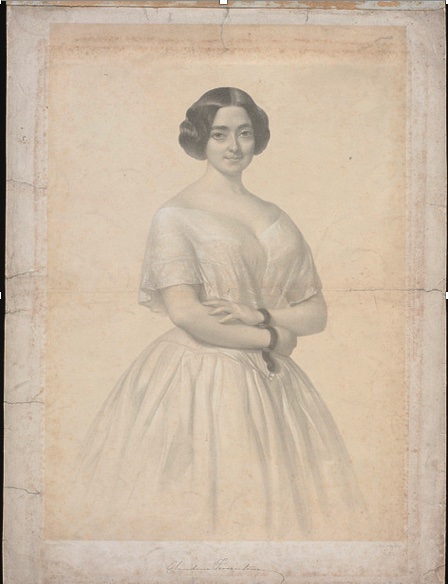
Mr West's meticulous listings of Bottesini's engagements are the backbone of this book, making of it a splendid, factual historical work and a valuable reference, but there is much more. The tabular matter is filled out with an immensely readable description of the times and their musical world, including much on such other megastars as Piatti, Ernst, Arditi and a not-quite megastar in 'Claudina Fiorentini', the Anglo-Spanish soprano who was, for some thirty years, the effective 'Mrs Bottesini'. Mme Fiorentini was one of the 100 singers featured (at length) in my Victorian Vocalists, so it was really interesting to me to be able to fill in the details concerning the Bottesini family's life.

Claudina Fiorentini


The spiderman finished his job by midday, and the tree-trimmer arrived. So I had to hurry the last chapters of this book. But, I can tell you, it is going on my 'A' shelf for a re-read as soon as possible. It's an ideal combination of minute scholarship and merrily flowing writing ... oh, that more books these days were like it. 

The current "A" shelf


I think I can safely say that it is my Best Book of 2021 ...  for anyone interested in the Victorian musical scene, it's a must.

https://chriswestbass.com/2021/07/23/my-new-biography-of-bottesini/

An enjoyable 'morning off'. I must try more often ... but are there other new books like these around? Is spring coming again after the long winter of unreadable and useless tomes ... Please!


Monday, January 17, 2022

Court Theatre: LITTLE SHOP OF HURRAHS


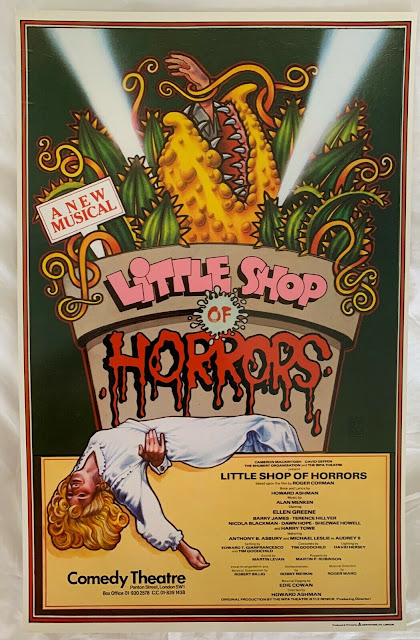
I have been connected with the delicious spoof musical Little Shop of Horrors for a long, long time. I had clients in the first grand London production, in the film, and went on to cast the show on three continents. I even traipsed to Sheffield a couple of decades ago to see a production ... 


So, when I saw that my local theatre had recovered (hopefully permanently) from its production of mediocre and scissors-and-paste musicals, and was preparing to give us this show, I called up my Mentor and said 'This year, I shall come'.

It's odd what we get served up here in Christchurch, NZ. Basically, there are three sources of musical theatre. (1) the professional Court Theatre (2) the amateurs who have, nowadays, taken upon themselves the name of Showbiz (3) the students, otherwise NASDA, who supply many of the best artists to (1) and (2).

Options recently? Well, the amdrams are part of a share-cost affair with other NZ amdrams, so we just get Big Famous Musicals of Recent decades. Been there, seen that, don't need to see it for a 20th time. But it's amdrams, so everyone has fun, everybody's friends buy tickets ... just as they did when I was an amdrammer in the 1960s.

The Professionals? I have lived near Christchurch for 20 years. I have not been overly impressed by the staging standards and especially the show-choices at the Court Theatre in recent years. Thus, I have not attended all that often.

The students .. ? Yessssss. This year we had The Drowsy Chaperone! (Hello, Court Theatre!). Previously, The Music Man, City of Angels, Spring Awakening, Once on this Island ...

When will the professional (subsidised) theatre catch up!!!!

End of lecture


TONIGHT

OK. I went with mixed feelings. The production was promoted, with many photos, as being 'different'. I didn't want it to be 'different' ... I just wanted it to be GOOD.

Well, it was both. In fact, with a few reservations, I think it was, all in all, the most enjoyable Little Shop I've ever seen.

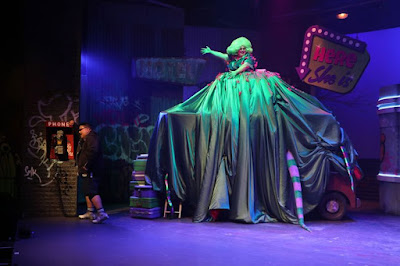
Different? Well, we don't have a lot of big, black-voiced jazz singers in Christchurch, so the part of Audrey II was remade around a large local lass (who was a lad last time I saw her) with airs of Divine. The idea and the performance came off splendidly for 9/10s of the show. It was grand to be able to see the plant's expressions and not just hear a disembodied voice.


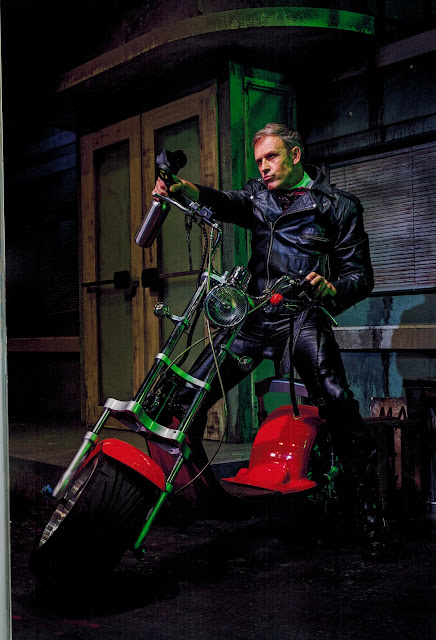
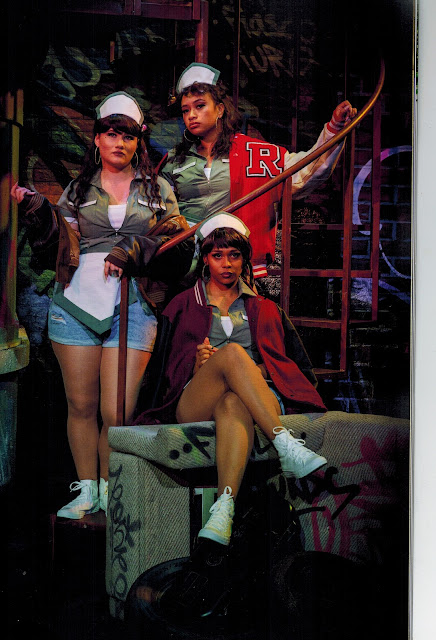
Secondly, the piece was souped up a tad, with the three Skid Row girlies turned into a rather intrusive glamour backing-group with airs of the Supremes, jigging endlessly about to somewhat excessive choreography in very non-Skid Row costumes. But singing the theatre roof off!

Actually, I'm surprised the roof was still on. I think this was the loudest, most over-amplified show I've ever attended in my 60 plus years of theatre-going. Even the bar staff, in the wonderfully-decorated foyer (their menus headed 'Feed Me') confided in me 'it's awfully LOUD isn't it'. It was.

But, the triumph of the evening was in the core of the matter. Unobtrusive, clever, fresh direction (Benjamin Henson) and quite outstanding casting and performances.

I have seen most of the players before. Some come from NASDA, the local music-theatre school, with which I was periodically associated over the last quarter of a century. However, the knack lies in casting such performers correctly, and here that knack was a 100% winner.

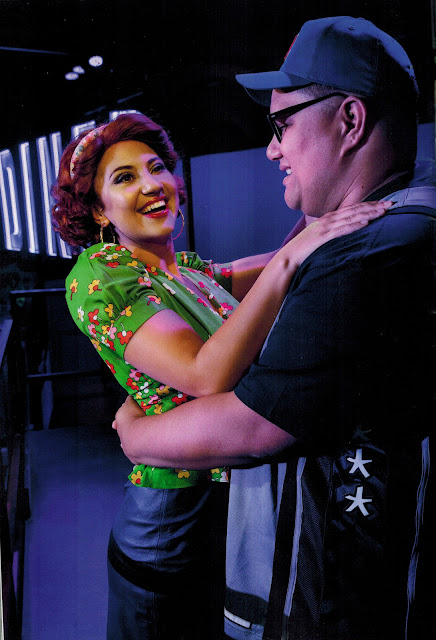
Rutene Spooner was Seymour. I last saw him as Amos ('Mr Cellophane') in Chicago. He was the Seymour of one's dreams: just the right amount of naïveté and adorableness, and a triple threat (as befits a NASDA graduate!) with a ringing singing voice that he finally got to use to its full. A five gold star performance.

His Audrey was right up there with him. Monique Clementson had the role absolutely down to a T, teetering on her unsteady high heels on her way to her date with her nasty boyfriend, singing sweetly and gormlessly ... I didn't think anyone could equal the original Ellen Greene in this role. This lass did.


The nasty boyfriend was played by Roy Snow (Billy Flynn in Chicago). A Court musical wouldn't be a Court musical without Mr Snow, and I for one would feel robbed if he weren't in the cast. He was as superb as ever, toying with the over-the-topness of the role, and singing up a storm, although he suffered, as he suffocated, from the distortion of the over-amplification.


Way back when, when we were casting the three 'chorus girls', the auditions were short and sweet. Each postulant was made to sing, cold, the line 'Alarm goes off at seven'. Try it, it's not easy. Reminds me of my opera debut in Amahl and the Night Visitors. Umpteen bars rest, then come in bang on E ... (or was it E flat?).

Well, these three ladies (Ezra Williams, Kristin Paulse, Jane Leonard) would have surely passed the acid test. Once again, fine casting. If I prefer the trio as a 'backing group' rather than a 'fronting group', that's just me. Folks like a bit of conventional glam, even in Skid Row.


I think the first time I saw Jonathan Martin on the stage was indeed 20 years ago when he played Stine in NASDA's City of Angels. Tonight, he was a first-rate Mr Mushnik, sufficiently Jewish without stooping to Faginesque burlesque, and his song-and-dance-duet with Seymour got (rightly) the biggest applause of the night.


Of Brady Peeti's Audrey II I have spoken. It was grand ... until ... the one directorial piece of rather crass misjudgment.

When Little Shop the musical was filmed, the producers wanted to feature the jazz singer Bertice Reading. But there is no role in the piece that Bertice could play. So they invented one that would give her a chance to Do A Number. I (her agent) thought it was a pretty poor number but anyway she did it, got her large fee and I got my 10% of said fee and hoped I'd heard the last of the Rocky Horror -esque 'Mean Green Mother from Outerspace'.

No such luck. It was exhumed as a vehicle for Ms Peeti and tacked on the end of the show as an anticlimactic sort of megamix, with the cast in vulgar pantomime costumes ... Such a shame ... after the perfect finale of Seymour and Audrey I disappearing, like Don Giovanni, into the depths of death ... and the (inaudible) final obituary, to have to sit through this bit of tasteless trumpery ...

I wish I'd left before it. Then I would have no hesitation in declaring the Court Little Shop my favourite ever. Turn the sound down by 30% (or 50%), obliterate the megamixup and its mean green mother ... and, yayyy. A first-rate evening in the theatre. See you again in two years.

Why two? Because the next musical is a jukebox affair and I don't do those. Hopefully the Court won't leave the gems of the ancient and modern musical to NASDA ...


Friday, January 14, 2022

January 2022: A is for Australia, Angst and Ardern, B is for Beasties and Books, C is for Christmas and Catlets, D is for Diabetes ....


It is a month today since I arrived back home from my Ardern-imposed exile in Australia...

The Angst is fading ... I feel it will never wholly disappear during what remains of my life ... but Gerolstein is working its soothing magic ... the setting, the folk, the critturs ..


Of course, the favourite critturs are Sherbertte's five incestuous (?) kittens ... They have made themselves throughly at home, bouncing across the lawns, galumphing down the gladdies, digging up the flower pots, escalading the fences ... and even making a cats cradle of the top of what is supposed to be their peacock-proof enclave..


Their juvenile energy is amazing ..


Books. Well, brother John and I have had a prolific writing year ...


which has really come to a peak at the dawn of 2022 ... This week, John carried off the Corsham Story Town Festival Poetry Prize for his poem Fingers Farooqi paints a story on the town wall during the night ...

A new and revised edition of my The Musical, a Concise History, with a 21st century chapter by my friend, Jamie Findlay has hit the bookstores...


And, any moment now, it will be followed by our first book together (after twenty-odd each, individually) at the ages of 76 and 72!

For some years now, we have been translating poetry from the French, at first mainly for John's volumes of international poetry, The Song Atlas and 52 Euros ... which led to, which led to, which led to .. We had a joyous time with the atmospheric, friendly works of Verhaeren, delved into everything from Yourcenar to Maeterlinck .. and our version of Baudelaire's The Cat was even named Poem of the Week by the Guardian newspaper. We were, at one stage, asked to turn our talents to the poetic (?) works of Genet. I started. Reams and reams of pretentious poppycock ... we both cried 'hold, enough' simultaneously, and dived, instead, with view-hallooo! into the wonderfully multi-coloured work of silly old Petrus. If you don't know about him, you'll enjoy discovering him. A wannabe, a dying-to-shock-and-stir guy, who actually had -- hidden among the slagheaps of posing and pretension -- some nuggets of gold to deliver ....


Yes, the new year has begun 'en trombe' ... but, alas, one less cheerful left-over from 2021. It seems that, doubtless thanks to my experiences of last year, I have fallen prey to senile diabetes. So another battle begins ...

And meanwhile the Family Books meuble is beginning to bulge at the edges ... We have over overflowed into the side-shelves! There is just a wee spot for Petrus .. I suppose I shall have to catalogue it one day ...


Time for a little stroll in the gardens before cocktail time ...


Sunday, January 9, 2022

Jenny the contralto or, the fiddler's bride


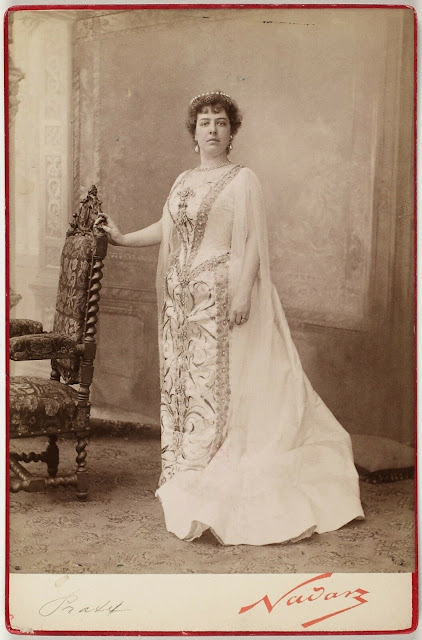
PRATT, Jenny [PRATT, Jane Mary Ann] (b 49 Rupert Street, St James Middlesex 26 September 1846; d Barnes 1926)

Mezzo-soprano Jenny Pratt had a variegated career, which ebbed and flowed for over thirty years, during which she changed name no less than five times.

Jenny was born Jane Mary Ann Pratt, the daughter of Thomas Fenwick Pratt (d 12 May 1871), a printer-compositor from Gibraltar, and dressmaker Mary Ann Bright née Fairney (b London 23 March 1825; d White Hall Park 28 July 1898), a jeweller’s daughter from a large London family. She was born sometime in 1846, and christened 25 October, which was apparently somewhat too close to her parents’ wedding date.

I don’t see any connection between the family and music, except that a Mr Henry Nelson who was ephemerally ‘secretary of the Italian opera’ is the Pratt’s house-guest in the 1861 census, but, soon after that, Jenny was enrolled in Dr Wylde’s new London Academy of Music. The St James’s Hall-based Academy had already produced its first ‘star’ pupil in ‘Mr Renwick’, and it seemed as if Miss Pratt – under the tutelage of Gustave Garcia -- might be the next. She was awarded the Academy’s first prize in singing in 1865 – ahead of Blanche Cole, Dove Dolby, Fanny Holland and Francis Gaynar – and shown off at the 1866 pupils’ concert in ‘Una voce poco fa’ and the Tancredi duet with Miss Dolby, with her laurels intact.

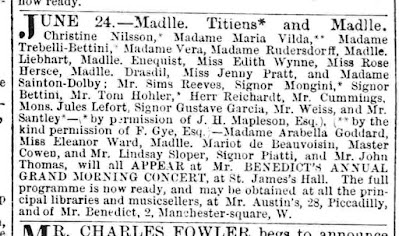
On 24 June 1867, Miss Jenny Pratt made her first public appearance, and it was at St James’s Hall, at the most fashionable concert of the season, that of Julius Benedict, on the most starry bill of the year including artists from Titiens, Dolby and Nilsson to Mongini, Santley and Reeves. Why? How? But Benedict would invite little Miss Pratt to his mighty concerts for a number of years. It can’t have been just because she sang his ‘By the sad sea waves’ so nicely.


She sang at Kate Gordon’s concert (‘a Rossini aria with taste and judgement’), and did the rounds of the spa towns and resorts, before on 7 December making a debut at the Crystal Palace, singing ‘Fanciulle che il core’ and Edward Silas’s version of Longfellow’s ‘The Curfew’, alongside Edith Wynne and Nelson Varley.

With the new year, Jenny Pratt made another first appearance, on the bill of the fifth of the season’s Boosey Ballad Concerts, singing the contralto favourites ‘The Lady of the Lea’ and ‘The Storm’ on a bill where the other contralto was Mme Sainton-Dolby.

During 1868, she appeared at the Crystal Palace, the Schubert Society, St James’s Hall, the Beethoven Rooms, with Mme Lemmens-Sherrington in the provinces, at Mr Austin’s concerts and at St George’s Hall, almost always purveying ‘The Lady of the Lea’, ‘Il Segreto’, ‘By the Sad Sea Waves’ or Benedict’s ‘Rock me to sleep’.

When Charles Goffrie’s Lujza Liebhart concerts at the Agricultural Hall began in September, Miss Pratt was on several of the programmes (‘By the sad sea waves’, ‘The Minstrel Boy’, ‘Ben e ridicolo’). The other contralto was the unknown Sofia Scalchi ‘from Bologna’. The conductor, Julius Benedict.

In 1869, she can be seen at the concert of the harpist J Balsir Chatterton singing a song written by that gentleman’s son, T Davenport Chatterton (‘My soul is dark’), at the Glasgow Saturday Evening concerts, at the Holborn Amphitheatre giving the Stabat Mater alongside a lecture, at concerts of Austin, Miss Clinton Fynes, L S Palmer and Benedict, but when she returned to Glasgow, in early 1870, it was in a different capacity and under a different name. She was Mdlle Prati.

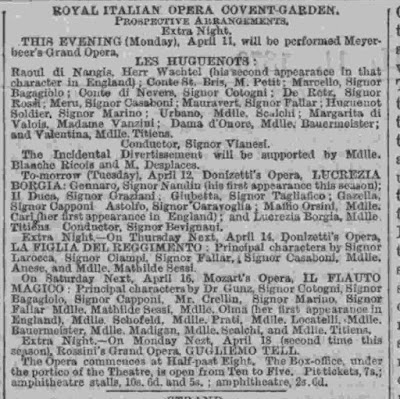
She had become Italianised, because she had been hired as a minor member of the Covent Garden Italian Opera Company alongside Mademoiselles Madigan, O’Brien, Clinton, Schofield, Bailey et al. Both she and Mlle Madigan were billed with the principals, but the only role I can see Jenny playing during the season is Third Boy in Il flauto magico. The company continued to Liverpool and to London, and Jenny remained a member, although rarely seen.


In 1871, she was back being ‘Jenny Pratt’ once more ‘a capital mezzo-soprano’ or ‘an exceedingly good contralto’ or ‘a clear and powerful contralto’ in the occasional London concert, and many more at the seaside resorts which she seemed to favour. Margate voted her ‘one of the best singers we remember to have heard at the Hall by the Sea’. Margate would remain a regular date.

In the autumn she took part in Rivière’s Covent Garden Proms (including Elijah), in November she visited Belfast for the Monday Pops, and December she was seen singing the Stabat Mater and the Sundays for the People. In early 1872 she returned to the Boosey Ballad concerts (‘The Skipper and his Boy’, ‘The Green Trees Whispered’) and later fulfilled a season at the Surrey Gardens.

But, in June 1872, she stepped back into being ‘Mdlle Prati’ for a little while, to play the role of Martha opposite Hervé in Doctor Faust (Le Petit Faust) at Holborn. A critic who was clearly out of sympathy with opéra-bouffe disliked the whole show and found ‘the only trace of refined acting or pretty singing is in Mdlle Prati’s performance of Martha’. Which would mean she didn’t play the grotesque Martha as the authors intended. The show – with Mrs Paul replacing Hervé – didn’t last long, and she was soon back at Margate (‘a special favourite here’) giving her ‘Minstrel Boy’, ‘Cherry Ripe’, ‘Charley is my darlin’’ and ‘Love was once a little boy’.


In 1873-4, once more, she alternated the seaside, the Boosey Ballad Concerts, the Sunday concerts (Stabat Mater, Jephtha, Judas Maccabeus, St Paul, Elijah) and the Covent Garden Promenade Concerts, where she played Grimwald, the page, in the first performance of Meyer Lutz’s The Legend of the Lys with Constance Loseby, J H Pearson and Furneaux Cook. At Tunbridge Wells, she turned to the politer form of operetta when she played in Randegger’s The Rival Beauties.

Connie Loseby

‘Politer’ theatre did not last long. In September 1874, Miss Pratt opened at the Philharmonic Theatre, Islington, in the first English-language production of Giroflé-Girofla, starring Julia Mathews. After her not-very-heavy dame in Le Petit Faust she was cast, this time, as the soubrette, Paquita, opposite Fannie Manetti as Pedro, and was adjudged ‘sprightly’. From the Phil, she progressed to Holborn again, cast by John Hollingshead, with the Gaiety Theatre company, first as Thisbe to Connie Loseby’s Cinderella (‘excellent singing … vivacity’), then as Madame Lange in La Fille de Madame Angot. ‘Her acting fell a little short, but her singing atoned’, as she brought down the house with the famous waltz finale. When she appeared as Fleurette in Bluebeard it was commented that ‘she is becoming much more at home on the stage, she acted in a graceful and ladylike manner as Fleurette and her good voice was employed with considerable skill’.

Julia Mathews


When the company returned to the Gaiety, Miss Pratt went too. She appeared in singing roles in A Midsummer Night’s Dream (‘Over hill and over dale’) and as Ceres in The Tempest singing the music which shapely Marian West as Ariel could not manage. Next, she was deployed to the Alexandra to repeat her Madame Lange, before her contract terminated. Miss Pratt continued her theatrical phase a little longer. She visited Liverpool where she played -- ‘the celebrated vocalist’ -- at the Amphitheatre in a ‘special adaptation’ of the Paulton brothers’ The Black Crook (Princess of Balzac), The Waterman and After Dark (with a song) but, after that, she seems to have simply folded up the stage, and returned definitively to the concert platform.
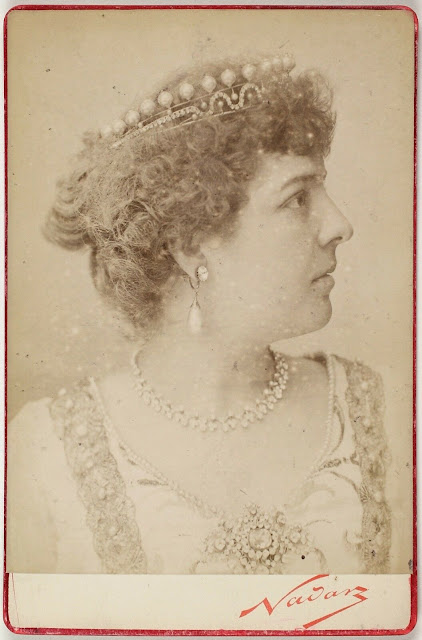


Over the next years, her name appears repeatedly in the same selection of venues, at the Brighton and Scarborough Aquariums, with Rivière at his Covent Garden Proms or his Aquarium concerts, at the Alexandra Palace… She also changed her name again. On 11 March 1878, Miss Pratt became Mrs William Henry Eayres, wife of the divorced violinist.
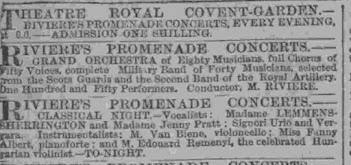


This was not a good idea, for Eayres was a serial adulterer with a scandalous history. His first wife had dragged him through the courts and noisily displayed his sexual misdeeds in a ‘letter to the musical profession’, which ended her up in the courts for libel. Jenny didn’t keep him on the straight and narrow for long. By 1882, he was at it again, and, in 1884, ended up in court again at the behest of one Alexander Glen Collins, whose wife he had repeatedly borrowed. The lawsuit went to the House of Lords, and became a much quoted precedent on ‘condoning’. I don’t suppose Jenny condoned, but she didn’t divorce him till 1887.

Mrs Eayres (as ‘Madame Jenny Pratt’) appeared from time to time in London (Aquarium, Alexandra Palace, Crystal Palace), but spent the large part of her time entertaining in the ‘spots’ of England: at the Blackpool Winter Gardens, the Southsea Pier, the Scarborough Aquarium, with the Southampton Philharmonic Society or at the Winter Gardens, Morecambe. She gave the occasional Athalie, Undine, or The First Walpurgisnight, but more often was heard in her old favourites or a new ballad such as Behrend’s ubiquitous ‘Auntie’.

Latterly, she took out little concert party troupes, sometimes with her pupils, and this seems to have been where she encountered a young stationery traveller with a deep bass voice named Ernest John Robinson (b Hoxton, October 1860; d 11 Victoria Avenue, Finchley, 2 September 1929). As soon as she had divorced, they were married, and in her second marriage Jenny found the happiness she had not found in the first. The Robinsons had two daughters, Victoria Jane Maryann (b 102 Gaisford Street 24 May 1888; d Worthing 18 July 1975) and Ethel Annie Fairney (b 65 Patshull Rd Kentish Town 11 October 1891; d Worthing 21 May 1979).
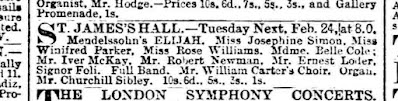


Mrs Jane Robinson continued to work as ‘Madame Jenny Pratt’ into the 1890s, but there was one more name change to come. Ernest chose to be called ‘Mr Ernest Loder’ for his modest career as a professional vocalist, and somehow the Robinson family became known as Loder. Jenny could be seen appearing in the occasional local concert at Clacton-on-Sea or Frinton, with ‘Go, lovely Rose’ or ‘She wore a wreath of roses’, up to the turn of the century, as ‘Mrs Loder’.

Mrs Loder seems to have died in 1926. Mr Loder died three years later (3 Victoria Avenue, Finchley 2 September 1929) leaving a fortune of 22,000 pounds. There must have been a lot of money in stationery.

William Eayres got himself another, much younger, wife, from Scotland, whence he had fled awhile, and he died in 1920.



Friday, January 7, 2022

A star in New Hampshire: Mrs Nichols.


I strayed today.  In my daily pre-breakfast zip through the pages on ebay, I have a system. Well, you have to reduce the number of items to look at or breakfast would never happen. So I 'search' for my keywords with a few minuses.  -Rare. Anything labelled 'rare' is almost certain not to be. -! Any listing full of exclamation marks is going to be a waste of time ...    I haven't got the time to waste on such as 'RARE! Dancer!! Christina Nilson'. Anyway, that's my ebay method. 

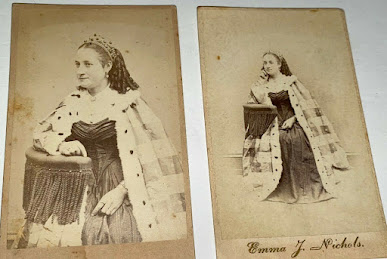
I also, alas, have a handicapped right arm/hand (legacy of a stroke) and have been reduced to typing with two fingers, so sometimes mistakes happen, and yesterday I pushed the wrong key when applying my filters and landed on 'Rare Antique Victorian American Costumed Singer Emma Nichols PA CDV Photo Lot!'  Emma [J] Nichols? Never heard of her. A plain little lady with the most preposterous cloak and tiara .. what on earth was she. Well, let's have a late breakfast ...


Here's the result.

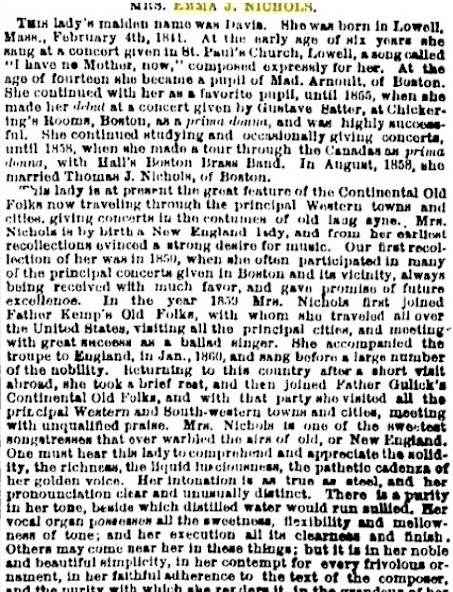
Emma J NICHOLS was indeed, for a decade, a singer in the western part of America. But that is not a costume. That was evidently her platform garb. For Emma was a ballad singer with minor concert groups in, mostly, the western part of the United States. 

Emma was born Emma J DAVIS in Lowell, Mass 4 February 1841. Father was Zebulon Davis (1798-1868), a farmer in Rockingham, New Hampshire, mother Sally née Huckins, and there were three elder siblings (Daniel, Rebecca, Laura). Emma married, in her teens (August 1858) a clerical worker by the name of Thomas J Nichols, son of a local shoemaker.

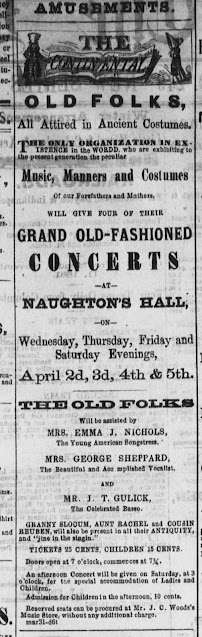
By 1860, already, she is advertising as a teacher of singing, and by 1862 she is the soprano with Father Jim T Gulick's 'Continental Old Folks Company', a company performing olde tyme songs, in 18th century costumes around 1 and 2 night stands from New Brunswick, Trenton, Princeton, Bordentown, Burlington, Mount Holly, Frankford ..  fellow performers, Messrs George M Shep(p)ard, J H Holloway and Gulick.


Mr Gulick went on to become one of Newcombe's Minstrels, the Dupres and Benedict Minstrels.


'Father Kemp's Old Folks Company' 'from Reading, Mass' (37 members) had originally (1857?) been an amateur group which had sung its 18th century chorales in costume at Niblo's Garden in 1859. The star act was 92 year-old Grandfather Foss with his Great Grandfather Fiddle. Emma soon transferred to the Kemp group (now 22 people with her as featured soprano), which made a trip to England in 1860 to show their novelty act. Mr Nichols was now 'Father Kemp's treasurer.  Emma 'the celebrated New England Songstress' stayed for nearly a decade years with these two troupes (which became ''Father' Kemp junior's' and the Continental Old Folks), progressing in her billing to 'the Jenny Lind of America'. In 1869 I see her setting out from Neponset, Mass, as a member of Spaudling's Bell Ringers, through Plainfield, Washington, Hackettstown, Orange, Newton, Newark ...

In 1870 (20 February), Emma gave birth to a son, Edwin Bowley Nichols, by  time Mr Nichols was listed as 'professor of music'. I don't see her performing thereafter. She is listed in 1870 as 'Music teacher'. Thomas is 'farm labourer'. 

Emma died of peritonitis at home at Plaistow NH, one day after her 39th birthday. I don't know what became of Thomas. Edwin (shoecutter) married, had a son, and weeks later committed suicide (24 October 1896), aged 26. The son changed his name ...

Bit of a sad tale, really. Better put my filters back on.

And look what's turned up after all that!


Happily, they don't carry the story to its end.

And what IS that cloak? An 18th century New Hampshire national costume?