Thursday, September 27, 2018

The Scottish Nightingale of the Bouffes-Parisiennes


For the past thirty years, Miss Augusta Thomson of Glasgow has been a curious item in my collection of Victorian Vocalists.  I had never even succeeded in tracking down more than a line drawing of the lady. And then, this morning, up popped a photo of her on e-bay. It looked nothing like the drawing ... but it needed to be enshrined on my blog, and it got me thinking about Augusta once more ..


THOMSON, Augusta (b Glasgow 11 December 1836; d 141 Cambridge St , Pimlico 14 March 1877)

Augusta Thomson seems to have been a should-have-been. But her apparently determinedly curious career didn’t turn out that way.

Augusta was born in Glasgow in 1836, the daughter of musician and composer Andrew Thomson and his second wife, Isabella (née McKinlay). Most of Thomson’s first family followed their father into good careers in music – Joanna (Mrs Rodwell, Mme Ferrari) (qv) as a vocalist, pianist and more importantly a teacher, James as a pianist, and Jessie Millar Thomson also as a teacher and songwriter. 
Augusta was at first trained by her half-sister, Joanna, and she appeared in public for the first time at the age of seventeen in a concert given by Signor and Madame (sic) Ferrari at the Hanover Square Rooms 19 May 1854. She sang ‘Sull’ aria’ with her sister. She put in another appearance at Joanna’s 1855 (16 May) concert, and then went off to France to study at the Paris conservatoire. She was awarded an 3rd accessit in her first year, and followed up by taking the 1er prix ‘à l’uninamité’ in July 1858. The press spread itself over her ‘soprano of magnificent volume and of unrivalled purity and flexibility’ as displayed in the Huguenots aria ‘O beau pays de Touraine’ and back home in Glasgow the local paper printed a Scotsman in Paris notice: ‘one of the rewards was carried off by a young lady from Glasgow, the sister of one of your most talented professors of music. Possessing a voice of extraordinary power, as well as of the most classic purity and flexibility, the singing of Miss Augusta Thomson was much applauded, and offered a most favourable contrast to the florid and tremulous style of vocalisation so prevalent here..’.
As a prize-winner, Miss Thomson had to make herself available to the French national theatres and, although the Conservatoire records that she went, logically, to the Opéra-Comique, in fact she didn’t. She went straight to the Paris Opéra. The knowledgeable British press was immediately on it guard. Miss Thompson, the young English vocalist who carried off the first prize at the late examination of the Conservatoire, has been engaged for the Grand-Opéra, and will make her début as Mathilde in Guillaume Tell on the occasion of the rentrée of M Gueymard on the 1st of October— that is, if the same influence be not exerted against her as was made use of against Miss Birch some years ago — which must be fresh in the recollection of our readers. Miss Thomson, however, appears ‘with a difference’ on the French stage. Miss Birch was taught in England, where, of course, they know nothing of singing. Miss Thomson, on the other hand, is a real pupil of the Conservatoire. It is curious to perceive how the Parisian press glorifies M Révial, the master, and says little of Miss Thomson, the scholar; as if teaching— French teaching— was everything, and genius, intellect, powers, accomplishments, energy, application, resolve, and bias, nothing. This is the invariable mode of criticising in the most polite capital in Europe’.
If the paragraph sounded rather nationalistic and neurotic, there was nevertheless truth in it. The power struggles at the Opéra were notorious, and Miss Birch – one of the great sopranos of the era – had indeed been disgracefully treated there. Augusta didn’t do much better. 

It seems that the debut actually took place 12 January 1859. Gueymard was Arnold, and Belval, Bonnehée, Mme Altès-Ribault and Mlle de la Pommeraye were the other principals. I can find no reviews. Odd in a country where a debutante at the Opéra got incommensurate coverage The press merely commented ‘Mlle Thompson a reparu cette semaine à l-Opéra dans le personnage de Mathilde de Guillaume Tell. La debutante a bien dit sa romance ‘Sombre forêts’; son duo avec Arnold et le beau finale du troisième acte lui ont également valu des applaudissements’. But she did not follow up as Marguerite in Les Huguenots. She went home.

Her first British appearance after her return was in no less a venue than the Philharmonic Society 16 May 1859: ‘the event of special interest was the debut of Miss Augusta Thompson a young lady who has achieved extraordinary success at Paris where she has attained the highest honours of the conservatoire, and made a most promising appearance at the Académie’. She caused a sensation. She sang ‘Reviens ma noble protectrice’ (La Part du diable) and her William Tell duet with Belart and the press responded ‘She has a magnificent soprano voice, while her powers of execution are consummate’. ‘[This] foreshadows an amount of reputation for her in this country second to none’. ‘A Louisa Pyne en herbe’. Buckingham Palace responded by commanding the young singer to perform there the next Friday.

She continued home to Scotland, on a wave of publicity. But Scotland was annoyed at the special increased prices and only enthused mildly (‘Merce dilette amiche’, ‘Quanto amore’, ‘Carno nome’, ‘Comin’ thru the rye’, ‘A Mile from Edinboro Town’). On her return to town, she appeared first at the New Philharmonic concerts (‘Pensa alla patria’,’Robert toi que j’aime) and the critic opined that French music suited her far better than Italian. He was clearly right and Augusta leaned away from the Italian somewhat thereafter.

And there was plenty of thereafter. In 1860, Augusta Thomson was seen frequently in the West End concert rooms during the season singing ‘Sombres forêts’, ‘Jours de mon enfance’ (Pré aux clercs), L’Etoile du nord, ‘Take thou this cup’ (Lurline), ‘Ah me, he comes not’ from Barnett’s Fair Rosamond, ‘Il Bacio’, Berger’s ‘Ave Maria’ et al. She appeared again with the Philharmonic Society, in the Royal Society of Musicians Messiah, at the Vincent Wallace concert at Crystal Palace, at Her Majesty’s Theatre for Mrs Anderson, sang Sidney Pratten’s music at his concert, and took part in countless personal concerts (Frederick Chatterton, Marie Rieder, Emma Busby, Lucy Leffler, Harold Thomas, F Scotson Clark, Mr and Mrs Tennant, Susanna Cole, Edmond Depret, Louisa Vinning, John Thomas, George Russell, Mr Willing, Aguilar, Augustus Mann etc etc). In August, she appeared at Mellon’s concerts at the Floral Hall where she shared the soprano music of The Messiah with Parepa, in December she made a debut at the Monday Pops (Haydn’s ‘Fidelity’, ‘My pardon, dearest treasure’) and she ended the year with a Messiah at Aberdeen.

1861 continued on much the same bases. More Monday Pops(‘Zuleika’, Mozart’s ‘The Very Angels Weep’, Macfarren and Dussek songs), and various concerts where she displayed her new favourite, the aria ‘Le Pouvoir de chant’ from Auber’s La Circassienne), plus yet another return to the Philharmonic (‘Miss Augusta Thomson, who is steadily making way, gave one of the loveliest airs from Spohr's Jessonda with real expression’ Le Comte Ory with Gardoni). When Francesco Berger staged a Don Giovanni selection she sang Zerlina, she took part in the concerts of Mme Rieder, Miss Busby, W G Cusins, Louis and Adolph Ries, Pratten, Madame Puzzi, Howard Glover, Mrs Anderson, Ganz and others, and towards the end of the year she was featured in Prince George Galitzin’s proms, where she performed his music and also that of Howard Glover and others more classic, and visited Leeds for an unfortunate production of Benedict’s Undine ([she was] the only redeeming feature’). Finally, she made ‘her accustomed annual visit’ to Glasgow were they were more generous to her this time: ‘a beautiful soprano voice of extensive range, clear and sweet, and her brilliancy and fluency of execution were amply shown in ‘Qui la voce’ and ‘Could life’s dark scene’ from Glover’s Ruy Blas. 

From Glasgow, however, she did not continue back directly to London. In the company of Alexandre Billet (piano) and Guillaume Paque (’cello), she headed for Geneva where she was rousingly received (‘voix ravissante’) and to France, and when she did return to England it was only for a handful of concerts.

‘Miss Augusta Thomson, who has been for some time missing, having disappeared from London at the moment when she was beginning to be of value … is engaged at the Bouffes-Parisiennes in Paris—by which it would seem as if she intends to work out her career in foreign opera. ...’

On 23 February 1863 she appeared at the Bouffes playing the principal girl, Inès, alongside Delphine Ugalde and Lucille Tostée in the first Paris production of Nuitter and Offenbach’s Les Bavards. The production has made it to Wikipedia where Augusta in just mentioned as ‘Thompson’. She wasn’t liked by the Univers Musicale: ‘A part une debutante qui a failli compromettre son rôle, la demoiselle Thomson qui serait mieux placé dans le genre sérieux car elle manque absolument de gaîeté, l’execution laissait rien a desirer’. The Bouffes closed for demolition in April, and the troupe headed for Ems.  I imagine Augusta went with them. But when the new theatre opened in January 1864, she was not there. She was back in Scotland, singing ‘Quand tu chantes’ and Scots ballads at the Glasgow Saturday Concerts. Up till now, the stage had not been very favourable to her.


As Ines in Les Bavards

She made a first appearance in Manchester in February 1864 in the Halle concerts, and then she made a surprising switch. On 3 April she opened at the Manchester Theatre Royal in the title role of the burlesque Ixion. Then, later in the year, I see her playing in a version of Leah (with ‘Sing Birdie Sing’ and Faust interpolated), Ixion and The Child of the Regiment at Nottingham, Jeannette’s Wedding and the burlesque Perdita with Lydia Thompson at Liverpool and at Christmas principal girl in the pantomime, The Jolly Miller of Dee at Birkenhead.

17 April 1865, however, she was brought back from burlesque and the provinces. She opened at Drury Lane cast as Sabrina in the masque Comus and once again was praised to the skies. But Comus over, she joined up with Terrott, Bartleman and Annie Leng in a ‘Royal English Opéra-Comique Company’ playing The Sleeping Queen, Violet’s Playthings, Once too Often, La Serva Padrona etc, adapted by herself) in polite venues.

But she was brought, again, back to London to appear at the Gallery of Illustration where she gave London a taste of the Offenbachian with her performance in Ching-Chow-Hi (Ba-ta-clan). No one, this time, complained of a lack of gaiety.

In September, she was recalled to Drury Lane for more Comus and at Christmastide she was principal girl in the Lane’s pantomime Little King Pippin.

After the festive season, she returned to Liverpool and burlesque, in July to the Princess’s for drama (‘she sang and acted with great vivacity’) and at the end of the year The Invisible Prince (Abricotina). The Princess season folded, but Augusta returned to Drury Lane where she and Tom Whiffen took over the roles in the panto curtain-raiser Terrible Hymen (Avant la noce).

But from Drury Lane, she continued to the very suburban Marylebone Theatre where ‘the great English vocalist from the Theatre Royal, Covent Garden ‘ ‘the Queen of English songsters’, played in a version of the Daughter of the Regiment, before starting on a reasonably downmarket series of productions: a remake of Auber’s Manon Lescaut written by herself as Sunshine and Shadow, The Colleen Bawn with music from The Lily of Killarney, Violet’s Playthings, The Muleteer of Toledo with music from The Rose of Castille, the pasticcio The Burgomaster’s Daughter featuring bits of Auber, ‘Sing Birdie Sing’, ‘The Hunters Horn’ et al, Violetta, a for the suburbs La Traviata, and extravaganza fashioned from Rob Roy, a Maritana in the same mould, then a reasonably un-deconstructed The Black Domino and The Slave, and a burlesque of Lucrezia Borgia with Augusta as Orsini … and then she was ill. Again.

She was engaged for the SurreyTheatre, and presumably more of the same, but fate and John Russell of Covent Garden intervened. Augusta was hired to play Wanda in what was to turn out to be the important production of La Grande-Duchesse, alongside William Harrison and Julia Mathews. Her experience of things French and of real opéra-bouffe served her well, and Augusta was hailed as perfect in the part. La Grande-Duchesse, as history tells, only played four weeks in this initial season, and Augusta went off to play The Fair One With the Golden Locks at the Surrey, but come the season Russell remounted his hit, and sent it on the road. Mrs Howard Paul was now the Duchess and the piece was as popular in Liverpool, Leeds and Manchester as at Covent Garden. 20 June 1868 it came to the Olympic Theatre for a second London season.

Opéra-bouffe was becoming the rage, but did Augusta stick with it? No. She returned to burlesque and the her collection of song-studded plays. She took them to Scotland, and Scotland was notimpressed with her versions of The Flowers of the Forest, True unto Death, The Maid and the Magpie, The Prisoner, A Border Marriage et al. When she starred in panto (The Long Pack) at Newcastle, it was a flop and had to be removed. But she continued with her dramas with arias, and took her own company to West Hartlepool with a bundle of them. Her version of The Muleteer of Toledo not only helped itself to items from The Rose of Castile but also from La Périchole.
At the end of the year she joined Mrs Liston at the Olympic Theatre, singing Jeannette’s Wedding and Little Emly as a forepiece. But 4 January 1870, Mrs Liston produced the burlesque The Princess by W S Gilbert, and Augusta was cast as Prince Cyril.
John Russell recalled her to opéra-bouffe, to replace the upwardly-mobile Emily Soldene in Barbe-bleue, but as soon as that tour ended it was back to burlesque with Francis Fairlie and with W H Swanborough. When she played Marchioness in Little Nell the press enthused ‘she displayed an amount of talent as a character actress that we had not hitherto given her credit for’.

21 March 1871 she returned to the opéra-bouffe stage as Zanetta in Henry Leslie’s Liverpool production of La Princesse de Trébizonde (‘her voice is peculiarly suited to Offenbach’s light, merry music and she is a great favourite’..) This production was to tour for a very long time, but Augusta, typically, did not stay long. She switched to play Frédégonde in a tour of Chilpéric, from which she retired in August ‘sick from overwork’ and, I suspect, from her friend and business partner, Estelle Bodenham.

When she returned, she joined Swanborough again, playing burlesque at the Crystal Palace (with Manon Lescaut’s ‘L’Eclat de rire’ and Bishop’s ‘The Pilgrim of Love’ interpolated), and then moved to the Royalty Theatre to where J E Mallandaine had brought his ‘musically complete’ provincial production of Chilpéric. Alas, he brought it without its drawing star, Miss Emily Soldene, and although Augusta gave her impeccable Frédégonde in ideal style, the run was not long. Mallandaine then staged his Paquita with Augusta in the title-role. It played 13 performances, and Miss Thomson was soon back with Swanborough, playing Rochester in Violet’s Playthings and a cut-down revised interpolated-into version of Ixion. ‘A superb soprano voice and exquisite acting ... we can not recall any vocalist obtaining a similar reception since Miss Louisa Pyne..’

The Swanborough connection bore West End fruit, and Augusta Thomson, billed big, appeared (27 November 1871) at their Strand Theatre. She played the title-role in Ivanhoe, and in Burnand’s Arion, then in Brough’s Pygmalion, before quitting the company and going out on another Chilpéric tour (24 March 1872) with W H Tilla – the King who had failed to fill the shoes of Soldene – as her leading man. Before long, the producers cried enough, and Augusta and Tilla took their place as managers. Cox and Box was played as an afterpiece to the opéra-bouffe: Augusta played Box. By August, however, she was weakening and was off, ill, again. They added a selection from the Soldene hit, Geneviève de Brabant to the repertoire, but by September they had shuttered and Augusta was at Bristol playing the Earl of Leicester in Little Amy Robsart.


Another opéra-bouffe engagement soon raised its head. 18 November 1872, Richard Mansell produced The Bridge of Sighs at the St James’s Theatre with Augusta in the splendid prima donna rôle of Catarina Cornaro. It had a rocky ride, closing in disarray when Augusta got ill again, then being remounted the following February in a cut version. It still failed.

30 June 1873 she was cast in Prince Moselle in Snae Fell at the Gaiety Theatre, but typically she abandoned the Gaiety to return to Henry Leslie, back in her old role of Zanetta, for the last weeks of his tour, before heading back to Liverpool. At Liverpool she played La Grande-Duchesse, a new and short-lived extravaganza Lothair, the pantomime The King of the Golden Valley and Clairette to the Lange of Lennox Grey in the latest opéra-comique megahit La Fille de Madame Angot.
Her Clairette was noticed, and she was soon back with Hollingshead and the Gaiety company, touring with Nellie Farren and J G Taylor as Zanetta in La Princesse de Trébizonde, Morgiana in The Forty Thieves and in Offenbach’s The Great Metropolis. 
She ended 1874 touring with the Liston company and playing Little Red Riding Hood at Glasgow, and in 1875 went out again with the Gaiety Company before recreating her Wanda, for Charles Morton, to the Duchess of Cornélie d’Anka for a season at the Opéra-Comique.

And now things began to shrink. Her next engagement was touring with a certain Albert Montgomery’s troupe playing in the musical comedy Loo, and then in Karl Meyder’s operetta company playing little 1-acters. She also got mixed up with a fairly hopeless type who called himself George D’Arcy (real name Willie Yelland), Estelle Bodenham’s widower, who joined in the remaking and pasticcio plotting with very little talent and advertised Offenbach and Augusta large.

At Christmas 1876 she appeared as principal boy in Open Sesame at the East-End Standard Theatre. Her principal boy was Alhambra ex-star Rose Bell, once Mlle de la Pommeraye and a member of the cast of that Guillaume Tell at the Paris Opéra, eighteen years ago, when anything had seemed possible for the ‘girlish, little’ Augusta Thomson.

It was her last stage appearance. Augusta died a few months later of ‘brain disease (one month & fourteen days) and paralysis (7 days)’. She had worked steadily all her career, except during her frequent illnesses, sometimes in splendid, classy companies and for most of the best musical-theatre managers in Britain. And sometimes in some very poor vehicles and places, for some less than notable managers. She had never again ventured into the opera. Perhaps wisely. But she had proven herself a perfect opéra-bouffe and opéra-comique leading girl … why, oh why …?


Wednesday, September 19, 2018

HMS PINAFORE: the last mystery ... finally solved

.
It’s D for Departure Day minus 1 ½. My beloved Winter Palace has been stripped bare of all my personal belongings, and is looking rather lonesome. Five big wheelie boxes are waiting to be transported to the basement, where they will reside till I return next autumn. A bit sad, but last year I left all sorts of stuff for the enjoyment of the summer guests and half of it ‘walked’.

So here I was, at midday, having been massaged, and haircut, and … surrounded by two bottles of bubbly, one bag of frozen broad beans, four bananas, some suspiciously elderly looking turkey, two eggs, half a onion, one blood sausage … and, of course, my computer. Well, the computer should take me through to what likes being a slightly odd dinner time … so whom shall I tackle this afternoon?

Well, my mind was made up for me. My dear friend Elizabeth wanted some help with one of her ancestors, and, on my way there, I wandered into Gilbert-and-Sullivan land … fatal!

HMS Pinafore.Well, we know all about the folk who created the principal roles, don’t we? I’ve even ‘done’ Fred Clifton, Jessie Bond and Harriet Everard this year. So, who is there left who is still a puzzle? Why, ‘Mr Dymott’. Bob Beckett, the carpenter’s mate. Always just Mr Dymott. No first name, no past, no future … Well, he has all of those things as of today. Here we go.


Aeneas Joseph Dymott was his full name, and like most of the Dymotts in Britain, he hailed from Hampshire. He was born in Southampton, the son of James Dymott, a tailor (d Broad Street 16 September 1863), and his wife Sarah née Frith (d Albion Place 6 July 1854) who can be seen in 1841 living in Parsley’s Court, French Street, with Nancy (b 12 September 1818, Mrs Henry Brice), Julia Mary (d 17 December 1885) and our lad. The girls would go on to be schoolmistresses, Aeneas established himself as a woodcarver.

Well, that was his day job. But young Mr Dymott had a big bass voice and when he wasn’t carving, he sang. But before I spot him singing, I spot him breeding. He had daughter, Julia Frost Dymott (1853), by a young lady named Eliza Frost, from Sunderland, married her four years later when a second daughter, Eliza Nancy, arrived, fathered a Mary in 1858, an Aeneas Frank in 1860 (replaced by another in 1862), and lost his wife when she was but 35. He would quickly remarry, one Ann Cress[e]y, daughter of a carpenter from Templecoombe, Somerset, and have yet another daughter, Celia (Cecilia Annie) …

But, by this time, Mr Dymott, installed with his family at 4 Hanover Place, was only carving wood part time. He was part of the male ensemble at Evans’s famous Supper Rooms (1863, with Messrs Brady, John Whitwell, Bamford, Smith, J Hogan, Godden, Way). Evans’s wasn’t often covered by the press, so I don’t know when he began and when he ended, but the vocalists tended to stay, and I see him again in 1868, as ‘second ie low bass’ with Messrs John Whitwell (baritone), Barrett, Ball (tenor), Walton, J Hogan (baritone), Smith and Matt Cooper, intoning ‘The Old Church Bell’ to the chop and porter male audience.
But between times, he had been seen further afield. In 1867, I see him as basso soloist (‘Down among the dead men’) at both the Canterbury Hall – with Emily Soldene and Alfie St Albyn, no less – and at the Oxford, singing solo in a selection from The Ruins of Athens. I suspect there were many, many more such, unrecorded occasions. In 1871, he (with Hogan) was on the programme at Store Street Rooms for the concert of George Allen, bass soloist at the Philharmonic music-hall. And in 1877 he went on the musical stage. The occasion was the (vanity) production of a Macbethish ‘opera’ entitled Biorn of which the details can be read in my British Musical Theatre Volume I. Its cast was as unusual as its text, and our Aeneas was featured alongside the author’s amateur wife Mrs Fitzinman Marshall and the indifferent Italian baritone, Mottino (very briefly of the Carl Rosa) as the Norwegian thane and his bloody wife. Gerard Coventry and what seems to have been the young ‘Giulia Warwick’ were part of the wreckage alongside some Italianate names which were probably phony.

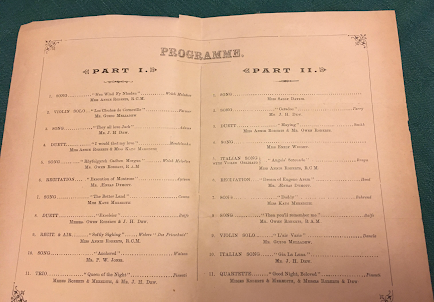
Giulia, as we know, went in to play in The Sorcerer. I wonder if Aeneas was in that chorus. He was nearly fifty, and in the next census he would describe himself as ‘woodcarver and chorus singer’. But for HMS Pinafore a real bass was needed for the glee, and so our hero got the part that would make us, 150 years later, remember and write about him.

But, please, Mr Dymott did not come from nowhere. By the time of Pinafore he’d been known as a low bass singer in the Covent Garden area for at least fifteen years.

The future is not so happy. When the split happened at the Opera Comique, Dymott chose to go with the money men, and moved to the Imperial and the Olympic productions of Pinafore. If he was looking for security, he backed the wrong team. But it didn’t really matter. He played in Pinafore, in the succeeding Marigold, filled in his 1881 census papers, and weeks later died. Aged 51.

Ann remarried, in 1887, a groom by the name of Thomas Stokes. I see that Eliza Nancy died aged 60, unmarried, and that Ce[ci]lia Annie became Mrs John Joseph Day, and had five children. Aeneas junior (‘sculptor, woodcarver’) appears to have lived to 1940.

Bother Victorian attitudes! I would love to know more about the early music-halls and Evans’s in particular … but, no. The press covered the Italian opera, Madame or Mademoiselle Telle ou Telle’s concert … but not Evans’s Supper Club. Which didn’t need the press to find its audience. But, sadly, left us with little knowledge of what was sung (as opposed to eaten, drunk, ruded and blarnied) there …

Anyhow, can we henceforth give Aeneas his proper name … and, is that the Pinafore originals tidied up now?


PS OK. NOT the last mystery. Here's another:

BICKERSTETH, Frederick Langdale (b Liverpool x 6 July 1846; d 24 Ladbroke Grove, Notting Hill, 28 February 1901)
Son of Thomas Silvester Bickersteth, a Worsley, Lancashire, straw merchant’s clerk, and his wife Sarah. However, when he married Eliza Major ‘of Walmer Grove’ at Birkenhead in 1869, his father was described as ‘Esq of Kingsland, Oxton, Cheshire’.
I see him in 1871 described as 'marine insurance broker' in Tynemouth, and in 1891 he insists on 'operatic vocalist.' A rather discreet one I feel ...


PPS: dateline 2022. It appears Aeneas junior also went in for a little performing:


Saturday, September 15, 2018

When the fat lady sings! And brings out a star ..

.
Yesterday I ran into this Bristolian photo from the early 20th century. Laurie’s Juveniles. Never heard of them. Amateur? Professional? Ephemeral? Acrobats? Concert party? Music-hall act? And who is the stout madame. Ah, ‘Carrie Laurie’s Juveniles’. So she is, doubtless, Carrie Laurie, or sometimes Lawrie (and thus, doubtless, of another name altogether).


Well, I had a wee scout about, and goodness me! Definitely professional, anything but ephemeral, not acrobats, but everything else. The Carrie Laurie troupe of young performers (usually 3m 4f, plus a little-boy comic) played the halls for some twenty years, from 1900 on, to, mostly, excellent reviews, sometimes topping the bill alongside known performers. And the ranks of the little players, obviously ever-changing, turned out a few to-be-well-known players, including a couple, good heavens!, with extremely tenuous links to myself.

So, first of all, who was Carrie? Well, she was born Caroline Eliza Dodge, in Christchurch, Southwark, in 1867, one of the children of a Bristolian couple, Edward Dodge, painter (houses, I suspect, later a gasfitter), and his wife Sarah Ann née Taylor. There they nearly all are at 37 Price’s Street, Christchurch, in the 1871 census: Edward, Sarah, Mary Louisa, Edward H, Walter (b 17 January 1863; d 1928), Caroline .. eldest sister Sarah Ann (Mrs Charles Stichbury) has departed. By 1881 mother, father, Walter and Caroline are living at 32 Windsor Terrace, Bec[k]ton, Essex, with Mrs Mary Louisa Edwards’s baby …

And, not long after that, Carrie went on the stage. I see her first at Christmas 1884, playing in pantomime at Exeter. In 1886, she made it to a London stage in pantomime at the Standard. In 1889, she went on tour with George Fife’s company, playing the title-role in Aladdin up-to-date and alongside Ramsey Danvers in the famous comedy Turned Up. And some time in there Carrie stumbled. There was, on the bill, both at the following Leeds pantomime, and in her surrounding music -hall dates, a comedy-duet act named ‘Rhodes and Conl[e]y’ ‘the Irish Sunbursts’. They’d been round for a few years (1881-1898), so Alfred Rhodes must have been a little older than Carrie. Anyway, Carrie dallied and the result was a little ‘Beatrice Ann[ie] Rhodes or Dodge’ born in Dublin 15 June 1890. Carrie and Alfred had been on the bill at the Scotia, Glasgow a fortnight earlier!


Plump and pleasing Carrie, with her good singing voice, doesn’t seem to have stuck around Alfred thereafter. I see her covering Britain as a singer in the halls, and in pantomime, visiting South Africa in 1898. One little snippet says she ‘toured with Henry Irving’. I must have missed that. Anyway, she had a perfectly good career of fifteen years at not-the-top-level -- in 1900 I see her at the Balham Music Hall – where she changed direction. She began her juvenile troupe. 'Six in number' of whom a child dubbed Carrots seemed the most popular.


 I first see them out at Brixton, the Empire Palace, Portsmouth (‘Laurie’s Juveniles, in 'Kindergarten', sketch of mirth and music’) and Leeds in November-December 1900, then straight into the Holborn Royal and Gatti’s on the Christmas Bill, playing a sketch with songs and dances under the title The Kindergarten. Kindergarten would serve them many years, varied by such pieces as the Vokes’s famous Belles of the Kitchen and The School Outing..


Of the few photos I have been able to exhume of the troupe, I think (judging by the size of Carrie’s girth) that this is probably the earliest.


Sadly, the names of the children aren’t mentioned, but several sometime members of the troupe did make adult careers and, of them, I know a little. I thought the 1901 census might help, but it finds Carrie at home at 17 Lambeth Road with just one ‘Thomas Holmes, music hall agent’, for company. (The family historians, who don’t differentiate between ‘Wife’ and ‘Concubine’, reckon this was the below-mentioned Mr Wray).


However, in 1911, the company is playing Birkenhead, and their digs lists in full the names, ages and home towns of the ‘Juveniles’ who are accompanied by Carrie, Beatrice (now 20) and Mr John Charles Wray ‘theatre manager’ (b Yorks 29 June 1847; d Teignmouth 4 July 1923, she had been co-respondent in his divorce) and Ruth Miller (dresser b Barking). Here is the list (with a few annotations).

Ethel May CLARKE 16 b Trinity Square, Poplar 19 March 1894 daughter of George Clarke warehouseman
Jessie Eliza Rosina NOONE 15 b Battersea 6 July 1895 daughter of Augustus Edward Noone, m 16 December 1923 John Frank PERKINS; died 152 Ribblesdale Rd, Wandsworth 18 November 1979
Violet WILSON 14 b Birmingham
Bloomah Elizabeth LEVY [Bloomah Yerman Gimmack LEVY] 14 b Stepney 28 February 1897
Lilly KIRK 14 b Woolwich 
Leonard Lloyd LORRIMAN 15 (b Nottingham 4 January 1896; d Weston super Mare 1943) son of John Elijah Baddeley Lorriman (d 1942 a 78) and Kate Elizabeth née Bryan, stationary engine driver/lace jennier. C11 Father works in a cotton factory, 
John William BUTLER 15 Walthamstow (b West Ham ApQ 1895)
William MOISE 14 b St Helier seems to have been the son of a Jersey hairdresser of the same name
Alfred [Ernest] CRAWLEY 11 b Sheffield 14 January 1900. Who became a crane driver?

Maybe some of these are in these later pictures. As you can see, I haven’t really been able to follow up the what-became-of of the little troupe. Except in a couple of cases. For this list includes one name which would (when changed!) become very well known on the 20th century stage and screen, and one which would become similarly well-known by association/marriage. And yes, to both of those I, in the next generation, have my wee link.


First, Alfred Ernest Crawley (11 August 1899; d 1985). He joined the company in 1909 to take the part of the little boy comic in the red wig whose comicalities were – whoever had played him, from the start -- the highlight of the performance. As an adult, Alfred changed his name to ‘Roy Barbour’, of whom Wikipedia will tell you all, and his son, Peter Barbour and granddaughter, Sue Barbour, came into my life when I cast London’s Barnum. They would be the first folk hired and the backbone of our company.

Then young master Lorriman. Len was one of the sons of a Nottingham family. His career, it seems, ended early, but then his younger brother, Francis (1898-1967) joined up, and he proved much more durable. He changed his name to Frank Laurie, married the singer and (later) famous comedienne, Gladys Morgan, and stayed in the business for many years. I see it suggested that they wed at 16. Not so, they were married at Bristol in 1923: fully 24-5 years old. And the next year Joan Lorriman was born (b Bristol 26 January; d Worthing 16 August 2018). When I was a minor member of The Black and White Minstrels, Joan (Mrs Bertram Frederick Hollman) was lead soprano with one of the Robert Luff companies.


The internet tells me that the radio and concert baritone, ‘Mark Raphael’ (b Whitechapel 7 April 1900; d Croydon 1988), was at some stage a Laurie Juvenile – maybe under his real name of Harris Furstenfeld – and there is whole biography devoted to him which may give more tips. One Ernest Alfred Nicholls (d 13 May 1967) is also quoted as having performed with Carrie, and a certain ‘Jimmy Lynton’ otherwise Charles Parsons as well. I don’t know him nor his grandchild who is an English politician named Tony Blair.

Then there is a Gladys Morgan (1898-1983) who married Frank Laurie (?) also of the Juveniles, who carried on performing into adult life and the TV era. She can be read of at http://sussexwomen.weebly.com/excerpt.html

The only other Laurie Juve whom I have pick up on is a little madam by name Charlotte Walkingham (b 1897), daughter of a deceased bricklayer and a paper sorter, from Hull. She was had up, in 1914, for stealing handbags, and thereafter vanishes from my ken.

Carrie’s activities were covered occasionally in the press: ‘Miss Laurie and her little charges reside in a large 14-roomed house when in London, at Brixton. One large room contains a piano and organ, and is set apart for practises, another accommodates the dressmaker, who makes all the children's wardrobes for the stage, and another large apartment is used for dressing and making up, which is all done before leaving the house to go to business, to which the kiddies are conveyed in a pair-horse omnibus. Miss Laurie's splendid stage experience admirably fits her for the work of training the young idea. She studied singing and voice production under the tuition of Signor [Albert] Visetti, and toured England and America with the late Sir Henry Irving. She also played several seasons under the management of Mr Willie Edouin, and has appeared as principal boy in many of the leading pantomimes’.

Yes, well, a tad ‘publicity’, but the Brixton bit is true enough. 16 St John’s Road. Fourteen rooms? Wow! I see her there in 1904, so she must have already garnered a few shekels.

Carrie died in harness, on 2 May 1921, at 31 Christchurch Rd, Tulse Hill. Still officially single (in spite of what the family historians say!), and possessed of 3000L. With her, died the Juveniles troupe, whose day was past and whose quality, it seems, had withered.

Beatrice married civil servant William Seymer Whitcher and died at 9 Old House Garden, Twickenham 21 December 1957. Her will gave her name as ‘Rhodes’. I wonder what happened to him. Oh, I suspect her of being the older and heftier ‘Juvenile’ in this photo from … when?


Some of the children seem to be in several of the photos …  but, alas, none are dated ...

Any more folk out there whose grandparents were Carrie Laurie Juveniles ..?

Top of the bill in 1904!


Thursday, September 13, 2018

Baranowski, or the Stonemason of Harborne. A sad tale ...

.
Well, today was meant to be packing up day. But in my m(e)andering yesterday, I bumped into Mr Elisha Mander of 29 Bull Street and 4 Hall street, Handsworth, Birmingham. Leather case manufacturer, photographic and jewel case maker, employing 18 men and 50 women and children ... But Mr Mander was also a photographer. I see him at it way back in the early 1850s, though I don't think I've bumped into his work before.

There were just two photos bearing his imprint, here, under my eyes. And labelled! Very cryptically, but something to go on! 'Mr Mitton' with a little girl and, yes, 'Mrs Mitton' with a baby. So I thought, well, maybe, just maybe, I can sort them out. And guess what, I think I have.


The first step was to forget 'Mitton'. The name is clearly 'Milton'. And we're in Birmingham, and Mr Mander is at 29 Bull Street. Which seems to house, also, Mr Marris's furniture and carpets. So these pictures were taken sometime in the 1860s or the 1870s. I reckon early 1870s. So what more simple than to hie me to the 1871 census and find a young family named Milton, maybe with a little girl in tow.

Bullseye. There's only one that comes near qualifying, and it hits the target absolutely. I think I am right in saying that we have here Mr Thomas Milton, stonemason (b March Cottages, Cheltenham 1847, x 12 July), his wife Eliza née Harris (b Birmingham c1848), their 2 1/2 year old daughter Sarah Ann Emily (b Oxford 1869), and their infant son, Ernest Harry (b Birmingham 1870).

That's what a 2 1/2 year-old looks like, isn't it? Or is it? And Ernest was born at the very end of 1870 ... so it looks as if our photos come from 1871.

The stonemason, his wife and children seem to have lived their lives quietly ... but the ending was not to be a happy one. In the 1881 census, Thomas is in Cross Street, Birmingham, alone, a boarder in someone else's house. Little Ernest is farmed out on Mrs Milton senior, née Mary Pimble, a church cleaner, who still has two of her own sons at home. Sarah Ann, I cannot find. Nor Eliza. But she turns up the following year. In the churchyard. I wonder why ... childbirth?

Because there was a third child. Minnie. Born in Birmingham in 1873. And died there in 1879, aged six. 1873? Maybe it's Minnie and not Ernest who is the baby in our photo. Making the parents 26-7. And that would allow Sarah Ann to be more than 2 1/2. More like four. Yes? You who know about babies, tell me. It feels more comfortable to me. So why did Ernest, then, get left out of the photoshoot? Is there another photo lurking somewhere?

I get a bit lost now. In 1891, I can find only Sarah Ann, working as a domestic servant in a schoolmaster's house in Edgbaston, before she marries, on Christmas Day George Henry Cutler, saddletree-maker. Ernest is still with granny, in Great Colmore Street, and has begun his lifelong work as a bookbinder. He, too, would marry: Rose Broughton. But where is father? On Sarah Ann's marriage certificate (she is also of Great Colmore Street) he is listed as 'stonemason' and it doesn't say 'deceased'. Yet it is Rose Broughton and a Frederick Milton who are the witnesses. And when Rose marries Ernest (always of Great Colmore Street) he is still not noted as deceased. But it is Rose's father who is witness, and no Milton.

Well, Sarah Ann and Ernest carried on the family. Sarah had a daughter and two sons, all of whom wed and one of whom seems to have emigrated to America. Ernest had a son, George Edward Milton ('high pressure boiler operator) who married in his turn ... and, well, I didn't intend to follow the family down to the present day, but it was kind of easy, so I did. Both Sarah Ann's and Ernest/George Edward's branches still sprout merrily ...

And if Andrew and Christopher Baranowski and their children, down in Welsh Wales, and the offspring (if any) of Doris Florence and Joseph Bedford, Thomas William Edward Milton and his wife Eileen née Roberts, Mrs Mary Buena Shephard, Alfred I E and Inez Milton, want to see what their ancestors looked like ... well, here they are!  And, perhaps, in return they could tell me what exactly happened to Thomas, and why Eliza died at 34 ...

Photos courtesy of another grand e-bay shop: Music-Ad World. To which I am returning now to revel in the other goodies to be found there.

PS. I hope that Thomas's father was not the Thomas Milton sentenced to 7 years transportation in 1851 for serial theft.


Wednesday, September 12, 2018

M(e)andering in South Australia ...

.
I’m in a state of pre-departure from my Winter Palace (well, winter is theoretically over), so I’m doing a smidgin of tidying and washing, and having a laze. And whereas other folk might watch television (mine hasn’t been turned on for five months, hope it still works) or read a book, I, less passively, have a little wallow in the past.

Well, today e-bay didn’t put up anything I fancied in the New Zealand department – just more scenic wonders and more maoris, neither of which are meat for my game – so I wandered, a little aimlessly, to the e-bay shop of ‘roui.kari’. He of the disappearing Christchurch lady. It’s a splendid site, with lots of fascinating pictures, and sure enough, there was one which jumped up and grabbed me.

Adelaide, South Australia. A chap called Will Sowden with splendid moustaches. He was labelled ‘Aunt Edith’s husband’.


And, as I more or less expected, on the next page was a photo of ‘Aunt Edith’...


This should be easy. Love him or pick on him, William John Sowden, newspaperman, was a ‘personality’ in South Australia. In 1918, he was knighted. Sir William!


But hang on, his wife wasn’t ‘Edith’. Neither of his wives. Odd. Yet there was the marriage record: William John Sowden and Edith Long. 1897. Hmm why so late? Daughter of Joseph Mander Long. No such person. All the signs pointed to false form filling in, and the answer seemed obvious. Edith was Mrs Long and this was a second marriage. And so it proved. And once I’d cleared the irrelevant knightly newspaperman out of the way, all went smoothly.

Aunt Edith was born Edith Mander in Norwood, 2 January 1862, the daughter of Joseph Mander ‘of the waterworks’ (1819-1892) and his wife Eleanor née Ennis (1821-1896). And she had three elder sisters, and four surviving brothers. She wed Charles Long (1856-1930) ‘accountant’ at Port Elliot 21 April 1879, lived at Glen Osmond, Parkside and Evandale, divorced him (on her petition, for ‘adultery and desertion’ he’d been shacked up with his niece-by-marriage for the last five years!) 2 May 1893, and re-wed, our Will Sowden (d Black Forest Adelaide 21 December 1934) on 30 June 1897.

Now, I was in luck here, because the modern Mander family has some good (but not infallible) family researchers in its ranks and, more importantly, some photos which it shares with us (I wonder why they let these ones get away!). So courtesy of the family, here are the four sisters. Undated, but evidently pre-1909 and Edith’s death. Keturah (the dark one), Annie (the grey hair), Edith and Harriett Elizabeth (the plump Mrs William Scottney Turbill, blacksmith).


Is there more? I think so. The ‘Auntie Edith’ photo has ‘Pa’s sister’ inscribed on its verso. Well, three of the sons went to early graves, so it’s got to be Joseph George Mander (1847-1931). Who, with the assistance of his wife ‘Kitty’ (née Fletcher) had four sons and four daughters … Ada (who died at 18), Archie, Fred, Catherine, Joseph, ill-fated Hilda, Harriet, Peter (died as an infant) …

Rundle Street, Adelaide
I dug a little further at ‘roui.kari’. And bingo! Archie’s fiancée. Mrs Morrisey (widow). Also photographed in Rundle Street, which seems to have been populated entirely by photographers. Archibald John Mander, draper (b Norwood 23 May 1873; d 16 Katherine Street, Fullarton Estate 4 January 1932). But he died a Benedict. Sorry Mrs Morrisey.


There are a few more Adelaide photographs in roui.kari’s store. I reckon at least some of them come from my same source, because someone who likes writing on photos (like my mother!) has written ‘who?’ on two of them. A pair of children, a venerable gent, and three pretty ladies. Here they are.


Family? Friends? I wonder where and if they fit in. The family has provided pictures of the two youngest sisters, poor Hilda, who survived an illegitimate baby and died bearing her first legitimate one, and Harriet. They look, to start with, to be of a more swarthy breed than the fair damsels above. Well, Mander is a Jewish surname and the family includes a couple of Levis and frequent Josephs...


Ah, well … but hang on, what’s this? A carte from another dealer, toughie12. Taken by Bond of Rundle Street … There I DO see a family resemblance! But how would a Mander photo end up in America. Toughie12 has had the goodness to include the verso of the card on his entry: it is desperately blank. Not even a ‘who?’. Ah well. You can’t win ‘em all.


Oh, you know those four sweet maidenish-looking old ladies in the family photo? Maidenish old ladies be damned. They’d been round the park. If Edith got through two marriages without children, Keturah (‘Till’) had two marriages (Barlow and Thyer) and produced an Edith May and an Arthur Herbert by the first and two sons and a daughter by the second. Her brother Herbert had also married into the Barlow family. Annie too had her two husbands (Williams, then Miller) and half-a-dozen children … so there must be someone out there who would love these photos …


Get on to ‘roui.kari’ before they vanish!


Tuesday, September 11, 2018

I remember, I remember ... the place where I was born ...

.
19 Palliser Road, Mount Victoria, Wellington, New Zealand.

On the ridge of that hill in the background. Or .. wait a minute ...

We're on the big number two bump. Opposite Mr Hinge's plunging pine forest.


It was a dear old house. Clapboard and corrugated iron, with a dear little turret that John and I deemed terribly smart. And swarming with borer. It was great fun to stick a compass down the holes ...  It was built on the side of the hill, and had, on the next level up, a grand lawn and garden, with a big taupata hedge and a summer house which only served to breed wetas ...

Dad, when he wasn't running Wellington Technical College grew a cornuopia of veggies -- I remember the broad beans, the spinach, the gooseberries -- We tried chooks, but the rats got them. He built a sandpit for we two boys, but our main joy there was squashing the slaters and huhu bugs that invaded it.

Oh dear, what lucky lads we were. What a wonderful childhood. I think I only made to run away from home twice, and I giggle to remember what I packed into my kiddie suitcase. I got half way up the road and remembered it was tea time...

We left Wellington when I was 10 and John 6 ... father's big promotion meant we removed to Richmond, Nelson ...  but as I age, the fondness for no19 returns ...  I'm sure that, in New Zealand there are some photos...