Saturday, October 17, 2020

The history of Madame Rivers and Little Emmie


Publishers don't work on weekends, so there was no heap of proofs on my desk top this sunny Sunday morning. I always work weekends, so I copyread someone else's proofs, and took a stroll down ebay lane to see if anything caught my eye ... This did:


Madame Rivers and Little Emmie. On the back, we are told that Madame is Madame Pauline Rivers. So, what are they? A music-hall act of some sort? And why is the younger lady 'Little' Emmie. She don't look very 'Little' to me. Curiosity piqued, I dug a little, and found all sorts of bits and pieces, mostly to do with the 1910s and 1920s ... Madame was a producer and choreographer during those years (and more), Emmie was her 'daughter' and star pupil, and their principal playground was the Blackpool Tower and Winter Gardens ... Fine, but who were they? I contacted old friend Barry J Barnes, as I do whenever I need to know something about Blackpool, and he came back with this ...


And I was off and away ...


'Pauline Rivers' was not born as such. Neither was she a Madame, nor a Mumsie. She was born at 12 Mount Pleasant, Bath, at the turn of 1867-8, the daughter of Henry Edmund Adams (1846-1904), a journeyman tailor, and his wife Annie, and baptised 5 January 1868 as Annie Caroline Adams. Some time in the 1870s, the Adams family left Bath, and removed to Newington, and Caroline became a pupil of Paul Valentine's Dancing School ('256 Westminster Bridge Rd, opposite the Amphitheatre'). Mr Valentine was a prolific ballet-master, teacher and supplier of troupes of dancing girls -- juvenile, adult and barely-adult -- to the spectacles, pantomimes and music-halls of London, and I'm am sure that little Caroline appeared with various of these troupes before, at age fifteen, she became featured and principal danseuses. As 'Pauline Rivers'. Well, she could hardly be 'Annie Adams': that name had already topped many a bill in the music hall thanks to the popular Wightish serio-comic of that name.

My first sightings of Pauline are in 1883. She is dancing at the Oxford Music Hall in Valentine's troupe in the ballet Dollytoyiana..


Come Christmas, she was engaged for Mrs Lane's Britannia Theatre pantomime. The well-known dancer, Lily Wilford, late of the Alhambra and the Philharmonic, was principal girl, so Pauline got to dance Columbine.

Quickly promoted to featured, then solo, then principal dancer, Pauline remained a solo dancer with Valentine's troupes for several years, dancing for an extended period in the Oxford ballets, appearing in his spectacular Britannia and Jubilee and, come Christmas, in pantomime --Daddy Long-Legs at the Britannia, Cinderella at the Brighton Aquarium, Robin Hood at Plymouth (with a certain J A E Malone as the Baron!), The Yellow Dwarf at the Liverpool Shakespeare. In 1889, aged all of 21, she was engaged to choreograph the Glasgow pantomime.

Pauline's career as a performer was almost entirely under the aegis of Mr Valentine. In 1891, his agency placed her, for the only time in her life, in a musical comedy when she toured in the dancing role of Margery in a revival of Randolph the Reckless. Census time came during the tour, and we see Pauline in Leeds with her colleagues -- Hetty Benson, Lilian Totherington, Charlotte Westfield, Florence Cambridge, Evelyn Margaret, Florence Vincent ... but she was swiftly back in her natural habitat, dancing the jockey hornpipe at the Canterbury, featuring in a grand ballet at Liverpool and the Paragon Music Hall, in the Manchester pantomime, in a Valentine tarentella at Blackpool's Winter Gardens and in his Carnival electrique, at Cardiff ('in a diaphonous robe of lustrous sheen, she dances with exquisite skill a serpentine dance'), in Valentine's El Dorado at the Canterbury, in his flying ballet in Leicester's Robinson Crusoe ... all the while continuing to stage dances at Glasgow, Blackpool, Exeter ...

It was Blackpool which proved the stayer. Pauline moved in to the area which she had got to know so well with Valentine; putting together, training and choreographing troupes of little and not so dreadfully little girls for spectaculars and pantomimes. 'The Pauline Rivers Sextette' Pauline Rivers's Twelve Little Sunshines, Pauline Rivers's Twelve Amethysts, the Twelve Tower Girls. In the 1911 census Pauline and her youngest sister, Lottie Beryl, can be seen in digs at Salford with Bessie Howarth, Nellie Langley, Viva Lynn, Mary Mellor, Gertie Dawson, Nellie Wilkinson, Nellie Hawley and Emmie Tweedale, aged 14 ...


Emmie Tweedale (1896-1994), otherwise Little Emmie 'the most wonderful child toe dancer' was born in Manchester, the daughter of hackney cab-drive Edwin Tweedale and his wife, Elizabeth née Davenport. The family moved to Blackpool and Emmie became Pauline's star pupil, the leading lassie of her troupes, and her unofficially adopted daughter. She was still billed as 'Little Emmie' in the 1930s, still Blackpool's leading lady ...


Pauline and Emmie featured at the Blackpool Tower up to Pauline's death, in 1938. Emmie inherited her 'mother's' L2739 18s 2d, and erected a fine monument over her tomb 


The funeral (with a little bit of mythology attached) made the papers as far away as Australia ..


Emmie married music-hall tenor Lewis F Coates in 1939 and live to a great age. At her death, she was buried alongside her beloved Mumsie.


1916

80 children as 'white coons' in Pauline's cakewalk


Monday, October 12, 2020

Miss Marguerita Beatrice de Wyndale. Wot?


We all love a good mystery.

Especially when it gets solved, after hours of digging.

The mystery began when, following up the story of Alice Barth for Glenn Christodoulou and this week's blog, I spotted this advertisement ...


Madge Stavart we know all about, but Miss who? At the Savoy Theatre? Never heard of her. I emailed the G&S personnel guroi -- George Low, David Stone, Jeff Clarke ... no one had heard of 'Marguerita'. Of course, the Cartesian programmes sadly didn't list the choruses, and if this lady were a Savoyard, she was clearly a chorine. But ... chorines advertise? Marguerita clearly had Ambition. And it seems, indeed, that she was right so to have. Following her stint at the Savoy (the ads go from late October to late January), she was engaged at the Philharmonic: Agnes Maydew in G Lash Gordon's London Pride, Sir Walter Raleigh in Little Amy Robsart, Lord Haricot in G Lash Gordon's Nightbirds, Phil in G Lash Gordon's De-Lights of London. Mr Gordon evidently liked her. He actually liked her a lot, but we'll get to that part of the tale in due course. 

From the Phil, Marguerita continued to the Royalty to appear in Sindbad with Harry Nicholls and Fannie Leslie, and thence to the Gaiety, where I see her playing in Done on Both Sides with Frank Wyatt and Harry Monkhouse and then in the burlesques Valentine and Orson and Little Doctor Faust, playing Rudolph behind Edward Terry, Nellie Farren, Kate Vaughan and the theatre's other stars. When Teddy Solomon's Virginia and Paul was put up, July 16 1883, Rita was in the supporting cast, as Amy, behind Lillian Russell. 

At Christmas, she took the title-role in Little Goody Two Shoes at Sunderland. Sunderland liked Miss Rita Wyndale (as she had now become) as an actress, rather less as a singer. I'm not sure what she was doing in 1884 (though I have my suspicions), but she was back by Christmas, playing Bohea in Aladdin at the Theatre Royal, Glasgow behind Harriet Lauri and Juliette Piemonte. And next thing, Mr and Mrs George Lash Gordon (yes, it was Rita) were on their way to Buenos Aires, Rosario and San Nicolas, for an English plays season. They had a good time, being Mr and Mrs Gordon away from prying eyes, so it is little surprise to find them, soon after, turning up in that haven of de factos, Australia. As members of the first Brough and Boucicault company ... and there they stayed.

So I shall take a pause to tell you who Rita actually was. Naturally, she was neither Marguerita or de Wyndale. Her birth name was Margaret Beatrice Richardson, and she was born in Pancras in 1861, the illegitimate daughter of one Margaret Richardson. Miss Richardson can be seen to have farmed her baby out with the family of a coach-painter named Fuller. Fourteen years later, she married Mr Charles Windle or Windale Jackson, a smalltime lawyer of Gray's Inn. Maybe he was the father. He died two years later (6 November 1877) so maybe he was just 'doing the decent thing'. Anyway, when Rita married, the following year, she did so as Jackson, and quoted Charles as her father.


I haven't chased up Christopher Wilson (b 33 Talbot Rd, Kentish Town 19 May 1859). He doesn't stay in the story long, and the 38 pages documenting his divorce case against Rita, for adultery with Mr Charles Livingstone Gilks, who, I see, was an 'advertising agent', make a sad story. The Queen's Proctor  intervened, the names of the ladies with whom little Christopher had been screwing around got a dip in the mudbucket, the judge cancelled the decree ...  all of which meant that, when Rita met George at the Phil, she was a married woman, and the best they could manage was a bit de facto. So Rita Richardson otherwise Jackson otherwise Wilson never could become Rita Gordon.


George had a fine career in Australia, both as an actor and a playwright, until his sudden death from a burst blood vessel 18 March 1895. His funeral was well-covered in the press, but there was no mention of Rita. Condolences were proffered to his mother, sister Bessie Lash Gordon (Mrs S E Hartnoll) took an ad in the Australian papers ... but his 'wife'? Rita put her own ad in the local press 'inserted by Madame Rita Wyndale'. 


Rita didn't have to teach very long. The following year (7 January 1896) she married (was Mr Wilson dead, then?) the widowed James ('Sunny Jim') Anderson Cragg of the City Club Hotel, 'one of Melbourne's oldest bookmakers', fisherman, golfer, billiard player and all-round well-liked bloke. Jim died at Findon Street, Kew, 16 March 1935, at the age of 75, Rita 27 July 1950, aged -- as we know -- 89.

A long way from the Strand, and the Savoy and the Gaiety Theatres ...

Amd no, I have no idea why facebook insists on crazy line-spacing.


Saturday, October 10, 2020

A soubrette plucked from ebay ...


Doodling through ebay with my morning tea, waiting for the next wodge of editor's proofs to come through. There's always something fun to find, if you ar'n't in a hurry ...

Today, I happened upon this pretty lady


Wonder who she was. Also wonder who her milliner was. That's a very chorine-type costume, yes? Let's turn it over .. ah!


Soubrette, eh? Yes! There she is. 1918. Singing 'Land of Hope and Glory' at a Chelsea victory celebration. 1924: Miss Ethel Beard singing 'Mother England' and 'Under the Moon with you' in Bruce Bairnsfather's Old Bill revue, Ullo. Miss Betty Bright, Miss Ethel Beard and Miss Jean Lister and wow! J T Macmillan and George Mudie. Then, Carry on Sergeant at the Oxford. In 1927, she is touring in the Astaire show Stop Flirting (without the Astaires) for Donald Banks, as Vivian Marsden. Panto at Cardiff .. 

She was clearly, by now, a little more than a soubrette, for in 1931 she turns up on the National programme, supported by just a baritone and a pianist in an hour-long concert! What next? My next sighting is in 1932 and she is playing Lucy Lockit in the Austin Beggar's Opera, in 1934 ... good heavens ... Nadina in a touring production of The Chocolate Soldier, which earns her a little para in the provincial press: 'she has played leading parts in nearly every country in the world, not only in England but in French, German and Spanish. One of her greatest triumphs was in India as Carmen with the Carl Rosa Opera Company. In England she created a furore in June's part in Clowns in Clover ..'  The Carl Rosa?  Is it true? Yes, there she is, singing Siebel in Faust in Bombay in 1930. Next sighting, 1935. Signora Vannucci in Romance. 1937. I guess it is she in the cast of 1066 and all That. 1940. Playing on the road in The Corn is Green with Phyllis Neilson-Terry. 

Goodness, a fine career ... and there seems to be a lot more! Athough, of course, one mustn't mix this Ethel up with actress who died in 1918, nor with the one who played on the radio in the 1940s. Nor, of course, the potter ..

I think our photo must come from the earlier part of her career ... or is that a Nadina costume?

Friday, October 9, 2020

A Scholar and a Gentleman or The Writer Writ


Yesterday, the postman brought me a parcel.

That doesn't happen very often, unless brother John has a new volume of verse out.

Well, it was indeed a book. A very lovely-looking book. I look forward to getting past page three. Page three, you see, brought me up short with amazement and delight ...


.
Now, writers of books are, truthfully, often not very generous. I have happed upon 'works' that simply take swodges of another's (and I don't mean just mine) original research and churn it out again, as all their own work. It's quite easy. You just credit a horde of ancient or minor or tertiary sources as a 'beard', University thesis-style. And then have a wee sneer, CUP style, at the book pilfered from. I'm a little hard to pinch from, word-for-word, for, as those who have read my books will know, I have a rather individdle turn-of-phrase. But what the heck ... the cut-and-pasters are missing all the joy of the hunt ...


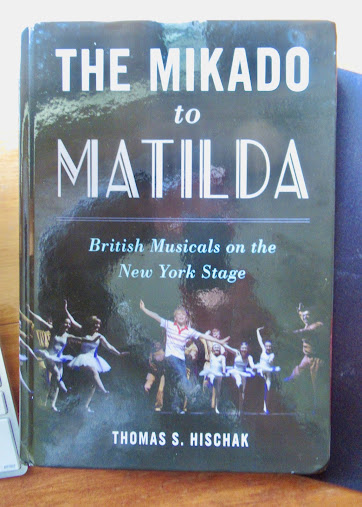
Of course, I suppose it's always likely to be the best and most established writers who are willing to be the most generous. It is certainly the case here. Tom Hischak donned the mantle of the wonderful Gerry Bordman at OUP when Gerry's theatre and musical-theatre books needed updating and he has carried on from there as one of the American theatre's principal chroniclers ...

So, I'm all the more blushingly proud of his dedication.

Maybe we'll even meet one day!

And now, back to checking the edited typescript of my own next volume. I'll get into MIK-MAT with cocktails this evening ..


Sunday, October 4, 2020

Mrs Operetta: the story of Alice Barth


I have a tidy supply of home-made nineteenth-century musical theatre biographies, the ones that didn't go into Victorian Vocalists, bursting the seams of my Dropbox. Tales of singers who shone on the international operatic stage and tales of lads and lassies who sang only in provincial concerts. The whole spectrum. Well, one end of the rainbow without the other is not much good when you are looking at the whole world of Victorian music, is it.

More and more often, these days, I find myself dipping into Dropbox, and pulling out a plum or two, whether as a contribution to a book, a journal, a website, or even someone asking 'my great-grandmother was a singer, do you know anything about her?'. Often, I do, and it is great fun to be able to help out with a wee (or not so wee) biog. 


This month I've been particularly plum-pullish. My Marion Burton zhooshed off to Theatre Heritage Australia to follow my Blanche Reives, Henry Wharton, Clara Merivale et al into the next issue of their on-line magazine, and today I got a request for ... Alice Barth! So, off she flew, and I thought well, while she's sitting on the desktop, why not share her with the world? So here is the tale of Alice ... a durable and effective Victorian vocalist


BARTH, Alice [Mary] (b 7 Eversholt Street, St Pancras 25 August 1848; d 35 Delancey St, St Pancras 18 July 1910)

Alice Barth was born in London, in 1848, the youngest of the surviving daughters of a gentleman by the name of George Harman Barth (b Hatton Garden, 27 January 1807; d 8 Cambridge Villas, Hammersmith, 9 September 1869) and his wife, Sarah Jane née Wheeler (1812-1870). Mr Barth was something of a curiosity. He had started life as a perfumer but, in the 1851 census, from a home in Mornington Crescent, he lists himself as being a ‘mesmerist’ and, sure enough, the occupants of his home include two youngish ladies of independent means who are his ‘patients’. Hmmm. But Mr Barth progressed from mesmerism into the treatment of maladies by the use of undefined ‘gases’, and in 1854 he patented ‘improvements in an apparatus for administering and supplying and purifying gases or vapours for medicinal and other purposes’. He described himself now as an ‘operative chymist and lecturer’.

Mr Barth’s two youngest daughters, Kate and Alice, both studied singing under Lucy Fosbroke RAM, and it was under her aegis that they made there first appearances as concert singers: I spot them 28 January 1869 singing in the concert given by Mr Hoyte (organist of All Saints, Margaret Street) at Myddelton Hall, in the company of their teacher, and, again, at Miss Fosbroke’s own concert of 24 May where Alice gave Ganz’s ‘Since Yesterday’ and joined her elder sister in the duet ‘The Fan’, alongside Susanna Cole, Fanny Poole and the like. ‘They were rewarded with an amount of applause that must have been very encouraging to them’. However, the sister act was not to be. The following year Kate married Mr John Finch, an upholsterer, of Flora Villas, Chelsea, and retired to a very brief married life ended, seemingly, in 1872, by childbirth.

Alice lost her teacher as well, when poor Miss Fosbroke also died, at the age of just 34, in December of 1870. Which may explain why, when obituary time came eventually around, Alice Barth’s singing teachers were listed as Randegger, Thorpe Pede and Sidney Naylor. Well, Randegger perhaps, but Miss Fosbroke had laid the basics. It does seem – and I am only guessing here, but the coincidence would not be great – that Alice Barth may have owed her first engagement – the one which would set her off on nearly forty years of a career as a vocalist – to her father and her brother-in-law and their colleagues. The brother-in-law in question was William Henry Walenn (1828-1896), another ‘chymist’ and inventor, with a penchant for electricity, which led him to invent and patent a range of articles from an electric aid for rheumatic cures to a system for automatic electric gates. He had married Alice’s sister, Skene Charlotte Barth (b Wolverhampton 1837; d Bryanston Mansions 2 February, 1927), in 1854, and would produce, in addition to the inventions, something like 14 children, of whom a number made themselves a prominent position in the musical world.

Both Barth and Walenn would surely have had connections with the celebrated Royal Polytechnic Institution, London’s most popular outlet for inventive physical and chemical ideas and demonstrations, which had flurished since 1848, under the direction of the charismatic John Henry Pepper (1821-1900), the inventor of the ghost illusion named ‘Pepper’s Ghost’ and the populariser of the spectacular scientific lecture.

At Whitsun 1871 (29 May), Mr Pepper opened a less inventive spectacle than usual, a piece entitled A Trip to the West Highlands of Ireland, teamed with a new presentation of the songs of Henry Russell ‘with scenic optical and dioramic illustrations’, produced under the aegis of the famous songwriter himself. The popular tenor Joe Plumpton sang the Russell songs, and for the Irish part of the programme, it was Alice who provided Irish ballads. ‘Miss Alice Barth made her debut yesterday and both she and Mr Pepper must have been highly gratified at the reception which she met with. Her voice combines great purity with considerable compass and volume and evinces careful cultivation and good taste; and the audience testified its appreciation by a double encore’ (Daily News), ‘Several Irish songs were sung by Miss Alice Barth in a manner which elicited loud and well-deserved applause’ (Morning Post), ‘a voice of good quality and considerable compass’ (The Era).


Alice became an immediate favourite at the Polytechnic, and she would remain there, both with Pepper and with George Buckland, for more than 18 months, through frequent changes of programme, giving patriotic songs to accompany Pepper’s The British Army and its Stations (The Battle of Dorking), ballads in The Story of the Shadowless Man, singing ‘songs and duets ancient and modern’ with Florence Hunter in the ‘pictorial and anecdotical entertainment’ Old and New London, Buckland’s versions of Undine and The Sleeping Beauty (singing Reichardt’s ‘The Image of the Rose’), J L King’s lecture on Jerusalem as it was and is (where she slipped in Gounod’s ‘Ave Maria’) and the illusion show The Three Roses, or the Invisible Prince in a New Light. Perhaps her most outstanding success came, however, during the illness of the Prince Consort, when each evening Miss Barth – widely advertised – stepped forward to give ‘God Bless the Prince of Wales’ with ‘an electric effect on the audience’.


In between times, Alice also took part in some of the city’s popular concerts, singing alongside such patented artists as Rudersdorff, Liebhart, Edith Wynne, Vernon Rigby and the Pateys, and duetting with Helen D’Alton, as well as visiting spots ranging from Windsor to sing with the Windsor and Eton Choral Society to Margate’s Hall by the Sea during the summer season.


Alice Barth would return, over the years, on many occasions, to the Polytechnic but, in the first days of 1873, she found her career moving decidedly onwards and upwards. She was engaged to take over (4 January) the role of Morgiana in the Gaiety Theatre’s matinees of the burlesque Ali Baba à la mode. Her singing went down a treat, but the press mused ‘[she is] graceful and refined if not perhaps sufficiently piquant for this class of performance’. On 17 February, Alice entered the evening bill, playing Donna Elvira in Don Giovanni in Venice, to Nellie Farren’s Leporello. ‘[She] sang creditably and with more experience of the stage will be an acquisition to the company’ came the reaction, but Alice Barth did not persevere (or was not persevered with) at the Gaiety. On 8 May, she opened at the Crystal Palace, again playing Donna Elvira, but not, this time, in burlesque, but in Mozart’s opera, alongside Blanche Cole, Ida Gilliess, F H Celli and Henri Corri. During the Crystal Palace opera season she went on to sing in Satanella, behind Miss Cole, and as Adalgisa to the Norma of Miss Gilliess.


She sang at Rivière’s Covent Garden proms, at Margate again, she sang at the Freemason’s Hall in popular concerts of The Creation and Rossini’s Petite Messe Solennelle, and in September she was engaged as co-prima donna, with the young Gertrude Ashton, at a brand new theatre, the Alexandra in Camden Town, where Mr Thorpe Pede had been installed in virtual command.

I have written an article about Mr Thorpe Pede or Peed. Enough said. He is quoted (by himself) as being the singing teacher of both the Misses Ashton and Barth. Miss Ashton (daughter of a fine singing techer) objected firmly in print to the description. Anyhow, Alice left the Gaiety and the Crystal Palace, Covent Garden and the Freemason’s Hall to go to Camden Town, and there she appeared in Pede’s The Magic Pearl and In the Clouds, played Georgette in ‘Twas I, and principal boy in the Pede panto of Mother Redcap until 'his' money ran out and her engagement ended.


During 1874, she appeared again at the Crystal Palace where, in September, she was responsible for the production of a double bill of Offenbach operettas – Howling Wind (Vent du Soir) and Le Rouge et le noir, but on 8 October she retired from the stage to marriage to a Birmingham engineer by the name of Frederick William Usher.

It was, however, to be but a brief retirement. After the birth of her son, Frank, at the beginning of 1876, ‘Madame Barth’ returned to the Polytechnic (the operetta Courtship Under Difficulties with Buckland), to the concert platform at the Westminster Aquarium, the Freemason’s Hall, to St James’s Hall where she gave ‘Love’s Young Dream’ and ‘Young May Moon’ on St Patrick’s Night, to Rivière’s proms (‘The Harp that Once’), to the Brighton Aquarium – another venue which would become a staple down the years – and, in August 1877, to the Crystal Palace and its opera company. There she repeated her Donna Elvira, sang in Guy Mannering and as Adina in L’Elisir d’amore and, on 13 September, took part in the first English-language performance of Mozart’s little L’Impresario, adapted into English by W Grist as The Manager. Alice was ‘much applauded for her brilliant rendering of the solo assigned to the high soprano, and in the scene where the young prima donna reveals her jealousy of the other artiste she was sprightly and amusing’ (Era). In the autumn, she went out of town with the Crystal Palace Company, in December she returned to town singing Il Matrimonio segreto with them, and then she moved on to a loftier venue. She was hired as one of the young artists who were to feature in an English-language opera season at no less a venue than Her Majesty’s Theatre. During this operatic season, she appeared as Anne Chute to the Lily of Killarney of Mathilde Bauermeister, and took over suddenly – without rehearsal – the role of Arline in The Bohemian Girl, when the neophyte Carina Clelland took ill.

It may have seemed, at this moment, that Alice Barth would go on to a good, if not significant, career in English opera, but in the event – for some reason – she chose, for the meanwhile, to go a different way. Between appearances at Brighton, Blackpool, Margate, Windsor and other such venues, in April 1879, Alice Barth sent out a small tour of drawing room operettas: Virginia Gabriel’s Widows Bewitched and Offenbach’s Forty Winks (Une nuit blanche). The experience was obviously a satisfying one, for over the years to come ‘Alice Barth’s Operetta Company’ would become a familiar feature of the southern circuits, with regular London appearances at the Crystal Palace or the Alexandra Palace. The popular Widows Bewitched would remain the staple of her repertoire, but The Sleeping Queen (featuring Alice alongside Lucy Franklein, Richard Temple and Gerard Coventry), the Garden Scene from Faust, with Aynsley Cook as Mephistopheles and Henry Walsham as Faust, Massé’s Les Noces de Jeannette anglicised as Haste to the Wedding, and The Rose of Auvergne all made appearances in her repertoire in 1880.


The operetta company, however, did not tour the whole year round, and Alice took time out to take turns with both Traverner’s and Walsham’s small-scale touring opera companies, to sing at the Covent Garden and Hengler’s proms, an Elijah at Lancaster (1880), and in November 1881 (5 November), in spite of a putative ban on HMS Pinafore being sung in Britain for three years, to sing Josephine at the Alexandra Palace. But, always, she returned to her own little company, and to the drawing room operetta. On 29 August 1881 she joined Buckland again to play a new musical sketch, Cross Purposes, and, when the Polytechnic was announced as closing, it was her company and Widows Bewitched which was brought in to play the closing performances. Their success was such, that, on Xmas Eve, the old place re-opened, and Alice Barth’s Ballad Opera Company was again the attraction.

Soon, they were on the road again – Alice, Kate Leipold, Falkner Leigh and Eric Lewis – producing a new piece, A Storm in a Teacup, at Brighton (18 February 1882) and, such was Alice’s reputation now as a drawing room performer, that when Alfred Reed and Corney Grain made one more attempt to keep ‘Mr and Mrs German Reed’s Entertainment’ afloat at St George’s Hall, it was Alice Barth whom they called in to play Arabella Upshott in The Head of the Poll, alongside Fanny Holland and North Home. A Storm in a Teacup and Widows Bewitched were supplemented by Quid pro Quo, The Chalet, Dr Miracle, A Fair Encounter, The Loan of a Lover and, on occasion, a truncated Trovatore, as the Barth company made its way around Britain in 1882 and into 1883, adding a version of George Fox’s The Captain of the Guard. And then Alice put the company’s shutters up for a while and went off to the Sheffield Theatre Royal, to play and sing ‘Mirth, a good fairy’ in the pantomime, Beauty and the Beast.


Miss Alice Barth clearly had no fixed ideas about genre. She simply played what she wanted to play, and made a success wherever she went, and the year of 1884 is a fine example of this. After panto at Sheffield, she visited London for the Royal Aquarium proms, she sang Wilhelmina in The Waterman in a London Benefit, and then resuscitated her company for the production of a new operetta, This House to Let (Brighton, June 1884). Then, in September, she went back on the road -- as co-prima donna, alongside Blanche Cole, of J S Tanner’s sizeable English Opera Company. She sang Susanna to Miss Cole’s Countess Almaviva, she sang Maritana and sometimes Arline, and, when the company put on The Crown Diamonds, she was Diana to Blanche Cole’s Catarina. Her singing and her ‘piquancy and grace’ were everywhere remarked on, and her acting was very often singled out for special mention.

She carried on through a second tour with the opera company (now managed by Sidney Leslie), and, when it paused, she brought back her own repertoire and, with Joseph Pierpoint, tenor, Michael Dwyer, baritone, Louisa Lyle and Richard Cummings, re-opened at Leamington 9 May 1885 for another operetta tour. The Nabob’s Pickle, Ganymede and Galatea, The Waterman and The Noble Savage strengthened the best of the old repertoire through a goodly tour until (with a small parenthesis for a flop musical The Pet of Newmarket at the Holborn Theatre) she moved on to Worcester to play the pantomime Dick Whittington, and then picked up her place in the newest version of the Leslie opera company. And now she was singing Amina in La Sonnambula.


1887 saw the Alice Barth company again on the road, with Gounod’s La Colomba (The Pet Dove) and Don Pasquale the newest items in the repertoire, but disaster struck in Preston with the death of the company’s principal tenor and Alice’s right-hand man, Joseph Pierpoint. The tour closed down, and soon after Alice joined the forces of Arthur Rousbey’s rising English opera company. Now, she was less seen in such roles as Arline, Maritana and Susanna: when The Marriage of Figaro was staged, Alice Barth sang the Countess, when Il Trovatore was done she now took on the role of Leonora, and if some were heard to whisper that the voice was perhaps not quite hefty enough for those roles, the management of the Carl Rosa was not one. Alice Barth was engaged to appear with this best-known of English opera companies as Mozart’s Countess at the Theatre Royal, Manchester.


But, again, from Rousbey and Rosa, Miss Barth wandered off to lesser things: engagements as prima donna in Edwin Leahy and Calder O’Beirne’s short lived small-dates troupe, and then with the outfit headed by the lady who called herself ‘Ilma Norina’, but it didn’t seem to harm her prospects. In November 1889 when the Norina company and the Carl Rosa collided in Glasgow, Alice Barth was playing, not with the small company, but appearing as Donna Anna to the Zerlina of Zélie de Lussan and the Elvira of Georgina Burns in Don Giovanni with the grander one! And a month later it was the pantomime, Beauty and the Beast at Oldham.


During the 1890s, Alice Barth continued her multi-layered career. She sang in concerts in the East End of London, visited Aston Lower Ground in Birmingham regularly to sing with a military band, she visited the Crystal Palace, and took trips out of town to sing prima donna roles with amateurs ... and between all that, she fulfilled a stint with Valentine Smith’s opera company as prima donna (1890), went on the road for a long tour with the Burns and Crotty company singing one of the sisters in Georgina Burns’ star-vehicle Cinderella, and took guest turns with the Carl Rosa as Donna Anna, the Countess Almaviva, Janet Raistrick in Jeannie Deans and the Marchioness in The Daughter of the Regiment, before returning to Rousbey to play the juvenile lead, Marie, in the same opera. And there was still time to pop off to the Tyne Theatre, Newcastle, to play the Baroness in yet another version of Cinderella.

And then, in 1895, Alice Barth’s career took one more and definitive turning. The rise of the so-called ‘musical comedy’ during the 1890s, had seen the touring circuits flooded with examples of the ‘new genre’. Now the combined singing and acting talents of Alice Barth found a fine playground for their expression as she went on the road playing the role of Mrs Honeycombe in the very long tour of the hit musical The Gay Parisienne (1895). Her success was such that she was soon hired to play a similar role in London, and in 1897 she succeeded Kate Talby, at Terry’s Theatre, as Lady Hawser in what would be another exceptionally long running piece, The French Maid. Alice Barth had become a classic ‘komische Alte’, a comedy singing character lady. Over the years that followed, she was seen in Big Claus and Little Claus, Her Royal Highness, Skipped by the Light of the Moon (1899, Mrs Dingle), Little Hans Andersen and, most particularly, in repeated seasons of the seasonal Alice in Wonderland in which she played the dual role of the Duchess and the Red Queen. In 1907 (2 March) she took the role of Lady Heldon in the Seymour Hicks production of My Darling at the Hicks Theatre.


During these years, however, Alice Barth did not neglect the kind of music in which she had made her success. In 1897, she took on the management of a season of operatic concerts at the new Wembley Park pleasure garden, and, from 1900, for six consecutive seasons produced and directed the musical recitals at the Victoria Hall, Waterloo Road.

My Darling and the seasonal production of Alice in Wonderland of 1907-8 marked the end of Alice Barth’s career as a performer, and she died two years later.

Her husband, Usher, had died in 1889, and it was said that she had subsequently married the actor and vocalist known as F(rank William) Campbell Bishop, some years her junior. However, they must have popped over the border to tie the knot, for I can find no record of this. And Alice died as the widow Usher.

I have no idea what became of Alice’s son, Frank Usher, but music certainly stayed afloat in the Barth family, well into the twentieth century, thanks to the work of sister Charlotte’s children. Dorothea (1875-1948) violin teacher at the RAM, Arthur Julius Walenn (1861-1937), baritone vocalist and RAM professor; Gerald Harman Walenn (1871-1942) violinist and teacher, latterly in Australia; and Herbert Gregor Walenn (1870-1953), the celebrated ’cello player and professor, all made careers in music, but the most memorable theatrical contribution was made by son Charles Rovy Walenn (b Islington 2 July 1867; d Hendon 30 May 1948), a leading player with the Savoy Theatre/D’Oyly Carte Gilbert and Sullivan companies for decades, through nearly half a century on the West End stage.

And elder son, James Farquharson Walenn (b Jan 1860; d 10 Feb 1884) organist and composer, died at a young age, while Frederick Dudley Walenn (d London 10 April 1933) became a painter and Principal of the St John’s Wood School of Art.



Saturday, October 3, 2020

Redecorating Kurt ...


Well, I've pretty much done with the clearing out. No takers for some items, not even for ready money, so they've gone back into less folders and less drawers, where I imagine they will moulder until Wendy and Paul inherit them, and then maybe some more ... There seem to be, sadly, these days, no or few institutions interested in preserving the history of the heyday of the live theatre ...

I wonder where, for example, these thirty-four 1850s and 1860s London theatre-bills will find a home. In a decorator's stock, perhaps.


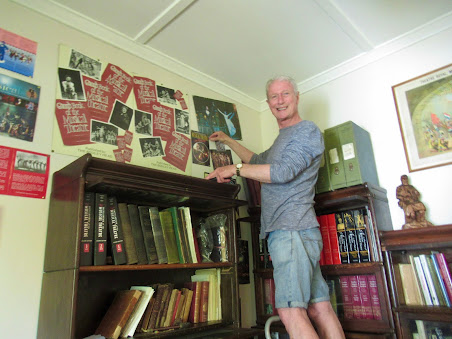
Maybe I should just say, bother the history, and take them out of their protective packaging and pin them on my walls as decoration.

I am prompted to that animadversion by the fact that, having disposed of most of my 'stuff', I am giving my office a make-over. Well, I spend 80% of my waking hours here, so ... Previously, the house pictorial arrangements have been fairly aligned. Derain, van Dongen, Sainthill in the dining room;


Procktor, Hiero and .. well, I know it's rotten to mix paintings and photos, but my favourite photo of Ian, in the living room. 


Bedroom: aboriginal art, Conrad Martens, Russell Drysdale, a great Norman Rubington, two of Nana's Austrian paintings and, above the bed, my newest purchase, a beautiful Carol Moffat.


Dressing room: a whole wall of paintings, from G Sutherland to Nicky Counsell. Even the loos are decorated. But with C19th theatre posters and bills. And my office?


Until this month, its walls were the home for my favourite horsey pix. Seppl, Elena, Fritzy, Cliffy, Davey Crockett ... well, amongst them, they won me over fifty races. But those horsey days are gone, alas, thanks to the jiggery-pokery in New Zealand harness racing. So, I thought, it was time for a change in decor. The skiting on my 'skite-wall' needed to be about yours truly (and brother), rather than his pets ...


Being rather physically inept at the moment, I called for aid from an artistic pal of half-a-century who can still climb ladders


Damme, Bryan Aitken, fifty years ago *I* was slimmer than you .... and you can still climb a ladder and wield a hammer ...

A bottle of bubbly and some delicious Wendy-canapés got us through the exercise. No, it's not finished... think of all those books coming up next year! But, looking up at my wall-in-progress, I can see how the world, notably the publishing world, has changed. The lavish publicity printing of Macmillan, Basil Blackwell, and, especially, the wonderful Bodley Head is no more. Publishers shove your book on the Internet, put hunking excerpts on the ghastly google.books, and think that's enough.

Ah well, I lived the end of the good days ... and I'm still here ... still writing ... still publishing ... but I see that most of the printing on my under-construction 'skite wall' is from the twentieth century rather than the twenty-first. Oh, well, end of a wonderful era?


Chuckle. Anyone want to know what is on those shelves? Well, you can see my books, of course. Also Richard Norton's indispensable American Musical Theatre. The Kutsch & Riemann which is sadly outdated. A complete set of the British Who's Who in the Theatre/Green Book ... and off to the right, some of my friends' books, plus little favourites ... but who needs Collins Dictionary nowadays? Who needs Brewer or even Larousse? Do I really need Kobbé? Or three Hungarian dictionaries? I think Rotary is in for another haul next year, from the new-look Gänzlorium ...

Watch this space!


Friday, October 2, 2020

The Ages of an Author ...


 Forty years on ... looking back on my life in the profession that chose me ...


Upper left: The 1980s ... the seventh floor attic at Fielding House, Mayfair, opposite the Shah's London mansion and Cecil Beaton's flat, where, when things literary became seriously professional, I installed my tiny writer's eyrie. The draughty windows looked out over the rooftops of London, a row of ancient mews stables, and -- six floors down -- a chattering restaurant ... they also blew in a bout of Bell's Palsy.

Here, I began to collect the vast amount of material (hidden, off right) which was to become the British Musical Theatre Collection, and here I wrote the whole of the two volumes of The British Musical Theatre. On that little typewriter. I loved those Warners curtains. They later became cushions before they died of old age. I see my desk held its once pristine, now battered copy of Florian Bruyas, a postcard of Billee Taylor, a photo of my father on skis .. I see I had hair, a tiny waistline ...

Then, three stages of the 1990s. My shelf-lined study at the back of Les Arabanes, St Paul de Vence. Away from the stunning view of the perched village at the front of the house. Progress from Amstrad to Apple, arrival of Microfilm machine, vast enlargement of the source material shelves which latterly spilled over into the hallway, then the living room ...  here was written the bulk of The Encyclopaedia of the Musical Theatre. I remember the dreadful day when the floppy disc containing the whole of Letter "M" crashed. And the even more dreadful day when dear Ian had his first little stroke ...  It was time to go back to base. And there was no way those rows and rows and shelves and shelves and boxes, gathered from all round the world, could go too. I sold the whole huge collection, and our home, and we set out for Australasia. 'Home'.

The early 2000s were spent in our new home in Canterbury, NZ, where preoccupations other than writing took over. Well, writing for publication, anyway. But in between my times as a nurse and a horse farmer, I managed to complete my vast biography of Emily Soldene, and the less vast ones of Lydia Thompson and Willie B Gill. Then, after Ian's death in 2006, I set out to travel the world. I'd had my time as an author, hadn't I? I'd said all I had to say about the musical theatre, hadn't I? I was 'old hat'. Gone the days when the BBC called on me when they needed an 'expert', when Radio NZ promoted me in a 26-part series, when I got my photo in Woman's Weekly as a pin-up boy. Anyway, the world of publishing had sadly changed since the 1980s ... and the Internet? What was that ...?


The 2010s: It is probably because of the Internet that I have had a second coming. A boy has to do something when he's not travelling or reviewing or gallivanting or gourmandising. The Internet was rather like having a portable library, so I could spend my time dipping and delving into the past wherever I was, without my dear, (largely) departed library. My cosy 'Winter Palace' at the Cove, Yamba, New South Wales (above) doesn't have a book in sight: yet, I I can write just as I did in the '80s. 

My 'Summer Palace', on the farm at Gerolstein, New Zealand, is not totally bookless. I will never give up my complete Meilhac and Halévy, my complete Planché extravaganzas, my Gore Vidals, my Hungarian Theatre Encyclopaedia ... but that is largely because they are old, memory-filled friends. And they look nice around the walls of my seriously shrunken study where, nowadays, a bit incapacitated, I spend most of my days. Sans teeth, sans hair, sans waist-line, sans much hearing, but thankfully not sans wits. Forty years on from that photo in the Hill Street attic ...


And the result of the work (and play) of all those years?


No, it's not quite all mine, I'm the bottom two shelves. Shelf three is brother, John Gallas, on the left, late husband, Ian Bevan, on the right, plus father's wee mountaineering manuals, and a couple of the many books published by the great-uncles Rosenbaum in Vienna, something like a century ago.

One slight problem. John's prolificity and my renaissance mean that in the next 12-18 months there will be half a shelf's-worth of new books to fit in ... ah, well, I'll face that situation when I get to it!


Thursday, October 1, 2020

Ten Saints in a plastic folder


With the new book finished and delivered, I'm according myself a little 'time off', which inevitably means a bit of springcleaning ... I'm doing well. Caseloads of 'stuff' have walked out the doors recently, heading to all sorts of parts of the world ... and I'm getting down to what seem to be the last folders ... one of which contains these ...


They are engravings, the work of the well-known Parisian graveur Jean Chièze, and they seem to date from 1941-4: part of the series of Les Saints-Patrons des corporations. I guess Ian bought them when he was in France, being a war-correspondent. Alas, I see that there are supposed to be twelve in the set, and unless two are stuck together, I have ten, plus a duplicate of Saint Bernard-de-Menthon, the patron saint of mountain climbers ... oh, perhaps they are from my father's alpinistic family!


I have Saints Yves, Laurent, Nicolas (jolly sailor boys), Bernard de Menthon, Fiacre, Georges, Éloi, Jean de Porte Latine, Cécile and Honoré. So that means I'm missing Sainte Catherine, patron saint of needlewomen, Saint Hubert, patron saint of hunters and ... oh! there are obivously more than twelve .. Saints Crépin and Crépinien, patrons saints of shoemakers, Saints Come and Damien, patron sainst of doctors, Saint Vincent, patron saint of wine-makers...

I see that the whole thing was published by Aubanel in 1942 in black and white, and has been reprinted since. Black and white!


But the magical thing about these engravings is their miraculous, brilliant colours. Mine are fresh as a newborn buttercup: I would guess they have been in this same folio ... an impulse purchase in the rue Faubourg Saint-Honoré eighty years ago ... since they came from the press. They really ought to come out ... imagine all ten, en bloc, featured on the wall of a chic French restaurant ...

And now I suppose I ought to find out just how many go to make up the set ... before I put them back in the folio ... oh! there is a series of Patron-Saints of Métiers as well? Wait a moment. A Danish antiquarian lists them ...

Jean Chièze - Les saints patrons de Metiers des France. Douze images graées par Jean Chièze. Collection dirigée par Renée Moutard-Uldry. Originalkartonmappe mit einer Textseite und zwölf Holzschnitten, welche die Heiligen (französischen) Berufsgruppen darstellen. Sehr schöne und farbfrische Exemplare. Nummeriert, hier Exemplar 66 von 450 Exemplaren. Zustand: Die Mappe mit Gebrauchsspuren und lichtrandig, die Blätter gut erhalten und sehr farbfrisch - guter Zustand.

Edition originale. Tirée à 450 exemplaires sur Ingres des papeteries d'Arches. Les planches gravées représentent Saint Nicolas (marins, enfants et marchands de vin), Saint Yves (avocats), Saint Vincent (vignerons), Saint Come et Saint Damien (médecins, chirurgiens et pharmaciens), Saint Fiacre (jardiniers, horticulteurs et fleuristes), Saint Crépin et Saint Crépinien (cordonniers), Saint Eloi (orfèvres), Saint Hubert (chasseurs et forestiers), Sainte Catherine (couturières), Saint Honoré (boulangers), Saint Bernard de Menthon (alpinistes) et Saint Jean Porte Latine (imprimeurs).

On dear, thats 9 of my ten, but I have Sainte Cécile instead of Sainte-Catherine. Maybe it was a sort of supermarket mix-and-match thing. You picked the ten Saints you wanted? I got music, and gold, a double helping of mountains and even sailor-boys but oh ... I missed out on wine!  And I seem to have missed out on being numerotéd as well.

Well, back in the box boys. The web says you're worth about 35-75 euros apiece. I really think for that you ought to get out and show your colours to the world ...