Saturday, January 26, 2019

FIFTEEN GIANETTAS


.
The earlier Gilbert and Sullivan operas-bouffes underwent some strange (re-)casting during their original runs. Some of it worked magnificently, some is an enduring puzzlement.

Liverpudlian-Australian ‘Alice May’, entirely efficient, created the part of Aline (The Sorcerer) at least partly because she and her paramour, conductor ‘Grievous Bodily’ Allen, were investors in the production. So far, so good. Alice was replaced by her understudy, London-Jewish ‘Giulia Warwick’ (Julia Ehrenberg), again perfectly competent. The management followed up the Australian piste, so fruitfully mined by John Russell at Covent Garden, by casting Tasmanian Emma Howson as Josephine (HMS Pinafore), and following her contract’s end, gave a turn to very pretty little Alice Burville, a sometime burlesque actress, to touring prime donne Eleanor Loveday and to ‘Duglas Gordon’ (Ellen Louise Thomas) both proven on the circuits, Fanny Holland, star of the German Reed establishment, and, in a first, but far from the last, dip into the American scene, the pretty and pretty disastrous Blanche Roosevelt. Jewish opera singer Helene Crosmond (Hannah Levy) was to have created Mabel in The Pirates of Penzance, but in the end it was Jewish music-hall soprano ‘Marion Hood’ (Sarah Isaacs) who made a grand success in the role, depped for by student Ellen Shirley, and by another very capable lady, ‘Emilie Petrelli’ (Emily Mary Jane Peters). 

Fanny Holland


When Miss Petrelli turned down the ‘soubrette’ role of Patience, stability finally hit the prima donna spot at the Savoy with the arrival of yet another Jewish soprano, ‘Leonora Braham’ (Leonora Abraham). Miss Braham would become the copybook Savoy leading lady.

But all good things must come to an end, and during the run of Ruddigore, Miss Braham put an end to her long stint at the Savoy. She was replaced by … an American. Geraldine Ulmar was, however, a totally different bouquet of bluebells to Ms Roosevelt.


She had been well and truly tried in the Savoy roles in America, and she was thoroughly capable. Miss Ulmar played Elsie in The Yeomen of the Guard through its run, and introduced the role of Gianetta in The Gondoliers. When she was not, or no longer there, the chaos began. Fourteen other sopranos would follow her, for shorter, very shorter and slightly longer periods as lead soprano of the show. Why? I have no idea. Four were Americans, one was Australian; thirteen were heard of (a little or, in some cases, a great deal), thereafter, and fourteen I have been able to discover at least a little about. Of one (or maybe two) I know nothing. So, how about a little list.


1) Carrie Donald [DONALD, Caroline Kerracher Rodger] (b Edinburgh 9 February 1870; d North Berwick April 1930) A choir singer at St Giles Cathedral, Edinburgh, she had played Gianetta on tour and was more than capable. She went on to play for Carte in Ivanhoe, La Basoche and The Vicar of Bray, before retiring to marriage as Mrs Thomas Lamb.

2) Alice Baldwin. Miss Baldwin, if that were her name, played the role just a handful of times then disappeared. Chorister? Understudy? Friend of the management? Amateur paying her way? I have no idea.
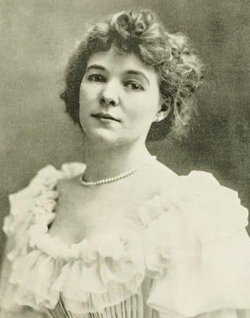

3) Mina Cleary [CLEARY, Wilhelmina] (b Allumette Island, Quebec 17 August 1862; d Brookline, Mass 27 June 1929). Miss Cleary was an established performer. Daughter of an Irish hotelkeeper, Martin C Cleary, and his wife Maria Coghlan, she had played supporting roles with the Boston Ideal Opera Company between 1885-8. Her sister married the company’s bass, Eugene Cowles. She subsequently went to Paris to study and, ‘on the way home’, played some performances at the Savoy. The experience was not continued with, and Miss Cleary returned to America and the Bostonians before marrying physician John Masury and retiring.


4) Nita Carritte [CARRITTE, Lillian Henriette Temple] (b New Brunswick c1864; d New York 1 August 1929). Daughter of a doctor, Dr Thomas W Carritte of Amherst NB, and his Swiss wife Susanna Louisa Givaudin, Nita was brought up in St Paul and studied, after her father's death, with Anna La Grange in Paris. From there she (‘Nita Carita’) was hired for Augustus Harris’s 1890 Covent Garden season. Maybethology says she played Micaela. However, although that underliked role went through several tenants during the season – Minnie Evans, Margaret McIntyre, Mdlle Colombati, Regina Pinkert --, Nita did not go on. Mind you, neither did Harris’s other new hiring, Mdlle Tetrazzini. However, Nita did get to play Micaela, to friendly notices, when it was produced by the Carl Rosa in October 1890. Her publicity also says she played Faust and Mignon, but the notices credit, first, Georgina Burns and then Amy Sherwin. 5 January 1891 she succeeded to the Savoy, and played Gianetta till 21 March, when the show was advertising ‘last weeks’. Four years later, she revisited to the Rosa for some performances as Carmen, but, on her return to America, appeared only in the flop musical 1999, and in repertoire at Castle Square, before marrying musician, Frederick Emil Gramm (28 December 1899) and retiring.


5) Maud Holland [HOLLAND, Alice Maud] (b Girlington, Bradford 24 February 1867). Did she or didn’t she? During August 1890, while Carrie Donald was in possession of the role of Gianetta, Maud Holland, daughter of a couple of elementary schooteachers from Bath and Wales, and an established West End soprano, was billed for a few nights in the part. A pupil of the Royal Academy of Music, Maud had made her debut as a teenager, as cover to another ex-student, Miss Etherington (‘Marie Tempest’) in The Red Hussar, and went on to play lead roles in The Rose and the Ring, in Maid Marian (Robin Hood), in an English version of François les bas-bleus, on tour as Charlotte in La Cigale and Teresa in The Mountebanks, before creating the principal girl’s role in Little Christopher Columbus. She later succeeded May Yohe in the star part, and appeared as Alésia in La Poupée, before fleeing across the Atlantic, following her divorce from the actor known as ‘Lytton Grey’ (Charles Ford Morgan). Mr Morgan’s lightning remarriage makes it look as if there were a little collaboration between the ex-spouses. Maud did not make a notable career in America (I see her, only, advertising cough lollies). Her second daughter, as Alice Maude Morgan Grey, married into the aristocracy as Lady Alvingham.


6) Nellie Lawrence [LAWRENCE, Nellie Louise] (b Brighton 1868; d Sussex 4 November 1912) seems to have been another ephemeral Gianetta. She is a little bit tricky to follow, as there were two other contemporary ladies of the same name in action, one playing dramatic leads in the provinces with Andrew Melville and another dancing in the chorus of musical comedies such as The Silver Slipper. Our Nellie was born in Brighton 1868 where she was brought up, with her sister, by their widowed mother. Her venture into the musical theatre was brief, but she seems to have been a useful Cartesian, stepping in for those in larger parts than hers in The Pirates of Penzance, The Yeomen of the Guard, The Gondoliers (Fiammetta) and The Nautch Girl (Cheetah), before once again going back to ‘living on her own means’.


7) Esther Palliser [WALTERS, Emma F] (b Germantown, Penn 28 July 1868) was easily the most talented of D’Oyly Carte’s American prime donne. The fact was not slow to be recognised, and, apart from her engagements with him, she did not appear in the musical theatre again, restricting her operations to opera, oratorio and concerts, largely in England, before her return to America, and her retirement, as a singing teacher in California.
Miss Palliser, daughter of music teacher B Frank Walters (1840-1918) and his wife Kate Fronfield, first appeared on stage in America, as Gianetta in The Gondoliers which role she repeated as her debut in England 9 December 1890. She appeared for Carte in Ivanhoe and in La Basoche in 1891, before moving on to Covent Garden and Drury Lane to sing Carmen, Faust, Cavalleria Rusticana, Lohengrin et al. In 1893 she sang Brangaene at Covent Garden, and created C V Stanford’s Mass in G with the Bach Choir.
Miss Palliser moved to California in the mid-1910s, and taught music for a while, before vanishing from public view. Last sighting 1923. However, her birthdate is not quite so well hidden as that of her death. She was not born in 1872 as always claimed, for she can be seen in the 1870 census of Philadelphia, aged 2 or 3, living with her parents, aunt, and maternal grandparents.

(8) Louise Pemberton [PEMBERTON, Louisa] (b Chelsea 1868) Miss Pemberton played four performances at the Savoy in September 1890. Was it an ‘audition’, a ‘tryout’? Who was she? She appears to have been a greengrocer’s daughter from Chelsea who taught piano. Unless she changed her name thereafter, it seems to have been her only venture on the stage.

Norah Phyllis


(9) Norah Phyllis apparently did change her name [aka MA[C]GUIRE, Norah]. Only I’m not quite sure from what. She was ‘Norah Phyllis’ when she came on the scene in 1887-8 at All Saints’ Rooms Kensington (‘Poor Wand’ring One’) and St Colomb’s Church Notting Hill, under the aegis of teacher George Ernest Lake, and 20 March 1889 she made a ‘debut’ in concert at the Crystal Palace. In 1889 she joined the Carte company on tour, playing Elsie Maynard, and 16 December she was hurried on at the Savoy to dep for Geraldine Ulmar as Gianetta. Mr & Mrs Carte took her to America some weeks later to bolster their Gondoliers company (‘she is capable of playing any role’) and she ended up playing Casilda to the Gianetta of Miss Palliser. When the ‘American company’ returned to England, she again played Casilda to the Gianetta of America’s Lenore Snyder, before taking over as Gianetta at the Savoy. In December 1890 she sang at St George’s Chapel, in 1 July 1891 with Richard Temple’s Crystal Palace company in The Mock Doctor, and at the German Reed Entertainment in The Old Bureau, after which she apparently got married. Her husband was a doctor, stationed in Bombay, and thence she travelled. However, in 1899 she returned to England, the stage, and Carte and appeared, under the name of Norah MacGuire (or Maguire), as Lazuli in The Lucky Star et al in the country. She followed up as Nadine in the unfortunate The Prince of Borneo, as Lauretta in L’Amour mouillé for Tom Davis, sang Blush-of-the-Morning in The Rose of Persia on the road and as a replacement for Agnes Fraser at the Savoy, and my final sighting of her is as prima donna of several Carte repertoire companies, ending in 1905. In 1909, she can be seen playing Josephine with the Lichfield amateurs ...

All I know of her vital stats is that her birthday was celebrated on 3 September ...


(10) Emily Squire [SQUIRE, Emily Jane] (b Ross on Wye 2 May 1867; d 3 Bourne Court, Bournemouth 1 September 1948). I was most surprised to find the name of Emily Squire listed as having played Gianetta for a couple of weeks in June 1890. Miss Squire (or Mrs Edward William Jennings, as she became about that time) had a long and fine career, but certainly not as a musical theatre player: oratorio, concerts and the great provincial music festivals would be her natural habitat for some two decades. Emily was the eldest daughter of the musical family of Cornish bank clerk (later manager) John Squire and his wife Emma née Fisher. She studied at the RCM, and later at the RAM (Parepa Rosa Scholarship, Sainton Dolby Prize, Llewellyn Thomas Gold Medal), appeared in concert in Cardiff, Bath, Exeter, and in London at the Crystal Palace Saturday Concerts and the Handel Festival, supporting Nordica in Israel in Egypt. In 1889 she sang the quartets in Elijah behind Nordica and behind Albani, performed The May Queen and The Woman of Samaria in a Devonshire Festival, The Prodigal Son and The Last Judgment at Hadleigh, Parry’s Judith at Exeter, where the programme included her brother, Willie, the cellist and songwriter W H Squire. She made a first professional acting appearance at Ascot as a hurried replacement in the operetta Tobacco Jars.
In 1890, I spot her in concert in Swansea, Glasgow, Leicester, Hereford, and as Ursula in The Golden Legend at Newport, and then came the news: Miss Squire had been offered the role of Gianetta. But she was turning it down. A fortnight later she appeared at the Savoy. She played a dozen or so performances, then zipped back to Swansea to get married (18 September 1890). After which she returned to the concert platform – Grieg’s Olav Trygvason, The Fall of Babylon, another Prodigal Son, four engagements at the Three Choirs Festival – where she led a fine career over the next twenty years.


11) Cissie Saumarez [BARTRAM or BARTRUM, Mary Jane] (b 9 Barton Street, Bath 1870; d London 23 July 1930) was born in Bath, the second daughter of cabinet-maker Edwin Bartrum and his wife Mary Jane née Summers. She studied in London with an unknown Signor, and went on the stage in 1890, covering and taking over the role of the little bride in Dorothy. She moved to the Savoy, where she appears to have been a general swing, playing, at some time, every one of the principal contadine. She played Suttee in The Nautch Girl, but by March 1892 she was on the road featuring in the title-role of one of the interminable Dorothy tours. A selection of mostly unimpressive touring musicals (Wapping Old Stairs, Sport, The American Belle, The Transit of Venus) and pantomime princesses was relieved by a stint as Mrs Ralli Carr in Gentleman Joe, and a Diana Vernon in a Durward Lely Rob Roy, before she found a niche as singing lady (and sometimes man) in Shakespearian productions and became a longtime adjunct of F R Benson’s troupe. She later played in comedy under her married name, her husband, Mr Arthur [Herbert] Whitby (1869-1922), being an acting member of the Shakespeare company.


(12) Amy Sherwin [SHERWIN, Frances Amy Lillias] (b Judbury, Tasmania 23 March 1855; d Bromley 20 September 1935). Quite why Amy Sherwin played a week as Gianetta, I cannot imagine. She was at least a decade older than the other Gianettae and thoroughly established as a concert and operatic singer in places from her native Australia – she sang in Namaan in Tasmania, in the shadow of her elder sister, in 1872, and May 1878 made her operatic debut as Norina with a visiting opera troupe -- to America (La Traviata with Strakosh, H M S Pinafore, Damrosch’s Oratorio Society of New York, Brooklyn Philharmonic Society, Damnation of Faust, Cincinnati Festival), to Italy, to – in 1883 – Britain. She was engaged by Carl Rosa, for whom she first appeared as Maritana (7 May). In the seven years that followed she led a highly successful career in Europe and the colonies … only to come to rest at the Savoy, aged 34, for this incomprehensible week of Gianetta. Amy continued to work as a vocalist into her fifties, before retiring to teaching. She had married the agent Hugo [Heinrich Ludwig] Görlitz (1854-1935), in New Zealand in 1878, and had by him a son, journalist [Hugo] Louis (1881-1978), and a daughter, Jeannette (Mrs Jolley, 1884-1936).


(13) Annie Schuberth [SCHUBERTH, Annie Elizabeth Sophia] (b Pimlico 1869), daughter of a Russian-born accountant, was not a novice when she played her little turn in The Gondoliers in July 1890. And she wasn’t Miss Schuberth, either. She had made her first stage appearance in a musical comedy The Beautiful Duchess at Templar Saxe’s concert in 1887, and in 1889 (19 June) she married the said gentleman, and bore him a son (I’m not sure in which order). After some concert experience, she then went on tour in the title-roles of the French musicals Pepita and Falka, and then joined Saxe (who was understudy to the leading lady) in the London cast of the Carl Rosa company’s Paul Jones, taking over the role created by Kate Cutler. And then she made her short stop-over at the Savoy. 
She went on to play Charlotte in La Cigale alongside Geraldine Ulmar, in Miss Decima, toured some more in the star roles of Pepita, Falka and La Cigale, played Marion in Poor Jonathan, Lolika in The Magic Opal … and got herself divorced by Saxe (Templer Edward Edeveian) for persistent adultery. They both remarried: Saxe whisked off to America where he became a cinema actor, while Annie wed (3 December 1895) an ageing Bradford lawyer and, after playing a while in Willie Edouin’s Qwong Hi, let her theatre career fizzle out while she had two more sons. However she re-emerged, in 1906, to play in the Manchester panto, and in 1910 and 1912, giving ‘I Dreamt I dwelt in Marble halls’ in the northern music halls. Husband Charles Law Atkinson died in 1916, and Annie, apparently, changed her name, not to Atkinson, but to 'Annie Hubert'…


Lenore Snyder

(14) Lenore Snyder [SNYDER, Leonore] (b ?Indianapolis c1868; d Camden, London July 1911). Miss Snyder was raised, and doubtless born, in Indiana, the daughter of Frederick W Snyder (machinist) and his wife, Virginia née Ballenger (m 27 March 1867). The three can be seen in 1880 living at Brightwood, Indiana. She apparently sang, first, in the local Presbyterian church, and I see her performing with the Indianapolis Lyra Society in 1887. As an amateur, she took part in a local ‘opera’ called Maganon, and appeared as Mabel in The Pirates of Penzance, which led to a first professional engagement in 1889. She appeared for the Duff company in the title-role of Paola (played in Britain by Leonora Braham) and in the Chicago musical King Cole II, before being hired to deputise for Esther Palliser as Gianetta in New York’s Gondoliers. She subsequently sang the role on tour in Britain and, briefly, at the Savoy. In August 1890, she returned to America where she played in The Pirates of Penzance, The Red Hussar, Carmen, Dorothy, Iolanthe et al, before being recalled to Britain in place of Australia's Nellie Stewart, to create the lead role in The Nautch Girl and the revised Vicar of Bray. Back in America, she joined Harry Dixey for an attempt to float Mr Dobbs of New York, and there was more Patience, Iolanthe, The Sorcerer, The Mikado … The press judged her ‘irreproachably correct … and tame’. It was advertised that she was to go to Paris to study, it was reported that she had married American basso, William H MacLaughlin, and that she had returned to the stage in Dorothy Morton’s role in The Wizard of the Nile. But that seems to have been it. A professional career of impeccable credits, but seemingly less éclat. But there was a reason for its ending. Lenore retreated to Paris, and, in 1897, was reported to be seriously ill. Mrs Lenore [W] MacLaughlin died of tuberculosis and was interred at Camden cemetery 15 July 1911.


Well, that is the who. As to the why? We will never know. The Savoy would flounder its way through the unimpressive likes of Ellen Beach Yaw and Nancy McIntosh, and the novelty casting of Hungarian star Ilka Pálmay and noted opera singer Pauline Joran, to the stabler days of a Ruth Vincent, but never again would it devour fifteen prime donne – genuine and wannabe – in one leading role. Why did it happen? And who the hell was Alice Baldwin?


Thanks to David Stone and the g&s archive for most of the photos herein. Anybody got a Maud Holland?

PS Yes! George Low came up with a Maud photo, and also a replacement slip announcing Agnes Wyatt as Gianetta. He has also seen a programme with Decima Moore listed as Gianetta. Typo or fact? And who, then, played Casilda. Which would make 17 Gianettae. Except that he is dubious about Nellie Lawrence ...


Sunday, January 20, 2019

Och aye! I'm the Queen of the May!

.
While I was sipping my ginger tea this morning, prefatory to getting out into the garden on a lovely, summery day, I had cause to look up my notes on Jimmy Rae of the Soldene company. Which led to a dip into Olive Rae of the D'Oyly Carte company, which led to ... the discoveries were not tonitruant, but here, in any case, are the results for those who love Cartesian minutiae.

Fast backward to the original production of Merrie England. Those who have seen the show or (like me) been in it, will remember the little role of the May Queen. The personification of village beauty and a spare soprano. The role was played, during the run of the piece at the Savoy by two successive vocalists, Miss Joan Keddie from Dundee and Miss Olive Rae from Edinburgh. I don't think the Scottish nationalism of the part was intentional, but it remains a fact that merrie England's May Queen was a Scot.

The first of the two ladies was Miss Keddie:

KEDDIE, Joanna [Paterson] (b Dundee 1878; d Glasgow 12 August 1921). At her death, the local paper acclaimed her as 'one of the finest sopranos Dundee has ever produced'. Joan was one of the children of Robert Keddie 'of Dundee and Calcutta', manager of the Samnuggar Jute Factory, and his wife Agnes Mitchell Paterson, and she began he working life as a pupil teacher at a local school. She also began singing as a teenager, and after some time as a member of the St Mary's Church choir, under S C Hirst, was quickly promoted to soprano soloist with the Newport (Dundee) Choral Society. I see her singing in Smieton's Ariadne and in Theodora as early as 1898. In October 1900 she is still in Dundee, singing at the Kinnaird Hall with J W Turner and Constance Bellamy, then with Durward Lely and Marie Titiens, but at census time April 1901 she is in Sculcoates, playing 'a bridesmaid' in Musgrove's Belle of New York company and covering Margaret Douglas in the title-role. The local press had already announced her as hired for the tour of Florodora, and as being engaged at the Savoy Theatre or alternatively in the Carte touring company. I see her as 'a peasant girl' in the tour of The Emerald Isle. In 1902, Joan was hired for William Greet's production of Merrie England. Quite why she moved on I am not sure, but shortly afterwards (10 January 1903) she married a member of the Belle and Carte companies, American baritone George Daniel Whitehead. It does not appear to have been a durable marriage. Whitehead returned to America, thence to Australia, where he ended his days. Seemingly with a different wife.


Her name does not appear on the London bills again, but she apparently covered Evie Greene as The Duchess of Dantzig (although Kitty Gordon and Elizabeth Firth succeeded the star), played Signorina Tasso in The Cingalee, and went on tour with The Talk of the Town before putting an end to a professional stage career and returning to Scotland, where she acted, henceforth, with the Dundee Comedy Club and sang with the local musical societies. In 1914, she appeared in Oh! Oh!! Delphine!!! for Eade Montefiore, but seems to have 'retired' definitively following a second marriage to James Taylor and the birth of a daughter.


If the career of Miss Keddie was brief, that of Olive Rae was even briefer:

RAE, Olive [Margaret Milne] (b Madras, India c1878; d Wimbledon 3 August 1933) was another product of the Scotsman in India tribe, but not of the jute mills. Her parents were the Reverend George Milne Rae DD of Madras and his wife Janet née Gibb. Her first public appearances were in Oxford, her first in London was at the Salle Erard (27 February 1900) in a recital of her own ('fresh, clear soprano .. much taste .. great distinctness'). She appeared at the Steinway Hall and the Derby Temperance Hall with Sydney Poyser, with the Bath Orpheus Glee Society and in several other provincial venues before venturing on to the stage in Merrie England at the Savoy and on tour.


She went on to appear as Titania in The Princess of Kensington, Lady Violet in The Earl and the Girl and The Princess Whom He Married in Little Hans Anderson before returning to the concert platform (St Andrew's 1909) and life as a vicar's daughter. Unless she was the Olive Rae who played Doris Bartle in Peggy (1911) at the Gaiety Theatre ...

At some stage she married and became Mrs Captain George Bertram Pollock-Hodsoll. Widowed in the war (Flanders, 9 November 1914), she was married a second time, in 1918, to a widowed tea planter, William Alexander Steen.

She died in 1933 calling herself Mrs Milne Rae.

The tradition of a Scottish May Queen was not continued with. In 1951 the part was played by one Gladys Cooper and at Sadler's Wells by Ava June.


Monday, January 14, 2019

Bradford, 1857, or names on an operatic playbill


.
Yesterday, as I continued with The Big Tidy Up, I came upon this playbill. Well, most of it. As you can see, the banner is missing. But never mind, I know what it is. It is a bill from a season of opera presented at the Theatre Royal, Bradford in June 1857 by Henri Corri.


*Henri Augustus Corri was to go on to be a force in English opera, and also a staunch purveyor of good quality touring operatic companies, but this was an early effort and didn’t turn out quite so well. Corri had been playing at Drury Lane in the episodic English opera seasons staged there by Edward Tyrrell Smith – Devilshoof in The Bohemian Girl, Don Jose in Maritana, and the like. In between stints in London, the company was sent on the road with, again, the standard repertoire, as the ‘Drury Lane Opera Company’, featuring, from time to time, such artists as Elliot Galer, Fanny Reeves, Julia Harland, John Herberte, Oliver Summers and other hardies of the touring circuits. But on 7 April 1856, when the ‘Drury Lane’ company opened its new tour at Bradford, there was a difference: it was ‘under the management of Mr Henri Corri [and Mr Herberte]’. Much of the troupe was made up of members of the Corri family … Henri, brother *Eugene (b London, 23 October 1826; d London, 4 February 1870), sister Emma Jane (‘Emilie Adami’) (b Dublin x 27 December 1832) and her husband, Frederick Younge (b Barron Street 19 February 1825; d Brockley-Whins 6 December 1870) ... but the Corri family didn’t at this stage have a prima donna in its ranks, so the useful *Rosalia Lanza (b Grafton Street, Fitzroy Square, London 22 July 1818; d Islington, London May 1905) took the soprano leads, with *Herberte [GADSDEN, John Burnett] (b 273 Oxford Street, London, x 19 December 1819; d Somerset Street, Portland Square 12 September 1857) as first tenor.

This unpretentious group gave its Bohemian Girls and Maritanas, and such virtually three-handed pieces as La Sonnambula, L’Elisir d’Amore and The Daughter of the Regiment through the year, and then set out on a new round, again from Bradford. As per our playbill. With a new prima donna and a new tenor, much the same repertoire and … disaster. Henri had ‘forgotten’ to pay the royalties on his ‘cheap’ operas. He had ‘forgotten’ to pay May’s for the hire of the costumes. And I dare say he had forgotten to pay a few other bills as well, not to mention such tawdry things as wages. By December, he was declared bankrupt. But less than a year later he was a valuable member of the Pyne and Harrison company, and this little hiccough was all forgotten, as he soared up into the heights of the English operatic world.

I was about to put this playbill back in its drawer, when I had the whim to find out just who were the folk who made up this rather slim-line company with, I imagine, it’s bootstrap budget …

No problem with the ‘stars’. *Henry Manley (b St Martin’s in the Fields, London c 1819; d 27 Castle Rd., Holy Trinity, London 2 February 1891), who replaced ‘Herberte’ as lead tenor was a proven touring opera tenor who ran for a number of years a company of his own round number two dates, often with his brother *John Manley, who was a long-lived operatic comprimario. Marian Taylor [TAYLOR, Elizabeth Sophia] (b Cleaveland Street, Marylebone 24 February 1826; d Hammersmith 24 April 1886) was not exactly an operatic prima donna. Burlesque and musical comedy were more her style. But she was an attractive and vivacious performer who was game to attempt Norma and Leonora in Il Trovatore at least adequately. She was also, it was said, a pain in the pants. When Corri went bankrupt, she took over the management of the company and ran it through the festive season. For her reward, she found herself a lover amongst the company. They were both married … but that’s another convoluted story. She had a long and occasionally acrimonious career on both sides of the Atlantic, largely in burlesque, ultimately without a husband.

Brother Eugene was principal bass, seconded by another faithful comprimario, *Robert Morrow (b Preston, c 1822; d Malvern, 6 October 1867), brother in-law Fred Younge, an actor-who-sang-a-bit, was still there to play mostly-acting roles … and that leaves ‘Madame Villiers’, ‘Madame Roby’, ‘Mrs Montague’, ‘Miss Montague’, and the chorus players Messrs Beale, Belford and Henri.

Hmmm. ‘Villiers’? ‘Montague’? Sound very much like stage names, yes? Well, I uncovered the ladies and … one was, and the other wasn’t!

So let’s go with Madame Villiers:

SCHOTT, Rosa Antoinette [‘Madame Villiers’] (b Toronto, c 1834; d Glenart Tor Park, Torquay 20 October 1918)

Miss Schott made a promising start to a career, which marriage, motherhood and family concerns pushed in a rather disappointing direction.

Rosa Schott was a member of the well-known German family of musicians and publishers. Her father, Adam Joseph Schott (b Mainz 1794; d Poona 4 August 1864) occupied various places in the family business, but was latterly employed as a military bandmaster in various corners of the world. His wife, Teresa Rosa Ziegler was from Malta, and his children were born in America, Canada and Gibraltar before the Schotts came to rest in London, where father became bandmaster of the Grenadier Guards, sometime musical director of the Highbury Barn Tavern et al.

Rosa seems to have begun her career as a member of the company at the Surrey Theatre in mid-1854 where I see her singing Lisa in La Sonnambula and Pastorella in The Golden Branch. From there she moved to the Haymarket Theatre where I spot her, in plays and in musical roles, as Marian in Paul Pry, in The White Horse of the Peppers, The Nervous Man, The New Haymarket Spring Meeting, Love’s Martyrdom, A Daughter to Marry and then as Julia Mannering in Guy Mannering, Brightray in the pantomime The Butterfly’s Ball, The Postman’s Knock, et al.

At the same time, she appeared at the Crystal Palace (‘‘The Rose’ with her usual taste’) with the Cole sisters, and in oratorio at St Martin’s Hall (Reinthaler’s Jephtha and his Daughter with Clara Novello, Ann Banks, Bessie Palmer, Montem Smith, Lewis Thomas) … Miss Schott, it seemed, could do anything.

But then came the man. On 31 January 1856, Rosa married Mr Robert Edwin Villiers (b Somerset St 18 April 1830; d 8f Bickenhall Mansions, Gloucester Place 29 April 1904), a supporting member of the Haymarket troupe, and after a tour as seconda donna with Henri Corri’s doomed opera troupe, retired to produce Marie Therese (b 21 March 1857), Laura Fanny (5 May 1858), Edwin Adam (25 May 1859) and eventually Isaac (b 8 April 1863).

But Mr Villiers wasn’t content to be a supporting actor all his life. In 1860, he took on, initially in partnership with one Mr James F Tindall, the lease of the South London Music Hall and, on 22 December, the venue opened, with Mr Frank Raynor of Weston’s topbilled amongst the singers, and Mrs Villiers in small print. Also in the small print was her younger sister, Helena Cecilia. This was not a good idea. Helena was to turn out to be the poison in the pastry. But the South London Music Hall was a good idea, and Edwin Villiers a much better manager than he had been an actor. And Mrs Villiers was swiftly ‘the principal singer’ of his house singing everything from ballads (‘The Green trees whispered’, ‘When Maggie gangs awa’’) to a Rigoletto selection with Mr Raynor. Helena didn’t stay too long. Apparently lacking her sister’s vocal talents, she went off to become a well-regarded dramatic actress, who sang a bit, under the name of Helena Ernstone.

Helena Ernstone

Subsequently, Villiers introduced ‘comic duologues’ into his programme, and he and Rosa performed these with some success. Rosa even returned to the Haymarket briefly, to play Nelly in No Song, No Supper to much applause. But she did not take up again fully the career her marriage had interrupted.

In 1869, the South London was destroyed by fire, and Villiers moved on to running the Royal Hotel and Assembly Rooms in Margate. Through the 1870s, Mrs Villiers featured on some of the bills, took an annual Benefit, and her elder daughter, Marie also appeared as a vocalist.

But the tale was not destined to have a cosy ending. In 1877, Villiers, who had also taken over the famous Canterbury Hall, went bankrupt to the enormous tune of 60,000 pounds. But worse was to come. Little sister Helena had been weaving her nets, and had begun an affair with Villiers. Finally, in 1880, Rosa sued for divorce. In the 1881 census, Villiers and Helena (‘sister-in-law’) are living together in Marylebone.

That seems to have been the end of the London careers of both the sisters. Not so, Mr Villiers, who made himself respectable all over again, went on to launch the London Pavilion, and maintained a position at the top of the music-hall business to the end of the century.

Rosa lived much of her subsequent life with her widowed daughter, Laura, and Marie’s son Edward Angus Hill-Mitchelson. Marie (‘Miss Marie North’) was on the road with her actor-producer husband Edward Alfred [Hill] Mitchelson. Marie died in 1912, and her mother in 1918. Mr Hill-Mitchelson remarried and, keeping up the family trend, divorced two years later when his wife accused him of adultery with ‘at least two (female) members of the troupe)’. Helena, who had somehow amassed a nice wee nest egg, never married and died alone at The Chalet, New Road, Ferndown 2 July 1933.

Rosa’s son, Adam, was for a while (prior to divorce) married to the musical comedy and music-hall performer Emma Broughton, sister to the more famous Phyllis Broughton.

Emma Broughton


One down.

ROBY, Rosa Maria (née SOANE) (b Margate 5 July 1819; d Hackney November 1880) doesn’t appear much, that I can see, after this engagement, and the 1861 census shows us why. She is the wife of Henry Greatorex Roby ‘comedian and artist’, whom she married in 1855, and the mother of Ada M (4), Bernard Henry (3), Charles Montague (2), Louisa Agnes (4 months) … 28 June 1862 came Beatrice ...

Rosa was the daughter of the well-known playwright, librettist and adapter George Soane and his wife Agnes. She described herself in the census as ‘actress’, and it was her sister, Clara Agnes (1817-1898) who was the vocalist, appearing in 1848 at the famous London Wednesday concerts alongside Sims Reeves, *Miss Poole, the *Williamses and *Mrs Alexander Newton. I see what I assume is Rosa playing with Macready at the Manchester Theatre Royal in 1849, but in 1852, when she appeared as Ophelia at Leicester she was criticised for her ‘almost gigantic figure and stiff action’. Exeter, however, found her ‘an accomplished actress’. I notice that she played the part of Julia Mannering bereft of its usual music. Odd.

Two down.

MONTAGUE

‘Mrs Montague’. I got myself in deep here. For, no, it is not a veritable name, although some of the sort-of family historians, and even other theatrical writers would have us believe so. I got in deep, because there is more than one ‘Mrs Montague’, all actresses, related the one to the other, and all in some way connected with the Corri family! I started off chasing one Mrs M, then gradually came to realise that it was surely her sister-in-law I was after. Or not. And the story goes like this.

On 20 December 1814 a coach-joiner by the name of Daniel Gainey (1794-1869), from Kingston, married an apparently very young London lass by the name of Emmeline Maria Hetling (d 1865), and they settled at 10 Little Farmer Street, Tower Hamlets. Around about 1821, they, and their first child, moved to Aston, Warwickshire, and at the same time Daniel stopped joining coaches and he and his wife took to the stage. Daniel called himself ‘Henry Montague’ and his wife was ‘Emmeline Montague’. They had, by my count, five children in the 1820s, four of whom survived, all of whom went on the stage. Three of those eventually got wed into three of the most extensive theatrical families in Britain, so the ‘Montagues’ remain a footnote to the history of the Corris, the Cowells and most fashionably of all, the ‘Comptons’. They also used the same Christian names – Emmeline, Susan, Agnes, Henry – in all branches, called themselves Montague whether they were(ish) or not, and generally made it hard for me to sort them all out …

Since I was looking for ‘Mrs Montague’ (otherwise Gainey), I naturally went looking for the wife of the one surviving brother of the flock, William Stuart Frazier Gainey or Montague. And there she was. Actress. William married Sophia Leathley Cowell, niece of W H Murray of the Theatre Royal, Edinburgh, sister to the comedian Sam Cowell, in Cork 5 May 1845. They had two sons, both of whom died in Lambeth, in 1851, while William was working at the Surrey Theatre. After which, Sophia disappears, and William is apparently shacked up with Miss Alicia Woulds, sister of Mary Jane Woulds of the Bath Theatre, now the wife of the third Corri brother, Patrick. William would eventually marry Alicia after Sophia’s death in Yarmouth in 1858. So is this my Mrs Montague of 1857? Sophia? Or, more likely, Alicia? The Corri connection made it seem possible. But then I found another Corri connection.

The story of Daniel’s eldest daughter, Emmeline Catherine Gainey ka Montague (b Tower Hamlets, 1 November 1820; d Hastings 31 December 1910) is oft told. She married into the Mackenzie ka Compton family, and spawned a host of theatricals. Youngest daughter Susan Caroline Biancha (b Aston, 9 September 1829) seems to have dropped her spare names, and got wed in 1851 after a little career. Middle daughter, Agnes Louisa Mason Gainey (b Aston 13 July 1827; d Ashby de la Zouch 1906) took to the stage as Agnes Montague.

I first see her at the Theatre Royal, Manchester in October 1846 cast as Donaldbain to the Macbeth of Charles Pitt. Susan is baby Macduff, and Hecate is sung by … Patrick Corri. In 1847, Agnes is featured with Charles Kean and Mrs at the Theatre Royal, Dublin, in 1849 I spot her at Harrogate, in 1850 at Greenock and in 1851 playing Lady Anne to her father’s Richard III in Clitheroe. Back in Manchester, I see her in Timour the Tartar with a ‘Miss Montague’ who may be Susan, at Bury she is ‘sister of Emmeline’ and ‘of William’ and father is the stage manager (‘late of Bath’) of the local theatre. In 1854 she is at Derby and in 1855 Northampton and at Preston where she is now … Mrs Rupert Corri! But she then vanishes. So is it she who is ‘Mrs Montague’? In 1870 she is again ‘Agnes Montague’, with her husband at Rochdale …

And Miss S Montague, who can be spotted playing with the Bath amateurs in 1851? Is that Susan? The family lived long in Bath -- father actually became known as ‘Bath’ Montague -- where they seemingly traversed a few vicissitudes. In 1832 ‘The poor light comedian of Bath (Montague) for whose benefit Miss Jarman, Warde and Meadows performed gratutitously netted upwards of 200L which sum was immediately applied to the relief of the poor invalid and his necessitous family’. But in later days, when the family was aureoled with the exploits of the Comptons, granddad was referred to as ‘the great comedian’.

The extensions of the ‘Montague’ family are legion. I’ve explored most of them, and there are a few that do not fit. Not counting what appear to be the premarital child/children of William and Alicia. I have a spare Emmeline, a spare Henry Montague Gainey and family … but, never mind, the point of this exercise was to identify ‘Mrs Montague’ of the Corri company and the accompanying ‘Miss Montague’. Sophia? Alicia? Agnes? I think I will rule out Sophia as being unlikely to be involved with her husband’s mistress’s family company. Alicia? Well, Alicia was a harpist. But from there to playing the dramatic role of Meg Merrilees made famous by Charlotte Cushman … On the other hand, Agnes, the ‘tragedienne’, recently married into the Corri family …

Well, I put it to you, and I leaves it to you. But I think I favour Agnes.

And that just leaves Mr Beale, Mr Belford and Mr Henri. Mr Henri doesn’t convince me a lot. But Charles Beale was for real. At one stage, in the wake of the Corri bankruptcy, he was ephemerally listed as manager of the company. Mr Belford is evidently not the same chap of that name who played with Phelps at Sadler’s Wells, and then with Henry Marston … perhaps his brother?

I’ll put the bill back in its place now. It’s certainly provided me with a day and a half’s amusement and challenges. And it might encourage the family historians and others involved to correct the details of their fairly celebrated famil(ies) on Geni and Ancestry.com. Meanwhile, I’ll have one more go at working out who the ‘Emmeline Montague’ (b c 1852) who allegedly wed Tom Paulton (brother of the famous Harry) fits in, and where Henry Montague Gainey, husband of Mary Thornhill (married 1836) and father of Bessie Montague Gainey belongs, and which Henry it was who died 18 September 1877 …


* the artists thus marked have full-length biographies stored in my data base. I may get round to publishing them at some stage!


Wednesday, January 9, 2019

PGB goes Jungle!


.
I’m repeating myself, I know. But I don’t very often go to the theatre now. I’ve hardly seen a new show (and not many remakes of old ones) in the last couple of decades that has given me anything like the sort of joy that I used to find in ‘musicals’ (by whatever designated name) in the previous half-century. Too electrified, too amplified, too stultified, too trendy, too imitative, too camp, too second-hand …

However, when I do make the effort, I often seem to be rewarded in inverse proportion to the pretentiousness of the production.

Britain went through a period like this in the 1950s. When Roger N Hammerstein ruled the waves. And the answer came from the smaller theatres. The musical went back into those more intimate venues, where words and music could be heard without amplification: The Boy Friend, Salad Days, Valmouth etc. Well, I’ve said it all before … so I’ll jump straight to the point. These days, almost inevitably (and yes, there have been one or three exceptions), when I have a really good time at the theatre, it is in a ‘small’ show …

Charlotte Sweet

GRIMM!
On Christmas Day 2018, alone with the twinkling lights and a gin, I chortled happily away listening to the delicious little Charlotte Sweet. I wanted an opera? Cavalleria rusticana is my all-time favourite. When in Berlin, I had a joyous time at the local music school with a really lively modern, burlesque fairystory musical Grimm!, far more beautiful than Disney’s Beauty and the Beast, and back home in New Zealand I got involved in a concert version of a superb small-cast musical entitled Fairystories. Which wasn’t a burlesque and had nothing to do with Perrault or the Comtesse d’Aulnoy, but ... Well, why Fairystories hasn’t had a full-scale professional production (I’m tempted to say ‘yet’, and I’m also tempted!) I do not know but … well, listen to this

Ali Harper sings
FAIRYSTORIES

I discovered Fairystories when I discovered its writer/composer. Paul Graham Brown. I went to sit in on a meeting at a gay caff off the Nollendorf-Strasse with a Dutch producer, and a Berlin entrepreneur who were planning a musical of Deep Throat. Well, it is no worse an idea than 75% of the musical 'adaptations' served up in the last 40 years. PGB was to be composer. Of course, it didn’t happen, but I got to know PGB and to listen to his produced (and a few unproduced) musicals. Notably a three-handed version of King Kong which is now into its eighteenth European production. I sat in on the auditions for his new piece Dynamite, and thought: why is this man’s stuff not produced outside central Europe? I voyaged into the German countryside to see a production of his many-years-before-Wildhorn Bonnie and Clyde. I voyaged to a place called Biedenkopf to see a musical written especially for the town’s festival and played on the ramparts of the local Schloss.


I still hum the secretively saucy song ‘Underneath’!. There have been annual new PGB pieces there, while he also had new, large-stage musicals played in Wiesbaden, in Hof … and our little show took place in Christchurch, NZ.


I read Fairystories for the first time, alone in a little beer garden in the Isle of Wight. I didn’t even notice my shandy was finished. At the big moment of the last scene I was horrified to find I was shivering and what … had a huge lump in my throat. If I were ever going to go into production … well, I didn’t, but our little showcase (featuring NZ’s top musical star) was a huge success with those folk … enough!


Needless to say, having discovered that rara avis, an outstanding young(ish) lyricist-composer (and even dramatist!), I wasn’t about to let go. So PGB and I have, since, become firm friends, and the little cottage at Gerolstein has, for the last few years, become the (Kurt) Gänzl and (Wendy) Williams Retreat for Productive Composers. Courtesy of Richard Marrett and his spare keyboard.


So, at midnight of the New Year 2019, Wendy ferried PGB from Christchurch airport to Gerolstein …

Yes, he’s here now. But after a day’s work at the keyboard, he’s down at the beach, so I can write this freely. I do NOT puff performers and writers who are friends. If I don’t like something they write, I tell them so and write nothing. This one, I'm writing about.

This year, CEO/librettist Birgit Simmler was headhunted from Biedenkopf to somewhere called Luisenburg. No, I don’t know more than approximately where it is. But, as in other German theatres the folk there are prolific in producing new works. PGB told me, last year, he was writing a new show for them. Like, what? A version of The Jungle Book. Not ANOTHER one? I have to admit, and I told him so stoutly, that yet another Disney remake was not at all what the world needed.

I should have known him, and Birgit, better. This morning he gave me a CD. OK, in the right mood now for a bit of Kipling… Well! this is NOT Disney….!!!! Yayy!!! Not even Lion King-type Disney. Which one might have feared. OK. It’s 70 minutes (today’s best attention length!) of stage show, with nine numbers and two tutti reprises, and it’s the most enormous fun! …

Firstly, the Luisenburg cast is quite superb. And the score, into which they dive with an enthusiasm wonderful to hear, gets yeoman service. 


Karsten Kenzel’s adorable Baloo, teaching babies and audience, is a joy … and rapping apes! … and on top of that they have a kosher Ravi Srinivasan on percussion … 


But my favourite, especially as sung by Inez Timmer, a mixture of Hermione Gingold and Kathleen Ferrier, is the snake’s song … much better than the Disney one ...


Damn. This is a grand, grand show! Five star fun for all ages.

I might even start going to the theatre again if they put up shows like this one.

He's home. OK, laddie, into that cottage and starting spinning straw into gold ..


Tuesday, January 1, 2019

Bigger watch ...

.
Why does someone need so many watches?

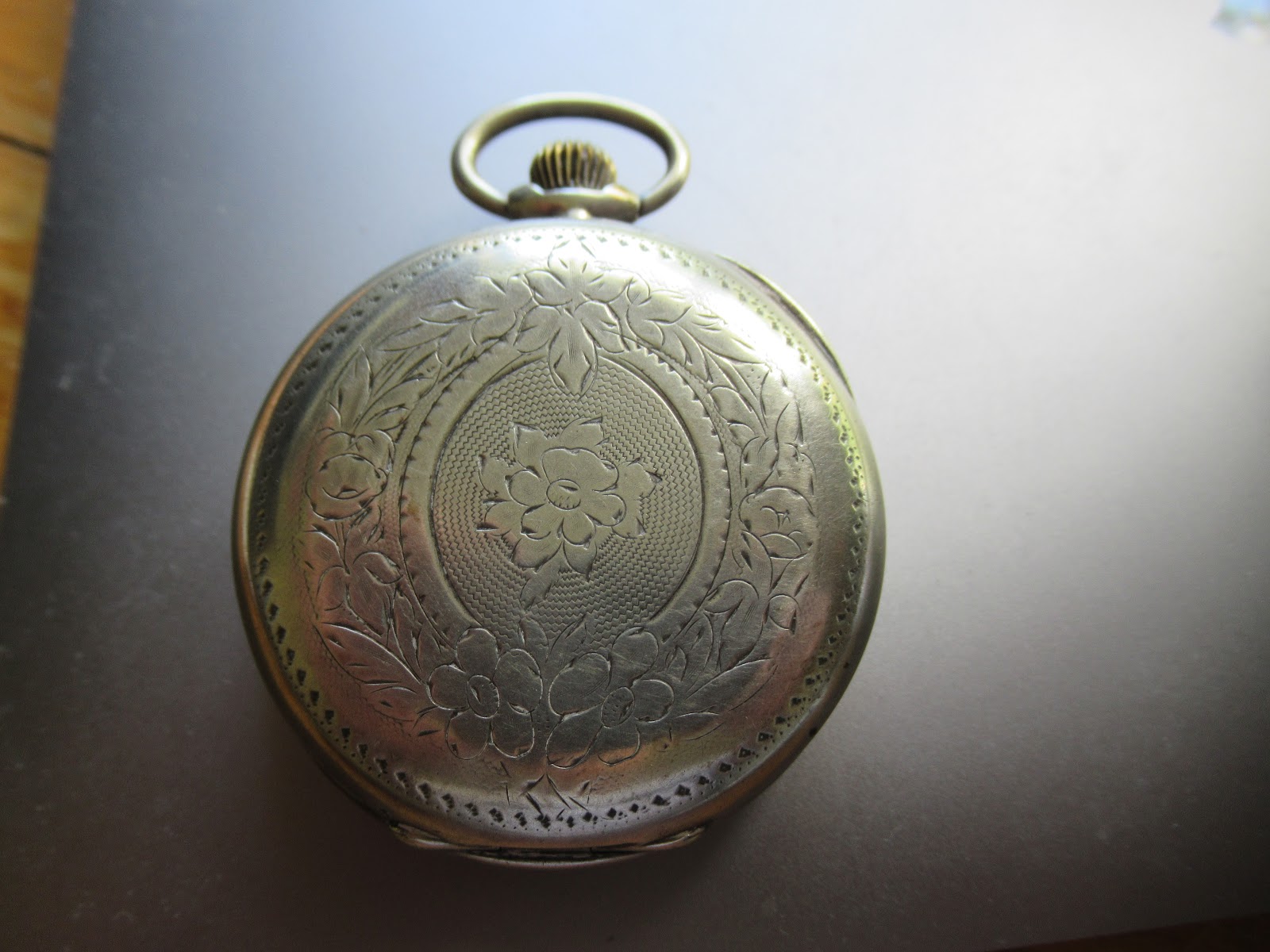
This is similar, but bigger. Nearly 2cm across. Same grey (silver?) metal. Same slightly clunky decoration, same bezel winder as Littler Watch


but the dial has, this time, a maker's name ... TERRASSE


Open the back, and there it is again: TERRASSE. 


International Exhibition Philadelphia 1876. 15 Jewels.  And those numbers again 147351.


And something else ...

a cartridge containing what looks like 0.800, and a tiny punched (assay?) mark ...

Well, I looked for Terrasse, and I found the Geneva watchmaker Mathey making very similar-looking watches, 

Mathey watch
and then I found this ..

Jacot, Gustave of Le Locle. This maker was born in 1864 and died in 1939. He was probably working prior to 1881 when he would have signed his watches in his own name. In 1881 he, with his brother, Bernard Jacot (1861-1898), set up La Terrasse, Maison, Le Locle. After Gustave died, Bernard took over running the company. In 1911, the company used the trademark Primax on their watches, parts 
and packaging. From about 1920 the company traded as Terrasse Watch Co. In 1939, after Bernards death, his wife Allice took over the company. She died in 1953. The company was still trading in 1986.

So ... if that is correct, this is a post-1920 watch. Could be. It somehow lacks the delicacy of its little brothers. But what about the Philadelphia Exhibition? 1876? Gustave was making watches aged twelve? And 'after Gustave died'? But he, so this says, survived Bernard by 40 years? But 'Jacot Frères' of Le Locle are there all right, at Philadelphia. Oh, I don't know ...

Antiques Road Show-watchers: Good, Better, Best?


Hay will be a little great this year ...

.
Hay.

It's either too hot or too cold. Either too dry or too wet. There are good years and bad years, and in the skimpy years, prices rocket. We, thus, have always attempted to grown our own. With all the hazards that involves. This year, the hazards included a month of November during which it hardly stopped raining. Our 4 acres of dedicated hay grass grew and grew ... the haymakers' diary got all his November work crammed into December, along with December's work .... and still it rained. And the grass began to (over)-ripen ...

New Year's day dawned bright and sunny, and hallelujah! mid-afternoon the haymaker rolled down our drive ... I was having my post-prandial snooze, so I missed the action ... by the time I emerged: acres of thickly mown hay!


Surely one of our most sizeable crops ever!


January 2nd: 30 degrees! A perfect hay-drying day ... now two or three more like this, then it can rain all like likes...  leaving us with only one problem ...

Will it all fit in the barn!


Postscriptum: It will. But only if we take EVERYTHING else out! Last midnight the sounds of the baler were heard, coming down the drive, and by 2am the baler-fairy had magicked the cut hay into ninety-six big, square bales. The monstrosity of that feat will be understood when I say that in seventeen years of haymaking, the most the those meadows have yielded was, I think, forty-eight! And that in the days when we had over thirty race horses. Now we have ten elderly munchers ...


And the end of the haystory ...

The apprentice haymaker carting hay


And there it is ... our all-time record crop. No hungry horsies this winter!!