Tuesday, May 6, 2025

"I walk ...."


It's something most of the world takes for granted.  Not I.

Over the past few years, the effects of my 15 year-old stroke, which I thought I had, largely, conquered, have gradually started to kick in. 

Nowadays, I have often to use a walking stick. Even two. I have refused a frame. I fall over occasionally. But not if I'm careful. I cannot bend down to pull the weeds in my garden: I topple into the greenery.

So, most of the time, when at Gerolstein, I sit at my desk and write. I rarely, even, go outside to visit the horses. And when I leave the farm it is, nowadays, always under the guidance of Wendy and her wheels. I try not to let it get me down. After all, in one's 80th year, one can't expect to have all one's faculties, and I have -- thank the Gods -- still got my mental ones.


But, right now, I am not at Gerolstein. I am in Yamba, NSW, in my little Winter Palace (2rms, k&b). And Wendy is on the other side of the ocean. I have to fend -- with more than a little help from my friends -- for myself. If I, suddenly, find I need or want something from the shops or (more likely) the pharmacy, for example ... ? Up till recently, I could just pop down the hill ... And the wonderful Wednesday weekly market ... a trip up and down the hill, and the return journey laden to the gunwales ..?

And an unkind voice whispers in my ear 'if you can't do those things, you cannot spend four or five months a year, on your own, on the top of the hill, by the seaside'. So, will my years of Yamba soon be over. Could this be, even, my last winter in my Palace?

I woke, this morning, at 5am, and made up my mind. I would try the Market trip. The worst that could happen would be that I'd end up in a bruised heap on the ground. Best-friend Robert had taken me to the supermarket on Monday to stock up on heavy things, like bottles and cans, so I would only have to carry my 'delicacies' ...

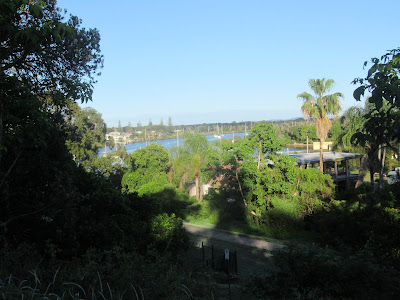
As soon as the dawn cracked open, I set out. No stick, as both hands were needed for shopping bags .. across Flinders Park (beautifully maintained by the local council) with its views out over the ocean ..


I took the slope slowly. Breathing was fine, but feet were a little unsteady on the dewy grass. And eyesight was a tad fuzzy. I fear I was inelegant; I got one or two curious glances. Past Robert's house -- where he was on a conference call to European parts -- then, downwards, to the coast and the Market. 'Down' is actually trickier than 'Up'. You feel you need crampons. But I reached my goal safely ...


Goodness, all those people! At 7am! The queue for Woody's Tomatoes was 30 metres long! I couldn't stand in line that long, so no tomatoes today!  Smoked trout and gravad lax, lamb fillets and patties, bananas (Jupiter, a bunch of bananas is heavy!), raspberries and blackberries, a big tub of excellent olives, avocados from Wendy's favourite stall ... 


A littlle chat to Pete, the orchid man ... whose stall is right by the road of return. Well, here goes! Oooh those bananas are heavy!

Up the hill. Very slowly. Five steps. Stop. Regain balance. Look at the view ..


Five more steps. Cheery hellos from other folk, heading downwards, and the odd 'are you all right?'  'Yes, I'm just a wobbly man!'. Up, up to the top of Flinders Park, and home is in sight. Downhill. A handsome young man in a nice car pulls up and offers to drive me home. A lady I've met before offers to ferry my bags home, on her bicycle ...  but I'm only 100 metres from home ...

Like a racehorse in its last furlong, I dragged myself to the Cove gate ... each step shorter than the last ...

It was an hour and a half since I had set out. But my mission was accomplished. I CAN still do it. Just. But next time, a smaller bunch of bananas!


Elisa Volpini: a star from Spain


VOLPINI, Elisa (née VILLAR Y JURADO, Elisa Margarida) (b Madrid ?20 July 1835; d unknown)


VOLPINI, Ambrogio (b Cremona c1826; d 9 Boulevard des Italiens, Paris 14 September 1871)


Two splendid artists: one, indeed, the lady, frankly famous. Much has been written about her, but facts, of the personal variety, are few to find. I have done my best.


 This little piece is really about the lady, but the gentleman, who was something like a decade older than she, had already been a well-liked leading tenor on European stages well before their marriage, so I’ll start with him.


I don’t know much about his background, just that he came from Cremona, learned his music from one Wenceslao Cattaneo, apparently in Milan, and had what appears to have been his first engagement at Carnevale 1844-5, at the Teatro della Società at Bergamo, where I spot him singing in I Lombardi (‘giovane che assai promette di sè’) and the contralto role in Mercadante’s Il Reggente. A season at Civitavecchia (May 1846) seems to have gone carrot-shaped, but he went on to Pavia for Primavera (Arvino in I Lombardi ‘ha sorpresi’), and, 1 July, he began a term at Milan’s Teatro Re, alongside another Cattaneo debutante, Angiolina Bosio, and the baritone Corsi. They began with I due Foscari (‘che già in questa parte ha colte bella palme’) and followed up with Giuseppe Devasini’s new Le due Sorelle di Corinto, in which he played the hero, Nettoleno. The young singers were greeted with a splendid reception. When he sang at Bassano (I due Foscari, Linda di Chamounix) with Guiseppina Leva, he was acclaimed as ‘il secondo Fraschini’.


He and Corsi both continued to Piacenza (‘giovine tenore che bene annunziadi sè’) and joined Annunciata Tirelli in I Due Foscari, Beatrice di Tenda, I Puritani and Giovanna d’Arco before, in March 1847, Volpini made an appearance at La Scala, creating the role of Volmiro (as a replacement for Moriani) in Carlo Boniforti’s opera Velleda alongside Eugenia Tadolini. It was a Benefit performance and the opera seems to have been played but once. However, he appeared in I due Foscari, and in Giovanna d’Arco and as Publio Ebuzio in Uranio Fontana’s I Baccanti at the Carcano, with Ersilia Ranzi, before leaving Milan, this time for Spain and Portugal.


I see him at Lisbon’s San Carlo, singing in Lucrezia Borgia, Giovanna d’Arco, Lucia di Lammermoor, I due Foscari, Attila, La fidanzata Corsa, Battista's Anna la prie and Ricci’s Gli esposti and soon the announcement appeared ‘L'Agenzia Verger e Co è esclusivamente incaricala di trattare gli affari … dal tenore Ambrogio Volpini che tanto si è distinto sui teatri di Spagna e Portogallo’. And he was re-signed for Lisbon (Eran due ed ora son tre, Lucia di Lammermoor, Macbeth, I Masnadieri, Lucrezia Borgia). The Verger family would have much to do with the Volpinis over the coming years. And so would the Iberian peninsula.


In 1849-50 I see our tenor singing I Lombardi, I due Foscari, Attila and Macduff in Verdi’s new Macbeth at Oporto, and at the Teatro San Fernando in Seville, in Cadiz (Lucia di Lammermoor, I due Foscari, Maria Padilla) and at Gibraltar; in 1851 I spot 'il bravo tenore' at Valenza (Beatrice di Tenda, Linda di Chamounix, La Favorita), in September at Alicante and in 1853-4 he’s back in Seville again, alongside the Sulzer sisters. Then Madrid with Gazzaniga, Nantier-Didiée, Prudenza, Malvezzi in Nabucco, Rigoletto, Lucrezia Borgia. In 1855-6, there he is again at Seville and Lisbon, giving Il Trovatore, Marco Visconti and Maria di Rohan, with Marietta Spezia and Mauro Assoni. And having his portait, by Greppi, lithographed. 


And somewhere in there is where Elisa Villar enters the story. Elisa had apparently been born in Madrid on a date which we are assured was 21 July 1835, to German Villar of Toledo, a music master, and his wife Maria Dolores née Jurado from Cartagena. The parentage, if not the date, are confirmed by her (second) marriage registration. The family removed early on to Seville, and settled, so an enthusiastic blogger tells us, in the Calle Betis. The teenaged Elisa apparently sang in the chorus and in small roles in the operas at the San Fernando Theatre. I see an Isabel Villar listed as comprimaria in the company there, but another biographical note assures us that this was her sister.


Anyway, in 1854, at Cadiz, Signor Volpini married Elisa Villar. Which seems odd, because, in 1860, she (‘age 28’) sailed to New York with her husband (admitting to 33), plus a 10 year-old Juan and 5 year-old Marie. But we know that Marie de la Espectacion Rosa Volpini y Villar was born in Vera Cruz 18 December 1858. So perhaps that New York document (or my eyesight) isn’t to be relied upon. In 1862, 'Ambroise' is said to be 35, and Elisa .. 21.


Anyway, it is a few years before Elisa makes an official stage debut, and, in the meanwhile, Ambrogio is going strong: further seasons at Madrid and Lisbon (Maria di Rohan, La Traviata Marco Visconti, Il Trovatore, a season at London’s Drury Lane, followed by a visit to Liverpool, Dublin and spots beyond. London was fairly impressed. He opened as Gennaro to the Lucrezia Borgia of Grisi and they nodded ‘Signor Volpini is supplying the place vacated by Mario, with a degree of success beyond expectation’. ‘To appear immediately after Mario in one of that great artist’s finest parts is a severe trial, but Signor Volpini stood it well. He is young, somewhat slight in figure, but well made and of an altogether agreeable aspect. His voice is sweet, mellow and what is called ‘sympathetic’ … his lower noted are veiled and deficient in clearness, but in the higher region of the scale there is a degree of volume and power which reminded us of Tamberlik, His intonation is irreproachable … taken altogether he is a performer of uncommon merit’. He followed up as Manrico to Grisi’s Leonora to more cheers ‘We make little doubt that this gentleman will become a great public favourite.  There is a freshness on his voice that is especially charming, sweetness and strength being happily combined with a perfect mastery over the best forms of Italian vocalism’. He also sang Edgardo to the Lucia of Madame Gassier (‘... a tragedian, who has few superiors on the musical stage’).


After London, he went to the provinces as ‘the new tenor who made so successful a debut at Drury Lane’, repeating his roles and also giving Alfredo to Mme Gassier’s La Traviata, Raoul in Les Huguenots and, in Dublin, he paired with Catherine Hayes in Lucia, Norma, La Sonnambula and Linda di Chamounix. They subsequently played a few performances at London’s Princess’s Theatre, in August 1857, before the British interlude was over.  


A little parenthesis here. Once upon a time, there was a Liverpudlian tenor named Henry Croft who, the Liverpool press claimed, was actually the Volpini of Drury Lane. He was not.


I don’t know exactly when the South American trip was set up. I don’t know precisely when they went. The tale is told that Elisa was along with them as wife and mother, and not as a member of troupe but, one night the star was ill and she went on as Tremocolada in Marco Visconti and .. etc etc. Maybe so, maybe not. The end-of-career Cortesi was prima donna, Tomassi [Sra Ardavani] was second, her husband the baritone, and a certain Sra Enrichetta Figlioli Fattori, of whom I know nothing, was also of the trip with her conducting husband.

Anyhow, they arrived in Mexico, before September of the year, and Ambrogio can be seen there singing Pollio to Adelaide Cortesi’s Norma and the Adalgisa of Elisa Tomassi in the capital and in Vera Cruz, with great success, in the final weeks of 1857. 

I have few records of their activity in South America, but it seems that Ambrogio sang all the tenor leads, at some stage (early, I suspect) a female ‘de Volpini’ was listed at the bottom of a company list, and only later Elisa Villar de Volpini was billed third behind Cortesi and Tomassi-Ardavani. The only actual sighting of her, on stage, that I have exhumed from the mass of Mexican reporting is dated 28 September 1859. That date was the premiere of local composer Cenobio Paniagua’s Marco Visconti remake as Catalina di Guisa, in which Elisa took the title-role opposite her husband. 


In 1860 and 1861, Signor Volpini produced seasons in Havana. The first featured the Heron (Natali) sisters, with Elisa billed next, the second toplined Frezzolini and Lotti, and Elisa sang La Traviata and Maria di Rohan. An American paper, summing up, as they ended their sojourn noted: ‘She is an artist much like Piccolomini and has just been engaged for three years for the Italian Theatre in Paris’. She. Not he.


The couple travelled back to Europe on the Adriatic in May, (and I notice that, since the early months of 1860, they are down to one child) and, in October 1861, Elisa made her debut at the Italiens, in the role of Lady Henrietta in Marta (29 October 1861) ‘mit bestem Erfolge’. Her colleagues were a mighty team: Alboni, Mario, delle Sedie, Zucchini. But Elisa Volpini came through splendidly: ‘Mme Volpini est ce qu'on peut appeler une jolie femme, elle a du feu, de l'intelligence, et sa voix, sans être forte, est des plus fraîches et des plus agréables à entendre’, ‘[Marta] ….. de Flotow était d'ailleurs représentée par une débutante dont la voix et la physionomie ont excité là sympathie générale’.    


Zucchini


She continued her ‘debuts’ the next season as Adalgisa to the popular Norma of Rosina Penco, and the approval continued: ‘Mme Volpini qui débutait dans le rôle d'Adalgise, dut être satisfaite de sa première épreuve, ainsi que de l'accueil qu’elle a reçcu’ ‘Elle a su se faire applaudir à outrance …  Mme Volpini nous paraît intelligente, sa méthode est excellente, elle vocalise avec charme et légèreté, et dans les passages un peu doux, sa voix est des plus sympathiques, Si Mme Volpini se montre dans d'autres rôles ce qu'elle a été dans celui d'Adalgise, nous lui prédisons un fort beau succès …’. ‘un veritable talent … Mme Volpini a fait applaudir au contraire des qualités simples et naturelles qui ne demandent qu'à grandir'.  


She visited Lille for a concert, Barcelona for a brief season with Mario (Rigoletto, Il Barbiere di Siviglia) and completed her Paris ‘debuts’ in Don Pasquale. Then, in June 1863, she made a first appearance in London, in the Italian Opera at Her Majesty’s Theatre. Still, she trod carefully. She began as Oscar in Un ballo in maschera, alongside Titiens and delle Sedie and was immediately declared a ‘valuable acquisition’. ‘Her well-trained high soprano voice is beautifully clear and brilliant and she sings with true Italian feeling and sentiment’, ‘took the honours’, ‘a young singer of great mark and likelihood ..’. But Spanish, of course!


She was scheduled to sing the Mermaid in Oberon, but in the event Rose Hersee did that, and the new little favourite’s only other role for the season was Zerlina alongside Titiens and Louise Michal.


When the company went on the road in August, Ambrogio joined them. In Dublin, in the missed-train (?) absence of Titiens, Elisa, regarded as an Oscar-Zerlina-Marta performer, made an unscheduled (?) appearance as Lucia di Lammermoor alongside none less than Sims Reeves and Santley. A ‘great success’ was recorded and Elisa’s career took a sharp upwards turn. She continued in Marta and Ballo as intended, and then came out as La Traviata to a huge reaction: ‘We question if we ever witnessed so perfect an impersonation of this character even with the recollection of Maria Piccolomini … with a voice of infinitely greater volume, tone and richness … Mme Volpini united all the dramatic force and reality of style …’


Across the channel, Paris thought they hadn’t had enough chance to see this new star: ‘Il y a un mois, à Dublin, Mme Volpini, obligée de chanter à l'improviste le rôle de Lucia, en remplacement de Mme Titiens, y obtint un tel succès que de ce jour, par toute l'Angleterre, elle est réclamé pour des concerts ou des représentations sans nombre (...) Attendrons-nous quinze ans pour réentendre Mme Volpini à Paris et pour connaître M Volpini?’. 

Well, it wouldn’t be fifteen years. But Mme Volpini was now the rage (‘one of the favourites last season at Her Majesty’s Italian Opera’, ‘a genine furore’). She starred in the Jullien concerts at Her Majesty’s Theatre (‘Saper vorreste’, ‘Leggero invisibile’, ‘O, luce di quest’anima’, ‘Il Bacio’, Venzano waltz, ‘Last Rose of Summer’) where she shared the honours with violinist Sivori, then set off for another 'brilliant' Verger engagement at Barcelona (Marta, Faust). In April and May she was engaged at Vienna (Lucia di Lammermoor, La Sonnambula), before it was time to return to London. 


She sang Marta with Giuglini and Santley, the Mermaid in Oberon, Andeluno in Mireille (making a hit with the Savoyard song ‘L’alba tranquilla’) and the last act of La Sonnambula in a spectacle coupé, she sang at the Crystal Palace and at Benedict’s and Arditi’s grand concerts and was judged, again, ‘one of the great successes of the season’.


 In later 1864, she sang at Lisbon (Rigoletto, La Traviata, Lucia di Lammermoor, Semiramide, La Sonnambula, Don Pasquale, Marta, Otello) alongside Mongini, Borghi Mamo and Squarcia, and impressed so strongly that she was named as a Court Singer to the King of Portugal. Thence, she proceeded to the Hofoper in Vienna (Un Ballo in maschera, Don Pasquale, La Preziosilla in Forza del destino, Vittoria in Tutti in Maschera) and the Rossini-theater, Madrid (Faust, Marta), and back to Lisbon again (Faust ‘elle fait fanatisme’, ‘one of the best Marguerites ever heard’). Oporto, Liège, Ghent (Don Pasquale) followed, and in winter 1867 she was engaged for the first time at St Petersburg and Moscow. And here, in spite of sharing the bills with Pauline Lucca, she scored as great a hit as she had in Portugal. For a decade, except when not in Europe, Elisa Volpini would spend most of her winters in Russia, feted as a star alongside the great names of the period. 


She did spend some time in Paris, however, 2 rue Rossini, where her last child, Pierre César Volpini, was born 19 November 1867.


Moscow 1868


 In August 1868 she sang at Baden, then, at a vastly increased salary, at St Petersburg, where, this year, both Lucca and Patti were engaged. In 1869, she accepted an engagement in a new opera company at the Lyceum, London. The company collapsed quickly. Elisa sang at a few, mostly high-class, concerts (Philharmonic Society, Benedict’s, Crystal Palace), and then hied her to Baden for the season and back to Russia. This year Patti, Artôt, Fricci and Hauck were there, and the programme included a new opera by Fabio Campana, Nostra Dama di Parigi. Adelina Patti declined to learn a new role, and so it was ultimately Elisa Volpini who played the role of Esmeralda (1 January 1870) alongside Trebelli, Bettini and Graziani. And the piece was successful. When Don Giovanni was played, Patti was, as usual, Zerlina and Mme Volpini sang Elvira, when Rigoletto was given ‘Cette représentation n'a été qu'un long triomphe pour l'éminente cantatrice, qui a été comblée d'applaudissements, de rappels, de bouquets et de cadeaux’. The cantatrice in question was Madame Volpini. When the company played Moscow, Elisa scored an 'indescrivibile successo' in I Puritani. 


This year, she was enrolled for the regular London opera, at Drury Lane, and the British press mused ‘a very sprightly lady with a clear and resonant soprano voice who may be remembered at Her Majesty’s Theatre … singing a small part and a pretty song in Mireille. Since 1864, Mme Volpini has been winning laurels abroad, more particularly at St Petersburg where she is reported to stand almost as well in public favour as Mdlle Adelina Patti herself’.


Elisa had certainly risen in stature since her earlier London performances, and she confirmed her new position in Marta, as Susanna in Le Nozze di Figaro (‘a lively natural actress and a thoroughly competent musician’, ‘surpassed Mme Sinico’) and particularly in the role of Filina in Mignon (‘Mme Volpini joue le rôle de Filina avec beaucoup d'animation, vocalisant avec une facilité et un goût à ne rien laisser à désirer’). When Campana's Esmeralda (ex-Nostra Dama di Parigi) was produced, however, la Patti now found the time to learn it. 


The St Petersburg season began in October, and Madame Volpini was to the fore, giving her Rigoletto, I Puritani and La Traviata, the last named opposite the Spanish tenor, Andres Marin (ka Andrea Marini).


Now, Ambrogio Volpini seems to have vanished from operatic annals for some years by this stage. His name doesn’t surface again. But we know that he died. For his tomb can be seen in Paris’s Père Lachaise cemetery. Apparently it has no inscription. But there is a stonemason’s mark of 1872 on the verso of the monument. It is possible – it was, after all, wartime – that the stone and the mark may post-date the burial slightly. And, yes ... 14 September 1871 aged 45 ... rentier .. 9 Boulevard des Italiens .. and what? 'son of Madame Elisabeth Ferrari de Garcia'?


Anyway, Andres Marin would become, eventually (29 November 1880), Elisa’s second husband.


 In 1871, the pair can be seen at Seville’s San Fernando, where the repertoire included Martha, La Favorita, I Puritani, La Traviata, before a return to Russia, now under the management of superagent Merelli (Il Matrimonio Segreto, I Puritani, William Tell as Carlo il temerario). In 1872 she made a brief return to the Paris Italiens, now under the management of Amedée Verger, to sing Don Pasquale with Gardoni and the younger Verger, and Lucrezia Borgia with Nicolini, before hurrying on to her engagement at the Teatro Jovellanos in Madrid (La Traviata 3 April, Don Pasquale, Rigoletto, Faust, Lucia di Lammermoor) with Marin and Napoleone Verger, thence to Hamburg, and another season at St Petersburg. 1873 saw her at Seville and Barcelona (La Traviata, Linda di Chamonix, Il Barbiere di Siviglia) and, of course, her seventh successive year in Russia (Roberto il diavolo, William Tell, La Traviata), while in 1874 she again shared her time between Spain and Russia (Der Freischütz). However, there was a management change in the freezing north. Signor Ferri now took over proceedings at St Petersburg and, when the 1875 prospectus came out, Mme Volpini was not included in the listings. There was an outcry from the subscribers and, when the season opened, Mme Volpini and Signor Marini were there.


Faust


 In 1875, I spot her at Bordeaux; in 1876, at Monte Carlo, Barcelona (La Traviata with Tamagno) and Trieste (Ophelia in Thomas's Hamlet, I Puritani 'immenso successo' with Campanini, Moriami, Castelmary' 'La signora Volpini è una celebrità...', La Sonnambula with Campanini and Tamburini), before, in 1877, Amedée Verger put together a company, with Madame Volpini and Monsieur Marin at its head, to go to South America. Elisa gave her Traviata, Puritani, Don Pasquale, Lucia di Lammermoor and her first Aida at the Teatro Payet, to spectacular response (‘Mme Volpini est adorée dans ces régions où l'on aime le chant brillant, coloré, chaleureux. Jamais cantatrice n'électrisa autant les dilettantes havanais..’). Verger died in the south in 1878, and in March the little team -- including Elisa, who had been reported, also, to have died from the yellow fever, returned home.

And come the winter, there the pair are singing William Tell, Traviata and I Puritani at St Petersburg and Warsaw …

They visited South America once more, in 1880, where Elisa shared the soprano repertoire with Maria Louisa Durand, but thereafter, married now (26 November 1880), they seem to have limited their activities to Spain. I see them, in 1884, with Napoleone Verger, performing in Alicante, Murcia, Cadiz, Oporto, Vigo …

My last stage sighting is an engagement at Malaga in 1886.


And I mean ‘last stage sighting’. Andres Marin y Estevan went on to have a second career, as the mayor of the city of Teruel, and has in consequence been much biographised. These biographies mention, of course, that he was the husband of ‘la Volpini’, and they record Marin’s death in 1896, but not one among them can I find which tells what became of the lady. An English article of 1895 refers to her as ‘retired’, a slightly later Diccionario encyclopedic hispano-americano de literature, ciencias y artes says she is living, widowed, in Madrid. The Bibliothèque National Française tidies her up as dead in 1887. A website, mundoclasico.com, say she died in February 1907.  They can’t all be right. But this last one has the flavour of fact... 


'Elisa murió en Madrid en febrero de 1907. La crónica de su muerte del diario El Diluvio y de otras publicacione indicaba que murió con 67 años, lo que haría que hubiera nacido hacia el 1839, reforzando el año que se deduce de los registros de nacimiento de sus hijos y de defunción de su primer marido'.


So she married at fourteen? I think not.


I will keep looking...


Articles on Lorenzo Pagans and Uranio Fontana credit both musicians as being, at some stage, a teacher of Elisa Villar de Volpini.


Their elder son, Alfredo [recte Alfred] Volpini y Villar (b 15 January 1862) was, in the late 1890s and the 1900s, the impresario of the Barcelona Liceo and the Teatro Real, Madrid.



Wednesday, April 2, 2025

'Signora Rossetti' (soprano) from Norwich


ROSSETTI, Marie [BRENNAN, Maria] (b Norwich, 1849 x 16 March 1866; d unknown)


Marie or Maria or Mary Rossetti or Rosetti (take your pick) was a young vocalist who seems really to have got around.


She was born in Norwich, the third child of Irish surgeon-dentist Andrew Brennan (d 13 March 1850) and his wife, Elizabeth Mary Flaxman Cross (b Scoruston 1815; d Greyfriars, Upper King St, Norwich, 7 January 1886), who worked as a haberdasher while she brought up the children, after their father’s early death. 

Son James [Andrew] (1846-1908) became a merchant’s clerk, but daughters Mary Elizabeth and Maria apparently ended up in Italy where, on 13 April 1869, Signorina Caterina Rossetta made her stage debut at Belluno as Oscar in Un ballo in maschera. Later the same year, I spot her singing the same role at Venice’s Teatro Malibran (‘vehemently applauded’).

The only sightings of a Miss Brennan in 1870 are more engagements to sing Oscar, at Tortona and in Malta, and the marriage of Mary to one Pompeo Arnaboldi in September, at Milan. I presume this was not our singer, rather her elder sister … but who knows?


In 1871, she turns up back in England. She is undoubtedly the Miss Rossetti (‘a debutante from Milan’) who sings ‘the solo parts in the choruses’ in the New Philharmonic Society’s concert Idomeneo in May, and she is definitely (‘of the principal theatres of Italy’) the Marie Rossetti who makes a ‘first appearance’ at the Crystal Palace 28 July as Marie in La Fille du régiment and then as Giselle in The Night Dancers. She was ‘especially admired’ for her ‘great promise, although immature and lacking in style ... plenty of voice and some notion how to act…’.

I spot her in concerts at Norwich ('Miss Brennan, as we prefer to call her') and Warwick, then, in March 1872, she advertises that she has been engaged for the Paris Italian opera. By July, D’Oyly Carte was advertising her (‘of the Italiens’) as his client, engaged for the Alhambra and for Niblo’s Gardens. The latter was certainly true. After a return to the Crystal Palace for more Daughter of the Regiment and Martha, Marie crossed the Atlantic for a six months’ season playing the Princess Lotos-Leaf in the spectacle Leo and Lotos. ‘[She] has become a great favourite, not only by reason of her piquant beauty, but by reason of her competent and charming vocalism’.


In mid 1873, it was reported that ‘after her engagement in New York, she proceeded to Italy and has been engaged as prima donna at the Fenice, Venice for June and July’, then for the Teatro Rossini and at (?) Fiume. And then, 19 October 1875, she appears – once more as Oscar – at the Teatro alla Scala, Milan, and, in August 1876, as a minor soloist alongside Patti and Lucca at St Petersburgh and Moscow! And then back at the Italiens, engaged for two months (one specific role?) in a list of sopranos topped by Patti, d'Angeri, Lucca, Heilbronn, Mauduit, Donadio ...


I see her only thrice – maybe four times – thereafter. Is she the ‘Madame Rossetti’ giving a concert in February 1877? 15 September 1877, she is in Glasgow singing at the Saturday Evening Concerts above Mr Arthur Hooper and Miss Jessie Bond, ‘Mme Rosetti’ (sic) is again a comprimaria at St Petersburg, and in 1888 (now ‘Madame Marie Rossetti’) she is on the fashionable bill at Isidore de Lara’s concert. And could she be the ‘Madame Rossetti’ singing Flora in La Traviata at Covent Garden in 1889? 

Finally, ‘Madame Marie Rosetti’ can be heard singing Verdi and ballads at the Clarence Esplanade Pier, Portsmouth in June 1890. From Norwich to Niblo’s, to La Scala and St Petersburgh, to the end of a pier. Quite a trip. Where did it end?


Is she the ‘Madame Rossetti’ singing at Cheltenham in 1914? Aged nearly seventy?


Is she the Mdlle Rossetti whom W S Gilbert mentions in his diary who was to be seen in Richard D’Oyly Carte’s office in the days leading up to HMS Pinafore?  I think so.


Is she the Madame Rossetti who 'resides in Rochester NY' who 'professes to be a musical medium, takes her seat at the piano and passes into a trance ..' Perhaps not.


And is she the Mdlle Rosetti who, in November 1883, is reported as marrying one General Chanzi, aide-de-camp of the King of Servia? The news made the Shields Daily Gazette. I wonder why. The name of General Chanzi was a warringly famous one: but the real General had been killed earlier the same year …


Ah! This is better!  1878 (17 December) in Hanover Square, Miss Maria Brennan of Conduit Street, daughter of James Andrew Brennan 'gentleman', married Alfred Barnard, aged 30 (b Norwich 4 March 1848), iron merchant, son of an iron merchant, of Norwich ... yes! Here it is in the Norwich press ... Maria, younger daughter of the late J A Brennan of this city ....  Gotcha!

In 1881 there they are, back in Norwich ... 1891 they're lodging in the Savoy Buildings, no 4 , 'living on their own means' ...


Then..?  Is Barnard the Alfred who died 27 November 1928 in Adelaide Australia? There are so very many of them ..


Monday, March 31, 2025

EMILY 2025. Year four: the first term.


 Well, Emily finished off the year 2024 in splendid fashion, notching up festive sixth win ...


The beginning of the new year was not quite so glamorous. She took on the big boys and girls at Invercargill, off a 15 metre handicap, and went down to the usual horde of Willies, after getting impossibly far back. She has indeed a fine finishing burst when called upon, but she cannot come from the rear, against horses of the calibre of the Williamson stars.

We sent her back to Invercargill the next week. And guess what. She was running last after a furlong. Why?  She finished 5th of 6, 13 lengths from the winner.  We were not happy. 

Now, I know certain horses and trainers 'play the game'. And very successfully, too. Under the ridiculous 'rating' system operated by HRNZ, horses are made to race others 'deemed to be' of the same 'rating'. Thus, if you have a horse which needs to be lightly raced, and which wins a race, it will take you half a year of unplaced runs before you get back to the 'rating' you won at. And if a one-time Oaks or Derby winner runs around at the back of the field, enough times, for fun, it is soon allowed to race against mostly merely maidens. Kind of stupid. But it's just about what is happening ...

Anyhow. EMILY is tutoying the 50 rating. Seems odd for a mare with 6 wins and 14 places in three seasons racing, and who has shown her ability to cut her jib with the best mares in Southland. And even most among those from the stables of the Willies from Womaru. But 'rules', even silly ones, are 'rules' ...

We console ourselves with the thought that if she gets another np, she'll go down a class. Most intermediate races have a 50 top. That is, presuming HRNZ doesn't change its rules again, or schedule races with an entrance rating of 35-100. In other words, any horse at all. A free-for-all ...  Not to mention 1900, 2000 sprints etc metres!  Thank goodness, in Southland we need handicaps, so we are, largely, not subjected to the dreaded mobile start.

Rant over. Just to say, EMILY is not among those 'trying' to lose. We play the game (yes, it's a 'game!) straight, to see our horses perform grandly, run on the podium, and when possible, win ...

So, Emily is now '50'. And there's a race at glamorous Gore, with a 50 top! Only ... its a sprint 1800 metres. And there are other borderline horses ... the splendid NUBLIAH CHARMAY and GRANNY ROSE, owned by our best friends, Robin and Geraldine ... Well, GRANNY went out favourite, we were second favourite .. and oyoy! there was a stumer! IMPERIAL MAN, by the same rare sire as Emily... remarkably well backed ..   Well, he stumed all right. And in a 3-horse finish Emily was a strong-finishing 3rd. Granny was second. R&G owe me a chocolate fish.

After that run, I was really certain that she would do something next up. 50 top again. So we'll be clever and play the HRNZ game and put a good junior driver up. We did. And I almost had a punt. I was so sure. But ..

I was devastated at the time. She finished a fair sixth. Looking back, it wasn't awful. A fair sixth. But I'd been expecting .. hoping ... well, next time!  Next time? I won't even write of it. I will never understand what Mark was up to. 'Go to the front' I messaged him. What did he do? Took the girl from a grand start position, back to ... last. Folk could be forgiven for thinking we were playing the 'game'. In a large field, there was no way through for her. She finished at the tail of the field.

I have never felt so near to giving up racing for the third time. But when I sobered up ... 

A week later she lined up again. There were two hot pots this time ... a Willie, of course: Brad's KRACKA LOOKA which had won the race at Wyndham when Emily was 6th, and the occasionally unreliable AH DINNAE KEN .. but heavens, Emily was 3rd favourite! Why? She'd been 10-8 in the betting when she'd run 11th! We know she likes Winton, but ...

Someone must have told her. Mother-Trainer Kirsten took the reins this time and, yes ... after Em's usual reliable start, went FORWARD!  Kracka Looka and Ah Dinnae Ken chose to go backwards. But where there's a Willie there's a way! Matty's PYRAMID ROSE, which had been way back in earlier races, stormed past Emily early on to take the lead ... and she stayed there. Emily had a good stab at her in the strait, but ran out of pouff in the last yards and got passed by old pal BILL BOOTIT. Third. And the hotpots were 3 or 4 lengths back. Hope and enthusiasm reborn ...  THAT's our gutsy wee girl!

So, last race of March. Wyndham. 14 horses. And, yes, a stumer. We have raced against PAIGE many a time, in Canterbury. I think the score would be in our favour. But here she is, hot-tipped by Carter Dalgety and hot favourite. Above no less than four variegated Willies, including Kracka Looka. EMILY is 6th favourite, paying $12 to win. 

Well, everybody went away well this time, especially our other old pal, ABADABADO, who is a touch nippier than Em. Then Matty's FLORENCE THE MACHINE (fifth favourite) zoomed round to take the lead from him, and Emily got pushed back to four deep on the rails. Kracka Looka and Paige to her outside. Groan.


But, in horse-racing all is never lost. Kracka Looka moved, Paige didn't and Kirstin whisked Emily on to the back of the Kracka, and off the rails. Yeeees, went the squeals in Gerolstein's drawing room!  Round the turn, Florence and Bill Boottit were about the falter, and Paige was steaming around the outside ..


Down the strait and Emily switched to the very outside ...


Paige had got away. Abadabado ran on stoutly for second and -- yes! Emily outsprinted the rest of the field and took another super 3rd!


So: first term - seven starts for three thirds, and ending on a promising note. Can't complain, eh, girl!

And the new term starts straight away...

It is to be at Invercargill. Not her luckiest track. But 2200 metres, which ought to suit ... and only seven starters. Wyndham had sixteen! Odd. And only one Willie ..  BUT the second, third and fourth from the Wyndham race, plus Ah Dinna Ken, which I guess will be favourite .. but, who knows ... I don't think there's a stumer in there ...


Go, little girl  <3 Second term is ON!

Nice run ...

https://www.youtube.com/watch?v=tE6RvvRwRPU&t=5s


Tuesday, February 25, 2025

The struggle for the superbowl ..


Quite a few years ago, sister Vicky gave us a garden ornament for Christmas.

A bowl? A dish? 

I didn't quite know what to do with it, so I filled it with sugar-water and hung it from the wisteria for the delectation of passing birdies.  They staunchly ignored it. For years.

The little birds at Gerolstein used to mass every evening in the gum forest, a couple of hundred metres from the house. At dusk, there would be a huge exodus, and, to the accompaniment of a noise like a jet engine, hundreds of the little things, simultaneously, rose from the tree tops and disappeared into the setting sun.

Then a storm came, and knocked the forest down.

I don't know where the birdies had their rendez-vous after that. Until ... last year, they began congregating on the wisteria, outside the dining room window ..


To encourage them to visit regularly, I got the bowl -- or is it a dish? -- put some bird seed in it, and hung it from a strong wisteria branch. They ignored it.

Just out of picture, is a 29 year-old magnolia tree. A 50th birthday present in the days when I was young. It manages some blooms every year, but it is scarcely a success. I noticed that the sparrows were using it as a stopover between Wisteria and Dusk so, since I was banging my head on the dish -- or is it a bowl? -- regularly, I shifted the thing to the mangolia tree ..

Bzzzzzing! Feathers, tails a-flying the sparrow squadrons descended ...

Sparrows are sweet, but they are bullies. There are other little birds in our gardens, and the bravest of these were the greenfinches ... and the battles of the bowl (it's really a dish) began ... 


The two armies seem, at last, to have declared a cease-fire ... in fact, the creatures are just as apt to fight off one of their own kind and colour as the other team ... a bit like football players ..


Anyway, for now, the Battle of the Bowl is over. Until the chaffinches get up courage.

Time to go fill the bowl!  Or is it a dish?


Careful Quintilius Quayle! There's a sentry on guard!


 PS dissertation on the question of Bowl versus Dish can be found here:


Tuesday, February 11, 2025

Every sheet music cover holds a tale ...


Having disappeared back to the C19th century, and discovered the wonderful piece of sheet music for the Emily Soldene hit 'Launch the Lifeboat', I, of course, lingered longer, back in those days, and came up with more delightful musical discoveries: songs and dance music from the Victorian era. This one is a beauty ...


Title? I don't know exactly what it means, but soldier (see striped pants) no1 seems to be scraping down his horse. Soldier 2 seems to be hanging up a saddle/harness. I see a stirrup dangling. Nice hay-racks. Ah! OK. Giggle tells me that a Stable Call was a trumpet call, alerting cavalry that it's time out to care for their horses.

There was a piece, apparently by Wellington Guernsey, entitled the Stable Call Waltz (for six or sometimes seven trumpets and military band) being played by the band of the Queen's Bays in Ireland in 1844. Colonel Charlton. Then they played the Stable Call Troop. Composer? J Holt.

Date. Late 1848 to January 1849. It was advertised in the provincial press, and reviewed pleasantly.


Captain Coster. Who was he, and why was the dedicated to him? Captain James Coster. Facetiously described as 'gallant and far-famed' in the press. Not. By 1850, he was out of the Lancers and up in court for ungentlemanly pubehaviour.

 
Some years later, he met his nemesis. A military band frightened the horses of his phaeton and, at the corner of Halkin Street, they ridded themselves of the not-so-gallant Captain who landed head first on the road .. fracturing his skull ..  It wasn't terminal, however. Not just yet. He lasted till 22 January 1863, when he died, aged 46, at 14 Cornwall Villas, Willis Rd, Kentish Town, described as formerly Captain in the 16th Queen's Regiment. Seems like he never got another job. He left 'under £2,000' to be administered by a wine merchant named Smith.   Oh, he had two (successive) wives, the second of whom, well off, survived him by 28 years and left a small fortune ...
I see that during his soldiering years, he took part in Garrison theatricals. Perhaps that's why he became a dedicatee.

And, lastly, the composer. Josiah George JONES. I spent a wee while exhuming Mr Jones, because I didn't expect him to be Josiah rather than James or John, because he didn't remain Bandmaster of the 16th long after this, and what had looked like a promising career in churning out 'well written' polka arrangements for the rising firm of Joseph Williams somewhy fizzled out. 

Josiah was born in Hunslet, Yorks in 1818. He seemingly married Mary Ann née Summerhayes as a teenager, and I see him in 1841 at York Buildings in Bridgwater, Somerset, with a couple of sons, already, and running a business as music and musical instrument-seller and a 'toyman'. I don't think that is a parallel to 'toy boy', maybe he was selling toys as well as music. Welll, it all went wrong. He was declared bankrupt later that year, and scooted out of town to settle in the High St, Taunton (Castle Hotel). Quite what he did there, I hav'n't been able to winkle, nor have I been able to discover when he chucked in shopkeeping and joined the military -- after Taunton he was doing something in Portsmouth -- but he was, anyway, with the 16th regiment, in Norfolk, in 1848.

And in 1848 his name started to appear on sheet-music covers. The 'Douro Waltzes', 'The Bixley Lodge Galop', 'The Good Night Polka'.'The Abbotsford Polka', 'The Military Schottische', 'The Carrawroe Polka', 'The Bridal Wreath', 'The Hardwicke Polka' ... published by Williams, and collated into a guinea Polka Album 'containing alll the popular polkas composed by ..', 'containing as much music as is usually published for 2gns') by the composer ... 

But 'The Military Steeplechase Polka' was published circa 1851 by D'Almaine. As was Jones's Military Band Journal. And Mr Jones had left the army and -- advertised as 'pupil of Bochsa on the harp' --  had settled at 3 Trinity Terrace, Radford Rd, in Coventry. His wife 'pupil of H Field' taught piano. But that didn't last long. He advertised that he had been 'advised by several eminent physicians to leave the army and settle in some mild climate'. The mild climate he chose was the Isle of Wight, where he opened a music warehouse in Union Street, Ryde. He founded the Ryde Philharmonic Society, gave concerts with his wife and teenaged cornettist son, acted at Church organist in Cowes, staged Balls, gave classes on the Hullah singing method, conducted the Rifles Band, imported some well-known singers for concerts  ... 

The Jones family (seven or eight of them now) can be seen in Ryde in the 1861 census, but soon after they removed to Winchester ... Josiah died there 27 April 1887, Mary Ann 13 October 1891. Josiah junior followed where his father had led. After a period with Kirkman's pianos in London, he returned to the Island and held positions in Cowes and Newport, up to his death in 1907.

Hic iacet Josiah Jones


Another inviting music sheet also led me into previously uncharted (by me) territory


Both Tinney and Saville were well-known in the area of 'fashionable dancing': the former as a skilled composer and arranger of dance music the latter as 'one of the most successful cotillion leaders ... in fashionable London.

Frederick George TINNEY (b Marylebone 21 February 1815; d Pimlico 13 November 1860) was the son of another musician, William Tinney and his wife Chressy Ann. He ventured as a composer at a young age, but found his niche as an arranger of popular operatic fantasias and, above all, as the pianist and musical director of Charlies Ollivier's Quadrille Band. In 1848 he joined with the equally successful Charles Coote, and Coote and Tinney's Band became one of the most fashionably patronised of dance orchestras. The partners ran their business in tandem with a music publishing firm, but the whole went down, in 1857, in bankruptcy. Tinney was, by thi time, in poor health, and he would die, at the age of 45, 13 November 1860, leaving a widow and seven children.


Augustus William Saville Lumley or Lumley Saville (b 5 December 1828; d 13 April 1887) was a sort-of-aristocrat. One of the four illegitmate sons of the unmarried Earl of Scarborough and his concubine Agnes something. Number one son went on to become a Lord, a Privy Councillor, a diplomat  in high places etc. Number two son went, of course, into the church. Augustus led cotillions.
He attended Corpus Christi, bought himself commissions in the Life Guards et al during a decade, but doesn't seem to have actually fought anyone. He became an adjunct to the Prince of Wales, was named a Colonel, was nominated Marshall of Ceremonies to the Queen ... but was sued by his tailor for 'neglecting' to pay for his ceremonial uniforms. On that occasion he was listed as 'artist'. And he was. In 1880 he exhibited a full-length portrait of his friend, the Prince, at the Royal Academy. It wasn't much liked. And he led cotillions.

"Cotillion"

I don't think this was one of them. In spite of its 'credits' it doesn't seem to have been performed much. A W Nicholson's Avalanche Polka, twenty years later, did rather bettter. Anyway, I see this piece being played, naturally, by the still-thus-named Coote and Tinney's Band in 1859. I think the quality of the cover engraving shows sign of declining days. But it got played at HM's State Ball (Coote, its publisher supplied the music) before Leon Leoni, then W C Levey brought out their Avalanche Galops ...


Alpine motifs seem to have been popular.  But I'm not getting into researching the poundingly prolific Mr Charles Handel Rand Marriott ... another year.

I like this one better. Kiko? Qui ça? No idea ...  Even Yves Ballu can't catch her! But she reminds me of my mountaineering great-grandmother!


Date? Well, after 1865. When Hutchins and Romer sold up in 1884 they were still in the same premises. I'd say probably 1860s. Alpensteigerins were à la mode at that time.

So the tale beind this one stays hidden. I'll try again another time ..

One more.


This one I can date to 1845. The troupe, after successful showings in Paris, opened a season at Her Majesty's Theatre 8 April 1845. After, it was reported, 'difficulties' which seem to have involved the Austrian and French governments, and the German gossip press, on the 'across the state line for immoral purposes' lines. 

They were a huge hit ...


Who were they? A group of thirty-six children, girls and boys ('all Jewish' affirmed one memoirist), said to be aged from 10 to 14, trained by Frau Josephine Weiss of Vienna. And what made them special? Apparently they were lively and natural, and Fr Weiss's joyous choreography allowed and encouraged them so to be.

So, who was Fr Weiss?  Josephine MAUDRY. Born in Alserstadt, Vienna in 1804, the daughter of Johann Maudry and his wife Constantia née Franeck. Married at eighteen ....


And had already found her metier in her teens, for I see her in 1823 (11 March) in Klagenfurt taking a Benefit at Carl Meyer's Theatre, at which she staged a ballet, Die schlaue Liebchen, with a cast of children.
At some stage, she became ballet mistress and choreographer at her 'home' theatre: the Theater an der Josefstadt -- I see her there first in 1841 -- where has she been?  After several hours digging I came upon this .. 1840 ...


'Formerly solo dancer at the Kärtnertor ...'. Husband a performer. Coming from Hamburg .. been teaching children .. a six-year-old pupil dancing the Cachuca ... she is an established dance-teacher, especially of children. So the troupe which was to make her name didn't spring from nowhere. Yes, there are 'her pupils' performing .. and she choreographing ... at the Josefstadt in October 1841. Music by Lanner and Suppe. Conductor: Suppe. Her name was seen as a dance arranger in all sorts of festivities, as far afield as the Deutsche National Theater in Hungary in -- ahha 'the 36 pupils of Mme W .. 'Todtentanz'. Will make a tour of Germany. Königstadt Theatre, Berlin September. Frankfurt October. 


Then: 'Das Kinderballet der Madame Weiss wird in Paris erwartet'. Here we go.

The Paris season was the turning point. The little dancers became the craze of the city. Much to the miffedness of the Opéra's regular dancer. Anything so huge naturally attracted attention, and the Frau Grundys of Germany, Austria, France and England leaped to pile accusations on Josephine who was depicted as running a child prostitution ring ... they would all be proven liars in time, but 'mother' must have had a time organising a travelling troupe of more than 50 people and coping, at the same time, with the busybodies of the continent.

Summary. The English season was as big a success as the French one, and it too provoked its share of squabbles. When Josephine fell to taking Benjamin Lumley to court -- and he, her -- the impresario accused the manageress of false advertising. Her dancers weren't Viennese, most of them were English. Well, the Frlns Weber, Werner, Kock, Pirock, Sperl, Darebny and Florianschütz who returned to their mothers around this time certainly weren't English. Though their replacements certainly were. And Mr Lumley's 'Italian Opera' heberged a good number of fake 'Italians', singers and dancers.

Céline Moncelet, HMT 1845


Josephine took her troupe to the provinces, to Ireland, back to Paris, back to London (Drury Lane this time, with the personnel increased to 48), then to America ...


Back to Paris-- to the Théâtre de la Porte St-Martin, around France -- Dijon, Lyon, Bordeaux -- nearly everywhere with success. With most poeple. The baldheads in the front rows in some provincial towns preferred their dancing girls to have a little more age and a lot less clothing.

Berlin, once again took the Grundy prize. Someone got the police to stop the show, charging Josephine with cruelty, underfeeding, prostitution and kidnapping of 30 English girls. Once again, there was no complaint from the girls or their families and the thing faded away.

1852, however, marked the end. On 23 December Josephine died at the age of 46. It was rumoured that she had left a keepsake to each of her girls. Unlikely, there had been a heck of a lot of them.


A memorial service was held at the Parish Church of Maria Treu. The Mozart Requiem was sung, with such stars as Staudigl and Erl in the solo parts. I suppose the foul-minded Frau Grundy didn't attend.

The other interesting thing on the English sheet music is the attribution of the music. I suspect -- just suspect, mind you -- that it may be a bit .. er .. woolly. Or, shall we say, 'of convenience'. Maretzek? Yes, it's that Maretzek. Maximilian. From Brünn. Born there 28 June 1821. He wrote an autobiog which I used to have, but I opshopped it after catching it in .. um .. inaccuracies. 
Why do I suspect this credit? Firstly, because Josephine's group has been dancing their routines for several years now. Surely they didn't change the music for London. Secondly, Mon Jullien is involved and anything involving that gentleman is always 'problematic'. Maybe I'm unduly wary .. but ... it don't seem quite right ..


Maretzek began his career in his home town, and his operatic Hamlet was produced at Mlle de Tref[f]z's Benefit in 1840. He went on to Prague, to Bamberg, tried his hand at French romances, an overture Agnes Sorel, then published six mazurkas and some polkas in Paris. Did Josephine pick up his tunes there and then? Or just him? Was he the troupe's conductor? Or not even him? Just his name? Or .....  Ahha!!!! Advertisements in the Paris press during the troupe's January-February 1845 date.  'Bernard Latte, passage de'Opéra 2. 'L'Allemande', 'Le Pas des Fleurs', 'La Tyrolienne' 'La Mazurka', 'Les Moissoneuses' dansés par les trente-six danseuses Viennoises'. Arrangés pour piano par Maretzek'. 4 francs 50 apiece.  Et voilà!


After the vast success of the little dancers and Josephine's dances in London, the opportunistic Jullien announced that he had purchased the rights to ALL of their music


Well, of course, you couldn't, of course, buy up the copyrights of thirty odd German composers, new and old, so .. what easier than to credit them enitrely to a young musician who would be only too glad of the réclame? Oh, Jullien rewarded Maretzek a couple of years later by giving him a job as chorus master for his ill-fated opera season at Drury Lane, and produced his ballet, Génie du Globe, there. Some reward! Maretzek went on to America and memorableness. But I'll bet he didn't compose Josephine's music. Piano arrangements, I'll allow. I suppose they have 'EXCLUSIVE COPYRIGHT's too. Whose?