Thursday, June 7, 2018

Three times a star: from THESPIS to TROVATORE ...

.
This is the short biography of one of my favourite C19th performers. A lassie from Woolwich who appeared with some of the most famous companies of the century, from a burlesque boy to Azucena with the Carl Rosa Opera Co. It's been already published as one of the one hundred 'lives' in my Victorian Vocalists, but because of its G&S connection, I thought I'd put it on the Sullivan Appreciation Group's page ..

TREMAINE, Annie aka BEAUMONT, Ada and AMADI, Madame [CRILMAN otherwise CREELMAN, Anne] (b Woolwich Cadet Barracks 27 January 1848; d 1 Elgin Court, Paddington 12 December 1934)

Annie Crilman had a career of unblemished success as a theatrical vocalist and actress. Her private life, however, was not without its hiccoughs, as a result of which that career was sliced into three, or even four, or perhaps even five pieces, under three different names.


 Annie was born at Woolwich Barracks, the only daughter of a Scots sergeant in the Royal Artillery, John Dickie Crilman (b Old Monkland, Scotland 1 July 1809; d 1866) and his wife Caroline née Warden (d 1894). She began her career in her teens, and I first spot her as ‘Miss Tremayne’ or ‘Miss Tremaine’, aged sixteen, singing at Weston’s Music Hall. Weston’s featured the fashionable operatic selections, under the baton of Pat Corri, on its bills, and I imagine Annie was decidedly useful therein. 

In the same year, she sang on the opening night of the Cambridge Music Hall where she replaced Maria Luisa Ellison as ‘prima donna’ (‘Last Rose of Summer’), and later at the Strand (‘Sing birdie sing’), the Rosemary Branch et al, but Weston’s was her main date and she was soon given billing in the operatic selections alongside William D’Almaine, Rowland Lascelles, John Jennings, Douglas Mellon, Pat and Eugene Corri, Ellen Read, Miss Brougham (The Dragoons, Lucia di Lammermoor, Il Trovatore, The Mountain Sylph) and as ‘principal ballad singer’ to the establishment.


She featured at Weston’s until 1868, with time out for a tour with ‘The Great Vance’ (billed as ‘the great soprano from Covent Garden, Hanover Square Rooms etc’), and turns at such as Camden’s Maison Dorée, but in November she moved on, and up. She also got married.

Her husband (m 28 December 1868) was a commercial traveller named James Percy Fitzgerald, and the following year, at their home at 35 Bishopsgate Street, Annie would bear him twin daughters: Annie Caroline and Florence Ellen.

Her move from the music-halls was into the theatre. John Hollingshead was opening the new Gaiety Theatre in the Strand and he selected the leading ladies for the vocal part of his soon-to-be-celebrated company largely from the best singers of the music halls. Connie Loseby of the duo Constance and Losebini was his ‘principal girl’, her opposite number was Miss Tremaine. The burlesque boy was Nellie Farren.


Annie appeared on the theatre’s opening night as a boy, Albert, in the burlesque Robert the Devil, and over the next five years she was a prominent member of the Gaiety troupe playing, not only roles in operatic and opéra-bouffe or burlesque pieces (Zanetta in La Princesse de Trébizonde, Widow Brown in Zar und Zimmerman, Clementine in Barbe-bleue, Pamelia in Cinderella the Younger, Lucy Straw in Wat Tyler MP, Gertrude in Loan of a Lover, Wilhelmina in The Waterman, Lucy in The Beggar’s Opera, Karamel in Aladdin II, Lady Allcash in Fra Diavolo, Orestes in La Belle Hélène, Cicely in The Quaker, Daphne in Thespis, Ganymede in Ganymede and Galatea etc), but also leading roles in comedy opposite Toole (The Birthplace of Podgers, Uncle Dick’s Darling, Paul Pry, Dot) or Stoyle (The Matchmaker). In the off-season, she toured with Toole as leading lady in comedy and also found herself promoted in the Gaiety operas on the road. Musical or comedy, she was invariably received with delight and praise.


But this section of her career was coming to an end. In November, in spite of her husband’s disapproval, Annie went to Dublin, as the star of a company performing La Grande-Duchesse and La Belle Hélène. And she didn’t come home. She carried on with the Gaiety company, featuring as leading lady in Les Brigands, La Périchole, Barbe-bleue, The Beggar’s Opera, and when Dublin was sated, in February, the company moved to Belfast and places beyond. They didn’t stop touring till June. Mr Fitzgerald was not happy. But Mrs Fitzgerald was. Hollingshead’s manager was a gentleman by the name of George Beaumont Loveday (b Wolverhampton c 1833; d 8 Woburn Place 21 December 1887), and Annie and he had become amorously involved.
So Annie didn’t ever go home. She skipped the country. Lydia Thompson’s famous burlesque company was in need of replacement girls for its new American season: so Annie put her hand up. America was suitably distant from Bishopsgate. Lydia doubtless couldn’t believe her luck at netting Miss Tremaine of the Gaiety. The next news Mr Fitzgerald had of his wife was when the papers identified ‘Ada Beaumont’, the stunning new vocalist of the Thompson Company, at Broadway’s Olympic Theatre, in Mephisto as Annie. The ‘Beaumont’ said it all. Annie had abandoned husband and children for her new love.

Ada-Annie toured with the Thompson troupe until May 1874 (‘brilliant singing and dashing demeanour’), and later the same year joined forces with C D Hess’s Clara Louise Kellogg opera company, playing mostly mezzo-soprano roles (and Marguerite in Faust, Berengaria in The Talisman etc) to rave reviews. In 1876 she toured with the visiting Therese Titiens, singing Azucena to the star’s Leonora and Adalgisa to her Norma. 

In 1876, Mr Fitzgerald sued for divorce (6 July 1876). He would later remarry, and the girls were brought up by their new mother. And Annie married George Loveday (25 January 1877) and lived happily ever after. Well, for the 10 years that he lived. She had two sons by him: George Reginald Lee Loveday (b 8 Tavistock St 14 December 1877; d Los Angeles 19 October 1942) who didn’t sing, but who, like his mother, fled to America following marital misdemeanours, and Lionel Edward Kempster Loveday (b 5 Mecklenburgh Street 18 December 1881; d Canterbury 1 June 1938)

The new part of her life necessitated a new name, and Annie decided to go Italian for her engagement with Mapleson’s Italian Opera (Donna Elvira). ‘Love-day’ became ‘Ama-di’.

In 1880 she sang with Frederick Archer’s opera company (Leonora, Zerlina etc), and in Armit’s season at Her Majesty’s (Orsini, Azucena, Donna Elvira, ‘a real acquisition’ ‘Il segreto’ ‘with great spirit winning by general consent an encore’), before in 1881 she found her next niche: in the rôles des Desclauzas in comic opera.


‘Madame Amadi’ played in London in Thérésa’s role of Margot in La Belle Normande, Cerisette in The Naval Cadets, Margot in La Boulangère a des écus, another Thérésa role in which she was judged better than the original Aimée, and in 1882 she appeared at the Alhambra as Artemisia in The Merry War. She guested opposite Sims Reeves in Guy Mannering, played the superb role of Madame Jacob in Our Divaand Donna Tralara in the unfortunate Mynheer Jan(1887).

After Loveday’s death, she went to the provinces playing Mrs John Wood’s role of Mrs Jannaway in the comedy Mamma, then returned to town in further musical pieces: Marjorie, Captain Thérèse, The Rose of the Ring, Maid Marian, Cigarette, The Golden Web, His Highness, The Queen of Brilliants, The Taboo and the odd comedy (The Planter), establishing herself as the best operatic komische Alte of the time and place.

In 1893, she was engaged by the Carl Rosa Opera Company and over the next five seasons appeared with them as Martha, Emilia in Otello, Lady Allcash, Mrs Cregan, the Nurse in Romeo and Juliet, Mamma Lucia and Magdalene in Die Meistersinger.

And then, after her thirty-plus years of thoroughly successful career, Annie Loveday went into a long retirement. She died at the age of 86.


Wednesday, June 6, 2018

‘High-flying, adored’: The nineteenth century ‘Empress of the Air’

.
Oh dear. I should stick to my own area. The area where I know who people are, even when they fib. The musical world. But, today, that world led me, by old notes interposed, sideways into the adjacent world of variety and of circus … and, having flaired a story, and started to nose about a little ... well, I had to finish. As well as I could.


The circus world, of course, is even more full of myths and legends and pseudonyms than the musical one, but, over the years, there have been several intelligent attempts to sort out the Monsieurs and Madame, the Signors and Signorinas of the 19th century circus world. One or two of them have been largely successful. But not always successful. Well, how can you be biographically successful when one name can cover (mostly in a row) half a dozen different people? How would the public know whether the Madame Saint-Brillant up there on the high wire is the same Madame of the same name they saw last year. Jenny Smith from Liverpool or Mary Crouch from Glasgow? And how would a writer, a hundred years later, know who any of these folk were?


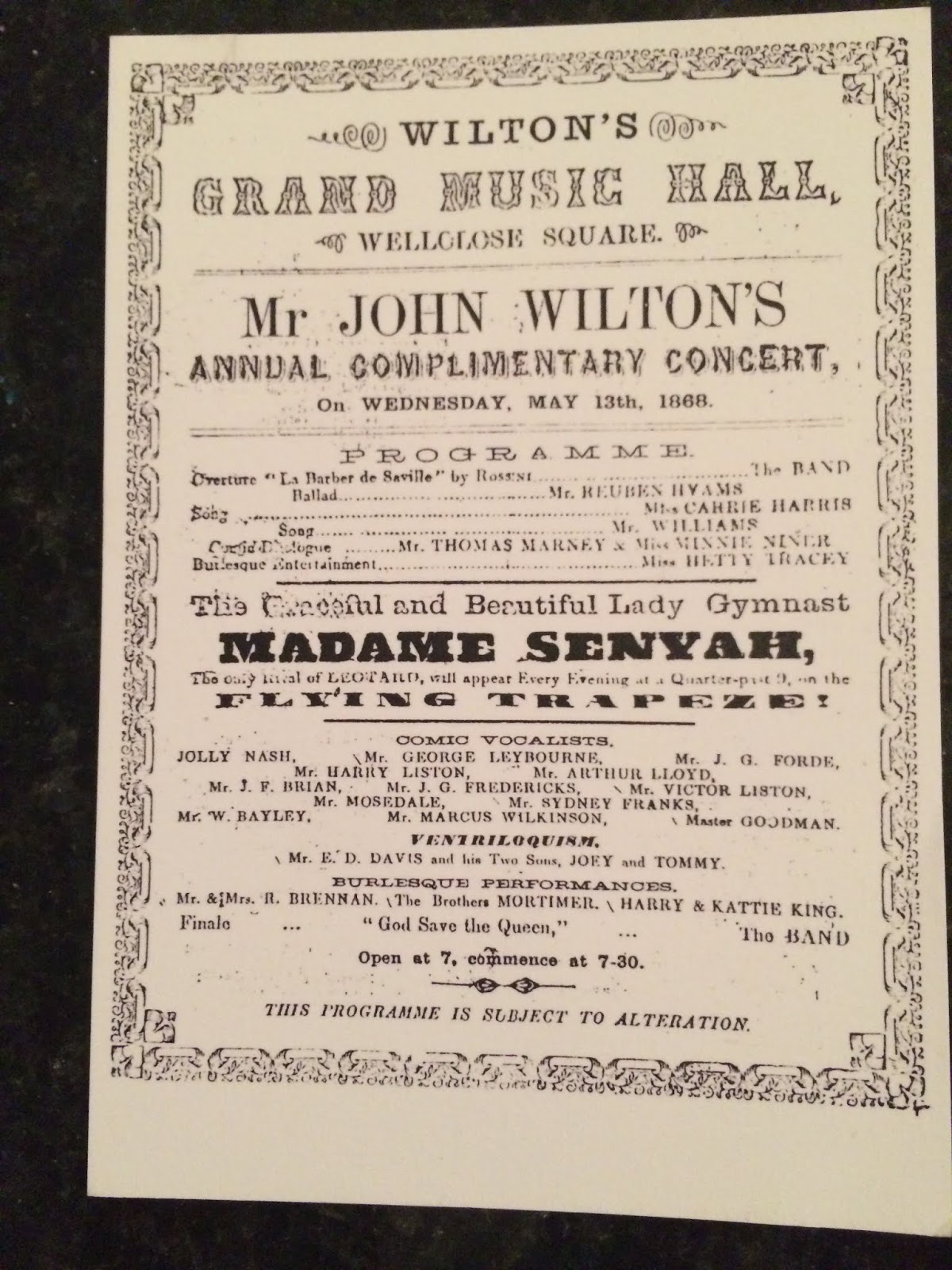
My lady is one of those cases. She was one of the most effective of the female gymnasts and acrobats who raised pulses and eyebrows in the 1860s, when such a thing was quite rare. Mme Stertzenbach, Azella, Zazel (there were four of them!), Nat[h]alie, Lulu (well, 'she' was a man in travesty) … but, then, there was the bulgingly fit and incredibly strong Madame Senyah. Whose name, every journalist was intent on telling the world, was ‘Haynes’ spelled backwards. Well, her name wasn’t Haynes. It may have been her sometime partner’s name (sometimes the press said ‘brother’, but it actually was ‘husband’), but it wasn’t hers.


Her identity is, however, not at all straightforward. We are told she was Phoebe Frost. Although a couple of the most serious circus books (see below) seem to have muddled her up with her partner’s other partners. Was she Ada? Was she Maude? Was she Phoebe? It’s Phoebe whom I like. Phoebe? Well, Phoebe existed, and she was registered as Phoebe Frost at birth and appears as such in the 1851 and 1861 censi, and wed, yes, Mr Haynes in 1866, before I officially lose her.

Now, I thought my bit of today research was not fitting the right dates. But then I stumbled on an article from Phoebe’s dying years in – why!? – a Washington newspaper. She was trying, at 66 years of age, to keep the trained dogs with which she had latterly done an act, and starving herself as a result. So she talked (to good effect! ‘Vesta Victoria’ saved the dogs). And she told her story … well, some of it … to a passing journo.

Phoebe was born in Carlisle in 1842. Yes, there she is getting christened ‘Phoebe Frost’, 27 June 1842. Her parents are William Antonio (haha!) Frost and his wife Zipporah née Kite (b 1817), from a circus family of Bedale, Yorks. All funambulists, equestrians … showbiz folk. A later paper says Frost was ‘Dan Harvey the clown’: but Harvey isn’t visible till 1863. He’d be 50. Second career? Or bunkum? Phoebe relates tales of father tight-roping the Thames with her in his arms … sure, but under what name? Ah! Maybe Signor Antonio?


Because Madame Antonio ‘from America’ turns up at Cremorne in 1850 doing a spectacular tightrope act (‘100 feet above the ground’, ‘150 feet above the ground’, ‘30-50 feet above the ground’), surrounded by fireworks, and I’m certain that that is Zipporah from Bedale. She does this wonderful ascent (she’d have been 33) and then disappears. Or does she? Strangely enough a ‘Madame Boutelle’ turns up in the late 1850s and 1860 doing exactly Zipporah’s rope act. Assisted by Mons Antonio [Boutelle] (clown). I wonder. Then the Boutelles disappear and Dan Harvey appears. Could it be …? 
But the family historians say that William no-Antonio Frost, equestrian with Cooke's circus, died aged 43 in 1847. This seems to be another Antonio. But Zipporah had daughters in  1846 (Louisa Clarissa), 1849 (Adelaide Nelson)  and 1854 (Jane) .. And yes, 'Signor' is still performing his feats in 1853 .. and 1860 .. as 'Signor Antonio'. 1847 'Signor Antonio and his son ..?


We don’t see much of Phoebe as a child, although I spot her with sister Sarah, who married equestrian performer John Wilson, in the 1851 and 1861 censi. Labelled ‘equestrienne’. She was an ‘equestrienne’ two years earlier, with Ginnett’s Gigantic Hippodrome Circus, I discover, thanks to a website https://www.shakespeare.org.uk/explore-shakespeare/blogs/ginnetts-circus/which shows the visitor’s book she signed on the company’s visit to Stratford-on-Avon. 


Ginnett’s was a large affair playing Dick Turpin’s Ride to York, Cinderella, Mazeppa and featuring the brothers of the title alongside ‘Miss Ella from the Imperial Cirque Paris, Berlin St Petersburgh and Niblo’s Gardens’. I guess Phoebe was an also-rode, in the advertised company of 60. And alas, although when they got to Hull, the press saw fit to say that a local Miss Wilkinson ‘the daughter of Mr Wilkinson the great somersault thrower’ was a member of the troupe, Carlisle didn’t do the same for Phoebe.

So she appeared in public – as what? Mdlle Antonio? Mlle Phoebe? – young, but I don’t get a handle on her until March 1867, when she is Mrs Hay[n]es, and becomes ‘Madame Senyah’ and a gymnast-trapeze performer in collaboration with ‘Mons Senyah’. Samuel Haynes. I presume he’d worked, previously, under another name too. He was a ‘muscle man’ acrobat … ‘The great English and Continental gymnasts’. 


September 1868

But hang on … this isn’t Phoebe! This Mrs S is one Miss Ada Jacobs! So that’s why I found a reference to the ‘daring Jewish trapeze artist’. Ada, who has been starring, since her ‘arrival from America’ (‘what part of America is the lady from, we wonder’ hissed The Spirit of the Times, ‘a timid rider’ judged Ireland) in 1864, as Mazeppa with her 'milk white steed and splendid lithograph posters - … oh no! with Ginnett’s Circus! Was Monsieur also from the ranks of Ginnett’s, then?


So how long was the putative ‘Miss Jacobs’ ‘Mrs Senyah'? Not once Sam married Phoebe, I'd guess. By 1868, she’s back doing Mazeppa with Ginnett’s. She’s still doing it in 1870. Sam had changed 'Madame's fairly soon.

Mr and Mrs Senyah were extremely successful, first in England and then, from 1868, in America, with their unusual (for a woman who really was a woman) flying trapeze act. She was praised for ‘the daring and dexterity of the most agile and adventurous male gymnasts’.

There are loads of reviews of the act, which was clearly the best, or at least one of the best, of its time: ‘In the act she flew by means of suspended rings along a wire, loosing hold of the rings to be caught by her partner who was hanging by his feet from the bar of a fixed trapeze’.

However ... by 1869, Phoebe is touring with Yankee Robinson and advertising as a single. But a Mons Sanyeah can be spotted in the small print. Sam, or A N Other?


So when Sam opened at Tammany Hall in 1870 his partner was 'Madame Maude Sanyeah'. Or Mons 'trapezist, flying rings, dancing barrels' and Mlle Sanyeah. 


And Sam was defending his corner. And Maude. The 'Leap'? I though that was Zipporah's trick.


In 1871 C W Noyes Great Crescent City Circus advertised them as 'Mr and Mrs'. Phoebe was playing Mazeppa and an equestrian The French Spy in Chicago.

In 1872, they toured to San Francisco. And now it gets even trickier. Phoebe or Maude (or whoever the official Mrs S was) is reported in the press to have married ‘the modern Milo’, ‘the man of iron sinews’, muscleman John Conklin (4 November 1872). 'We were under the impression the Mr Conklin was married to a lady in Philadelphia' the press snickered. And Sam is having children by Madame Maude Seny[e]ah. 

The circus books equate Phoebe with Maude. I admit it’s tempting. But it can’t be. Phoebe is back in Britain in 1875, while ‘Sam and Maude’ are still in America! And then there’s a ‘Mademoiselle Geraldine’, Mlle Leola and there's still our Ada … Mrs George Holland … who writes to the press with her continued claims to having been ‘Madame Senyah’ the first. 

Then there are three ill-fated children ‘Senyah’ or ‘Sanyeah’: Aurelia (b August 1873; d 21 March 1874), Thomas Elbridge (b Michigan 1872; d New York 10 March 1878), Olive Theresa (b New York 27 December 1877; d New York 14 February 1878) … whose children were they? A working gymnast’s?. The two daughters are credited to Maude or !?Alice Moore. And Thomas’s death certificate significantly says: father born England. Mother born: Michigan. So, he’s not Phoebe’s. And certainly not ancient Ada’s. And look, here's another: 20 January 1876 in Indianapolis ... and another 'ten pound baby boy' in Grand Rapids in 1879 .. after which she seems to have renounced performing.

In 1874 Washburn's troupe advertised Sam and Maude .. as brother and sister!! Phoebe is touring South America ... then I spot her with Conklin in New Orleans in November 1875 .

Pregnant trapezists? Ouch!

Anyway, Phoebe had a stunning career after her return to England in 1875 (with seemingly no male impediment). And I spot her 1877 at Paris’s Cirque d’été (‘Madame Sanyeah est une blonde de haute taille rappelant par sa structure les statues de la place de la Concorde(...) Mme Sanyeah termine ses exercices vraiment prodigieux en faisant tournoyer dans l'air un monsieur qu'elle tient entre les dents’)


Charles Reade related in his The Coming Man in the 1870s: ‘I have three times seen Madame Senyah —a grand Anglo-Saxon whose name is Haynes—do the ordinary business of the Trapeze—though she cannot weigh less than thirteen stone—and then come down the rope head-foremost, twist one leg round it, hang down by that leg, put a mouth-piece, with three leathern straps attached, into her mouth, and, in that position, head downward, and hanging by one leg hold three great hulking fellows dangling in the air for ever so long – by her teeth’ . Well, if he says so …


Madame Sanyeah (sic)’s career came to an end at Portsmouth’s Hippodrome 17 April 1879. A wire broke, and she fell. She was not injured but, as she murmured, ‘I am no longer as strong as I used to be’. She changed her act, performing instead as ‘the Marble Gem’ a series of classical (male) poses, which had formerly been played as a coda the act, the highlight of which was ‘Satan’s Fall from Heaven’ and ‘The Flight of Mercury’ in which she used ‘all her old gymnastic talents’. 


We are told that she became a dog-trainer after her gymnastic career was over, and ‘ended up on streets performing for 2d to 3d a day. She almost froze in winter and …’ before being rescued. A later picture, in the Washington story, tells of her living in a hayloft with her dogs … Well, I spot her appearing with a team of performing dogs and goats in the provinces into the 1890s. But, by 1896, she is destitute, living with her animals…

‘She was cared for in her last days by Mrs Lawrence and her daughter (‘Vesta Victoria’) says a long story about ‘Madame Senia’, a few days after her death, in the Dundee Advertiser. I guess they picked it up from somewhere … The same story says ‘she was, in private life, Mrs Hall’. Yes! There she is in the death registers. Lambeth. June 1910 (died 23 June 1910, Lambeth Infirmary). Aged 60. Someone’s misread a 9 as a zero. She was 69.


Well, maybe it isn’t an ‘error’. The 1901 census has just found me Phoebe Hall, born Carlisle, aged 45 (recte 59), in Blackpool. And she’s with Mr Hall! Stewart Hall, said to be born Preston, 1862, comedian/clown at the circus. (he was 37 and a married acrobat in 1891, under whatever name …) Well, well. Maybe she picked him up and ‘twirled him around’ as she did with Jean Pasta in music-hall days.

But, hang on, she’s supposed to be destitute and dog-ridden in 1901 ...

Oh, and Zipporah had died (1897) in Newington Workhouse ...

Well, as far as I can make out the were but three gymnastic Madame Senyah/Sanyeahs. Plus a few cheats. Ada for a wee while, then Phoebe, then the rather more modest but friendly Maude. They were clearly all three good athletes, but Phoebe seems to have been the one who created the memories …

Poor Mr Haynes stayed in America, got past being a ‘catcher’ in a trapeze act (as one does), didn’t make much of a success of anything else, and finally ended up in an insane asylum ('printer, divorced') at Kankakee, Ill, where he died, apparently by drowning, 25 August 1900. Aged 65. No idea what became of Maude. I see her performing with Sam as late as 1879 ('the four revolving and dancing globes, juggling act on a rolling globe, see-saw plank, ascension on the globe, the beautiful fountain of fire, flying rings etc). By which time Phoebe had been back in England, working visibly, for three years.

Ah, me. So many loose ends in this story. But that’s circus …

PS I should quote the main books that mention Madame S by any other spelling. They are both rather better than their ‘university thesis’ titles suggest (hehe ‘cultural identity’ … what?!). But they haven’t sorted out Ada from Phoebe from Maud[e]:

Circus Bodies: Cultural Identity in Aerial Performance by P Tate

Women of the American Circus: 1880-1940 by K Adams and M Keene

And that San Francisco marriage? 4 November 1872? Show me the certificate ...

OK, your turn to have a go at Mons and his Madames. I’m leaving the circus, and heading back to my singers!


Sunday, June 3, 2018

A breach of many promises: the tale of Nellie Bromley.

.
Nellie Bromley’s name is still remembered today. She has made her way into all sorts of books and articles and even climbed the exalted heights of Wikipedia. Fair enough. She probably (just) deserves it. But she is not Wikied because of her career as an actress, under managers from such as Pattie Oliver to John Hollingshead, from Alexander Henderson to Edgar Bruce, or for her years of sophisticated comedy successes at the Criterion Theatre. She is there for one reason only. She was the first actress to play, for something over three months, the female lead in a little afterpiece, at the minor Royalty Theatre: the part of the Plaintiff in Messrs Gilbert and Sullivan’s Trial by Jury.

So, apart from a slim list of credits culled selectively from The Era, does anyone really know anything about the beauteous (see illustrations) Nellie? Well, if you want to, read on. Oh. This is going to be a reasonably long one. And Trial by Jury and its mythology will take up just a few lines.


I shall start in 1814, when a Miss Hannah Shailer married John Charles Bromley on the 5 July. And they bred. Fluently. I spot a William, a Hannah Charlotte, a Jesse, an Emily Bertha, a Hubert Algernon, an Eleanor and, good heavens, a Thaddeus … before papa gave up the ghost in 1839. Hannah, however, was tough. She carried on, and in 1841 we see her at Portland Plan, South Kennington, with Eleanor (15) and Thaddeus (14). I don’t know where the survivors of the rest are. But it doesn’t matter. It’s Eleanor (15) I’m interested in.


Eleanor went on the stage. Two years after that census, and a few concerts at Store Street et al ('pupil of F W Brandau'), she appeared at the Queen’s Theatre as Fanchette in The Soldier’s Secret and thereafter at the Adelphi (Giannina in Ondine, ‘Miss Bromley will be a favourite indeed if she continues to carol as sweetly … enough to seduce any but a spellbound one from all other allurement’, Tom and Jerry), the Strand (Psyche in Cupid, The Knight and the Sprite, Rosabelle Neville in Saloon and Cellar), the Olympic (Love and Jealousy, Nysa in Midas, Minna in The Fortress, The Genius of Chloroform in A Mission to Borneo, Lestelle in The Flying Dutchman, Brigands in the Bud, Jessica in The Merchant of Venice), the Lyceum (Robin Hood, Fatemma in The Magic Horn, Lady Finnerina in The Enchanted Forest, Presumption), the Surrey (Baroness in Sure to be Shot, Barbara in The Iron Chest, Mary Ann in Sophia's Supper, Princess Brighteye in The Three Princes, Pepita in The Old Ferry House, Mme Blondeau in Matilda,  title role in Moon Queen pantomime, The Mountaineers), then, after a gap, at Drury Lane in the 1852 pantomime (Genius of Improvement in Hudibras), at the Haymarket (The Sheriff of the County, Rappings and Table Movings, Fairy Queen to Lydia Thompson's Little Silverhair), before, at Christmas 1854 settling in, long term, back at the Olympic … My last sighting of her is at Christmas 1859. And for good reason. On 15 December 1857, Eleanor had married Charles Henry Cook, in 1860, she gave birth to a daughter … and she died (5 February) in the attempt.


Move to the 1861 census. Hannah Bromley née Shailer is looking after her daughter, Emily Bertha ‘professor of music’ (1833-1869), and two grandchildren: the fatal Jessy Cook aged one, and Eleanor Elizabeth Emily Bromley aged ... ten. Our Nelly. We hasten to the birth records … born 30 September 1850. Mother Eleanor Bromley. Father … who? … Arthur Bromley? But I don’t have an Arthur amongst Hannah’s children. This looks like an obvious case of virgin birth. I’m 90pc sure that Eleanor jr is a premarital child of Eleanor sr. Wonder who ‘Arthur’ was. A myth?


So, we arrive at ‘Nelly’. 1866. Young, like mother. And very attractive, like mother. She’s hosting a stall at the Crystal Palace, alongside the likes of Lydia Thompson. Already? How? Why? And by the December of that year she’s engaged at the Royalty Theatre playing Dolly Mayflower in Burnand’s burlesque on Black-Eyed Susan. She stayed at the Royalty for a couple of years, playing in burlesque (Bad Dicky, Claude Duval, Military Billee Taylor et al) and comedy (Humbug, The Boarding School, The Serious Family &c), went on tour for L J Sefton with Sothern in his repertoire, and … well … I’m not going to fill a page with credits, but she went from the Globe to the Court to the Royalty (with the odd matinee at the Gaiety), thence to the Olympic under Ada Cavendish, and to the Strand, where she scored a hit within a hit (1873) in H B Farnie’s new-style musical comedies Nemesis (Praline, ‘What are a lady’s wants today’) and El Dorado (Verdurette, ‘Forget not to remember’). Farnie’s next effort, the pasticcio The Black Prince found her playing sisters with Selina Dolaro (Flossie and Sybil), opposite the ill-fated C W Norton (see elsewhere), but that one was less successful.


So Dolly Dolaro went off and took the Royalty Theatre, to star herself as La Périchole with which she also produced a little afterpiece by name Trial by Jury. And her 'sister' and friend Nellie came in to play it. I doubt that she covered Dolly in the main piece --the vocal power of the one was not equalled by the other – but, anyhow, she got a plum part.


No need to dilate further on this much dilated upon episode, except to say that there is a myth perpetuated in G&S circles, that Nellie was ousted from the role of Angelina, in favour of Dolly’s ‘friend’, Linda Verner, after some three months, for cause of jealousy. Bunkum. Don't believe a word of it. Dolly and Nellie remained good friends, and, in September 1876, can be seen holidaying together in Scarborough.


By that time, Nellie had moved on to the heart of her career, at the Criterion Theatre, playing Mrs Graham in the hit adaptation of Le Procès Veradieux as The Great Divorce Case. Nellie became a fixture at the Criterion, through the long-running French farces adapted as Hot Water, On Bail and Pink Dominos before moving back to the musical theatre as René in the Folly Theatre’s La Créole.


In 1879, she created the role of Amy Jones in another grand success, the comedy Crutch and Toothpick, and also took the title-role in the Teddy Solomon burlesque Venus, then returned to the Olympic for Hollingshead ...  in 1882, she took up Lottie Venne’s great role of Betsy at the Criterion … but, as we can see from the 1881 census, Nellie had by now moved in with the artist, Archie Wortley, of aristocratic descent. She would marry him in 1884, more or less retire, and give her four children a father. 


Yes, the four children. Well, Nellie evidently had a good time around 1870, when she produced two daughters in double quick time. Lillian Bertha (the ill-fated 'Lilian Eldée', d 14 February 1904, but where does this insistent ‘Bertha’ come from?) and Zoe. Father, in each case, unrecorded, but supposed to have been the Duke of Beaufort and Lord Carrington, respectively. Then she turns up, in 1881, at Margate, with Wortley, the two girls plus a Valentine Robert (aged 2, b 30 November 1879; d Canada 5 July 1950) and a John (aged 0). I mean, what? Who? The babies are ‘grouped’, so each pair looks like the result of a separate relationship … the Duc d'Alba was whispered as a candidate. The registration for Zoe’s 1891 marriage to Francis Edgar Croft, son of a baronet, leaves the space for ’father’ despairingly blank. Lillian's for her marriage to Charles Edward Duncombe Esq, likewise, though 'Eleanor Emily Edith Stuart Wortley' and husband were her witnesses. Mum clearly didn’t cough up her secrets! But, then, neither had grandma.

Le Duc d'Alba

One of her affairs, however, wasn’t a secret. In 1878, some little gossip journo posited her marriage with a Mr Baltazzi. She hadn’t married anyone, but … no smoke etc? And, suddenly, two little boys?


The Baltazzis were big. They were the sons of a Smyrnese banker, educated at Rugby, and, I think, both married. Alexander raced horses, Hector rode horses (‘en gentleman’) and there were other brothers, too. And a sister who married a Vetsera, and had a daughter who died at Mayerling … Anyway, I think it is Hector they’re getting at. But it’s just a guess. It’s ‘fake news’ as to the marriage …Nellie lived to a nice age, as Mrs Wortley, and died on 27 October 1939, at Lymington. More than half a century after the role which has subsequently made her wikipediable…

I’m curious, though, as to what the birth certificates of those four children might say! Anyone got a few quid to spend????

Son Robert lies in Red Deer Cemetery, Alberta


Friday, June 1, 2018

Putting Charley to rights ...

.
I feel that I have already written the biography of Charles J Campbell, long-singing light baritone turned tenor, for he played such a colourful part in my big biography of the one and only Emily Soldene. So –particularly as David Stone has covered his D’Oyly Carte years in his usual precise detail – I’m not going to do the whole thing again. But … well, he’s on George’s list, and there are a few details which need putting straight.

In 1924, the widowed Mrs Campbell applied for an American passport, to go on a trip. She was very obliging with dates: her birth, her husband’s birth, their marriage, their surname … and every single one of those was a lie. Not even a little lie … years and years and years out … and, incidentally, making their daughter illegitimate.


Let’s start with Charley. I’m not sure when folk started giving the date of 13 March 1856 for his birth. It’s become general (I hope I didn’t succumb!) and it is way, way out. Of course, it is difficult to disprove, because Charley wasn’t a Campbell. As of today, I know that he was born Charles James Cleaver, son of a carpenter from St Helier, Charles William Cleaver, and his wife Mary née Moore. And the date? 13 March 1849.

I see, then, Cleavers in the 1851 Newington census: father, mother and children Mary, Ellen, Charley and Alice; and again in 1861, when papa has given up the saw and chisel, and become a coffee house keeper. Father died in 1867, and I don’t see the family in 1871, but I suspect they were somewhere in Clapham, for in November 1870, a Mr Cleaver appeared with an amateur Royal Aboriginal Minstrels at Clapham Hall singing ‘Come to me, Angel of sleep’.

By the time I catch up with him again, some three years later, he has become Mr Campbell and is employed, over Christmas 1873, at the Liverpool Prince of Wales Theatre, in A Handsome Husband, the burlesque Lurline and La Fille de Madame Angot, star Selina Dolaro. After plenty more touring in Angot, and a brief West End season in The Black Prince, he rejoined 'Dolly' Dolaro to play Tarapote in La Périchole and a Juror in the original production of Trial by Jury. He played the Foreman and the Counsel, later switched to Emily Soldene first as the Counsel then the Defendant … and the story as known was under way.


On 18 November 1876, Emily began her ‘world tour’. 


Knight Aston was her boyish, plumpish tenor, Mr Campbell was in support, and the chorus included a lady calling herself ‘Eugenie Nicholson’. Oddly enough, the Eugenie was real. But her surname was Williams and she was from Liverpool. Mr Cleaver and Miss Williams were wed in Boston 14 April 1877. 


Those who called Charley ‘nauseatingly effeminate’ might have been surprised: but the couple were a couple till death, and their daughter, Violet Eugenie, lived till 1959.


I’ve told the tale of how, when Knight Aston went home to his own problems (he had married a convicted confidence trickster), Emily simply promoted her baritone to first tenor. And he was splendid success.


The ‘Campbells’ stayed in America, and Charley became a leading tenor in comic opera. In 1887-8 he travelled to Europe for a year, and toured with D’Oyly Carte’s Continental Company, but he returned to America and to the forces of Rudolf Aronson to play, most importantly, Eugene Marcel in the hit of the era, 
Erminie. He remained prominent for much of the 1880s – and Eugenie worked too – but in the 1890s the engagements, though still plentiful, were often in more modest companies and productions. I see him in 1891 in a production named The Sea Queen in Baltimore.

            He was into his fifties (though admitting nearly a decade younger) when his performing career was run down, but he had begun a second career, as a librettist and/or lyricist, most often in conjunction with Ralph McGay Skinner. They authored A Friend of the Family, The Fortune Hunters, Lady Betty’s Courtship, His Honor the Mayor (The Pink Hussars), The Gay Musician and The Motor Girl with, latterly, some success before, aged 60, Charley retired.


He die  Charley died, ‘of heart disease’, at 736 181st Street, New York on 27 February 1918, just of his seventieth birthday, and was buried in Woodlawn Cemetery. Eugenie, working in a shop, survived him by thirty years, and died 4 November 1949.

Postsc

Eugenie in 1924

             So, there is Charley Cleaver, hopefully, set to rights. Chuckle. Say 'thank you', webmasters, and get fixing those names and dates on your sites!  Potscriptum: This blog led to my 'meeting' Charley's 21st century family, whence come the grand family photos added herein ... including Charley's man-cave with his collection of swords ..


P