Tuesday, September 3, 2013

Dazzling Death at the Philharmonie


On returning to Berlin, each year, one of my first jobs is to check the opera and concert schedules for the season.
This September, the concert that stood out above the others was a Mahler Chamber Orchestra Philharmonie concert of Shostakovitch and a previously unknown (to me) Britten cantata, Phaedra. I’m a sucker for a cantata. And for Shostakovitch. So, months ago, we got on the internet to book …
Failure. Too soon? Tried again and again, blamed the computer and tried another. Failure. Wrote to the MCO and to the Berliner Musikfest .. persisted ... but was finally forced to accept ‘best available ticket’. Tricky for me, with my ‘special needs’. But we got in!  That was the main thing.

Tonight we rolled up, all anticipatory, to the Philharmonie. A vino with my friendly barmaid in the foyer and then to our seats. Oh. For once, I hadn’t booked top price tickets. 60 euros for a small orchestra and 2 soloists? I settled for 45. And where were we, on this ‘best available’ system? In the front row of the Gods. Thank goodness I had Paul to help me with the stairs. Up and down. Alone, I would never have made it. Never again ‘best available’.

Other people must have not been as dogged as I. The salle was 50% empty. Rows and rows and rows of gaping nobody. And yet the ordinary Konzerthaus show we got turned away from last week ... sold out? Why? Super band, super programme, super soloists ... why? Too dear? Too hard to book? Both, I suspect. Well, it was a shame. And the absent folk were in the wrong. It was a fascinating concert. Even from the crow’s nest.

We started with a taster of Shostakovitch: a string octet ‘Prelude and scherzo’. It was like a little overture: the sweet, wandering prelude, and the vigorous scherzo which worked its way up to a driving finish.

And then, alas, all mood was dissipated by an endless rearrangement of furniture: chairs, stands, podium ... why not have put the 8 players on the forestage?

The Britten was what I was really looking forward to.  I discover it was written for an Aldeburgh Festival and premiered by Janet Baker. Odd then, that it was billed as a Dramatische Kantata für mezzosopran. The Janet I knew was absolutely a contralto. And odder still that the soloist for tonight was listed as … a soprano!


Well, the piece has Aldeburgh and Janet written all over it. Beautiful English music, tuneful bits, orchestral features … what it is not, I’m afraid, is ‘dramatische’. Phaedra, especially in Racine’s version, is one of great tragedy queens of European stage history. I don’t know what sort of the reception the cantata originally got in its ultra-English premiere, but here it failed to raise the temperature. It was enjoyable, but it didn’t stun. And, yes, part of the problem was that the soloist, Angela Denoke, the possessor of a beautiful, even, high mezzo, was not a contralto. I don’t care if she has played Kundry. Her lowest notes disappeared into the orchestra, the highest lacked excitement. This is Phaedra, for heavens’ sake.
Phaedra, a not-very-dramatische scena für Alt. Enjoyable, but not stunning. I feel Britten would have done better with Boadicea or Florence Nightingale.

As I wobbled down the 100 stairs at interval, I said slightly disappointedly and greedily to Paul, ‘I want to be thrilled’.

Well, I didn’t have long to wait.


Shostakovitch’s 14th symphony is hardly what I would think of as a symphony. It is a collection of sung pieces, for bass and mezzo/soprano soloists accompanied by strings and percussion, on the theme of death, to words by such (sometimes self-indulgent) specialists on that subject as Lorca, Apollinaire and Rilke. Not jolly. But as set to music: stunning. And you couldn’t understand a word anyhow (what language were they singing in?).
The collection starts with a quiet, pensive De Profundis for the bass (Petr Migunov) and we were immediately on song. What a voice! A lovely soft-grained bass-baritone, with no meretricious effects. Britten would have loved him. I did. But it gets better. A dramatic ‘Loreley’ gave Miss Denoke the chance to get into her proper register, and deliver some cracking singing. While being endlessly pure and warm, she got here the drama and urgency that in Phaedra she had not. And then she topped it off with a beautiful setting, gloriously sung, of Apollinaire’s ‘Trois lys’ (‘Le suicidé’).  Migunov brought the work and the evening to its high point with his delivery of ‘O Del’vig’ and ‘Der Tod des Dichters’ … I was getting a bit lost textually here, but just sat back and let the wonderful music and perfect singing spa-bath me! …  and just as I was thinking, ‘please let them sing together’, they did. Just for a couple of lines …

I was thrilled. And a happy man. The audience was too. They’d been polite after the Britten, now they exploded. Volley after volley of applause and cheers. Me included. The artists and conductor Teodor Currentzis – who’d produced magic from his little wind-and-brassless band -- were called back again and again. Not ‘German’ calls … real ones.

Well, that’s three MCO concerts for three thrilling nights. I missed Sasha Waltz of course, what a time she would have had with the non-symphony! But I am expanding my horizons each time … thank you MCO. Until next time.

Postscript: message to the celeste player. Please turn off/down your lights when not playing. They shone out like car headlights…


Saturday, August 24, 2013

HI JINX IN HESSE!


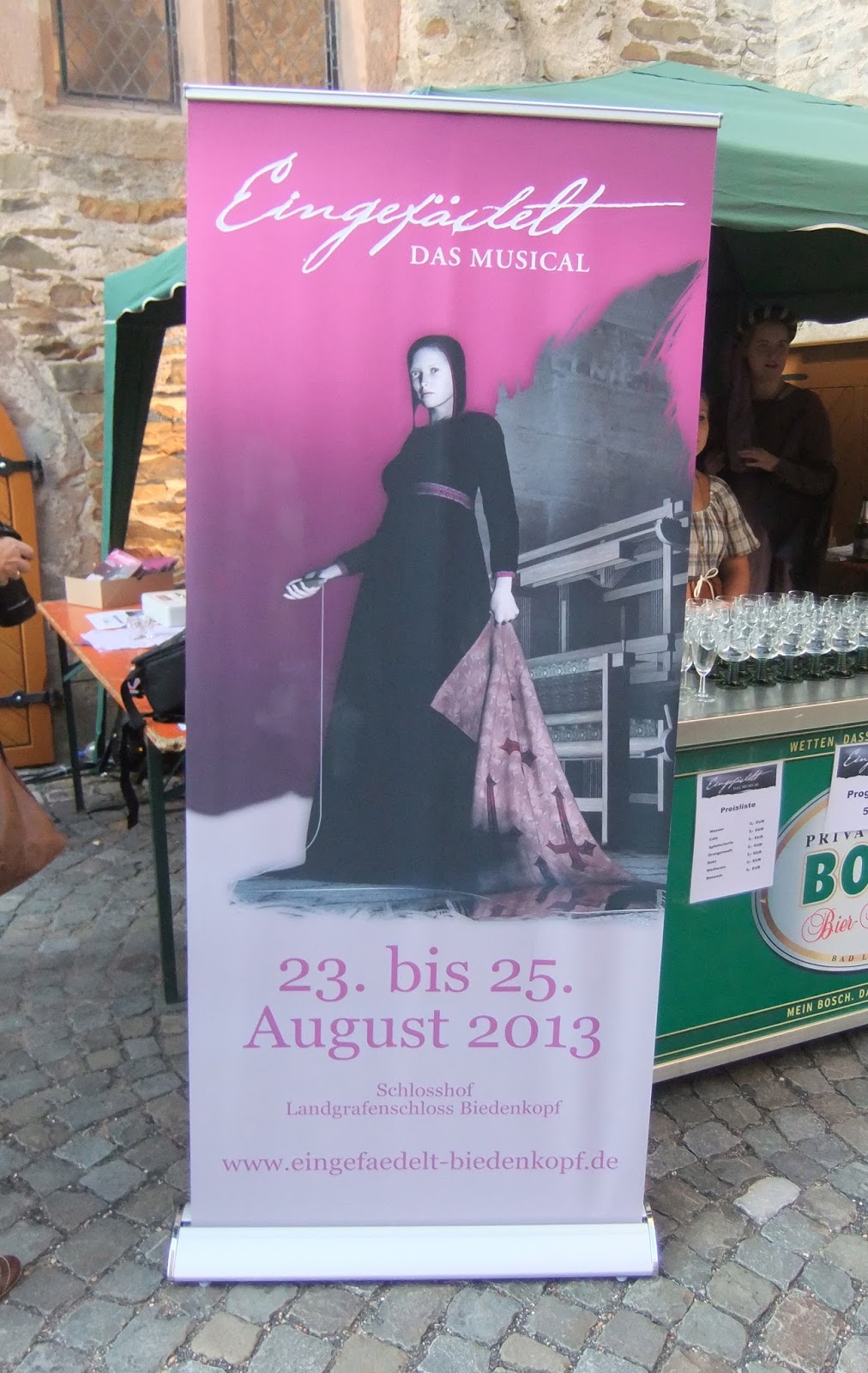
Twenty-four hours ago, I was hundreds of kilometres from home, on a hilltop in Hesse. As night fell, I was curled up in a pink blanket, in the courtyard of the marvellous 14th century château (or Schloss, to use the vernacular) of the small town of Biedenkopf… and don’t say ‘where?’…  with a nice whisky … Why? Well, of course, it was theatre. And this is the outdoors season.


I had voyaged across a quarter of Germany for the first showing of a new musical play, from the pens of Birgit Simmler and Paul Graham Brown, whom I last witnessed together in action in the grand Dynamite! in Berlin. So why Biedenkopf? It’s a long story … but let’s say right away, this wasn’t just a new musical: it was an event.

Biedenkopf hasn’t got a theatre. Madame Simmler comes to the town, and has an idea ..  Biedenkopf has an adventurous mayor … Birgit called up her old collaborator… the town council supported the project …


And so last night the musical Eingefädelt, conceived and built on a background of the history of Hesse, was born. It was staged on a tiny platform in the Schloss, with a cast made up of local players, sugared with a topping of professionals, before 350 (that’s capacity!) enthusiastic folk…  including several industry professionals who’d made the long trip.
Including me. Whose German is fair to lousy. But who had conned the plot with the locals.


The central character of the tale is Katha. A medieval Biedenkopf lass, who, having been involved in her abusive husband’s death, sets out to seek religious and temporal absolution from the local Fürst before giving in to the advances of a much prettier tenor. The trouble is that (fact) said Fürst has been imprisoned in the tower for having wed – in these just post-Lutherian times – for a second time. So Katha and her Stefan have to get him out.
But that’s only the plot. The background is niftily made the foreground: the other three main characters represent commerce (Kurt, a Hessian cloth-seller), religion and right (Eleanor, an aristocratic lady cloth buyer) .. and fun. Or freedom and family life. Er, I might be wrong on the last. Represented by Errol Flynn.

The whole story is staged in exemplary fashion around a sole piece of stage furniture: a wagon (tumbril?) of cloth, the essential export of Hesse, owned by Kurt, used by Katha as a means of escape, and so forth … neatly done!


There is a great deal of story and play, somehow easily got into 1hr 40, and still leaving room for what seemed like a huge score of often short numbers. But they are Mr Brown numbers, so, of course there are some jewels in there. My particular favourite was ... I can’t give you titles, because, in fashion of Germany, the programme gives historical info on Fürst Philipp, but not a song list … the number by Eleanor and her underwear Mädchens which ended the first act ‘en trombe’ (choreography: Tim Zimmermann). Actually, I liked best most of the combined voices numbers (and the two-women duo which didn’t happen), although the tenor had an attractive and showy number in act one, and Errol Flynn has a nice jaunty dancy piece in the same act, which stands out amid the dramatic and soulful pieces.

The piece is well crafted. Of course. But I will bet, now that its got to this stage, the collaborators will fiddle with it, before the obvious revival.


And so, the piece being decreed well-made and enjoyable, but probably improvable, we come to the players. It is not considered right to give a critique (unless it’s a rave) on amateurs, at least, not by name. But what do you do when they’re all mixed up together and one or two of the amateurs could be professionals?

The star of the show, for Biedenkopf, was local vocalist Yana Gercke, who played pretty Katha. She has had success in a telly-competition. Rightly so. She has a lovely warm, sympathetic mid-range voice. I wish the part had demanded more of her vocally. Or not?  This was her first essay in an acting role, and she is a natural. She reminded me of the young Frankie Ruffelle.


Her oppo was Karsten Kenzel. Tenor? He’s played Sky Masterson. A pretty fellow, tending to the chubby, and with a decidedly pleasant and rangy light baritone … a very good all-rounder. Good casting. Good singing teacher.

These two, being involved in their dramatic story, didn’t often get to give us much fun, but that was made up for by the others.

David Schröder was a copybook alter komischer (is that right?) as the Cloth-Merchant … and then there was Dr Carsten Wenzel as the Zeugmeister von Rommel. Yes, Doctor. He’s a dentist and an amateur. He had a plum part and rightly played it as a burlesque of Errol Flynn. I likened him to the Cat from Shrek. But. There is more to a role than one delightful pose and a one-dimensional portrayal. Never mind, he was fun when not being too camp, and he sings and dances to a good level.


The performance of the night, for me, was Lisa-Marie Joch, as the Lady Eleanor.  A superb stage presence, a grand delivery, a fine voice and she knows how to dominate the stage  … yes!


Several members of the local cast distinguished themselves, but – in the usual way – amateurs will be amateurs, and there were a (very) few clumsy horrors. Gosh, how I wished Katha had killed her husband before scene two. Or scene one.

And to top it all, when they liberated Fürst Philipp den Grossmütigen from the (real) castle in the last reel … it was the mayor. His stage performance wasn’t quite a fluent as his long speech afterwards … but he deserved it!


So, there we are. I consider my safari to Hesse well worth the 1000km. I am quite sure this local piece will become an annual, or at least a regular, in its very special surroundings … like The Student Prince in Heidelberg.

How many other towns in Germany – or anywhere --  have their own purpose-made musical?  Biedenkopf now has a delicious theatre space, and a spanking new show of its own.

And I’m very glad I was there at its birth.


Postscriptum:  The originally scheduled three performances having sold out .. the season has already been extended to seven!

Sunday, August 18, 2013

999 Little Angels Singing....


Germany goes in for open-air theatres in a big way. I’ve tried a few: from the large one at Mörbisch in Austria (Das Land des Lächelns) where you needed a telescope and a litre of insect-repellent, to the fun one (audience rain-protected!) at little Bökendorf, last year (Bonnie and Clyde). Tonight it was a Berlin one, the ‘celebrated’ Waldbühne, out Spandau way, and the show, Die Csardasfûrstin – which I hadn’t seen since Sadler’s Wells and Marilyn Hill Smith, thirty plus years ago.

The Waldbühne is a wonderful but impractical venue. Built like a vast amphitheatre, with hundreds and hundreds of steps to scale, it houses anything from a Barbra Streisand concert to the Berlin Philharmonic … and tonight it was Operette.
Does it work for Operette? Well, it wasn’t perfect. The orchestra was in a tent, out stage right, with its conductor. Time delays resulted in a fair bit of untidy music. Then, if you are going to play on a vast stage, you need a king-sized Drury Lane cast. This type of stage eats choruses. And, of course, everything has to be sometimes unpleasantly amplified. But in the day of the mp3, that’s what everyone expects. And you know those things before you come.

But, on to tonight’s production. Straight away, let me say that I liked this open-air Operette way better than I had thought I was going to. Indeed, I liked it quite a lot. But I will also say that I would truthfully have liked the production better had it been ‘inside’. Where I assume it comes from. Quite a lot of the scenes are if not ‘intimate’ ... well, Act I takes place in a cabaret bar … act 3 in a hotel lobby … the ‘feel’ in an amphitheatre is a bit odd.

I should also say that we didn’t see the ur-Csardasfürstin. We saw a long version. Because the extraneous material that was tacked into the show in the 1940s to make a big role for Hungary’s ageing megastar, Hanna Honthy, was retained, as was a spare interpolated aria for the hero, Edwin. Who has quite enough to sing anyway. So, nothing memorable was, I think, missing, we just had a couple of ‘turns’ in the middle of the action. Making Act 2 full of plums and Act 3 rather an anti-climax.


The physical production was fine. Traditional with a capital T. It could have gone on like this in 1915, 1950 or now. Just like everything that I have seen at Budapest’s Fövárosi Operettszinház. Compared to the other Operette productions which I have seen this year – Toi c’est moi and Ball im Savoy – it gave up visual extravagance, ‘originality’ and camp for delicious Hungarian authenticity: it certainly didn’t give up on fun (the audience laughed a lot), and it most certainly didn’t give up on Operette’s heart and soul: glorious music, and splendid singing. Some splendid singing. Which rejoiced my heart.

Logically, most of the cast comes from Hungary. All I can say is (and I’ve said it before) Operette casting directors: get yourselves to Hungary! All except two players, one prima donna and one clever comic, who were replaced with German ‘names’. For commercial reasons, and with only a degree of success.
The Hungarian cast scored 100 percent of success. And yet – no programme, only the two ‘stars’ billed anywhere on the net --  I don’t even know the performers’ names!
So often, the parts of the two jolly roués, Boni and Feri – who hold the show and the plot together -- are cast with makeweight comics-who-sing a bit. Tonight they were splendid comedians, real singers and deftly ditsy dancers: you couldn’t have cast the two parts better if you had tried. To hear ‘Die Mädis vom chantant’ thoroughly sung, and see it thoroughly danced, with a real fleetness of foot… And ‘Mädel Guck!’ was – as it can be, when well done -- the hit of the show.
In that bit of sweet song-and-dance Boni was paired with my favourite performer of the night. When the young lady in the crazy blue dress appeared upstage, I said ‘oh! please, let that be Stasi’. And it was. What a soubrette! A charming actress, full of life and fun, a lovely singer, a delightful dancer ... and she did the Marika Oszwald cartwheel! In fact, she could have just about been Miss Oszwald (one of my all-time favourites) reincarnate ..
The slightly older lady, who played Hanna Honthy, looked great and did her starry stuff with dash and a lot of chorus boys, the actor who doubled the ubiquitous Mischa/Alphonse (Ralph Morgenstern, billed) scored his comic points with flair … and the choruses sang and danced energetically. Maybe some of their dances were a wee bit too conventional to be true (like their costumes) but they gave the material as she was writ and as she has been played for nearly a century.
Which brings us to the two 'leads'.
The uxorious Edwin is a fairly soppy part. He only really gets to let his hair down and have some fun in the famous ‘Schwalben-Duett’, and he did so with delightful abandon. But if there’s nothing much to act in the role, there’s plenty to sing and the beefy (ie lose 5k) tenor vocalised lustily through the slightly high-for-him score, only coming to grief in the very upper reaches of his unnecessary aria. It should be cut. If I longed occasionally for a little more light and shade (lustily can get wearisome), I thought back to the last Operette hero I saw (no names, no packdrill) … and thanked the stars for a leading man with a real, ringing voice, who attacks his music with joyful confidence..
Sylva Varescu, prima donna and café singer, is not exactly a bundle of laughs either. And I’m afraid guest star Anna Maria Kaufmann just didn’t succeed in making a likeable character out of her. You didn’t care. Alas, neither did she succeed in singing much of the well-known music with which the part is crammed, in the way and with the sureness and flair it needs. Her voice, rich and round at the bottom, all right in the middle, wobbles and goes frequently off pitch in the upper register. And I’m sure I heard a backing tape click in when she reached the very top. This young lady is the original German Christine of Phantom of the Opéra, thus a ‘name’. She doubtless sells tickets: but I’m afraid she effectively let the show down. Sylva’s music is the heart of Kálmán’s beautiful score. It needs beautiful singing.

So a really nice night out, which ended up -- suitably -- with pink champagne with the amazing Yvonne Kálmán, daughter of the composer, whom I hadn’t seen for nearly as long as I had the show… then home across Berlin … was it really 1am?  I am back in business.

PS Note to the Waldbühne management. Where I come from it would be illegal to have seating for 20,000 with the only lavatories at the top of an escalier that the elderly (me) and, above all, the handicapped (me) cannot climb … four hours and several glasses of wine … I’m afraid the venue is off limits for me henceforth. Shame.


Wednesday, June 26, 2013

'MADAME AMERICA' HITS BERLIN ... Some like it heiss!


Last night I went back to the delightful, atmospheric Bar Jeder Vernunft, the glamorous little tented venue which, in 2009, launched me so auspiciously on my now annual round of Berlin showbusiness (http://kurtofgerolstein.blogspot.de/2009/05/attention-deficient-goldfish-in-berlin.html).

Somehow, I hadn’t been back there since that memorable night, but now all that is set right.

Ever since this city and its entertainment world became a fixture in my life, I have heard the name of Gayle Tufts spoken in every corner. An American comedienne and singer in Berlin. THE American comedienne and singer in Berlin. Germany’s ‘Miss America’. Or ‘Madam America’. But it has taken me until now to actually see her in performance.


Ms Tufts’ evening, Some Like It Heiss, is a classic, fun-filled mixture of stand-up comedy, fine monologue material, and zippy songs. And the lady herself a statuesque, twinkling dame who doesn’t look nearly old enough to be joking about the menopause. She delivers her material in a rich, clear contralto: mixing German with sprigs of American in such a way that even folk like myself, with a limited acquaintance with the German language, can understand the humour. And it is that genuine type of humour, based on real life and personal experience, and not just a collection of joey-joeys. Friendly humour, likeable humour. The best sort.

The musical part of the evening (accompanist: the enjoyable Marian Lux) was just as successful as the comic and just as personal. Great to hear original material, rather than ‘Don’t Rain on my parade’ or ‘I’m still here’! And delivered with ringing panache. Great to hear someone taking the mickey out of the oh-so-trendy Brecht/Eisler tradition. Great full stop. Has anybody yet cast this lady as anything from Dolly and Mame to Mrs Peachum?

So, a grand return, for me, to the Bar Jeder Vernunft, and a grand introduction to ‘Madam’ Gayle Tufts and her thoroughly ‘hot’ show. Those who like it ‘heiss’ will love this!  I did.

Sunday, June 23, 2013

THERE ARE FAIRIES IN THE MIDDLE OF MY KITCHEN ….


Today, to the Staatsoper. To see a ‘partly-opera’, by name Aschemond. Aschemond? A mixture perhaps of Aschenbrödl and Frau Luna. Oh no. Much more of a mixture than that. Shakespeare and Purcell stirred in (advertisedly) with a non-book and 21st century music by Helmut Oehring. Sounded like a dangerously 1980s University student cocktail. And what is this? … mixed in also with Sylvia Plath! Mon dieu! The trendy idol of the 1980s University crowd. How old fashioned! Oh dear. It seemed I was in for a horridly pretentious afternoon.

Well, it didn’t turn out quite like that at all.

When a piece cannily advertises in its programme that it has a non-book, you can’t criticise it for that. In fact, it sort of did have an outline: a series of glimpses back in time by a young man theorising on his crazy, sexually immature, repulsively self-centred mother’s alcoholic suicide. Ms Plath, I imagine.
However, someone wanted to use Purcell’s songs, and Herr Oehring obviously had his settings of Shakespeare’s sonnets in his bottom drawer, so the whole lot was turned into German text by Stefanie Wördemann, and voilà; the non-book. The partly-opera.
With fairies in the kitchen. I’m not sure why. But they were nice fairies and looked and sounded grand ..
 Aschemond certainly didn’t claim to have a non-score. In fact, it has a grand one. The mixture of Purcell’s music and Oehring’s modern tones worked magnificently. I waited expectantly to feel uncomfortable, but I didn’t. Which was a miracle, in two and a half hours WITHOUT an interval. The only bit of new music I didn’t like was the dirge setting of  ‘Shall I compare thee to a summer’s day?’. By the time the singer got to the last syllable of his (English) word, you had forgotten what the first syllable was. And, sorry Mr Purcell, the musical highlight of the night for me was the contralto showpiece in ‘Autumn’. By Oehring.

The staging, too, was a surprise. Looking at the photos before the event it looked like a boring box set. Well, the box set turned endlessly (perhaps too much) producing a seamless action, and in spite of the ‘non-story’ requiring the same scene to be repeated several times, only in the last half hour (when people began walking out of the audience) did it, with its deliberately slow pace, begin to drag. I see from the libretto that cuts have been made. More are needed. And an interval. Otherwise the slow pace becomes oppressive.

The cast sang their two kinds of music well: Tanja Ariane Baumgartner (contralto) got the bon-bon of the new score, Bejun Mehta (counter-tenor) the best of the Purcell. Marlis Petersen (soprano) as the mother did well in both, but one was so irritated by her smackable character that one just wanted the wretched woman off the stage.

A feature of the show was the written-to-order role of the housekeeper, played in sign-language by the non-hearing actress Christina Schönfeld, in a show-stealing but necessarily non-singing role, and the central grown-up little boy, the narrator, was played beautifully by Ulrich Matthes, in the crispest clearest actor’s voice I can remember in years.

I could go on giving ‘credits’ here for miles. They fill six pages in the programme. Two orchestras, instrumental soloists, two conductors, dance staff  (although the dance element was absolutely pasted in), designers of this and that, etc. But for a new piece, I think the piece deserves the attention.

I hope they work on with Aschemond. More trimmings? Perhaps a bit of an attempt to make the central woman less Plath and more sympathetic, a new setting of ‘Shall I?’ and cut the totally unnecessary choreography. And without doubt, put in an interval. Oh, and for the ordinary audience’s sake: kill that claque in the back row.

And then I think – pick yourselves up off the ground, you who know me -- I would like to see it again.
I who, in 67 years, have never seen an even partly-modern part-opera a second time.

The world is full of surprises!