Saturday, March 23, 2019

Coryphées and Courtisanes (1)


.
‘Une danseuse à l’Opéra’. It was a phrase which, under the brilliance of the French Second Empire had a particular flavour. Oh, it had had that same flavour for a century and more, before the days of Napoléon, and it continued on in its ways until the high-days fashions in France faded away into a mass of bourgeois morals … but the Second Empire ... ah! The Second Empire … with its very particular code of living... man and mistress!

Opéra coryphees Nane Danfeld, Irene Jousse and Mlle Gambelan

A danseuse à l’Opéra was a prize. A status symbol. Because these were the days when any gentleman, royal, rich or striving to be either or both, kept a 'mistress'. And by ‘kept’, I mean kept in the ostentatious height of fashion. Diamonds, carriages, and apartment in town, a house in the country. And, although a selection of actresses and singers – from Blanche d’Antigny and Marie Cico, from Esther Duparc to Hortense Schneider and the others whose details and addresses could be found in the ‘limited edition’ of volumes such Les Jolies Femmes de Paris---, were among the showier and best-known of these dames entretenues, the ladies of the Opéra ballet were the basic catch a man of position or ambition generally strove for. And he wore his mistress, once she had been won, on his arm like a stripe of rank. Singers? Bof! As one commentator of the time said, the singers go home to their own beds, the dancers go out to supper (etc).

Irène Jousse

I sha’n’t write an essay on the merry highlife of the French 1850s and 1860s. That has been done hundreds of times before. Factually and of course fictionally. You meet Pouponne or Loulou ‘danseuse à l’Opéra’ in the mythical ‘news’ or stories of the time, the mistress of so-and-so: the only trouble is Pouponne and Loulou never turn up in the factual cast lists of the era. Well, there wouldn’t be room for them. For there were only seventy odd members of the ballet at the Opéra at one given time, and I’m going to list a lot of them. At the top of the heap were the danseuses étoiles, the Carlotta Grisi, Taglioni, Cerrito, Rosati, Ferraris, Couqui, and so forth.

Claudina Couqui: 'Venti Anni di Paloscenico'

They stayed, usually, for a year or two and moved on to further triumphs in Vienna, Milan or Russia. The real Paris Opéra troupe came at the next level: the grands sujets, the petits sujets, the sixteen coryphées, and the four quadrilles of eight which, all together, made up the corps de ballet. Some of these lasses danced at the Opéra for a decade, some as much as two decades, some even much more. Some -- such as Dephine Marquet or Fanny Génat -- moved on, after a while, to play in the dramatic or comic theatre, one even ventured to the Bouffes-Parisiens to sing for Offenbach, but, although little corps de ballet girls came and went, the backbone of the troupe, the sujets and even the coryphées, was solid. And, largely, solidly ‘entretenue’.

Alexandrine Simon, Triple threat

The word ‘courtisane’ doesn’t strictly and everywhere apply. Certainly, there were those ladies of the ballet who shared their favours widely, some very acknowledgly virtual prostitutes, but the aim of a baller girl, high or low, was to hook a nice wealthy young baron (they were safer than financiers) … and keep him. And many did. But there were some others – famously, Anna Rust, who was so ‘sage’ even the stagehands were polite in her presence – who were staunchly not of the demi-monde. I guess this is she?


Some of the Opéra danseuses did marry, much to the disgust of supremo, Nestor Roqueplan, who hissed ‘une danseuse mariée sent mauvaise’. It was reducing the stock of 'available' ladies who drew the men of the town to his theatre. Well, he did his bit for the cause. His own mistress was of the company, as was that of Bagier of the Italiens … And, pace Mons Roqueplan, there were plenty of those demoiselles who were well and truly out for a good and lucrative time, such as the simple Clara Pillevoix, whose first question on meeting a new gentleman was ‘Monsieur est du Jockeyclub?’. If he weren’t, Clara wasn’t interested.

Clara Pilvois


There is a heap of books of memoirs written by gentlemen who inhabited this glittering world. Titles such as Ces Demoiselles de l’Opéra, Les Théâtres en robe de chamber, Le Livre des Courtisanes, Le demi-monde sur le second empire or even the Tétoniana of one Gustave Witkowski, which seems to be wholly on the subject of the girls’ breasts. They are mostly uninformative as far as facts are concerned, full of brief physical descriptions (mainly hair and figure!) and dubious anecdotes and curiously misspelled names, but they do give a ‘feel’ of the period, where being a ‘dirty old man’ was regarded as far from ‘dirty’. As long as the diamonds were clean.

But, what am I doing in this world. For decades, I’ve skipped through the doings at the Paris Opéra, studiously ignoring the dance and dancers, in favour of the singers … well, I just had an urge to put faces to some of these names. And facts. I’ve spent three days at it, and I will say that, thanks to such resources as the Musée Carnavalet and the collection of Paul Frecker, as well as several ballet-devoted sites, I’ve been quite successful at the first. The second has been much, much more difficult. The dancers were usually listed just under their surnames or stage names, frequently misspelt … but, putting aside the stars, here I go. Goodness, where do I start?

Right. Cast list from the opera L’Enfant prodigue, produced at the Opéra 6 December 1850. Huge list of dancers. The Belgian Adeline Plunkett (1824-1910) is cast in the featured role of the Egyptian dancer, Lia, and does a pas de trois with Célestine Emarot and Elisabeth Robert in Act II. Mlles Carabin and Adele Villiers are a couple of angels. There are 12 ‘Jewesses’ and 35 participants in the Apothéose of the last act, including the Mlles Nathan, Legrain, Caroline Pierron, Louise and Mathilde Marquet, Astory, Léontine Rousseau, Cassegrain, Nane Danfeld, Ynemer (Inemer), Lebaigle, Louise Vibon, Révolte, Josephine Gaujelin, Alexandrine Simon, Maria and Zoe Jourdain, Henriette Mathé, Domange, Boyer, De Haspe, the sisters Maupérin, the sisters Laurent, Maria Savel … all of whom will turn up on plenty of other programmes, before and after …

Louise Vibon

And that cast doesn’t even show the full force of the company. I see in the Cahier for the previous year Mlles Carlotta Grisi, Fanny Cerrito, Adeline Plunkett, Sophie Fuoco, followed by Elisabeth Robert, Célestine Emarot, Mme Fuchs-Taglioni, Mme Théodore, Caroline Lasciat, Aline Dorsé and the Mesdames Barré-Lointier*, Delacquit, James*, Franck*, Rousseau, Paulus*, Gybal*, Marquet, Gougibus*, Astory … phew! By 1851, Mlles Priora, Lacoste, Caroline Pierron, Constance Quéniaux and Mathilde Marquet have risen in the ranks and the asterisked ladies are gone. Well, some of those on the list don’t go on, or far on, into the new Empire and the age of the photograph, but three of these were to become memorable ‘pillars’ of the company, so I think it is with those three that I will start my episode one. With ‘Mademoiselle Caroline’, ‘Mademoiselle Aline’ and Mademoiselle Louise dit Marquet.


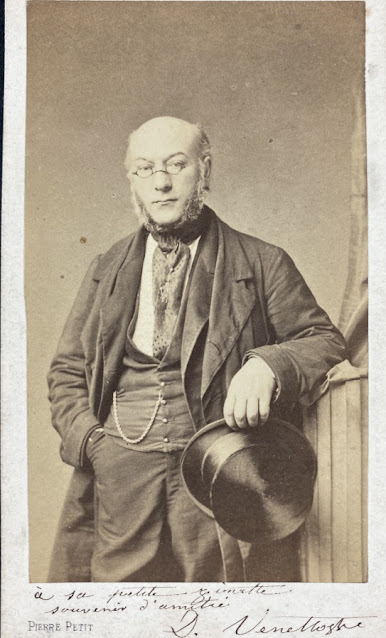
‘Mademoiselle Caroline’ was [Marie] Caroline Lasciat (var: Lassia). She had already risen, in the unphotographable 1840s, to being a ‘grande sujet’, dancing solos and pas de deux, mostly in support of a star., but occasionally toute seule. In 1852, she was referred to by a journalist as a ‘divinité secondaire’ of the troupe (but so were Robert, Taglioni and Marquet!), in 1857 Charles Biogne classed her only behind Rosati and Chouqui, in a peloton including Legrain, Nathan, Baretta et al. Which was not too bad: level two out of eight? So Mademoiselle Caroline was not a danseuse étoile, but she was an excellent performer, worthy of a featured spot in new ballets such as Le Corsaire, and that for nearly two decades. But there was more to come. Caroline married, around 1850, the Opéra viola player, Italian Dominique Pierre Paul Venet(t)ozza, and as ‘Madame Dominique’, after her performing days were done, became ballet-mistress at the Opéra and an internationally famous teacher of dance. Venetozza also took up teaching, but seems also to have found a better way to make considerable money which at his death (18 July 1894) he left to charities. Caroline had predeceased him (d Montrouge 1 June 1885), leaving a fine pedagogic legacy to French dance.


Caroline in pas de deux with star dancer Louis Mérante

Caroline in 1863

‘Mademoiselle Aline’ was actually Françoise Dorothée Dorlé (b Paris 2 March 1808), and a rather different kettle of fish. She, too, had been around a while before the coming of Napoléon, and had been a chorine at the Opéra and then a prima ballerina in the 1830s. At her return to the Opéra, she transformed herself into a character dancer and mime, to extend her career, as the favourite 'old woman' of the establishment, into the 1870s. She died, unwed, 9 March 1891 at Asnières. Of her private life I know nothing, but the occasional memoirist winks an eye, another tells us that at one stage she was 'all powerful' around the place, so I imagine …


Aline in later days

Louise Marquet (b Tours 12 May 1834; d Paris 22 December 1890). One of three (or was it five?) probably illegitimate sisters, followed her to-be-well-known siblings [Marie Louise] Mathilde’ (1826-1900) and [Josephine Victoire] Delphine (1824-1878), into the corps at the Opéra as a child, Louise, after her adult debut in 1849, found herself there a job for life. Since Delphine was the mistress of manager Nestor Roqueplan and Mathilde of Edgard Ney, ‘le Prince de la Moskawa’, she was well-placed. She, however, made her way on merit to the position of sujet, created many new roles – particularly those of the ‘superbe’ commanding type – over her long, and following her retirement from the stage, after nearly 40 years as a dancer, she became a ballet-mistress and teacher of deportment at the Conservatoire. The Marquet theatre legacy continued through Delphine’s daughter-in-law, ‘Louise Marquet’ née Loisel, and her daughter, actress Mary Marquet (1895-1979), while Mathilde finally married the baritone Marc Bonnehée (1828-1886). Louise apparently died a Mademoiselle. Whether she lived as one is rather obfuscated by the bright lives of her siblings.

Louise Marquet


My computer desktop is flooded with danseuses ... I shall deal with them tomorrow ... here endeth Chapter One.

1863

Mérante and Martha Mouravyeva


Tuesday, March 19, 2019

American (?) Amazons!

.
I came upon this photo earlier this week, during a momentary interest in chorus girls. What is it?


We have only one clue. The back is blank. Just the photographer's name.

So this is a bunch of chorines from an American show. Some time between 1871 and 1885, when Sarony was working out of that Union Square address. I would guess 70s rather than 80s.

So what in Olympus's name are those costumes? And the headgear? Valkyrie wings, Red Indian feathers. Chunky girls! 'Amazons' from one of the favourite pasticcio spectaculars of the time? Lassies from Vienna and Paris?  Ah, well, I'll find time, one day, to investigate. I got diverted towards the ballet-girls of Paris ...


Friday, March 15, 2019

The pretty Swedish girl .. from Brazil.

.
These little ladies smiled out at me from the pages of ebay today.


And I would be able to tell you their names, were it not that the show in question actually had two girlie choruses ... a dozen 'showgirls' and a dozen or so 'dancers'. Which are these? Can one 'dance' Allan K Foster's choreography in those shoes?


The show was titled The Girl from Brazil, and it was produced in America in 1916. But it was not an American musical. In mid-wartime, the piece was imported from Vienna. Of course, it was not allowed to remain unbotched and Die schöne Schwedin became, under the artistic direction of Mr Shubert, The Girl from Brazil. The score was diluted by numbers by a young man named Romberg.


DIE SCHÖNE SCHWEDIN Operette in 3 acts by Julius Brammer and Alfred Grünwald. Music by Robert Winterberg. Theater an der Wien, Vienna, 30 January 1915.
 The Stockholm banker Sven Liverstol (Ernst Tautenhayn) is in secret money troubles and anxious to marry his beloved daughter Hilma (Luise Kartousch) to the apparently rich young German Baron Heinz von Reedingen (Hubert Marischka). He is offered a large loan by Torkel (Karl Tuschl) and Schnorkel (Kurt Mikulski) on condition that the marriage takes place, but he is flung into desperate straits when his biggest customer, a dazzling lass from Brazil called Edith Lloyd (Betty Fischer), turns up and won't wait to withdraw her funds. And so there is no marriage, no Torkel-Schnorkel money, and when Edith goes off back to Brazil, with the actually underfunded Heinz as her secretary, she leaves the Liverstols thoroughly in the Swedish soup. In Act III, however, Edith finds her business in trouble through growing competition from one Sr Camberito. It turns out that Camberito is none other than the financially recovered Liverstol, and all can end with Hilma and Heinz at last together and with the money-marketing Edith and Liverstol joining hands and fortunes.
 Die schöne Schwedin proved something of a a disappointment at the Theater an der Wien and it was demoted soon after its 50th performance (16 March) to be replaced in the evening bills by Granichstaedten's Auf Befehl der Herzogin, a good-old-days piece which proved much more to the wartime public's taste than this often unromantic tale of financial dealings. Nevertheless, it went on to numerous other productions. It was produced in Munich starring Pia von Moosburg, Budapest was given Vilmos Tihanyi's Hungarian version, A szöke csoda (the marvellous blonde), it was foreseeably snapped up by Albert Ranf for the Stockholm Opera House and the Shuberts took up the American rights. In its American production the piece started out from New Haven 11 May 1916 under the curious title A Brazilian Honeymoon (perhaps a reference to the very first Shubert success, A Chinese Honeymoon), but by the time New York was reached, the lovely Swedish lass (played originally by Marguerite Namara, then by Beth Lydy) had given place to The Girl from Brazil (statuesque Frances Demarest) as the show's title. Hal Forde was Liverstol, John H Goldsworth played Heinz, and George Hassell had an enlarged comedy rôle as Torkel (Schnorkel had vanished). The American version was the work of Edgar Smith (book) and Matthew Woodward (lyrics), and Winterberg's 'above average' score was supplemented by the inevitable Shubert interpolations from the pen of Sigmund Romberg ('Bachelor Girl and Boy', 'The Right Brazilian Girl', 'Señorita', 'Come Back, Sweet Dream'). In spite of agreeable notices the piece remained only 61 performances on Broadway.
Germany: Theater am Gärtnerplatz, Munich May 1915; Hungary: A szöke csoda Budai Színkör 22 May 1915; USA: 44th Street Theater The Girl from Brazil 30 August 1916.


Monday, March 11, 2019

Musical theatre odd and pretty bits ..

 .
Some curious, or just plain nice illustrations which I've culled from the www which I'm storing here before clearing my desktop...


Who is this funny fellow? Joseph Proux? Preux? Prown? Photographed at Saint-Petersbourg in Barbe-bleue? I have a feeling that it might not be the Meilhac-Halévy-Offenbach Barbe-Bleue, but rather the féerie spectacular which was popular in the 19th century.


Date? 1860s? Looks like a German harlequinade group on tour. Alas on the verso they have only scribbled SCHWEDIN and a rather cheap rubber stamp of the photographer in Stockholm.


This pair clearly belong together. EINE NACHT IN VENEDIG. But where. Got it. Theater an der Wien. 1883. Arthur Guttmann as Bartolomeo Delacqua and Carl Lindau as Stefano Barbaruccio. What a pity the whole set isn't there. (Postscriptum: two years later two more, featuring Rosa Streitmann, turned up ...!) 


The inscriber didn't seem to really know what he was doing. It looks as if 'Lindau' was originally inscribed with the name of the third of the three comic Venetian senators: Franz Eppich. Someone please pop into the Vienna Theatermuseum and check out the likenesses?


Not much problem as to what this is. Gilbert and Sullivan's 'three little maids' (no matter how large and matronly they might be) were photographed in this pose across the world. This one is labelled as being from the John Stetson comic opera factory. David Stone tells me that the Yum Yum (centre) is the tiny Ida Mülle. 


so it would be 1886. They played at the Hollis Street Theatre in February ... so maybe one of the other 'maids' is Agnes Stone .. G&S experts, please ...


These pictures have been sourced in Slovakia, and the owner has labelled them just 'Italy'?. Unless there is something on the back to support 'Italy', I would guess that they are much more likely to be French or English. Because I reckon they are photos of a production of L'Auberge des Adrets, the hit French comic melodrama, played all over the world as The Roadside Inn, Robert Macaire or, musicalised, as Erminie. Macaire and Strop the comical thieves and the captured aristocratic bridegroom they impersonate ... ideas, anyone?


Here we have another Mikado, English, rather later, and assuredly amateur.

That's the end of today's 'mysteries', now some simply jolly pix


1920. Selwyn Theatre, New York. A 'musicgirl' comedy, which with Harbach, Mandel and the young Oscar Hammerstein as writers deserved a rather less coy title that Tickle Me. There were seventeen chorines (plus eight 'boys') of whom I imagine these are seven of them showing off their Charles Le Maire frocks.


Antonie Schläger (1859-1910) as what may be Santuzza at the Vienna Hofoper. Well, it certainly isn't Aida, Brünnhilde, Desdemona ..


I think I've posted this before, but it came up again today.


A delicious snap of the lovely Australian comedienne May Robson (1858-1942), doing her act. I wonder when, and in what ... probably not this!


Not rare, but charming. Fritz's famous lullaby (Fritz, our Cousin German), which, like 'Ah sweet mystery of life', in libretti since the ark, leads the long lost child to his sought ones


I just liked this cute picture of American star soubrette, Fanny Rice. She started her career in c1882, touring in The Gondoliers (Fiametta) and Patience (Ella), went on to play in comic opera with William Carleton, played Javotte in Erminie in Wanda to the Grand-Duchess of Lillian Russell, and spent some seasons with Rudolph Aronson at the Casino, before going out as a 'star' in farce comedy. Fanny remained active on stage and screen until the 1920s.


'We are the General's eight fair daughters'. In a palpable burlesque or imitation of the Major-General Stanley of The Pirates of Penzance and several other popular shows, James Mortimer bundled together the conventional book for Polly (1884). Edward Solomon's score and Lillian Russell in the title-role kept it afloat awhile ... and this photo survived.


Him. Baron Harry Archibald Campbell San Martino McLean Martin by any other name. I collect photos of him. So that one day -- ONE DAY -- Betsy Miller and I may explode the morass of lies and impersonations and false names surrounding this man ...


Donato, the more-than-briefly-famous one-legged dancer. Donato (whatever his real name may have been) first surfaces to my eyes, in 1864, at Vienna's Josefstädtertheater. So don't believe all the pieces you read about his being at Drury Lane in the fifties, or even of being a Spanish matador whose leg was gored off by a bull. The Garibaldian war seems a much more likely leg-severing place, if severed he indeed was, and of course Donato was the name of one of its 'heroes'. Among the many and varied tales spun about him, he is said to have been pre-named Juliano then Manuel, a member of the San Carlo ballet (before losing the leg) and a dancer in a tavern in Lyon (without it), and to have have danced  at the Marseille Alcazar, in the southern part of France and in Africa, some years before his Vienna 'discovery'. The reports of the time do not make it quite clear, but I think that he -- who danced gracefully, not comically -- wore a wooden leg ... which reminds me of a Swedish comedienne of more recent times who danced the dying swan with a wooden leg.


A long piece about 'Donato' in the Vienna press of 1866 has him as the son of a Count and a lady-in-waiting, as being more than one person (consecutively or simultaneously), as having two perfectly sound legs .. but at the height of the Donato-Epidemie in 1864 the press was already showing scepticism of the 'histories' of the various Donati ...


Anyway, the Vienna one proceeded to Kroll's Berlin, Brussels et al, as more and more other folk began imitating his act, he with his black servant, Marcellino, hied him to London and Covent Garden for the 1864 pantomime. I havent followed him up, but someone calling himself Donato was still performing in the Antipodes in the early 1870s. 


The great British musical ...


Imagine the voice of Charlotte Sainton-Dolby lending itself to 'I'm si....nging in the Rain"....


This is Leona Dare. Acrobat, dancer, body, otherwise Susan Adeline Stewart (Mrs 'Zoe' Hall) ... who has been mixed up, over the years, with various other gymnasts, male and female ... I think she was probably female?


 'Les Pattes Blanches, duo burlesque, émaillé de mots d’esprit et écrit sous une musique délicieuse, telle que Laurent de Rillé en a beaucoup'.

Why didn't I put Mons Laurent de Rillé in my Encyclopaedia? This looks like fun ... Les Pattes Blanches, produced at the Bouffes-Parisiens 20 May 1873 (not, Wikipedia, 1877) as part of a spectacle-coupé with, variously, Lecocq's Le Testament de M Crac (starring Debreux), Le Mouton enragé, Le Grelot (starring Anna Judic and Peschard) et al. Edouard Georges played Papa Loulou and Potel was Petit-Coco. The bill got the theatre closed down, but it was not the fault of this decidedly popular two-hander. It was repeated as an afterpiece to the saucy hit La Timbale d'argent, and played next season with Le Bouton perdu, Mariée depuis midi et al, and Desmonts replacing Potel as Coco. Its music was described as 'la brillante partition', the text as 'désopilante', and it remained in the repertoire for many years to come, being still played on stage and radio in the 1920s and 1930s.


Peschard (eig Marie Blanche Renouleau)

Alas, I haven't the script, but it is evidently a black-face comedy sketch in the line of Les Deux Aveugles, which one of the reviews summarised as 'the adventures on two Europeans caught up in a negro revolution, giving birth to a thousand hilarious bouffoneries'. Its particularly attractive score ('une musique fort gaie et fort lestement trouvée, toute composée de bamboulas et boléros comiques..'), from which a waltz-melody found its way enduringly into the 'charts' of the time.

Saturday, March 9, 2019

Autumn already ...


But Gerolstein's Wendy-tended gardens haven't quite realised it yet.

Large and small, showy and shy, the flowers of summer are holding on. Not yet, have we come to the 'Last Rose of Summer'!


More to come ..!