Portraits of the ‘Black Venus’
Last April, a surprising photograph appeared on the Wikipedia page devoted to Jeanne Duval, the long-term mistress of Charles Baudelaire and the “Black Venus” who inspired some of the most powerful poems of Les Fleurs du mal (1857; The Flowers of Evil). Baudelaire’s feelings about Duval were complex, ranging from love, affection and pity to hatred; he wrote in 1845 that she was his only consolation, in 1852 that she had become an obstacle to his happiness and writing, and in 1856 that he craved her company. It is hard to imagine what his poetry would have been without her. If this striking photograph is of Duval, and I think it is, its discovery matters, because we know so little about this key figure in the Parisian artistic world of the time, who has nevertheless faded from the record, written out by snobbery, racism and general bad luck.
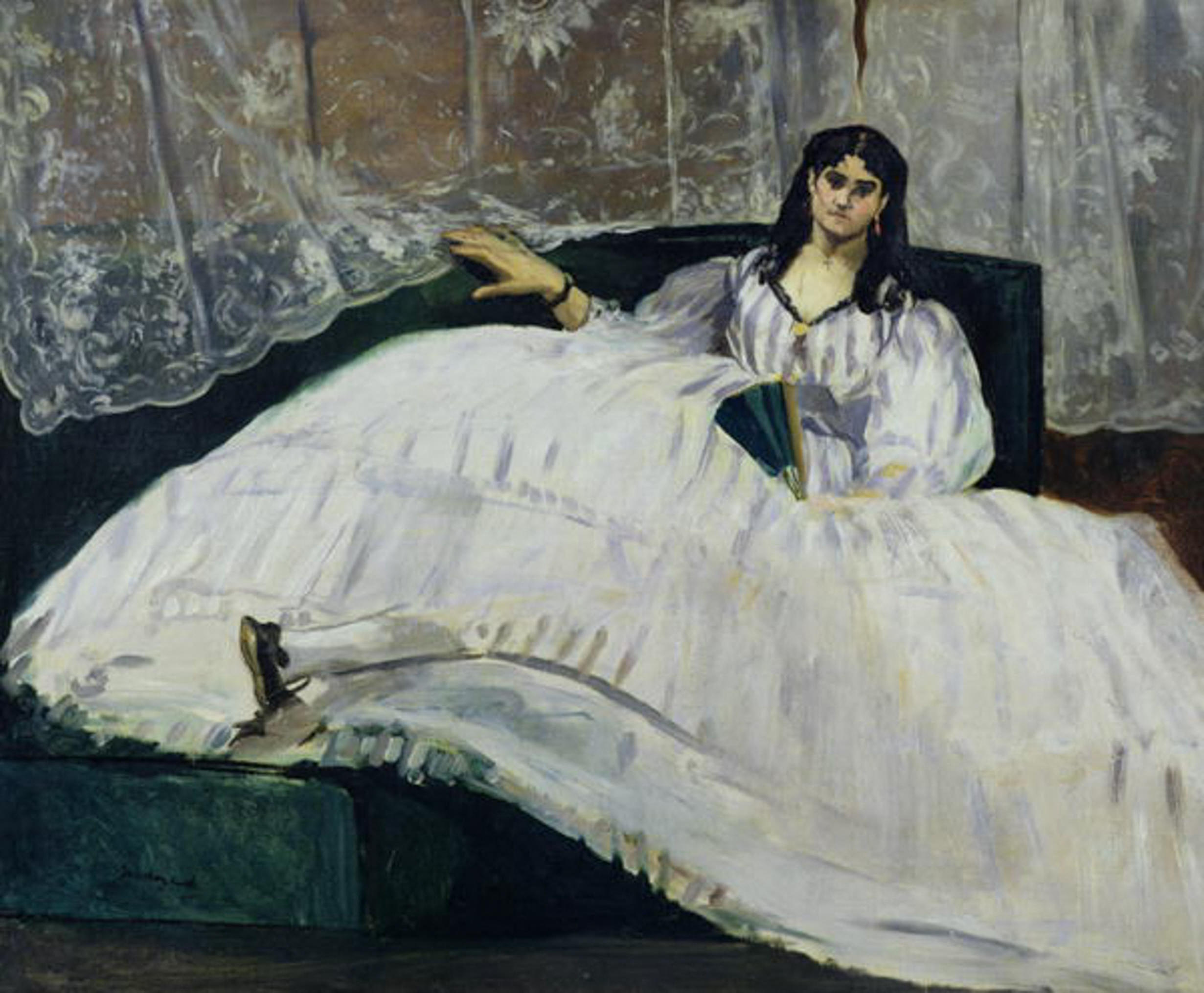
Until now, there have been no confirmed photographs of Duval, though it has sometimes been speculated, notably by the artist Maud Sulter, that she is the subject of a Nadar photograph, apparently from the 1850s, entitled “Young Model” (Duval would have been around forty at the time, but the title may have been playful). We do have some clues as to what she looked like. The photographer Nadar (a.k.a. Gaspard-Félix Tournachon) recounted that as a very young man he saw her speak one line, in a minor role on stage, and was immediately smitten by her electrifying beauty and her untouchable, aloof air: he claimed to have taken her to bed immediately afterwards. Baudelaire sketched her with large eyes, lips and bust, dark hair and a narrow waist. A shadowy image of her emerges from the corner of the canvas of Gustave Courbet’s “The Painter’s Studio” (1855), just above Baudelaire’s head, where the artist has scratched her out, for unknown reasons, but apparently at the poet’s request. (Perhaps they had argued, or one of them disliked the portrait.) In 1862, she was the apparent subject of a painting by Édouard Manet, usually entitled “Baudelaire’s Mistress”. This title was confirmed by Manet’s wife, Suzanne, after his death, during a studio inventory, but some scholars have questioned the identity of the sitter. The rigid pose and facial expression are often explained by Duval’s partial paralysis, after a stroke, likely syphilis-induced, in 1859. I will return to this strange painting, enigmatic like so much of Manet’s work.
In 2024, Ali Kilic and Catherine Choupin, two French researchers working independently of one another, published archival evidence indicating that Duval was born in Haiti in 1818, travelled to France in 1821 and died in horrendous conditions in a Saint-Denis poorhouse in 1868. We know that people saw her as a woman of colour, and that she was often criticized in her own time and afterwards on racist grounds, as Therese Dolan and Robin Mitchell have convincingly shown, but we know too that she may only have had one Black grandparent. We know that she also went by the surnames “Prosper” and “Lemer”, and that she worked for a time as an actress, probably using the stage name “Berthe”. We know that she could read and write, but was not always an admirer of Baudelaire’s poetry, or particularly interested in talking about politics and literature. We also know that Baudelaire’s mother disliked her and burnt all of her letters. But we have little sense of who she really was, or what she thought and felt.
And suddenly here it was, on the Wikipedia page devoted to her, a photograph allegedly of Duval, as if out of nowhere. Some light digging revealed that the photograph had first been posted online in early 2021, on a subscription-only blog (A Writer’s Notebook) by a Paris-based American writer, Summer Brennan. Brennan suggested that the photograph was of Duval, citing a couple of descriptions by those who had met her and comparing the image to Baudelaire’s drawings. She had found the photograph on a small carte de visite in the archives of the Bibliothèque nationale. The card – about the size of a business card of the kind produced on an industrial scale in the early 1860s – has the name “Jeanne” handwritten on its front and back. The back shows the renowned red signature imprint associated with the photographic studio of Nadar, and a date: August 18, 1862.
As of today, the photograph does not appear in the extensive online archive of digitized Nadar photographs held by the Bibliothèque nationale. Nor does it feature in the Musée d’Orsay’s collection of Nadar prints. Until its appearance on Wikipedia, in fact, the image seems only to have existed in the alphabetically organized boxes of cartes de visite stored in the Bibliothèque nationale’s archives in Paris, and on Brennan’s Substack. It seems incredible that nobody had noticed it before.
As a Baudelaire scholar, I was initially bothered by a few details. While there is no evidence that Duval ever had much money, in 1862 – the date given on the back of this photograph – she was definitely broke. We know that on leaving hospital in March 1861, Duval had been obliged to sell her furniture to pay debts, and that in early 1862, she had asked the poet’s mother for money and tried to sell some of his books and drawings to his friend and publisher Auguste Poulet-Malassis. It is extremely unlikely that she could have afforded the elegant clothes that the woman in this portrait wears. Duval was described by Baudelaire, long before 1862, as an old and sickly woman, and scholars have taken this description literally, despite the fact that she would only have been in her forties at the time. But the woman in the photograph looks neither aged nor frail. Finally, the woman in the photograph is wearing a ring on her wedding finger. She and Baudelaire were never officially married, and by 1862 it is generally agreed that they had separated definitively, after nineteen years together.
These quibbles seemed to hinge obscurely on the 1862 dating of the portrait, so I set out to discover whether the card portrait had been recycled from an earlier print, perhaps from before Duval’s stroke of 1859, which left her weakened by paralysis on her right side. I trawled the online archive of Nadar photographs to see if I could find clues that would help me confirm the date of the photograph. The best lead I found was the background prop in the carte de visite: a round, polished brass table top with a black spiral stem. The same table features in at least three other card portraits made by Nadar in 1862, which makes the 1862 date plausible. Further research revealed something unexpected: in total, I found twenty-three other (undated) photographs featuring the table, all differing in three key respects from the photograph of “Jeanne”.
In each of these portraits, the sitter is photographed leaning one elbow on the table. “Jeanne” is not pictured in this way. Also, in none of these portraits is the sitter photographed full-length, as “Jeanne” is. Finally, no other sitter wears a hat, the elegant table appearing to indicate an indoor setting. What could explain these anomalies?
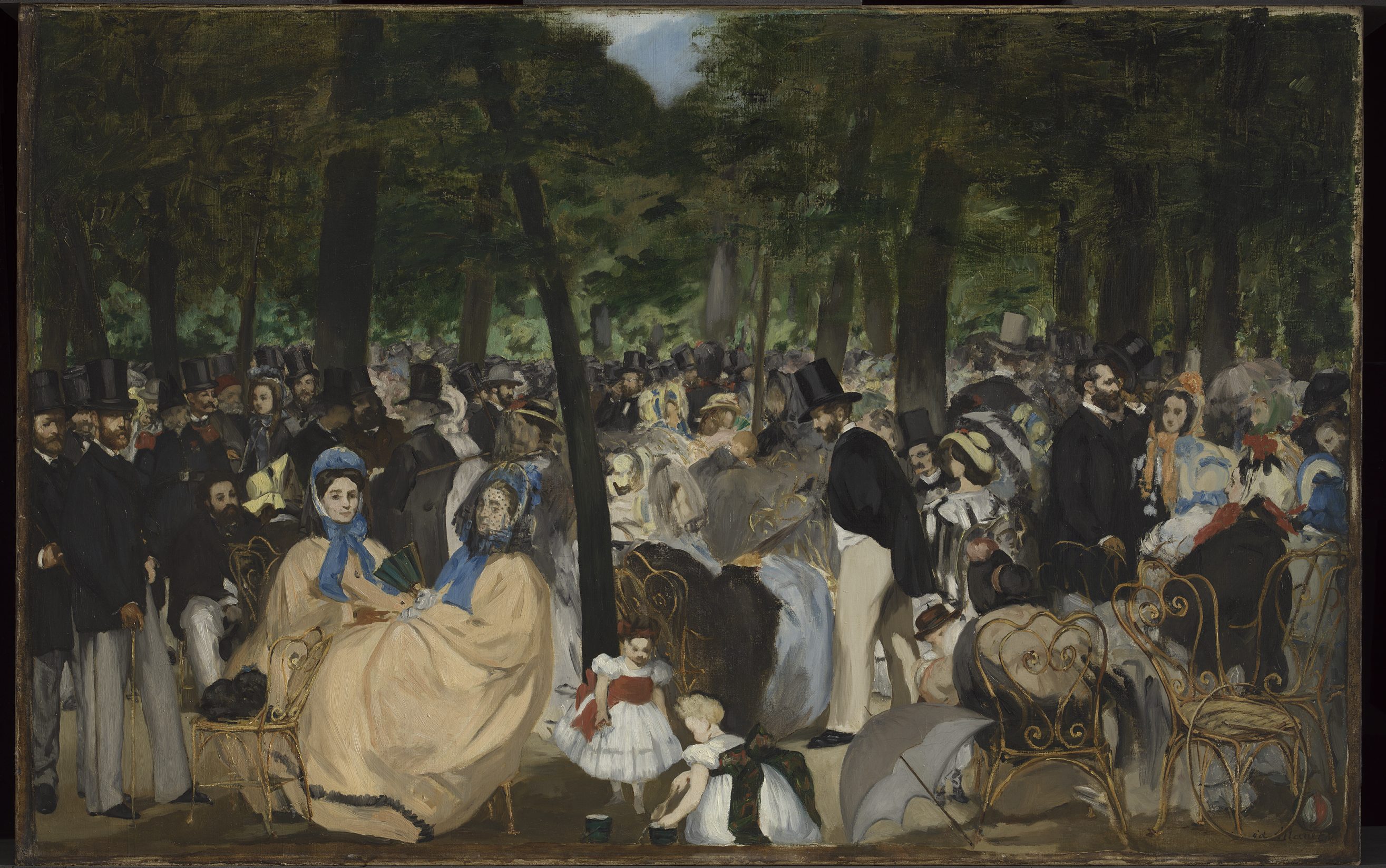
Brennan had noticed that the bonnet and bow worn by the photographed sitter are fashionably similar to those that feature prominently on the women dressed in yellow in Manet’s famous group painting of 1862, “Music in the Tuileries Gardens” (© The National Gallery, London). Intrigued by this similarity, and by the position of the woman on the left just below the painted profile of Baudelaire, Brennan wondered initially if Manet had intended “some stealthy (albeit whitewashed) nod to Jeanne herself”, though she decided that coincidence was the more likely explanation.
As it happens, her astute observation indirectly confirms the photograph’s date. After all, fashion is ephemeral by definition, as Baudelaire himself observed in his essay “The Painter of Modern Life”. In fact, referencing Brennan’s post, Justine De Young’s recent book The Art of Parisian Chic: Modern women and modern artists in impressionist Paris (2025) reproduces two fashion plates from summer 1862 to highlight precisely how “on trend” Nadar’s Jeanne is, with details such as the black ostrich feathers pinned to the crown of the straw hat, and a lapel at the back “to protect the neck from the sun”.
But Jeanne’s appearance tells us even more than the likely date of the photograph. Her posture and outline closely match those of the woman on the left in the foreground of Manet’s painting. The photographed sitter, like the painted woman on the right, is also holding a fan. We know that Manet often worked with photographs and cartes de visite in the production of his paintings. Could the photographic portrait of Jeanne have been intended to help him place her at the heart of his painting of Second Empire Paris? Scholars have long seen this painting as a kind of homage to Baudelairean aesthetics, with which Duval was closely associated. The possibility that she was modelling for Manet’s “Music in the Tuileries”, presumably for much-needed money, would explain her fine clothing – he could have lent the outfit to her. It would also explain why the photographed sitter is, unusually, seated in front of the table, pictured in full length and dressed incongruously in a bonnet.
Further suggestive of a link to Duval in Manet’s painting is the fact that the woman on the right, in the foreground, displays a fan that looks identical to the one held prominently by Duval in Manet’s “Baudelaire’s Mistress”, which, like “Music in the Tuileries”, was painted in 1862 (one of the titles it goes by is “Lady with a Fan”). It is striking, too, that the hands of the woman on the left are painted brown, ostensibly to suggest gloves, but also connoting dark skin, while the woman on the right wears a black veil. In Madame de Duras’s celebrated novella Ourika (1823), a piece of black crepe is used symbolically to represent dark skin when it is worn by the dancing partner of the female, African-born protagonist. To the left of the women, a black furry animal, sometimes read as a cat, sits on a chair. Baudelaire compares Duval to a cat in his poems: her gaze, like a cat’s, “cuts and splits like a dart”, and her body, like a cat’s, is “elastic” and “electric” (“Le Chat”; my translations throughout).
There is more. While viewing the photograph of the seated Jeanne in the Bibliothèque nationale, I came across a second carte de visite attributed to “Jeanne”. In fact, there were several of women called Jeanne in the box, but this one was dated August 18, 1862, the same as the first card portrait. It, too, was a Nadar photograph, and an examination of the legal deposit register showed that it was registered as “idem” (the same), just beneath the entry for the first carte. This second Jeanne, standing rather than seated, was wearing different clothes, looked more fair-skinned and appeared to have straight rather than tightly curled hair. She did not, at first glance, look like the same person. However, this woman shared the ballerina-like shoulders of the seated Jeanne: dropped shoulders are also a feature of some of Baudelaire’s sketches that are presumed to be of Duval. (Both Brennan and De Young mention the sitter’s curved shoulders.) In addition, the records held by the French library show that no other Nadar card portrait was made of a “Jeanne” in 1862, so why would a second one have been made on the same day unless it was of the same woman?
I ordered a high-resolution copy of the tiny card portrait and, after a few weeks of nervous waiting, finally saw what I was hoping to see: a close-up of the face shows that the standing Jeanne shares the same hairline as the seated Jeanne. She has the same blemish in the centre of her forehead and she wears a ring on the same finger. It looks, too, from the slightly long left arm and the dress fabric pooling on the floor, as if this allegedly very tall woman may be propped on a stool from behind to mitigate the effects of her partial paralysis. This would explain the tensed neck as well as the stiff posture, which is highly uncharacteristic of Nadar’s photography.
There is another thing that I was hoping to see, apart from a resemblance to the seated Jeanne. I had noticed, on close inspection of the miniature, card version of the photograph, that the standing Jeanne was wearing large earrings and had a piece of jewellery around her collarbone. The high-resolution reproduction revealed that this piece of jewellery was, as expected, a crucifix. The woman in “Baudelaire’s Mistress” also wears a crucifix high around her neck, as well as large earrings. Her expressionless face, her slightly downturned mouth, the shadow below her mouth and the continuation of her hairline below the top of her ears match the features of the standing Jeanne. In both the painting and the photograph, the subject stares directly at the viewer.
The physical resemblance between the photograph and the subject of Manet’s painting is particularly striking in the watercolour study for “Baudelaire’s Mistress”, but the emotional, expressive likeness is stronger in the oil painting . The art critics Griselda Pollock and Therese Dolan have previously suggested that Manet worked from a photograph, and even a carte de visite, in his portrait of Baudelaire’s mistress. The photograph of the standing Jeanne from 1862 is almost certainly that card.
It is impossible to be sure that the two 1862 Nadar photographs of “Jeanne” are indeed of Duval, but I believe that – thanks in particular to Manet – there is enough circumstantial evidence to validate the identification. The two photographs are, in turn, important for the new readings they open up of Manet’s art. The possibility of an oblique connection between “Music in the Tuileries” and “Baudelaire’s Mistress” opens the way to a new interpretation of the group painting. Could the bearded man a little to the left of Baudelaire, wearing what resembles (thanks to the Phrygian bend applied by a strategically placed top hat) a red revolutionary cap, be Victor Hugo, the same man discreetly alluded to in “Baudelaire’s Mistress”, according to Dolan, who finds a reference to Hugo in the ghostly lace motif at the fingertips of the phantom-like sitter?
Hugo was in exile on Guernsey at the time, in protest at the government of Napoleon III. By referencing both Duval and the author of the recently published Les Misérables in “Music in the Tuileries”, the Republican Manet may have wished to inscribe discreet allusions to absent figures, or ghosts, at the heart of his apparently celebratory depiction. Indeed, some Manet scholars, such as Nancy Locke, have discerned the hazy figure of a woman carrying a baby just to the left of the man in the top hat standing in the centre foreground of “Music in the Tuileries”. Her ghostly presence, along with the possible allusions to Duval and Hugo, could gesture towards those humans whom the government preferred to push into the margins, most notably in its sparkling transformation of the city of Paris around this time.
The photographs of Duval are not just important for what they tell us about Manet, and they are not just valuable, either, for the story they may tell about her connections with three famous French men of the nineteenth century (who happened to be close friends). They are also highly significant because they tell us something of Duval’s side of the story. This is important, because her letters have not survived, and the stories that have been told about her, both in her own time and afterwards, have often condemned her as Baudelaire’s immoral and unfaithful tormentor. These two newly discovered photographs tell us, first of all, that Duval wore a wedding ring, despite never having been officially married to Baudelaire (or anyone else as far as we know). Did she consider Baudelaire to be her husband, even after their separation? She also wore a crucifix around her neck, something that Manet’s portrait had already indicated. One of Baudelaire’s poems inspired by Duval, “Jewels”, describes her as naked but for her “sonorous jewels”: “Eyes fixed on me, like a tamed tigress, / With a vague and dreamy air, she tried out poses”. It is hard to imagine a crucifix in this context. In fact, neither the wedding ring nor the crucifix sits comfortably with the legend passed down to us of Duval as a diabolical seductress (even if the riding crop she holds in her left hand, in the standing portrait, gives pause for thought).
The photographs testify, too, to Duval’s strong-mindedness and independence: how psychologically challenging it must have been for her, as an impoverished, partially paralysed woman, to present herself at the fashionable studio of a former lover, and what a physical ordeal her changes of costume must have been. Recent archival findings appear to show that she spent her last years journeying daily across Paris, presumably on crutches, to work as a hospital cleaner, before dying in the poorhouse in 1868. While the Nadar card portraits, taken just a few years previously, do not evidence quite this level of fortitude, they do suggest that in 1862 Duval was more self-reliant and resourceful than scholars have generally understood, and certainly not the “old, infirm woman” described by Baudelaire in a letter of 1861.
Duval is associated, in Baudelaire’s poetry, with the triumphant transcendence of physical constraints through the senses and the imagination: “Are you not the oasis where I dream, and the gourd / From which I slowly drink the wine of memory?” (“The Head of Hair”). If these newly discovered photographs tell us anything about Duval, what they say has very little to do with transcendence, and everything to do with resilience. What these photographs confirm above all is Duval’s strength of character, and that is surely what Manet was trying to capture in his portrait of her.
Maria C. Scott is Associate Professor of French Literature and Thought at the University of Exeter.
Reply there came from Cambridge
Not the least interesting section of Maria Scott’s closely argued piece on Baudelaire’s “Black Venus”, Jeanne Duval (Commentary, January 23), concerns her laying to rest of her initial “quibbles” concerning the recent Wikipedia assumption that Duval is the “Jeanne” who features in a carte de visite photograph by Nadar from 1862. My own “quibble” is fundamental: the “Jeanne” in both this photograph and a second one discovered by Professor Scott herself, and taken by Nadar on the same day, is not Duval at all. The clue is contained in the handwritten inscription (by person unknown) that appears on the second photograph: “Jeanne (Mlle)”, a conventional form of stage name adopted by Parisian actresses at the time. Virtually nothing is known about Mlle Jeanne, but she certainly appeared at the Bouffes-Parisiens as the second page in the original version of Jacques Offenbach’s Geneviève de Brabant (1859) and, it now seems, in other roles.
Scott rightly acknowledges that the strikingly different outfits in the two photographs are at odds with Duval’s impoverished state in 1862. They are, however, perfectly appropriate to the actress Mlle Jeanne. They are theatrical costumes and, aided by related attention to make-up and coiffure, may be seen to advertise the actress’s versatility. Further research might lead to identification of the roles. That two such different photographs should have been taken by Nadar on the same day need therefore no longer arouse surprise.
A blog of June 2019 by “Kurt of Gerolstein” (the music theatre historian Kurt Gänzl) mentions Mlle Jeanne as one of the actresses of the Bouffes whose images formed part of a collection he had come across in a photographer’s catalogue (kurtofgerolstein.blogspot. com/2019/06/ladies-of-bouffes-parisiens-1855-1860.html). Gänzl reproduces an undated photograph of her in a visually different role, not by Nadar this time, but by the establishment firm of Mayer et Pierson. It may also be viewed currently on French eBay. It bears on the reverse side the annotation “Jeanne (Bouffes)”.
Michael Tilby, Selwyn College, Cambridge
Purely on skin-colour, I don't think either of the Mlle JEANNEs pictured on my blog could be described as 'the black Vénus'. As the correspondents note, there were a number of Mlle Jeannes around at the time. The photos are taken from the archive of photo discovery.
https://kurtofgerolstein.blogspot.com/2019/06/ladies-of-bouffes-parisiens-1855-1860.html