Monday, May 31, 2021

Coalminers and Cabaret


Fun photos on the shop-shelves this morning. From out-of-the-way (to me) places.

This one first. Four jolly lads from all corners of the world ...  dated 1930 ... names (once deciphered) are a real mixture ... so it has to be that European melting-pot known as the United States of America. But where? Is the Litchfield Ice Cream sigh a clue .. no.


Well, I can now tell you that this photo was taken in Hillsboro Township, Montgomery, Illinois. A township largely dependent on coalmining. 


And the jolly lads are (possibly in no particular order):

(1) Ernest Silvio MENGHINI from the Austro-Italian Tirol. Born 31 October 1899. Coal miner. Married to Delores (1900-1990). Two daughters and two sons. Died Hillsboro/Taylor Springs 14 March 1985.

(2) Anton ('Tony') VANZO born in Austria 11 May 1881. Coal miner. Married to Josephine Menghini-Ruffini, so, I presume brother-in-law to (1). He must be the one in the dark suit, aged 49 here. So does the naming go right-to-left?.

(3) Anton ('Tony') GLADINUS born in Leeds, England of Lithuanian parents (Frank and Margaretta) 8 December 1909. Married to Harriet Virginia née Holt (later Mrs Jas E Kenney, d 4 October 1990). Daughter Melody (b 22 July 1935). Son Thomas (b 16 January 1950). Labourer at the American Zinc Company. Died 1978.

(4) 'Sonny' Maxwell Leroy CLOTFELTER born Hillsboro 26 April 1910. Married Leora, then Mildred. Daughter. Here, a clerk in a feed store. Later worked for the water and sewage department of the municipality. Died 12 March 1964. 


The other eye-catcher was this set of three posted from Estonia, no identifaction, no date ... just the name, so I'm told, of the person to whom they were sent" "to defender N D Litvinov". Defender? Defending what and against whom? But then Russia during the early 20th century was usually attacking something or somebody. So that's not much help.


Anyway, here they are.


(2) and (3) might just be a school gymanstics team. Teacher, middle front? But (1) more or less gives the impression that the ladies are trying to entertain. The jockey dance? Oh dear, and one of them dared to smile ..  Siberia for you, ducky! 
The ebay vendor labels them 1920s. But he also labels them 'sexy nightclub dancers, pin-up style'. I wonder if he/she has more information than he/she is giving us. 


I'm a pretty good decipherer, but that is way beyond me ... and as for 'sexy' .. well, each to his own!

Decipherment (1): The first line: Village Tschutovo in the County Poltava
2nd line: For the Defender
Third line: Litvinof (Aparently a family name)


Saturday, May 29, 2021

Constance Drever: 'La Veuve Joyeuse'


It's lustige Witwe time ... after Emmy Wehlen, we have Paris's first Veuve jouyeuse ... 

DREVER, [Annette] Constance [Scott] (b Coonore, Neilgherry Hills, Madras 19 September 1879; d Edmonton, Alberta, Canada 21 September 1948) 


[Annette] Constance Drever, was born in India. Her father, and his father before him, natives of Scotland and the Orkneys, were both, in their time longterm employees of the East India Company and Indian army officers. Grandfather, Lt-Col James Drever, of Sanday Island, Orkney, had died of sunstroke while leading the assault on the fortress of Chinkiang Foo, China (21 July 1842).


Later, in a characteristically straightforward interview, she would say that her family had its roots in Norway and the Orkneys. But that was not all. Grandmother Drever's maiden name was Maria Gertrud Werner, and she had been born in South Africa.

Father Colonel William Scott Drever, 'Companion of the Star of India and of the Madras Staff Corps' (b Edinburgh 22 July 1830; d Madras 12 July 1883) married a not-so-distant relation, Miss Eliza Drever Leisk (b Shetland 17 February 1845; d London 10 March 1927) daughter of Robert Leisk, merchant, and his wife Elizabeth née Drever. Yes, sister of the sunstruck soldier! And from Orkney.


Constance related in her interview that her first languages were French, German and a smattering of Hindi, but English would have arrived pretty soon, for the Colonel and his family spent her early years going backward and forward between Britain and the Indian subcontinent, although she was apparently schooled in a Brussels convent. She began her musical studies with one of the multitude of Signors who infested the London music world, then 'progressed' to the care of the Irishman who called himself 'Odoardo Barri'. She took lessons in Paris from a more appreciable teacher, former tenor, Élie Téqui (1842-1927) but, returning to Britain, finally came to rest with another tenor, former Wagnerian Edwin Wareham.


She made a dramatic first appearance on the musical stage when she was promoted at three days' notice, from a minor rôle, to the star part of Kenna for the opening night of Edward German's A Princess of Kensington (1903), in place of ailing prima donna Agnes Fraser. 


She 'pleased greatly' 'by the fine quality of her voice and cultivated style'. She subsequently went on a short tour with a 'flying matinee' concert party headed by actor George Alexander, and including in its ranks fortyish and fading tenor Frank Boor (b Rio de Janiero, Isidor Notador in Poor Jonathan (1893), Dramaleigh in Broadway’s Utopia (Ltd) (1894), t/o Katana in The Geisha (1896), t/o Lollius in A Greek Slave (1898) etc). The couple were married in Edinburgh 5 September 1905. Boor became a theatrical agent, while Constance's career took off.


She returned to the theatre to tour in the title-role of the comic opera Amasis (1907) alongside Rutland Barrington, 


and then tour in the star rôle of Sonia (ex-Hanna) in George Edwardes's production of The Merry Widow ('sings with a character and power possessed by very few light opera singers') and to later take over from Elizabeth Firth as Natalie (ie Valencienne), and then as Sonia at Daly's Theatre. 


After an appearance at the New Theatre in the title-rôle of a revival of Dorothy, she went to Paris and there created the part of Missia (ex-Sonia, ex-Hanna ex-Die lustige Witwe), otherwise France’s La Veuve joyeuse, for Alphonse Franck at the Théâtre Apollo ,with enormous success. Her performance left such a mark on the piece and the rôle that for many years the star rôle of La Veuve joyeuse, written by de Flers and de Caillavet as an American, though subsequently taken by the French artistes Suzy Delsart and Jenny Bernais -- was, decidedly curiously, given the original plot -- obligatorily played in France with a strong English accent.


Nadina


Back in Britain, she introduced `My Hero' to Londoners in the rôle of Nadina in the English version of Oscar Straus's Der tapfere Soldat (The Chocolate Soldier, 1910, 'sang superbly') 


Tapfere Soldat


and then moved on to star as Rosalinde in a remake of Die Fledermaus called Nightbirds (1911), as Lizzi Flora in Straus's short-lived The Dancing Viennese (Eine vom Ballet, 1912) at the Coliseum, as Tatjana in Kerker's Grass Widows (1912) and, in succession to Gertie Millar, as Lady Babby in the rewritten Zigeunerliebe (Gipsy Love, 1912).


After making a music-hall début at the Coliseum, she thereafter spent much of her time singing on similar programmes ('wonderful powers as a singer of high-class songs') and she played out the last decade of her career as an actress (A Wife's Dilemma, 'Dreamland of Love') and vocalist on the variety stage and on radio.

Presumably divorced from Boor, she remarried, in 1923, the much younger Carl Rosa Training School baritone [Hugh Clayton] Randall Stevens (b Streatham Hill, 22 September 1896; d St Ouen, Jersey 3 July 1977), and they can be seen supporting comedian Stan Parkin in the revue Ring up the Curtain, in the provinces, the following year. They also had a son, Murray Scott Stuart Drever Randall-Stevens. According to the British records, they had him three times, before and after marriage. I think the one born 1926 may be the right one.


Constance had now, it seems, put an end to her performing career.

I see the spouses living at 131 Wigmore Street, and later at Julian Hill, Byfleet Rd, Weybridge. And I see Captain H C Randall-Stevens -- yes, he had been an RAF flying officer in the Great War -- going resoundingly bankrupt. In 1939 they are at Pine Oaks, Droxford and he is 'author and operatic singer' aged 43. Constance has knocked nine years off her veritable age. Author? I'm afraid so. The Teachings of Osiris. The Wisdom of the Soul. Atlantis to the Latter Days as inspirationally dictated through 'El Eros' to H C Randall-Stevens, The Book of Truth or The Voice of Osiris 'automatic drawings received by ..'. Oh Constance, you married a baritonic Captain and he turned into a complete charlatan!


Son Murray married Sheila Thompson in 1946, and at some stage the couple moved to Canada. Cariboo, British Columbia. I guess Constance was visiting him, or perhaps sister Margaret Lizzy Gertrude, when she died in Edmonton, aged 69. Hugh as well. I see Hugh Randall-Stevens, teacher in Edmonton's 98th Avenue. Teacher? I dread to think of what! But he was busy turning himself into a 'personality'


The Captain  returned home (1949), remarried (1952), lived in Hampstead, founded (1954) 'The order of the Knights Templar of Aquarius', wrote his books, and died at La Maison de Léoville in Jersey 3 July 1978.

Murray died 2 March 1976 in Houston, BC., leaving issue ... so maybe the line of 'La Veuve joyeuse' lives on.


When I posted this article, Katie Barnes sent me some more photos ...


and a grand story. When La veuve joyeuse was revived at the Châtelet in Paris, in 1982, whose photo was on the posters, and featured in the foyer .... why, our Miss Drever!


Thursday, May 27, 2021

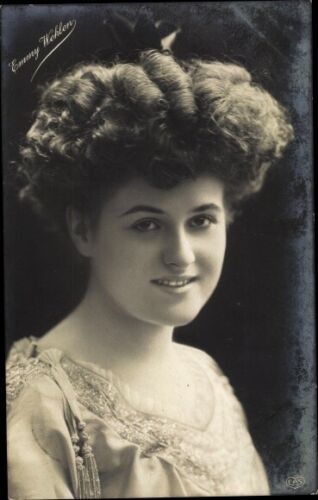
Emmy Wehlen: singing screen syren of the silent days


When I wrote the first edition my Encyclopaedia of the Musical Theatre, the Internet had not been invented. I had to exhume my history from libraries round the world. Now, of course, we have information (and a vast deal of mis-information) in our homes, at the click of a mouse. I am proud to say that surprisingly little of what I wrote a quarter of century ago has proven to be erroneous, but I have managed to fill in a thousand gaps in dates, names and facts, and some of my little articles could really do with a wash 'n' brush-up.

This was brought home to me, for the umpteenth when my friend, Dr Kevin Clarke, asked me for my lines on Emmy Wehlen. Well, the were all right as far as they went. But things like real name and dates of birth and death are important to an Encyclopaedist, and Emmy's were lacking. So I decided to spend the couple of hours before heading down town for my promised lunch of garlic prawns and pasta in seeing if I could dig up some of the missing data.

Well I got some of what I needed. The article now reads


WEHLEN, Emmy [WECKESSER, Emma Louisa] (b Mannheim, 25 August 1886; d New York, 1 January 1980).

Glamorous German singer who abandoned the musical stage for films.

The 'wunderhübsche' Emmy Wehlen began her career in the musical theatre in Stuttgart, Munich and in Berlin, where she was a member of the company at the Thalia-Theater in 1907-8 (Ihr Sechs-Uhr-Onkel, Doktor Klapperstorch, Das Mitternachtsmädel, Magda in Die Brunnen-Nymphe), before being taken to Britain to tour in the title-rôle in George Edwardes's production of The Merry Widow (1909). She appeared next as the gold-digging Olga in Edwardes's version of The Dollar Princess, in London and in the British provinces, then crossed to America to star in Ivan Caryll's Marriage à la Carte (1910, Rosalie) and as another fairly merry widow, Mrs Guyer, in Ziegfeld's remake of A Trip to Chinatown as A Winsome Widow (1912), ‘singing “Reuben, Reuben” as if it were the latest thing from France’. France? Pretty Miss Weckesser from Mannheim insisted to the eager press that she was Viennese ... "When they say I am Dutch it makes all my Viennese blood boil". I wonder why.


Scheduled for the star rôle in Broadway’s The Lilac Domino she dropped out with what was said to be appendicitis, and instead took the rôle of Winifred ('Freddy') in the German musical comedy The Girl on the Film both in London and then in New York, replaced Isobel Elsom as the heroine of After the Girl at the Gaiety Theatre, and then returned to America with the British company which played Tonight's the Night there in 1914.


Denying even more strongly, now, her German nationality (her brother Max was in the German army), she remained behind when the company returned to wartime Britain, and she soon abandoned the musical stage for the silent screen where she became a favourite and much-publicised leading lady between 1915 and 1921.


She made her motion picture début in Metro’s When a Woman Loves and appeared thereafter in such often slightly daring pieces as The Amateur Adventuress (`the story of a girl who wanted to know the meaning of the word life!'), the serial Who's Guilty?, Vanity, Fools and Their Money, For Revenue Only, Nine Tenths of the Law, Sowers and Reapers, The Duchess of Doubt, Lifting Shadows, The Pretenders, The Trail of the Shadow and The Outsider (`she determined to become an adventuress ... she succeeded beyond her wildest dreams!').


She then vanished from showbusiness annals, as Mrs Richard Averill Parke, wife of a well-off soldier and Olympic bobsleigh champion. The couple indulged in plentiful travel and Parke, 'of Staten Island', died in Switzerland in 1950 of cancer and cirrhosis of the liver. Mrs Emmy Parke is said to have lived until 1977.

The Mannheim archives record Heinrich August Weckesser (d Mannheim 26 January 1911) and his wife Maria Luise Wilhelmine née Teghtmaÿer with 'dessen Tochter' Emma Louisa born 1886, rather than the 1888 she later inscribed on her passport. Perhaps because the date of Emmy's birth was a few months too close to her parents' marriage.


The American records seem to show her marriage in two places in several different dates between 1919 and 1921, but always to Mr Parke.

And her death? Said to be in 1977. But I haven't yet found out the when and the where. I assume America. Between their various travels, Mr and Mrs Parke lived at 160 E56th Street. Between 1953 and at least 1962, I see her in residence at the Hotel Surrey at 20 E76th. America had been her home base for over half a century, and after being German, pretendedly Austrian, and naturalised British, she had become American by marriage. 

Post scriptum: Ms Irene Zweck writes 'Emmy Wehlen is my aunt and she died 1 January 1980 in New York'. So I guess she did!

So we nearly have the vital statistics sorted. Nearly.  As for the career, there were probably more, ephemeral moving pictures in those busy, starry years during and just after the war, and there will be a few more theatre credits hidden in the Stuttgart and Berlin newspaper archives, but I think we have the backbone assembled.


The beauteous Emmy spawned hundreds of photographs and postcards, decorated many a magazine cover and page three interview or theatre column, but although her career was not a long one, it is fun to see her image develop from that of a lively young leading lady, as in her German 'wunderhübsche' years


and her more porcelain English years


to the sophisticated 'adventuress' of a few celluloid years later


Post scriptum: Chris Zwarg writes that 'Miss Wehlen recorded about twenty sides for German Zonophone (plus a solitary German Edison cylinder) in 1907 and 1908. All of them are inordinately rare, both because of two world wars having bulldozed over humble cultural artifacts such as these, and because popular music was not considered very collectable for too many decades. Interestingly, besides excerpts from the Thalia-Theater pieces she appeared in, she also did a few cover versions of Massary's Metropol-Theater "hits" of the day, and a parodistic medley (to funny words by Henry Bender) on Die Lustige Witwe.'


Now WHAT rôle is that!!!?