This ceramic lady stared down at me, from above my piano, in the early 1950s. I found her a bit off-putting. My mother loathed her. Vater must have liked her, though: he'd brought her all the way from Vienna to New Zealand in the late 1930s.
MY DIARY: Kurt Gänzl
This ceramic lady stared down at me, from above my piano, in the early 1950s. I found her a bit off-putting. My mother loathed her. Vater must have liked her, though: he'd brought her all the way from Vienna to New Zealand in the late 1930s.
The name Haddock in C19th Leeds was synonomous not only with the fishmarket but with music.
Many is the time I have written the biography of one of my Victorian Vocalists who hailed from the Northern or Midland part of England, beginning a pupil of Mr Haddock .... Not always the same Mr Haddock, because there were several, all worthy performers, violinists, conductors and teachers ...
Amongst them were George Haddock (1823-1907) and his two youngest sons, George Percy (1854-1937) and Edgar Augustus (1859-1926). Which meant that I went .. er ... what ... which? when this wonderful photograph turned up, today, on ebay ...
Yes, an historian's dream. Date, place ... Only one problem. Is that initial a 'G' or an 'E'? I hie me to the Leeds papers of March 1890.
Since this is 11 January 2024, it's not much chop to say this is my 'Book of the Year' I'll just say ...
THE BEST BROADWAY BOOK IN DECADES
Miss McGinty and Miss Elvstrom
I just read a book. Cover to cover.
I don't often do that, I read to research. Factual books, not fiction, are my pleasure. The last fictive book I read was Alan Simons's The Village of Little Pletzel on-the-Zump. The last new theatre book I read ... gulp ... the last 'Broadway' book I (re-) read was either Moss Hart's Act One or Don Dunne's The Making of No, No, Nanette. And, even then, I just re-read my favourite bits. But today, I read a whole book, from page 1 to fin.
Fact or fiction? Well, Mary and Ethel ... and Mikey who? is a bit of each. A hazardous exercise, putting wholly fictional characters into and even influencing more or less factual events. Often it is just clumsily done and silly. But not here.
The author blends (theatrical) historical events and people with the product of his delicious Broadway-Jewish imagination and humour in a wholly enchanting narrative which had me glued to the page throughout. There is an air of magic ... a ton of twinkle dust and plenty of whisky sour ... emanating from the pages.
I'm going to break the cardinal rule of book/theatre reviewing, a rule which nowadays seems to have gone into hibernation. (1) Tell the reader what the book is about and (2) Then, how well the author has pulled it off. Well, I've already told you that Stephen Cole has pulled off his audacious tale, technically and in the most attractive English, summa cum laude.
So, what is it all about? I'm only going to give an outline here. I don't want to spoil the book for what I'm sure will be the many thousands of readers to come.
A Broadway story. Mary and Ethel. Well, it's not going to be Mary McGinty and Ethel Elvstrom, is it? Mary Martin and Ethel Merman are the most enormous female monuments of the American musical theatre during its mid-20th century glory period. But, don't we already know all there is to know about them? I mean they've been written about so many times in the endless books of anecdotes (true or false) that have passed for Broadway literature in the last decades. But not like this!
When an author makes dead people speak in direct speech you are out of fact, and into fiction. You know, 'Shakespeare said to Oliver Cromwell ..'.
This book has loads of direct speech. But, not inappropriately so. Because the star of the book is the wholly fictional Mikey, a 25 year old, gay Jewish lad who with his sort-of spirit guide, a black maid (some of the time), Mary2, who turn up, whenever needed, in the various episodes of the lives, public and personal, of our two heroines. Between them, they make sure history happens ... Mikey and Mary2 need to take on La Divina Commedia if they are looking for a follow-up.
Now, I'm about to make a shocking admission. I never saw either of these ladies on stage or in the flesh. But I've listened to every cast recording they ever made. And I'm afraid the stentorian tones of 'Mermsie' just don't appeal to me. Miss Martin at her best is decidedly more nuanced, but ... Anyhow, just to say, I'm not a pushover for the pair. I'm not one, though I know I am probably minoritaire, who leaps at the mere murmur of the names of Mary and the Merm. But ....
I came out of this book feeling I knew more about them than I ever had before. I think I actually 'like' them. And I definitely like Mikey, even if he did pop his cork for Jerome Robbins. But the one I want to take home with me is Mary2. Every man's Méphisto, Fairy Godmother and will o' the wisp rolled into one.
I could go on and on ... but I think I shall gush if I do. And I'm not the gushing type. All I will say is ...
This book is going to sell itself to the Broadway royal brigade. But I hope it goes much, much further. It is a masterful compound of fact and fiction that just happens to be 'about' two ikons of the American musical theatre, presented in the happiest of fashions ... all of which goes together to make this the best 'Broadway book' since ... er ... Bordman and Norton rolled into one.
We don't lunch out often out very often in New Zealand. Truthfully, Wendy's home cooking is heaps better than what you get in most restaurants. I found one beauty in Christchurch, but driving 50km for lunch when there's a farm and animals to be cared for .... not really on.
I also don't often get my two partners together in the same place, at the same time (Wendy lives here, but Paulie is in Berlin!) ... especially on a glorious sunny day ... with the Lemon Grass restaurant just reopened for 2024.
We did it. A beautifully lightly cooked Thai luncheon served in a superb setting under the hazelnut trees. And not another person within coo-ee. It couldn't have been more perfect!
We had vegetarian spring rolls to begin with. Thin rice paper bullets stuffed with bamboo shoots, coriander and all sorts. I meant to photograph it: they looked so picturesque, lined up on the serving board. But I ate them (with help) instead ...
Then I had a delicious Tom Yum soup with prawns ...
While the others got into the serious stuff ..
Oh, I wasn't being modest. I knew I'd end up with three kinds of leftovers! That is a lot of food ... hehe!
And we ALL managed dessert! Paulie and I wisely shared a brownie which was baked while we waited. Thanks to the hazelnut trees, we weren't baked too!
It's only 12 minutes from Sefton ...
When you come to the end of a perfect day ...
What's that? Vinho verde and nibbles at 5pm. Looks like the day isn't over yet!
This particularly well-developed lass turned up on my desk yesterday. Chorus girl, I thought, photographed in Paris. A bit come hitherish, showing off her physique like that ... but gollygosh, WHAT a physique ...
Well, of course, she wasn't a chorus girl. Like the beautiful Miss Braatz, last week, she was an athlete. And acclaimed as the best in her field in the entire world ...
Her field, in days when women didn't really do such things. was 'ornamental and long-distance swimming'. Esther Williams, curl up in the background, this lady would have been a bigger cinema star than you and Sonja Henje rolled into one.
Agnes Alice BECKWITH (b London 24 August 1861; d Port Elizabeth, South Africa 10 July 1951) was the daughter of Frederick Edward (dit 'Professor') Beckwith (b Ramsgate 16 December 1824; d Uppingham 29 May 1898) who operated in the 1860s as a 'professor of swimming', and had been a competitive swimmer since the 1840s ('champion of Margate' 1849 over 600 feet and 800 feet) etc
Tiens! A vase of wax flowers! But Fred Beckwith was on to a good thing, and as his multiple children were born, they were all put to the water.
I won't do one of my minutious family investigations here. I'll just summarise a few of Agnes' exploits. She seems to have come on the scene aged 13 (yes, she really was!) doing an act which involved swimming through a hoop alongside older brother Willie.
In 1875, Mrs [Agnes] Beckwith died, and Fred Ed was left to manage the family swimming business alone. Agnes and Willie played the halls in 1876, but Agnes's fame came thereafter from her endurance feats. Chelsea to Greewich in 2hr 46mins. Westminster Bridge to Richmond (20 miles). When Captain Matthew Webb did his famous first Channel crossing, his poisson pilot was ... Agnes!
In 1880 she did a 100 hours swim (17 hours per day) ...
In 1882 she married one William Taylor 'theatrical agent' by whom she had a son (William Walter Beckwith Taylor)
She performed until 1908 with her 'wonderful troupe of lady swimmers' (Oh Lord, NOT synchronised swimming!) but after the 1911 census, in which stated firmly that she was 'retired', I lose them.
Agnes's swimming story has been told (with notable omissions) elsewhere on www, so I won't copy. Suffice it to say that after the end of her career she and her son emigrated to South Africa where mother and son both died in the 1950s. But Agnes left her mark as one of the key figures in the history of women's swimming.
Here we go again. I'd never seen a portrait of Seymour Jackson, so when the sketch, and then the obituary photo, below turned up, I thought it was the moment to drag out my old Victorian Vocalists article and post it.
JACKSON, Seymour [JACKSON Samuel] (b Rochdale c 1851; d Moss Side 14 August 1912).
Mr Jackson was really big in Manchester ('Lancashire's Caruso'), for a decade and more. And a star in Llandudno and the Isle of Man. He was liked in the big cities and the small towns, too, but it was at home that he was voted the Lancashire singer of his era.
The thing about being a star in somewhere like Llandudno, is that the local press is inclined to fill columns on your subject. Someone whose personal history wouldn’t pull ten lines, if he were a city singer with a city journalist, could (and can) pull ten paragraphs in the provincial press. And, when you have a subject as open and unpretentious as Mr Jackson, well, the result is one of the best factual ‘interviews’ I have found. Well done, the North Wales Chronicle of 3 April 1886.
Samuel Jackson was the son of farmer John Jackson and his wife, Hannah née Marsland, who settled, soon after his birth, in Round Thorn Lane, in the hamlet of Baguley, near Manchester. Young Samuel initially worked on the family farm, but, at the age of 26, he opened up shop in Stretford Road, Hulme, as a fruiterer. At the same time, in spite of his family’s indifference, he had taken up music, joining the choir of the Weslyan Chapel at Timperley, while taking lessons from Mr Kirk, the organist at Bowdon. His first engagement was at Christ Church, Timperley at 6 pounds a year, then at St John, Brooklands, at twenty. There, he encountered Henry Wilson, of the Manchester Vocal Society and St Peter’s Church, who took him on as a pupil and as first tenor of his church. It is there that I spot the name of ‘Mr S Jackson’ singing solo for the first time, in a fundraising concert in January 1881, aged almost thirty, alongside some good local singers. He was quickly on his way to local celebrity. In April, I spot him at Liverpool’s Hope Hall, alongside Antoinette Sterling and local bass, Fred Gordon. In September he was back at Hope Hall, at the ‘Grand Opening Concert’ with locals Louisa Mills and Hannah Howard Dutton and Lea’s choir (‘If Love were what the rose is’), and a few weeks later he was seen in The Creation at Manchester’s Association Hall, with the local choral Union und Mr J A Cross. Cross would recall Mr Jackson, time and time again, for the rest of his career.
On 1 October 1881 Jackson appeared at the Free Trade Hall for G W Lane, in the company of Mary Davies and Leslie Crotty. The story goes that, as a result of sharing a platform with Crotty, Jackson was introduced to Carl Rosa. The time sequence looks a bit iffy here, but maybe it just took five years to make it happen. Much more happened with Mr Lane who, like Cross, would continue to engage Jackson, repeatedly, for his concerts for many years. Another connection which would be equally as durable was begun at Christmas when he was engaged to sing The Messiah at Douglas, Isle of Man, with Laura Smart.
In 1882, Mr Jackson was seen around the Manchester and Liverpool areas, at large concerts and venues and small. He sang at the Liverpool Concerts in the company of Edith Wynne, Robert Hilton, Mme Trebelli et al (‘How shall I woo her’, ‘Goodbye sweetheart’, ‘Mignonette’, ‘Led me your aid’), he sang at the Manchester Gentlemen’s Concerts and Glee Club, for Wilson at the Vocal Society and Cross at the Association Hall, as well as for the local orphanage, bazaars, garden parties, Failsworth School and in Belper, Ancoats, Lancaster (Messiah) et al. In October, he took a step into higher company when Edward Lloyd withdrew from one of de Jong’s Free Trade Hall concerts, and Jackson replaced him at the last moment in ‘My Own, My Guiding Star’, ‘My Queen’ and ‘Tom Bowling’ with considerable success (‘a strong clear tenor, very sweet in the upper register’). And Seymour Jackson decided to give up fruit, and become a professional vocalist.
![]() |
| Edward de Jong |
However, he did not, as yet, widen his geographical sphere much. During 1883 he largely repeated his engagements of the past two years – Cross’s popular concerts and oratorios (Elijah, Messiah), the Vocal Society, de Jong’s Concerts and the Working Men’s concerts, the concerts at Hulme Town Hall (Messiah), the Manchester Philharmonic Society (‘Sound an alarm’, Bach motet), Belper, Southport Winter Gardens, Blackburn, Stalybridge, Northwich, St Clement’s Bazaar, the Clifford Cricket Club --- although an announcement reached the press, and was widely copied, that he had been hired by Rosa. Something was stirring, but it was not for yet.
For the meanwhile, things continued as before, but more so. Many a Manchester engagement of all kinds, The Creation at Darwen, concerts and a ‘Festival’ at Llandudno (The May Queen, Stabat Mater with Mary Davies), Die erste Walpurgisnacht and Stabat Mater at Halifax, engagements from Bradford to Blackpool’s North Pier to Altricham and Nelson and, at Christmastime a Messiah at Leeds, alongside Alwina Valleria, Hilda Wilson and Bridson which won him fine notices (‘a fine voice and a sound sympathetic style of singing’ ‘a pathos and fervor which left little to be desired’). On 13 June 1884 he staged his ‘first annual concert’ with local talent at the Free Trade Hall.
At some stage – and I don’t know when!, for there doesn’t seem to be a period when he is not singing on home turf – he visited Italy to take lessons, but he didn’t stay long. He decided that Mr Wilson’s teaching was just as good as the fashionable Milanese gentlemen’s, and returned to Manchester.
In 1885, he performed with several of the principal provincial societies, singing Elijah with the Bradford Choir, alongside Annie Albu, Hilda Wilson and Bridson, and at Leeds with Mrs Hutchinson, Eleanor Rees and Frederic King; and with the Huddersfield Choral Society in The Messiah with Carlotta Elliott, Miss Rees and Watkin Mills. But, as ever, he also sang at the Co-op Society’s Tea Party, the Tramways Sick Society, the St Clement’s Harvest Festival, the Workingmen’s concerts, repeated Cross concerts and other Manchester dates, on Blackpool Pier, at the Edinburgh Cricket Club and many others of the ilk, as well as giving his second ‘annual’ (11 April 1885). In December, he sang in a concert in Manchester at which Georgina Burns and Leslie Crotty took part: this seems to me to be more like the occasion of his introduction to Carl Rosa. Anyway, this time it was effective.
So after a bundle of dates in and around Manchester (Elijah), Leeds, Sheffield (Lobgesang), Brighouse (Samson) and York (The Damnation of Faust) and Llandudno, Mr Seymour Jackson made his stage debut, with the Carl Rosa opera, in one performance of The Bohemian Girl, alongside Julia Gaylord, Jennie Dickenson, Aynsley Cook and Max Eugene, during the company’s Manchester season. His hometown press greeted him as ‘not only a born actor … a sweet voice and artistic conception of that which he has to interpret...’. He was ‘engaged for three years’, and in the meanwhile went back to his usual busy local routine The Spectre’s Bride at Dewsbury, The Sleeping Beauty at Blackburn, The Creation at Harrogate, The Blessing of the Children at Llandudno, the Isle of Man, de Jong’s concerts, as well as Edward Henry’s in which he sang the Miserere with Marie Roze and The Bohemian Girl with Philippine Siedle.
It was in The Bohemian Girl that Jackson made his regular debut with the Rosa company at Cork, and he followed up as Don Ottavio in Don Giovanni and Sylvain in Fadette. His notices were good -- ‘a pure tenor voice of sweet and excellent quality’, ‘impressed most favourably’-- but Fadette soon disappeared from the repertoire, and Jackson was left with sharing Ottavio and Thaddeus, until Martha was put up with Jackson teamed with Burns, Marion Burton and Crotty. This seemed to be his best role. Liverpool found ‘A voice of excellent quality and ample power coupled with and earnest delivery and acceptable presence ... ‘a voice of remarkable sweetness enhanced by intelligent training’. However, when the company weighed anchor at Drury Lane, for its London season, Jackson only got to perform Thaddeus again.
Soon he was back in Manchester, and for the season in the Isle of Man. Georgina Burns visited when he gave his 1887 concert and sang ‘Parigi o cara’ with him, but he would sing only once more with the Rosa. In 1888 (28 February), when the company visited Manchester, he gave one more Thaddeus. And when the J W Turner company visited he was ‘especially engaged’ to play Faust. The managers knew their box-office: Mr Jackson was ‘our most deservedly popular local entertainer’.
At Christmas 1887 he sang Messiahs at Leeds, with Albani, Patey and Mills – at Huddersfield and at Manchester, there were performances of the Lobgesang, The Woman of Samaria, The Creation, Jephtha, Stabat Mater and endless concerts at everything from the Prince’s Theatre and the Halle concerts to a Benefit for St Bridget’s Roman Catholic Female Orphanage or a Creation at Eccles Parish Church.
He ventured another Thaddeus with Arthur Rousbey’s company at Liverpool, and then 20 October 1888 he was back on the London stage. James Lancaster of Manchester had taken the Queen’s Theatre, to present his wife, Miss Wallis, in As You Like It, and they hired Manchester’s tenor to play the singing role of Amiens. In his hands, it was ‘ably rendered’, after which it was back home again for a brace of Messiahs and more of the same.
Only it wasn’t quite the same. Mr Jackson had seemingly taken a liking to the stage, and in early 1889 he put together a ‘Manchester Opera Company’ composed largely of local artists and including, all or some of the time, Albert McGuckin, the eternal Sallie Conway, Mrs Farrar-Hyde RAM, Emily Parkinson, Edward Muller, comprimario of Sydney Leslie’s company, and various one-off lassies. They played Widnes, Birkenhead, Ashton-under-Lyne, Keighley, Oldham, Harrogate and died at the Manchester Comedy Theatre, taking Jackson’s savings with them. In September he ‘of Peel Terrace, Chester Rd, Old Trafford’, was declared bankrupt.
But he didn’t stop. Blackpool, the Isle of Man, Mr Cross, a brief ‘Marie Roze concert party’, Mr T A Barrett’s concert (singing ‘Twas Sad When I and Dolly Parted’, from the Manchester musical, The Sultan of Mocha) and then …
Mr Seymour Jackson on the bill of the Empire Theatre Music Hall, Leicester Square (October 1890), and at the Manchester Palace of Varieties on a bill with Marie Vanoni, Addie Conyers, Eunice Vance and one Charles Chaplin.
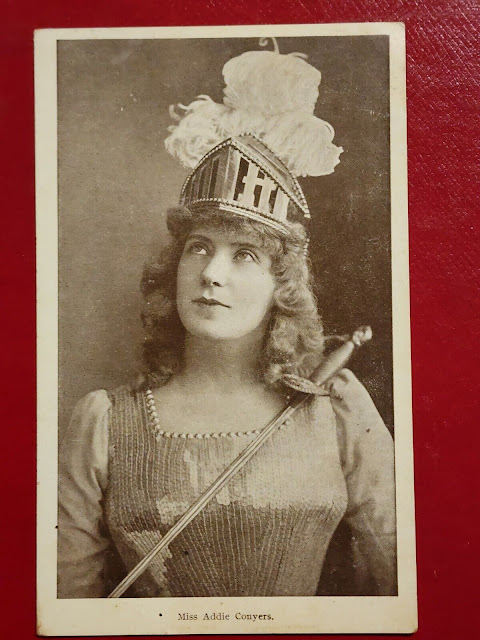
But in between the music hall stints, there were more concerts – Mr Cross, Mr Lane and Mr T A Barrett, the newest and most substantial of local concert-impresarios, the Botanical Gardens, the Old Folks and Blind People’s Party, the Chapeltown Sacred Harmonic Society, the Glossop Rugby Football Club, the British Dental Association dinner, the Blackpool Winter Gardens … And, as ever, sometimes he sang with local talent, and sometimes with such artists as William Ludwig, Fanny Moody, Charles Manners. At one Barrett concert he sang ‘A Wandering Minstrel, I’, while Kirkby Lunn sang Lady Sangazure, at another he duetted ‘The Moon has raised her lamp above’ with Ludwig; at a Lane evening he shared the stage with Mdlle Trebelli, Esther Palliser and Andrew Black; at Liverpool’s Good Friday concert of 1894 he sang the ‘Quando corpus’ of Rossini with Alice Esty, Lily Moody and Manners, before heading back to variety or the Blackpool Tower. He still, too, gave the occasional concert of his own, but nowadays the Free Trade Hall was only ‘moderately filled’.
In the 1901 census Samuel Jackson can be seen living in Blackpool with his wife, Elizabeth Jane (née Holt, d Sandy Lane, Baguley 8 June 1935) and five of their children. He is now ‘teacher of singing and vocalist’, and, indeed, in 1910 his name even appears in the cast list of a village production of Rob Roy. In the 1911 census, the Jacksons have returned to Manchester, and he is simply ‘professor of singing’. Two of the seven children are still at home.
The family historians disagree on his date of death. They all say 1935, but one gives a date in February, another in March, another 'after September'. Wife Elizabeth died in June of that year as 'widow', so the 'after September' is wrong. A more adept historian says he died at 226 Princess Rd, Moss Side, 14 August 1912. Since this was the address at which he was to be found in the 1911 census, and The Guardian published an obituary, I'll go with that.
| And to prove it, Mandy photographed his grave! |
His youngest son, Samuel Seymour Jackson (1894-1938) was the father of diplomat Sir Geoffrey [Holt Seymour] Jackson (1915-1987).

This morning, this nice portrait turned up on my screen. 'Horace Lingard' has been written about quite a lot since I first attemped a biographical article on him, sometime last century, in pre-internet days, So I thought I'd pull out the old (published) article and see if I could improve upon it with the aid of modern technology. and, oh goodness ... could I! To start with, he wasn't Horace, he wasn't Lingard, he wasn't even Needham (which everyone, including me, had averred), his birth and family were swathed in mystery .. and no one, except me, seems to have got his birthdate correct. Well, he did chop half a dozen years of his age, from time to time ... back to the drawing board .. remake the old article ..
LINGARD, W[illiam] H[orace] [THOMAS dit NEEDHAM, William] (b London, 20 June 1837; d London, 12 January 1927).
Buccaneering musical comedian who purveyed musical theatre to all corners of the English-speaking world for more than half a century.
I spy 'Mr W H Lingard' first in 1857, at the Exmouth Music Hall ('the celebrated serio comic'), in 1858 at the Swansea Music Hall ('the inimitable burlesque buffo and comic vocalist'), and at Newport Theatre Royal, for George Melville, in Shakespeare and drama and giving comic songs between the pieces ('A Mr Lingard who played Peter [in The Stranger] may with care become a good low comedy actor'. He played with John Chute's company in Cardiff (where two Mr Lingards were billed! Mr W and Mr H) and at Wigan, Mr H was Laertes and Mr W the Ghost to J W Benson's Hamlet. He appeared for a season with the stock company at Southampton playing Lorenzo ('a gentleman of more than unusual comic talent', 'never fails to make the people laugh') in Beauty and the Brigands. His Zerlina was Jenny Willmore and a certain Alfred Glanville was the Harlequin. He played She Stoops to Conquer with Felix Rogers, Wormwood in The Lottery Ticket, Cheap John in The Flowers of the Forest. Mr W Lingard played Muster Grinnidge in Green Bushes at Hull where both Mr H (who's been around since Ilfracombe 1854) and Mr W were engaged. Mr W was noted as the 'promising low comedian', so I guess that was Horace. He played First Gravedigger to Miss Marriott's Hamlet.
![]() |
| Panto for Chute at Bristol (1857) |
However, it was not as a Shakespearian comedian that 'Horace Lingard' made his most notable successes of these years. It was, rather, as a music-hall and stand-up performer, singing about what happens `On the Beach at Brighton on a Summer's Day', ‘The Model Police’, ‘The Life of William Shakespeare’, and ‘The Artful Dodger’s Return’ in an act built around a series of impersonations and comic songs.
He was hailed as 'a legitimate comic singer of no mean order' at the Southampton Theatre Tavern, then at Hardy's Dog Inn in Manchester (the other Mr L is at Norwich), the Whitebait Rooms, Glasgow (' a third and fourth call nightly' singing 'Jack Rag' and 'Reformation'), and at London's Knightsbridge Tavern, at the Sun, Evans's Supper Rooms, Canterbury Hall ... and Mr H is playing Macduff at Portsmouth with a Miss H Lingard ...! How many more? Ah, she's Mrs. Brother Henry has got a wife! Yes, he's Henry. Mr W moves on to the Adelaide Gallery and the South London ...
And Mr William Thomas, of Featherstone Buldings, Holborn, son of Henry Thomas, shipwright ...
Well, we are getting near to census time, and his address is 3 Sidney Square, Commercial Rd ... he's perfoming in Passion Week at the Surrey Theatre .. and, in May, is still in Tower Hamlets, so .. let's visit Sidney Square. Hmm Richard Henry Thomas of Sidney Square 'gentleman' died 4 October 1862 aged 42 ... I'll get on to investigating that later ... but oh! He's shifted to 24 Palace Rd.., Lambeth ..
PS 1861 census. 3 Sidney Street. Henry Park, tailor, and large family; James Wynn, clerk, and family. Sigh. Foiled again.
But how about 28 May 1855: died Mr William Thomas of East India House at no 7 Sidney Square aged 73. Grandpa? Or is it all a red herring?
Back to the 'great Lingard'. The Trevor, the El Dorado (not top London dates), Southampton ('always sings his songs most racily'), Worthing ..
I see Henry 'of Sadler's Wells', in Scotland, Scarborough, and in the Isle of Wight (with wife) in 1862; and William at the Dover Catch Club and the Marylebone Music Hall where a certain Julia Lamartine 'from the Glasgow Concerts' was also on the bill. Her name would appear as a connuber in 'Horaces' wife's divorce claims. I see already 'Mr W Lingard 'a remarkably good comic vocalist' and Miss Lamartine 'a pleasant contralto singer' engaged together for the Whitebait, at Day's Crystal Palace with Anna Caradori, the Surrey Music Hall, Sheffield, the Victoria Rooms, Southampton ... while the wife advertises ..
In early 1864 Julia and William ('the greatest comic of the day') are at Sam Collins Music Hall, in early 1865 at Dundee. Julia was billed as 'Mrs Lingard' and was hissed on entering, at which William took his riding whip to the hisser. They played at the Whitebait and the Britannia in Glasgow (his concert 6th March) with Lingard scoring particularly with his Staue Song and its impersonations. He apparently, diuring this stay won a contest for £100. William enlarged his Statue Song to present an entertaiment Men of the Past and Present Day, impersonating in quick-change Napoleon, Wellington, Garibaldi, Lord Clyde. He also borrowed songs, notably, from Arthur Lloyd, and made a hit with his 'The Organ Grinder'.
![]() |
Next, he proceeded to Weston's Music Hall in hometown Holborn for a long run. Thence to the Cambridge, where the lady vocalist supreme was Charlotte Grosvenor, and the Crystal Palace, Sam Collins's and the Phil, Islington. But there was no Julia. However, in November 1865 he is at the Alexandra, Manchester ... with Julia. So, she's still of actuality! However, once Will returns to town and the Pavilion ('the Statue Song has lately received some additons: General Grant, Robert Lee, Lord Palmerston ..'), the Phil and the Strand and the Alhambra ('the popular comic singer') ... he is up on his own.
Later that year Julia is at the Marylebone, then the Pavilion and at Brighton with no William. After 1866, and half a dozen years as a performer, I see her not at all. And Amelia is left alone to bill as 'Mrs W Lingard'. But not for long.
Lingard took his comic songs to Gatti's in the Wesminster Bridge Road and ... after a goodly stint at the Phil in Islington took his departure with a Benefit. 16 April 1866. The bill was topped by Vance, Arthur Lloyd, J G Forde and and young lady by the name of Alice Dunning. Song and dance. They appeared together in Hull in June, and at a flop Comic Festival in Bristol (16 June 1866), at Gloucester for Jolly John Nash (18 June) and were 'married' a couple of days later ...
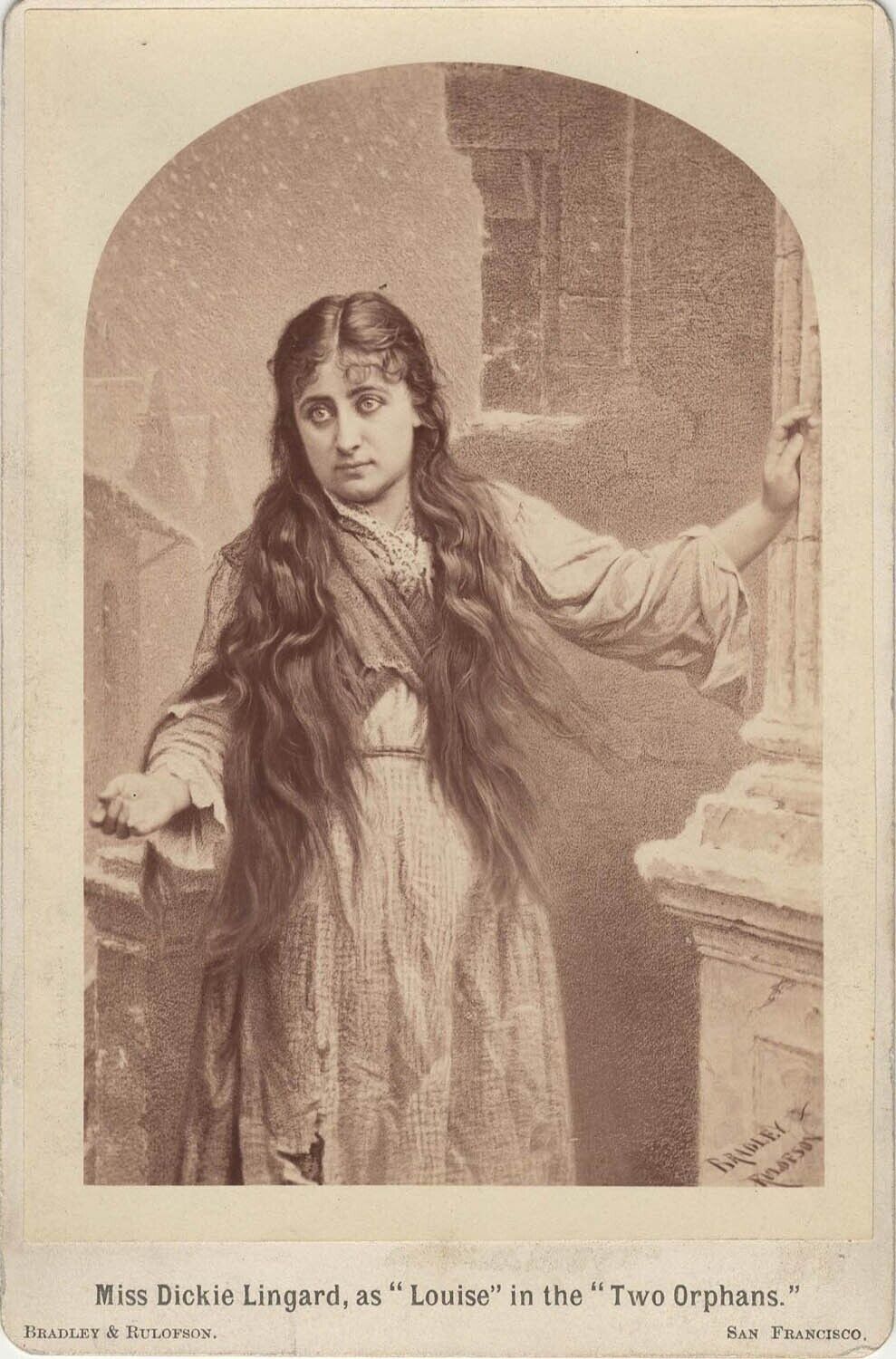
He played at New York's Theatre Comique in farce and burlesque and, supported by his new wife/'wife', music-hall serio-comic Alice [Anne] DUNNING (b London, 29 July 1845, d 22 Elm Tree Rd, Hampstead, 25 June 1897) and her sister, Harriet Sarah (6 August 1853; London 7 December 1938), who worked under the name of Dickie Lingard, he took over the management of the house (27 June 1868) for a short period, playing sketches and burlesque (Pluto with Alice as Orpheus &c) until it was burned down, when the company moved out to Brooklyn, then to Boston (1869 'Mr Lingard has made a hit') where Lingard took over the local Theatre Comique (later as the Adelphi Theater).
The American press hailed 'His success here is one of the marvels of the present theatrical era'. The American gossip press reported his 'separation from Amelia' and his several children by Alice. (They had two daughters).
Lingard shared his programmes -- of which his sketches remained the star item -- both with Susie Galton and Thomas and Blanche Whiffen (née Galton) and their family group, the earliest purveyors of Offenbach in English to American audiences, and with the Howard Pauls, and he travelled his company -- playing everything from drama to burlesque -- as far afield as the south Pacific, appearing in Australia from October 1875 billed as `the world-renowned comedian' in Our Boys, David Garrick, Married in Haste, the melodrama Dead to the World and a comic opera called I Ladroni, allegedly of his own making. However, I Ladroni (Theatre Royal, Sydney 19 February 1876), which he had first mounted in St Louis several years earlier, and which was allegedly musically compiled by Giuseppe Operti, bore a remarkably close resemblance both textually and musically to Burnand and Sullivan's early opéra-bouffe The Contrabandista.
In February 1879, hot on the heels of the first startling Broadway performances of HMS Pinafore, Lingard starred as John Wellington Wells in New York's first The Sorcerer and later the same year the Lingards sailed off again to New Zealand and Australia, playing HMS Pinafore (he as Joseph Porter, she as Josephine) and The Sorcerer. He was pursued legally, in a stranger-than-fiction saga of court appearances, featuring flights and at least one probably faked bankruptcy, by J C Williamson (who had played at the Theatre Comique in 1869 under Lingard's management) who had bought the Australasian rights to Gilbert and Sullivan's show. Balked by the courts, Lingard eventually had to give up, but he continued to play in his repertoire his own `sequel', The Wreck of the Pinafore, which ultimately found its way very briefly to the London stage. He also performed a number of French works (notably as Frimousse to Alice's Le Petit Duc), as well as Our Boys, Old Bachelors, Gilbert's The Happy Land, H B Farnie's Pluto and the inevitable I Ladroni.
After touring the rest of the Pacific circuit -- Japan, China, Hong Kong -- the Lingards finally returned to Britain where Horace mounted a special Gaiety Theatre matinée to promote his wife as a star, but metropolitan success did not come their way and it was ultimately in the British provinces that Lingard found himself a very comfortable niche.
In collaboration with ‘cellist, actor and producer Auguste van Biene, he produced and subsequently toured endlessly with English versions of such reputable French pieces as Le Droit d’aînesse (Falka, Tancred), Les Voltigeurs de la 32ème (The Old Guard, Polydore Poupart) and Pepita (La Princesse des Canaries, Inigo). In a rare venture into the West End he tried Pepita at Toole's Theatre in 1888 and was gratified with a run of 102 performances before going back on the road. He also played one London week of Messager's La Fauvette du Temple (1891) and produced a revival of Offenbach's Les Brigands. For this revival he used a youthful translation by W S Gilbert, published by Boosey and Hawkes, and once again found himself in court, on the receiving end of a writ from the author who had no wish to see his juvenilia thus displayed (nor, perhaps, for its influence on The Pirates of Penzance and The Mountebanks, in particular, to be noticed). For once, this time, Lingard was on the right end of the law.
Lingard also co-wrote (or at least put his co-name to) and produced a burlesque of his touring success Falka under the title Brother Pelican (1894) and mounted a new and short-lived show called The Chorus Girl as part of his repertoire in 1897 (Caractacus Tire). In 1899, now a widower, he was still to be found on the road, starring in the chief comic part of a musical called An American Heiress (Stuart McNab). He trouped his shows endlessly and, in his eighties, allowed himself to drop from star comic rôles to smaller parts, whilst also taking time off to direct amateur productions of the works which he had performed in his younger days. He died in his ninetieth year, with less than £100 to his name.
The two daughters of Horace and Alice Lingard both married music. Lulu (Louise Emily Marie Dunning Needham, 1867-1926) became Lulu Wicks, but then the wife of a doctor, and Nellie Wilhelmina (1869-1962)-- a leading lady in Australian musical theatre (La Cigale, La Mascotte) as Mowbray Lingard -- having disposed of a certain Frank M Burbank (‘of the Boston Theater’), became the wife of Arthur Godfrey, composer of the successful Little Miss Nobody (1898) and nephew to the more famous bandsman and arranger Dan Godfrey.
As related, Lingard’s first wife was actress and music-hall performer Minnie Foster (Amelia Martha Flint, 3 April 1860). She worked latterly as ‘Mrs W H Lingard’, and carried on doing so, even after her husband ran away to bigamise with Alice Dunning. The pair were finally legally divorced, apparently on a technicality (one son William Henry Thomas 7 November 1861) in 1878, she married a Mr Musto, and Lingard married Alice a second time (1883) just to make it all as nearly legitimate as it could be. Minnie died in Edmonton in 1903.
OK. I've upmarketed and expanded my piece a bit here and there. But the discovery that 'Horace' was possibly/probably really 'Thomas', which was revealed in the press, once Amelia Martha began proceedings has, anyhow, led me all over the place. With limited results.
And there is still plenty to find elsewhere on the personal side. What happened, for example, to brother Henry? Who was father Henry? Who was Miss Lamartine? And what became of son 'Harry' William Thomas? He can be seen in 1871 as a 9 year-old boarder under the name Harry Lingard at Mr Busk's school in Bessborough Gardens. In 1881 he is a 'professional actor' ... 'H Lingard jr'. At age 21 he was in court in Wales accused (not guilty) of fraud. In 1889 he was on the bill at the Foresters Music Hall ...
Late discovery: 1864 Henry Horace Lingard 'who had been performing the ghost all around the country' and had 'a theatrical establishment at Farnham'. Oh! Wandsworth Prison: 1863-4 Henry Lingard, actor, travelled in a railway carriage without a ticket ... and fraud! 12 months imprisonent! 1864 lunatic asylum in Bristol. If that's him, he died Fishponds 22 December 1874 ... 1861 census, Henry Lingard 29 actor born Bristol, with wife Sarah actress 29 ... 1864 Islington workhouse... Oh! Henry ...
This isn't really Alice's article. She needs one all of her own. When she died, in 1897, The Era reported lavishly
I'm all Lingarded out. I'll have another go in a few years ...