Friday, June 10, 2022

Shakesperian actors? Don't you believe it!


As is evident, I love to wander through ebay and pluck therefrom little treasures, especially of the theatrical kind ...

Of course, the 19th century theatre has been my (long) life's work, so I can pick up on photos and identifications that someone who is not steeped in the era can hardly be expected to recognise. And, witness yesterday's discovery, tell an amateur from a profession, or a mauser rifle from a javelin. Today was an example.

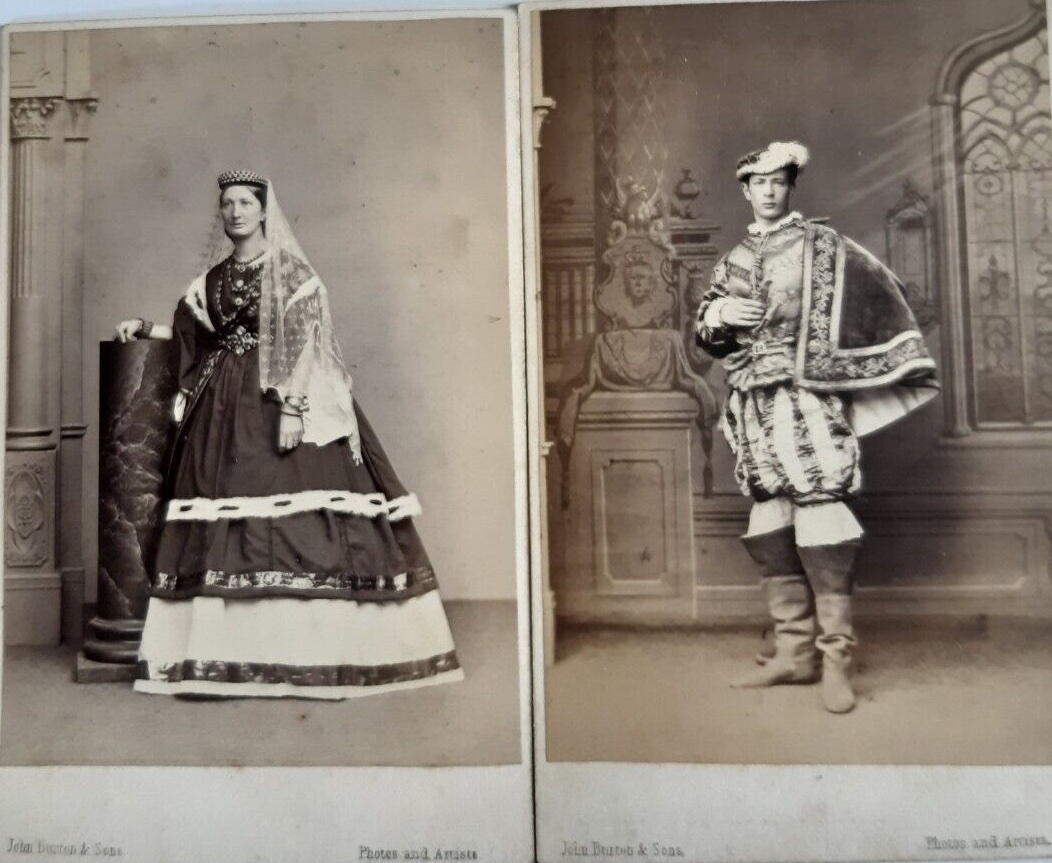
Visiting the eshop of 'Lauramii', I came upon a lot labelled 'Shakesperian actors', and dated Stratford (on Avon) 29 April 1864. Three people already bidding on it ... do they know?  The pair pictured here never trod a stage in their lives.


1864 was the occasion of the Shakespeare 'tercentenary' and all sorts of social festivities were held at Stratford to mark the anniversary.

Of course, there were performances of the plays


But columns and columns in the press were devoted to the local gentry's social events which were attached to the occasion


If one trudges through the guest list for the fancy dress... there is Mr Unett  as Prince Hal ...

George Gwinnett UNETT Esq of Castell Froma, Lillington (b Handsworth 9 December 1844; d Lillington 4 April 1912) son of a landed gentleman. George never married. The lady is not his wife, but his mother, Elizabeth Frances Letitia Unett née Unett (1826-1910). 

So, no, not an actor.

https://www.ebay.co.uk/itm/255568901663?hash=item3b8117f61f:g:m6gAAOSw~F5inKJ0


Thursday, June 9, 2022

Fred the brass-founder turns actor .. for 50 years ..


This week, I came upon this little bundle of photos. An actor. Professional? Amateur, I suspect.  But the name sounded vaguely familiar, so ...


Fred Grove. Of course, that wasn't his name at all. But he became a professional actor.

Date? 1870s-80s, maybe, when he was only an occasional professional?

Photographer? Richard Upjohn. Mostly a jeweller and watchmaker. 

So no clues there. But there were others. One of which was a long and close association between Fred and the celebrated Thorne family ...  and then a little, casual mention in the Era newspaper ... and an address ..

For, you see, Fred was active under two (almost three) names. I just had to discover that, and then meld the three together (or not). And I did.

Frederick Grove PALMER (b St Giles 1851; d St Thomas's Hospital, Surrey 31 January 1927) was the son of brass-founder David Palmer (employing 3 men and 2 boys) and his wife Mary née Grove, and was brought up as assistant to his father. In 1877 (24 June) he married Emily Bignall (d 50 Gresham Rd, Brixton 14 December 1924), by whom he would have two sons, Frederick and Mervyn.

Fred continued to found brass through the 1870s, but at some stage -- and I know not which was the cause of tother -- he both became close friends with George Thorne, and he got into the theatre and writing. Bits for the funny papers. Anything. I catch a glimpse of him in 1875. He and Emily advertise readings, lectures (a rather feeble Paris) and an entertainment (Wails from Wales) of his writing. And in 1879 (24 October) when George Thorne takes a Benefit at Astley's a little comedy by Thorne and G W Browne was played 'with Fred Grove as Lothario Spooner'.

In 1881 he and Thorne collaborated on a pantomime script Robin Hood which was played at Maidstone. Fred was credited as 'F Grove Palmer'. And thus it would remain: he was 'Grove' as an actor, and 'Palmer' as a panto author.  And we know the are one and the same man, because they both live at 6 Carlisle Street, Soho! The two friends would collaborate successfully on pantomime scripts for over a decade (Sadler's Wells etc).

He seemingly favoured his writing 'career' over his performing on through much of the 1880s, until the Thorne family again took a hand. Tom Thorne was the manager of the Vaudeville Theatre, and Fred and Emily Grove were hired as part of the company. In the 1890s, Fred would become stage director for Thorne. Now he was no longer founding brass, even part-time, but listed himself as 'actor'. 

Tom Thorne

Fred had a career of more than thirty years as a senior and character actor, notably with Martin Harvey and was still working at his death at the age of 75.

So, now. When did he play the roles in which he is portrayed in these photos? Surely this is amateur? Try 'Mr F Grove' ...

YES!!!! A third nomenclature. Sigh. 3 December 1872 ... aged 21 ....


And there he is doing a little bit in The Steeplechase at St Georges Hall in 1870. 

And 6 June 1871 ... 


And here is George Thorne. And maybe a professional engagement? 1874.

 How long this company existed I am not sure, but in early 1875 he is back with the amateurs (Mr J W Boughton's Company) at the Bijou, Bayswater where the repertoire includes The Children in the Wood (see photo) written by 'an opéra-buffer' who, I would guess, was Fred. At Greenwich, the company played Blue Beard with Fred as Shacabac (see photo) ('made a decided hit, his comic singing and grotesque dancing causing screams of delight'). Then followed various appearances with 'Miss Sarah Thorne's Company', 'Miss Maud Dudley's Company' (Miss Dudley was the leading lady of the amateurs) which played Plot and Passion (see photo) ...  then, over the next five years, odd appearance with Miss Thorne, and the occasional appearance as Mr Palmer ...


Soon after, the collaboration/friendship with the Thornes blossomed into the main part of Fred's career.  In September 1884 I see him at Greenwich, with Tom Thorne in Saints and Sinners ...

Our photos, undeniably, come from those days in the 1870s when Fred Grove/Mr F Grove/Fred Grove Palmer was a prominent amateur player ... I imagine the Upjohn snaps were all taken at one sitting ...  

Well, that's what I wanted to know!

And now I do.

Although it would be good to pin down the performances of The Puritan's Daughter, The Honeymoon and Catherine Howard. Mr Boughton's Company, I would guess. 

YES!!! Bijou Bayswater March 1875. The Puritan's Daughter. A new play by a Mr W Lavington. 'Miss Dudley acts prettily but with the exception of Mr Groves's King James, there was really nothing else deserving of the slightest praise'. Ouch.

PS John Waters Boughton (b Kennington, 12 November 1846; d Cosham 18 January 1914) went from being a solicitor's clerk, organising amateurs to become long-time manager of the Theatre Royal, Landport. 

.


TRIOMPHE!!!!  Within 24 hours Fred's great-great-granddaughter read this wee piece and the photos and their tale will hopefully find their way home!


Sunday, June 5, 2022

Vanara: Sixty years on stage ... but still a mystery


Here's today's little theatrical treasure, which led me off into a grand but, alas, only partly successful voyage of discovery.

The item couldn't be more precisely labelled. 


Mons and Mdlle Vanara. London Alhambra. 21 June 1871.

A variety act, then? A goofy comic and a beautiful girl. And they've been at St Petersburgh, where they had this photo taken ...

Well it all looks genuine ... except the Miss has mistakenly been turned into Mrs ...


Not a bad bill. The Vokes Family, the young William Parkinson as Tom Tug with the eccentric Edwin Odell as Robin, and our couple and Bekéfy are supported by one of the pantomimic Marshall family.


So, who were they? Where did they come from, and what else did they do ...

Well, I suspect that Mademoiselle-Madame was only a name-partner of circumstance. The double act seems to have lasted just the space of that particular act. Although I do see a 'Mlle Vanara' going out to South America as a première danseuse ...

It is Monsieur who is the interesting one. But, to my amazement, I don't seem to able to find him in any book of French theatre reference. Not his death notice. Not a little biographical snippet. Not a story. Not his christian name. The most notice he got in the press was when he got involved in a long lawsuit against the Paris Opéra who had sacked him from his post as character dancer and maître de ballet. The court reports, which list most people's names with all their multiple forenames, merely call him 'Monsieur'. So Vanara probably wasn't his real name.

He couldn't get away with that in the copyright registrations, where he was listed as 'G Vanara', nor in his other favourite capacity as a violently active Union leader, where he admitted to 'L-G Vanara'. For, yes, M Vanara was a violent, authoritarian and litigious man ...

So, if I don't know who he was, at least I know a bit of what he did in his successful career as, first, a comic dancer, then a choreographer, maître de ballet and character dancer. But only a bit. Because a 1907 pressbit (just before his sacking) mentioned that, by then, he had been 59 years in the business. So, what? Since 1850? Presumably as a child. 

Well, I can't find him as Vanara until 1867, whe he is second male dancer and comic at Lille. No sign of a Miss or Mrs. Next sighting is London, after which I see him in an act at Paris's Concert de l'Horloge with the sisters Ferrus (1872, Trio de tambours), and then at ... Buenos Aires! I don't know how long he remained down under, but when I pick him up again it is ... in London. Christmas 1881, and he is supporting the great Agoust in a real French (panto)mime show Macfarlane's Will ('fun and acrobatic skill') at the rather unfortunate Imperial Theatre.

L'Horloge

In the 1880s he got under steam in France. I see him leading 'the Troupe Hamilton' in the south, choreographing in Liège, as maître de ballet at Rouen's Théâtre des Arts, at the Grand Théâtre of Nantes (Le Tour du Monde in 80 Days), back at Liège for the production of Le Prisonnier du Caucase ... in the 1890s he spent a good time at Marseille and in 1896 he visited England once more to play the Alhambra in a ballet based on Plaquette's Rip van Winkle, in a gipsy Christmas piece Le Tzigane and in the patriotic ballet Victoria and Merry England. Music by Arthur Sullivan.


Back in France, he was Harlequin at the Funambules before moving to the Capitole of Toulouse (where he arranged interpolated dances for Carmen!), the Grand Théâtre of Lyon ... he was an habitué, these days, of the best provincial houses in France. So it was hardly a surprise when he was appointed character dancer and deputy regisseur at the Paris Opéra. 28 September 1900. That date was repeated over and over when it came to litigation time. He made his debut on the Académie stage 13 October in Widor's L'Étoile, and in January of 1901 he was appointed maître de ballet under Hansen. Something went wrong and he resigned a year or so later. He was good at resenting being a deputy.

His time at the Opéra seems to have been documented. He arranged, choregraphed, schooled the baby ballerinas, played such roles as Dr Coppelius, Mouni Pénitent in Bacchus, or the Witch in La Ronde des Saisons ...

At the same time he was occupying himself with syndicalist affairs ...

The American press copied 'the rule of the Tsar of Russia is mild democracy compared with the autocratic régime of M Vanara, the ballet-master' and detailed that the ballet ('the revolt of the tutus') was going to go on strike against his strictness and heavy fines.  As if all but the most virtuous of them didn't have a 'Monsieur du Jockey-Club' behind them.  But I guess it made good trashy 'news' then as it does now ..  They didn't strike.

But the management of the Opéra changed. And they ridded themselves of M Vanara. Who, if the 59 years is true, must have been over 70. And he sued. And lost. Well, you see, apart from anything else, he didn't have a contract. For three years he tried, with his syndicalist lawyer behind him. And inevitably, each time, he lost ...

My last sighting of M Vanara is in 1910, at the Moulin Rouge, writing, staging and playing in a ballet named Le Fakir ...

L-G Vanara. All those cities he visited .. no one ever said 'our townsman'. No one ever said 'the Italian'.  Who was the man? ...  Lyonnet doesn't include him ... is there a ballet book somewhere that credits him with anything more than the libretto of Le Lac des Aulnes ...

All éclaircissements gratefully received!


And a couple of éclaircissements duly arrived ...

Oy! Laura Bellini's company: not very high class ....

And Joe Carl White came up with this possibility ..

Found a Paris death record for a Gustave Vanara whose dates roughly line up
Gender: homme 
Death Age: 75
Record Type: Décès 
Birth Date: 27 juin 1845 
Birth Place: Avignon
Death Date: 16 nov. 1920 
Death Place: France
Father: Vanara
Spouse: Mathilde Coutel


Saturday, June 4, 2022

Help! Name the Operetta ...


I'm stuck.

These three photos came up on ebay this week ...

Vienna. Clearly an operetta/opéra-bouffe/comic opera ... but WHICH operetta ...


Photos 125, 126 and 131 ...  so where and what are 127, 128, 129 and 130? 

Adolf Ost was at Strauchgasse No1 in the 1860s and early 1870s ...

What show featuring Chinese and maybe-European characters fits the bill?  And has an oriental komische Alte? The only one I can think of is Le Cheval de Bronze ... but it wasn't in Vienna in the 'sixties. Just in Munich .....  My brain is dry ... I'm stumped ...

I'm sure this set of photos must be in the Vienna Theatermuseum ... hopefully identified ... but maybe someone knows?


Post scriptum. We went looking among Bruno of Photo Discoveries' stock, in search of the missing numbers. Not yet, BUT we found another, rather earlier Chinaman!


Paris. 1859. Jean-François Kalikaire player and deputy régisseur at the Palais-Royal, dedicated to his pal 'Lassouche' (who would go on to long and considerable fame).  Kalikaire played Le Pacha in a 1 act revue En avant les chinois!  Look at that cast! Hyacinthe, Pradeau, Brasseur, Gil-Pérès, Luguet, Marie Cico, Schneider, Félicie Thierret, Irma ....!  Authors Labiche and Delecour ...  


Mind you, it don't seem terribly chinois! They don't have pachas in China do they? But the list of characters holds promise of an hilarious finale piece! 

Félicie Thierret

It must have been enormous fun.  Sigh.  The theatre in those days was a 90% different thing to that which it is in the benighted 21st century. Ah, well. I guess that's why I'm an historian.

Lassouche


Who is this? Aaaaaah! 1863? Mlle Marie ..


Haydée Abrek, or the Baroness takes to burlesque


The most unlikely things turn up on e-bay. Ten years ago, I wrote this little article, and consigned it to the 'failure' shelf, resigned to never knowing who this noble lady, fleeing the Franco-Prussian war in England, was. Well, I still don't know for sure ... but here is a photo of her!


ABREK, Haydée

In an age where newspapers make a speciality of trying to publish everything remotely private or secret about even the most unfamous 'celebrity', it is hard to credit the modesty of the Victorian press. And that modesty and respect are the reason I can’t identify Mlle or Madame Abrek for you.

The lady had a short career on the British platform and stage – just the time it took for the Franco-Prussian war to do its thing – but, during that time, I can find no journal which let out her aristocratic identity.

‘… the name assumed by a lady of high social position and acknowledged ability whom recent events in France have compelled to appear before the public as a professional singer.’

‘… under whose fanciful nom de guerre Parisian visitors may perhaps recognise a mezzo-soprano whose voice has been often heard in the Madeleine’

‘… many lady amateurs, owing to revolutionary changes in France and Italy, have adopted the lyric drama or have taken to the concert room professionally …’

The Marquise de Santayana ‘formerly lady-in-waiting to Queen Isabella of Spain’ was quoted as an example. And Mme Abrek. There was a suggestion that she was a Baronne … that is all.

The fanciful name in question was taken from Mikhail Lermontov’s 1835 poem Khadji Abrek, and I wondered why. I searched the 1871 London census, and found, interestingly, in Gloucester Place, a certain Philip Albrecht (not the Duke of Württemberg!) with a fifty year-old lady just given as H and a 20 year-old daughter, also H. And I found a Madeline Albrecht in Charlotte Street, ‘29 years old, actrice’, also from France. But I’m just guessing.

Mme Abrek’s arrival in London was marked by a concert on 2 March 1871 at St James’s Hall. Gardoni and delle Sedie supported, and the lady sang the Bacchanale from Galathée, Gounod’s ‘Ave Maria’, Angela’s air from Le Domino noir and ‘La Manola’ in a programme notably briefer than the usual London concert, before a largely French audience. The critics allowed her ‘considerable power and good quality’ and thought her innate drama would make her more suitable for the stage. Within days, the press was publishing an evident floater that she was ‘rumoured to be hired by Mapleson’.

delle Sedie

She wasn’t, but she played plenty of other engagements. Two days after her concert she was on the programme at the Alhambra at a French charity concert, and 1 April she made a debut at the Crystal Palace alongside Natalie Carola and Vernon Rigby. She gave Métra’s ‘Valse des roses’ and ‘Orpheus and his lute’ and Gounod conducted. She followed up at the New Philharmonic (Galathée, ‘La Manola’, ‘Ah, mon fils’) and on 16 May launched a series of concerts entitled the ‘Lady Artistes Musical Soirées’ at St George’s Hall. The Gottschalk girls, Mesdames Calderon, Sanz and de Lys performed, along with one Mlle Brusa ‘a supporting player from the Italian opera buffa’ (I thought hmm, for another French actrice, Mlle Brun, is Miss Albrecht’s roommate in the census) and the international press gave much notice to this one-sex arrangement. Mme Abrek sang her usual numbers and also recited Racine’s ‘Songe d’Athalie’.

Delphine Calderon


She appeared during the season at the concerts of Mr Austin, Sophia Flora Heilbronn and the young harpist, Mme Léonie Vattelette-Mottard, alongside the well-connected Mme Conneau, and the English Princess Matchinsky (who failed as a singer), and in August began a season with the Covent Garden proms. She was referred to as ‘the esteemed French singer and reciter’ and showed, in Offenbach’s ’Invocation to Venus’, where her best abilities lay.

Early in 1872, she appeared in Antoine de Kontski’s concert, alongside Monari Rocca and shortly after the pair played, with Mme Conneau, in the musician’s operetta Les deux distraits at St George’s Hall.

In May, she was taken on by Montelli’s French opéra-comique company, playing a hastily put together season at the Opera-Comique with Marie Cabel as star. She played the Marchioness in La Fille du régiment, Madame Barneck in L’Ambassadrice and Jeannette in Les Noces de Jeannette and, after a nervous beginning, where her humorous acting was more appreciated than her out-of-tune singing, improved into an acceptable performance.

Marie Cabel


Producers now felt her apt for the stage, and she headed for Liverpool to attempt Emily Soldene’s role of Drogan in a pirate production of Geneviève de Brabant. She soon left, and returned to town, and instead took up the role of Crusoe in an Olympic Theatre extravaganza How I Found Crusoe.

‘Madame Abrek made her debut as Drogan and Miami. It was a pity more of the music of the piece was not allotted to her, as she possesses a fine voice which she uses artistically. Her knowledge of English is hardly sufficient as yet for spoken words …’. The piece ran through January 1873, and closed.

Mme Abrek did not take to the commercial stage again. She played in Prince Poniatowski’s little Au travers du mur at St George’s Hall, and then…

Well, I suppose then it was safe to go home. To be a Baronne again, and leave the world of music which she had undoubtedly adorned better as an attractive amateur, than as a professional.


Friday, June 3, 2022

Exeter or, How Many Vicars Does It Take to Change a Candle?


Rain. Mud. The "tank" is in doing the tree-trimming and my beautiful green pastures look like a World War One battleground. I can't bear to look ... diggers and choppers and sawyers everywhere ... and MUD!

So what better to do than light the fire and snuggle back into the 19th century ...

I find that some of the most interesting bits of ebay ephemera come from countries such as Australia and, recently, France.

So while the kettle was boiling, I disappeared into France. More particularly, the shop of the oustanding 'photo discovery' ... and what I discovered was a disemembered photo album made up of portraits of English ladies of a certain class ... 

They were recognisable as being from the same album thanks to a neat and clear inscription in readily readable handwriting on each one ... so, where to start?  

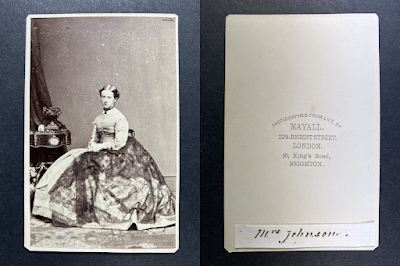
Well, I started in the wrong place, but that's the way of the game. But pretty soon I came upon siblings (always helpful for identification!) and came up with four sisters. Well, semi-sisters.  The Misses Martin. Here they are 


Georgina Harriet (29 June 1833-4 December 1899)

Jessie Anne Frances (Mrs Chas Cooper Johnson)
(16 November 1838-18 July 1920)

Renira (4 November 1845-19 December 1911)


Lucy Annora (Mrs Arthur Chas Cherry)
(d 2 August 1927) 

They are semi-sisters because the first two girls -- and there were 8 surviving children, because papa, George Martin, was a country parson, the sort with with 8 servants -- were by his first wife, [Lady] Charlotte Sophia Eliot (d 1839) and the younger ones by his second, Renira Henrietta Altenburg Bentinck (m 1842).

Father, long the Vicar/Canon of Harberton became Chancellor of the diocese of Exeter, and one day cut his throat 


The widow and daughters moved to Upton-on-Severn.  Lucy married banker Arthur Cherry and became the lady of Henwick Hall, Worcestershire (7 servants). Charlotte and Renira did not marry, and lived latterly with married sister Jessie and her husband at The Hill, Upton on Severn (7 servants).

Here is the second Mrs Martin 


Right. Let's have a go at some of the others and see if any sort of a link comes up. 


Miss Woollcombe. A daughter of Henry Woollcombe from Heavitree, Devon. Cleric. Later Archdeacon of Barnstaple.  Two possible links: the Church and the county of Devon, specifically the town of Exeter. Henry Woollcombe married Jaquette Elizabeth Louis (1846) and had issue including two daughters, Mary born 1847, and Jaquette born 1867. He also had two reverend brothers who married and had daughters .. but ...  I need to date this photo.

Augustus Alexander Stanislaus de Niceville, son of a French officer and born in Teignmouth practised as a photographer and landscape painter in Exeter in the 1850s and 1860s. I see him at 262 High Street from 1862 to 1865 .. but when I spot him again in 1873 he's moved down the street. So I think we can safely say that this portrait belongs to the 1860s. Which means that we can be 99% sure that this is Mary.


And she's buried at Heavitree ....

So what other Devonian photos have we in this bundle? Oh lawks! A perfect flock of clergy and their families. Never have I see so many Archdeacons!  And here is Mary Woollcombe's father ... and her mother ..


Archdeacon John Bartholemew. Archdeacon at Barnstaple. Canon and Co-Chancellor of Exeter Cathedral


Archdeacon Freeman

And a Bishop, no less. Here's Bishop (from 1868) Frederick Temple of Exeter


and here an earlier Bishop, which I presume is the well-known Henry Phillpotts


and his wife


Dean Ellicott of Exeter


and wife


And yet another clergyman. How many vicars does it take to change a light bulb?  Reginald Henry Barnes (b 12 February 1831; d 29 September 1889). Vicar of ... Heavitree. Born in the Cathedral Close at Exeter . And his maiden sister Augusta (b 9 August 1811; d 15 October 1901)... Reg was the father of actresses Violet and Irene Vanbrugh.


Irene Vanbrugh

and see https://kurtofgerolstein.blogspot.com/2023/03/shrimp-fish-net-girls-st-leonards-on-sea.html


Well, my two suppositions were clearly correct! The church and Heavitree and Exeter. And, I imagine, all these folk were attached to social circles to which our album-keeper evidently belonged.  

The Rev George Thomas Comyns, vicar of Axmouth, then Sidbury (d 27 March 1897)


Hmm. Here's an 1857 notice re Heavitree wherein features the Rev Barnes ... I notice one or two other names which also appear among the photos -- Sanders, Andrew ...


Miss Sanders photographed by de Niceville whe he was at no 262


Ah, and Mrs Sanders as well 


I think these may be the wife and daughter of Edward Andrew Sanders (2 March 1813-20 March 1905), banker and magistrate, of Stoke House, Heavitree (7 servants) ... fits the form, don't it?

And so does this one. Mrs Frederick Milton, née France Harriet Lewis. Mr Milford was a banker too, of [Little] Matford House. They had lots a children, but this album doesn't do children. Just ladies and clergy of a certain class.


I suspect that the Mrs and Misses Templer are those from ... Heavitree.  Living in 1861 in St Sidwell, Exeter. Georgina Charlotte Gertrude (d 25 April 1901) and Augusta Noel (d 27 November 1913). Parents George Templer and Charlotte Eliza née Kennaway (d 8 October 1875). 


Miss K Stephens photographed by Brice of Queen Street. Katherine Georgina Stephens of the Bishop's Palace, Exeter. (b Holcombe Burnell) daughter of the Vicar of Dunsford. (6 sisters, 9 servants)


Miss E Shapter by Angel, photographist. Elizabeth Shapter, daughter of Doctor Thomas Shapter, Barnfield St Sidwell. Or more probably (given the initial) her young sister Esther.

Mrs and Miss Oxenham by Angel. Died 27 October 1864 at her house in the Close, Exeter, Anne, widow of the late Rev William Oxenford vicar of Cornwood, Devon and prebendary of the Cathedral in her 92nd year. Daughter Anne Dorothea (b 8 August 1806; d Southernhay 10 September 1875). 1851 six servants ...


Mrs Bond, photographed by Angel


to whom, I suspect, belongs Miss E Bond


William Miles Esq. JP. of Dix's field House, St Sidwell, Exeter (d 5 March 1881)


Arthur Corfe Angel, son of the organist at Exeter Cathedral. He went to sea and was drowned at the age of 20 in the Bay of Biscay 11 January 1866 ..


It is becoming more and more evident that our collector was in some way connected with Exeter Cathedral. This is likely not just a maiden lady's Friends book. The fact that young Arthur Angel gets into its pages ...  But there are NO babies, and babies infest everyy maiden lady's scrapbook .. and only the holy among the gentleman get in.  


I also think that this collection was put together over a relatively short period. Early to mid 1860s. 

So, I keep on digging.

The Hon Miss Brodrick. If I am correct, sister of Viscount Middleton .. the one who didn't marry? Albinia (d 20 April 1863)


John Dinham. Not a clergyman? Maybe a tea dealer died 1864? Left 40K ...


Mrs ?Ware


Miss Harington (three separate pictures!). Yep. Dignitaries of Exeter Cathedral under Phillpotts: Edward C Harington ... oh gosh, there's half the team!  Chancellor Martin, Ralph (father of Reggie) Barnes, Woollcombe jr, so I suppose the 'Dean' pictured above is Thomas Hill Lowe ...


Um. But Edward Charles Harington (d 1881) was unmarried. However, he had a sister .. Anne E Harington, born in the Isle of Man .. I see the two of them in 1851 living in ... The Close, Exeter! with the remarried mother Frances Shallcross ... Anne, born 1803 ... she don't look 60!

And so who was Edward TEMPLER Harington, curate of Whimple, vicar of Axmouth who died 11 May 1874 ....

Are we getting to 'family' here? Haringtons and Templers ....?

Miss Jane Smith of 2 Salutary Place, St Sidwells. Born Westminster 1767, unmarried, died 24 July 1867. Left a cool 7000L .. and a will with five codicils, and an Esq of an executor. Be fun to read those codicils! I hope she didn't leave anything to her dressmaker!


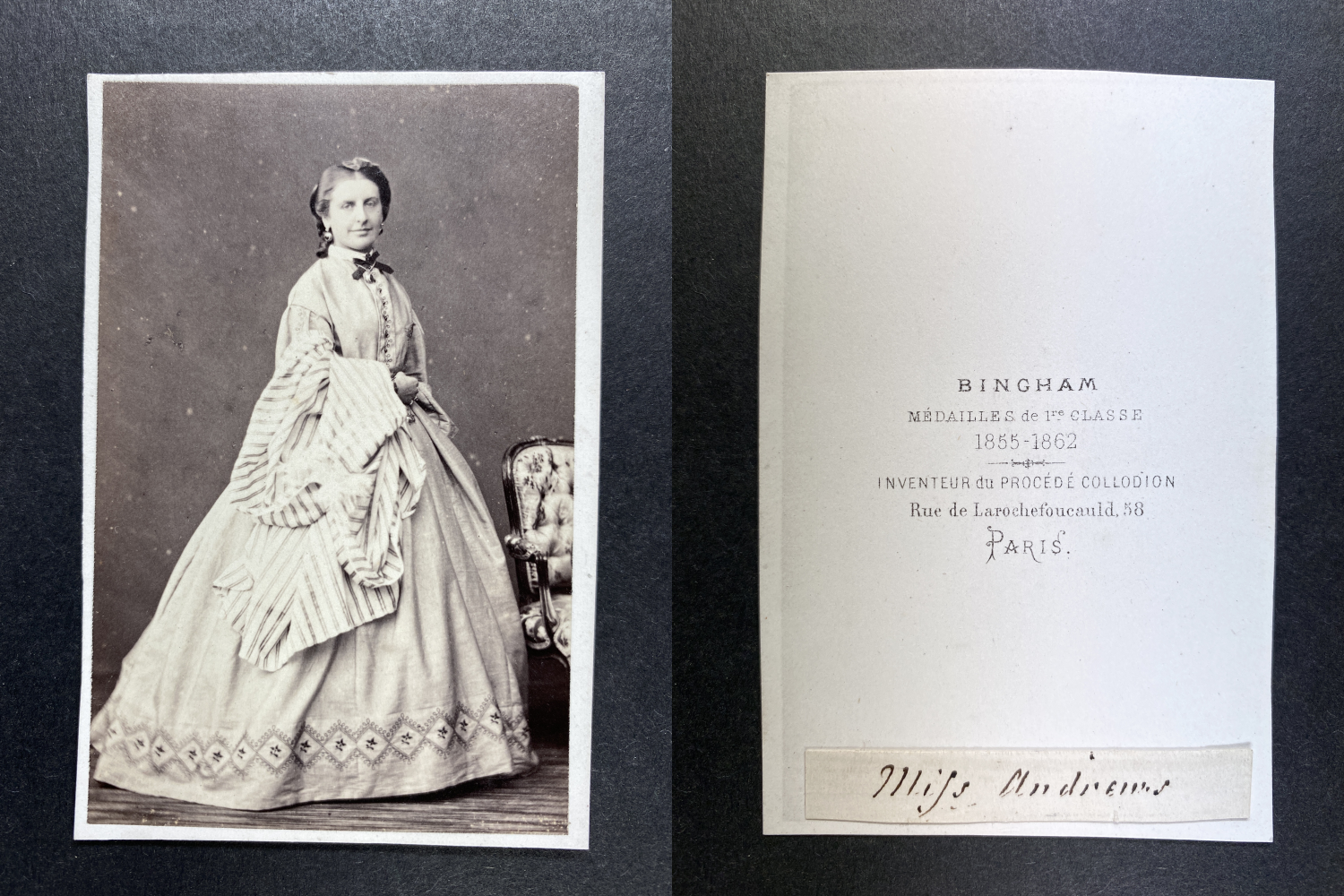
Miss Gibson Craig? Where does she fit in? There she is in 1861 at a charity meeting for the Exeter Female Refuge. And in 1864 both Miss G C, and Miss H[enrietta] E [lizabeth] G C, are taking part in an Archery Contest along with Miss E Bond, Miss Andrews ... ah! The Gibson Craigs are related to the Andrews! 'Biggs Andrews Esq QC, commissioner of bankrupts for the Exeter District, of Heavitree House' and Sir James Gibson Craig of Riccarton ... OK, we're into Scots aristocracy here. With Heavitree connections. There's one of the Miss Gibson Craigs aged 65 living with the widowed Biggs Andrews at Heavitree House (6 servants)  in 1871 ...  I think this might be Sir James's niece, Annie  ..


I imagine this is Anne Clarissa Andrews who married the Reverend Davie of Yelverton, Norfolk, youngest son of a baronet. Mrs is the former Helen Gibson Craig (d Heavitree House 11 March 1869). Yes, well I won't get into the ramifications of the Gibson-Craigs (they acquired a hyphen somewhere along the way)

And now a Viscount .. but, of course, he's not just a Viscount (no 7 of the ilk), he's the Very Reverend Dean of Exeter ... William John Brodrick (d 29 August 1870) and here he is dining with Messrs Woollcombe and Har(r)ington and Dr Shapter in 1867 ... 


These three ladies look as if they have been culled from the same album, too


I think that's enough. I'll keep an eye out for those Exeter labels though. There are still a lot of Devonian Revs who haven't turned up yet ...

And one comes up, from a wholly different source, just minutes later!  Well, not he but his wife, mother-in-law and other family! 
The Rev John Eva White, BA Trinity, Dublin, formerly deacon of St Mark's, Victoria, rector of Pillaton, Curate of Probus ...  married Miss Mary Peter (b Liskeard) 


Her mother, Elizabeth Hicks née Bishop, married firstly (1834) innkeeper Jonathan Elford of Liskeard, and after two sons (Alfred and Edwin) and a daughter (Louisa) and his his death (1846) the rather younger Simon Peter, attorney and solicitor. Peter died aged 32 (11 March 1853) after a brief marriage, which produced two daughters: Mary and Florence and a son, Reginald.  Mary was born 28 September 1847. Reginald 2 August 1850.

Mrs Simon Peter


Reginald Peter

Reginald had a dashing career: mayor, JP, magistrate ..   married and had six children ... and lived to over 80 (d East Looe 3 February 1932). Mary's clergyman was less durable. He died at Pillaton (the fief of the Bishop Family) 8 August 1876. Mary herself lived to 19 February 1931 back in Cornwall.

And here is Edwin Elford, son of Elizabeth's first marriage, with his wife [Ann] Louisa née Fell ...


Edwin became a 'merchant', and died at Heavitree 14 December 1887 aged 48. The couple had seven children, whose progeny must nowadays stretch from Devon and Cornwall to Australia, where their youngest son, Archibald Sefton Elford MA OBE, became an official of the Australasian Steamship Company.

And then there's Mrs Seccombe, photographed in Exeter, too. And her daughter, Rosa. Well, I went all around the houses before I discovered that Mrs James Seccombe was none other than Edwin's older sister, Louisa Elford. She married Captain James Seccombe 'marine and mineral agent' of the Phoenix Mine near Liskeard 18 October 1862.


Their daughter Rosa was born in Linkinhorne 24 September 1863, and was around 12 years old when this photo was taken. She married Benjamin Frazier Zimmermann of the army medical staff (19 January 1892) and they left their Bournemouth home for Bombay. Rosa died soon after in Belgaum (23 March 1897) at the age of 32.
James and Louisa, with son Cyril (b 1873)  appear to have migrated to Bolivia in the 1880s...  Yes, there is Cyril espousing first Matilde Sosa y Holt, then Gudelia Micaela Lemus Licona in Mexico 9 February 1916 ... and dying 10 March 1918. 


So, not so much church this time, but still a dose of Heavitree!