Sunday, August 8, 2021

Berthe Ferrucci, opera singer


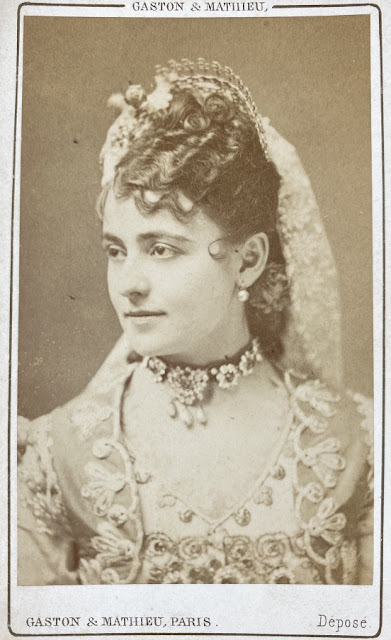
Revelling through a particularly nice (and large) bunch of operatic and theatrical cdv photos in the e-bay shop of Photo Discovery France, I came upon this lady. She was inscribed as being Ferrucci or Ferruchi of the Théâtre des Italiens. Who? Why had I not heard of her ...? 


And, goodness, she seemed to have been photographed quite a bit ..


The first dip seemingly told me a lot of what I wanted to know. A book entitled Le Nouvel Opéra by one Mons Faucon, and published in the year 1875, devoted several pages to her in her quality as a current member of the company at the 'new opera'. Her real name was Berthe Merson, she was born in Nantes in 1846, her father (who died in 1870) was a cavalry officer, she had a well-off early life, studied singing with Corsi and Duprez ... there follows a selection a great notices, from "Spain, Italy, Belgium, Eygpt" ..  as our 'chronicler' continues,  telling us she made her debut in Ernani in Milan in 1865 ...  before going on to give the highlights of her subsequent career.

Merson is not a common name, and yes it does/did flourish around Nantes -- the writer Charles Olivier Merson (b 24 December 1822), his son, the painter Luc Olivier Merson -- but also around Fontenay-le-Comte, an hour or so south of Nantes, where was born (4 November 1819) Charles's brother, the writer Ernest Merson. Sons of Pierre François Casimir Merson, printer, publisher and writer and his wife Marie-Jeanne née Vatelet. A book I have come across refers to 'les frères Merson dont l'histoire familiale est d'une telle complexité ..', but I think that an Esprit Victor Merson born Fontenay le Comte 15 January 1789 is very likely indeed to be part of the 'complexité'. Lt-Col Victor Merson of the cavalry died 21 December 1870?  I think we have our link. 
So suffice it to say that, if not born in Nantes, Berthe indeed belonged to a family with Nantaise roots. She also, if I take it that Jeanne-Marie Berthe Merson, daughter of Lt-Col V Merson of Fontenay and Jeanne Nymphe née Pernet (d 5 September 1895), is our lady, was born in Villers-Semeuse, Ardennes, not in 1846, but in 1843. But soldiers move with postings, and three years of fib is pretty standard for an operatic soprano of the 1800s.
So I'm taking the step of presuming this is she. With a slight reservation ...


Now the career. Studied with Duprez, yes. I see, very early on, that she is listed as a pupil. The début in Milan? So far, I see no sign. But there were lots of theatres in Milan where a talented vocalist (particulary a well-off one) might take her first steps. 

In 1864 she was engaged by Louis Avette for his season at the Grand Theatre of Nice, supporting prima donna Mme German[n]i. However, the audience would have none of the prima donna, and she was suffered to appear only once. And Berthe, who was apparently expecting to play Oscar, was sent on as Amelia in Ballo in maschera. The history of the theatre says she was hissed, but I think they are getting muddled up with the unfortunate prima donna. Berthe stayed for the season, and unless someone else was brought in, she and Benedettina Grosso shared the soprano roles. One Falcon and one Dugazon!  The operas played were La Cenerentola, Otello, Il Birraio di Preston, Stradella and Cristofo Colombo. I wonder which she played! However, I see that on 31 March 1865, when the season closed with a performance of the Rossini Stabat Mater, Teresa Morandini was there to sing soprano. Berthe sang the mezzo music. She clearly had a good time at the seaside: Fervaques recalled, years later, her driving her poney-cart rather expertly along the Promenade des Anglais ...

Louis Avette had run the theatre in the new en-France-ised city of Nice for five seasons with considerable skill and struggle. Now he threw it in and shifted his company to Marseille where they opened in June with Berthe billed as première chanteuse Falcon. And she scored splendidly 'Nous avons rarement entendu une voix aussi sure, aussi etendue, et aussi sonore' mis il reste encore a cette jeune personne il est indisensable qu'elle modère, egalise  at assouplisse le magnifique organe .. Elle est belle, a beaucoup de chaleur et entrain, elle parait avoir la passion et l'intelligence de sont art ...  The season included  Rossini's Moïse ('éblouissant en Amenaïde'), Otello as Desdemona to the Moor of Villani, La Traviata, Ernani ...

I don't know what, if anything, happened next. When she appeared next, she was said to have 'appeared in several Italian Theatres'. I have only found this one (Ferrara 1866) ... 


Come mid-1867 she was engaged for an Italian troupe run by the Signore Pollini and Beretta to play Berlin. It proved financially unsound, and instead she went to Campocasso at the San Carlo at Lisbon to replace the withdrawing Maria Pascal Damiani. She would be no prima donna at Lisbon, where the Marchisio sisters were assoluta, with Léontine de Maesen in reinforcement, but she gave performances of Il Trovatore ('une grande victoire pour l'eminente artiste .. une fort jolie voix, elle chante admirablement et est excellente comedienne'), Ballo in maschera, Ernani and Donna Anna, and was very much liked. As much, it appears, for her glamorous looks as for her 'soprano estensa e muita bonita'.


Her Lisbon performances earned her a contract with the far-reaching Merelli team, for Moscow and Warsaw. Tracking down performances in Moscow in these years is (until someone writes the much-needed book) a little difficult, but the season began 9 September and the repertoire apparently included La Favorita, Guillaume Tell, Le Nozze di Figaro, Don Giovanni, Rigoletto and Faust, and I have found mentions of Berthe as a 'superbe' Mathilde Tell, and as Countess Almaviva to the Susanna of Desirée Artôt. I would assume she repeated her Donna Anna to Artôt's Zerlina ... 'Mme Ferrucci a fait applaudir sa voix charmante et son style correct ...' 'Mme Ferrucci a été rappelée sept fois ; on la rappelait encore qu ' elle avait depuis longtemps déjà quitté le théâtre, pour rentrer à son hôtel'.  In Warsaw, she played Lady Pamela to the Fra Diavolo of Carríon and the Zerlina of Artôt and was voted 'une délicieuse Anglaise'.  She would return to Russia for a decided triumph when called upon to play Gertrude ('Mlle Ferrucci a été une reine irréprochable, action et chant', 'éloges sans reserve sont dus a Mlle Ferrucci') to the Hamlet of Cotogni and the Ophelia of Christine Nilsson.

Cotogni


In the meanwhile, the Suez Canal had opened, and Berthe was there, as part of the company -- Sarolta, Ferrucci, Giuseppina Vitali, Eleonora Grossi, Soboleska -- engaged for the Khedive's season 1869-70, which looked like being a vast undertaking. So far, I have only unearthed her as Leonora in Il Trovatore with Bulterini, Bartolini and Grossi, and Sarolta and Naudin in La Traviata. But Berthe seemingly did well, even with Sarolta to deal with in the beauty stakes: the gossip press reported 'A son bataillon féminin, à la tête duquel brille la Sessi, M Strakosh vient d'ajouter Mlle Ferrucci, une cantatrice dont la beauté a fait sensation au Théâtre-Italien du Caire'. 

I see the Strakosh Concert Party at Rotterdam on 2 December 1870 with Berthe in the company of Marie Marimon, Fernandez, Tombesi and Agnesi. After which, there was war. During which I spot Berthe and her mother in Vienna: not working, just passing through.

Then, in June 1873 the news came that Mlle Ferrucci had been engaged by Halanzier for the Paris Opéra. 'She is French' gasped the press 'she will keep the name that she took on in Russia'. Yeh. And at Nice, and Marseille ...

Halanzier


6 October 1873 came that day which could make or break a singer's career. At the Opéra, one performance, one night .. that famous 'first début' ... could mean acceptance into the Parisian fold, or rejection for ever, without even getting a second or third chance. And those in charge seemed to make success as difficult as possible. Berthe was given a mighty role in which to make her début, one which the press said -- seemingly correctly -- she had never sung before, and less likely, had never had a stage rehearsal of. The well-known role of Valentine in Les Huguenots, which, with the Rachel of La Juive and the Fidès of Le Prophète was a centrepiece of the dramatic soprano French repertoire.

7 October 1873, the music world couldn't make up its collective mind. La Presse said 'Elle a réussi' but when it tried the analyse ...


OK. She didn't fit into one of the French opera world's tidy boxes? Why not? Falcon was a pretty good fit. Was it the wrong role? No. She would sing Valentine till she sang no more. The English-language press summarised the Paris reviews: 'The new debutante at the Grand Opera  ... has been fairly successful only as Valentine in Les Huguenots. Her voice is resonant but deficient in power, and somewhat dull and wanting in timbre as to the middle notes. Her singing is better in dramatic than pathetic passages, and her acting is extremely fine throughout the opera'. So, was it a pass or a fail?

Neither. The announced second debut in La Juive didn't take place, but neither was Berthe sent away. She remained as a member of the Opéra for several seasons, appearing periodically in her role when Gabrielle Krauss couldn't or didn't. When the Opéra was burned, and the company moved to Salle Ventadour, she was cast as Donna Anna, alongside the Don Giovanni of Faure, Gailhard (Leporello) and Pauline Gueymard (Elvira). And, as far as I know, those two great roles were the only ones that she sang, time and again, seemingly mostly when someone else wouldn't or couldn't, during her time in Paris. 

Pierre Gailhard


I see her appearing in other theatres 'of the Opéra' now and then -- notably, giving her Valentine to the Raoul of Warot at Brussels, and also in Bordeaux ('grand succès') and in October 1877, back in Marseille.  And in Marseille she, as she had been a dozen years ago, she was hugely appreciated: as Valentine, as Rachel, as Leonora (Trovatore) and, as Jules Prével, no less, wrotre in the Figaro: 'Mais c'est surtout dans L'Africaine un role nouveau pour elle qu'elle a revele ses precieuses qualites: ampleur de voix, surete de methode, jeu dramatique, parfaire intelligence des nuances et, pour completer tout cela un physique qui fait d'elle une Selika accomplie. Depuis Mlle Meillet, les Marseillaises n'ont pas eu de Falcon pouvant lui etre comparée'.  Strange. So why did not he say that when she played in Paris. Was it all part of the game that was Parisian theatre and journalism..?

Mlle Meillet


In 1878, she is still in Marseille, giving Mons Campocasso her Valentine, her Gertrude in Hamlet and this time, Aida ...

And then it stopped. Thirty-five years of age? With a voice of her type -- always praised as perfectly produced -- surely, she had years and years left ...

I am pretty sure she married. And, yes, if she were the Berthe 'from Nantes' I know whom. Louis Jean Baptiste Fontaine was in the same business as grandfather Merson. He was a printer and publisher, who became editor of the Republican leftist paper Le Petit Provençal.

And if she were the veuve Fontaine, she died in Paris, at 55 Boulevard Haussman, on 30 March 1903. Aged 60. Nobody from operatic days, seemingly, noticed. But Le Petit Provençal gave her a half column, praising her attributes as a woman but ... with no mention of Mlle Ferrucci!  


Donzenac?  Corrèze? Ah, phew. It's the Fontaine family vault ...

Well, I'll throw this one out for improvement. Maybe, as I did once before, I've soldered together two different ladies. But I don't think so.  Final wee bit of proof needed ...


Friday, July 30, 2021

Panto 1910: Miss Esta Stella


I found this photo on ebay this week. Seasonal pantomime as it used to be, a century ago.  The year 1910, as I managed to winkle out ...

And I found a review, with cast list. This, the kind of review that pantomimes were worthy of in Edwardian Britain ...


So here we are, 'The Palace of Cards', the final scene from Jack Horner at the Prince's Theatre, Bristol, Christmas 1910.


And here is the review ... 


I wonder if photos of the other eleven scenes exist.


Esta Stella. Her publicity said that that meant 'star of the east'. It wasn't her real name, obviously. 

Her story is not easy to piece together. Her professional life, yes -- she carried on successfully for over a quarter of a century in music hall, and, latterly, revue --  but her private life.  I presume it is she, in the 1911 census, living alone (as she did till the end of her life) in Meadow View, Chertsey, as Madeline Stella, 27 years of age, born in Blackheath. What she does not tell us is, as what. She has scratched out what seems as if it might have been her real name of the census paper ...


The 1939 quasi-census shows Miss Stella living in an eight-room villa, still single and alone, Shepperton Villa, in Chertsey Bridge, Spelthorne. She gives her date of birth as 24 June 1881. Is that true?

So, we go to the birth records for ... ermm .. Kent or Surrey? .. but I find no Madeline ... well, try the other end. She suddenly stops appearing in the electors' registration list for Staines in 1939 .. dead, or just fled the war to kinder parts?

IT'S NOT SHE! Red-herring-time!

But bingo! Caroline Jackson of the Family Treasures Reinstated group came up with a newspaper clipping from 1972 ..

"The old-time revue and variety star, ESTA STELLA passed away on Monday, July 17, in Newhaven Hospital. She was 90, and had lived in retirement in Brighton for nearly twenty years. She was well known in the early part of the century for her many appearances in the late HARRY DAY'S revues, and as a star of the music hall, being known as "The Military Maid," with her singing and dancing act and also appeared in pantomime in the company of many old- time names. Her first husband was CON FREDERICKS, the American vaudeville performer."

Here I go again!!! Er .. first husband ...?

While I slept, Caroline and Gina squirreled away. Now it's my turn, while they (in England) sleep. Ive been on the trail since dawn and here is the result of all our lucubrations.

Esta STELLA [HUEY, Maggie Susanna Burton] sometime 'Little STELLA' (b 4 Nevin St, Liverpool 23 August 1881; d Brighton 17 July 1972).

Maggie was the eighth child (fifth daughter) of one William Duckworth Huey (1841-10901), the son of Duckworth Huey, hairdresser, of the London Rd, Liverpool who had died at the age of 32 (1 October 1850). William became a cook, a chef, a restaurant manager, a restaurateur, married Hannah Burton (1843-1913), had seven children, lost one, went bankrupt (1880), had one last child (1881), gave up cooking and became a clerk ...
Having had some dance training from her teenaged sister, Annie, she started in showbusiness as a juvenile, in concert and pantomime in Liverpool, as Maggie Huey. When she went on tour as Little Eva in Uncle Tom's Cabin she became 'Little Stella'. She and Annie played into pantomime at Croydon, Eastbourne, Sittingbourne, Greenwich and Hull, she was a juvenile vocalist and fairylike dancer on the halls, and for a while purveyed a male impersonation act... I wonder if she were the 'Little Stella' painted by James Sant RA. He seems to have painted both Babes in the Wood and Little Red Riding Hood as well ..


In 1898, she threw in the 'Little' bit, and became Esta Stella, and started out on the adult career which would take her through the next thirty years.

But I shall stick to the personal part. 

In 1901, I see her in the Kennington Road, in digs in the house of an Italian waiter, along with James Karno and John Dunning 'music-hall artists'...  


In 1911, she is with another music-hall family. Because she has married into it. 


The Norwegian gymnast Con Fredericks had come to Britain from Chicago, with his troupe, on several occasions from 1896. Latterly, part of the troupe was his son, Con[rad John] Fredericks junior (b 7 May 1883). Con jr and Maggie were married 5 December 1907. A daughter was born, and died at five weeks.


The couple can be seen, with the elder Fredrickses, in 1911. Both spouses, of course, continued with their careers, and the inevitable happened. Maggie went on tour in Hello, Everybody, for the provincial revue specialist, Harry Day (real name: Edward Lewis Levy), and fell. Con divorced her, but Levy's wife, 'Kitty Colyer' (Katherine Amelia Rea-Cox), apparently forgave him. 


They seem to have stayed married until his death 17 September 1939. And Maggie continued to work for Harry! She was still starring in Harry's Airs and Graces in 1918.


And called herself, in the 1939 listings, 'Stella Day, theatrical actress' widowed, 58. Address: 15 Cedar Avenue, Thornton Clevelys, Lancashire.

Both ladies lived to the age of 90. Kitty died in March of 1972, Maggie in July. Both calling themselves Mrs Day. 

Conrad remarried, an actress named Margaret Eva Douglas (b 15 June 1892), they had a son, Patrick Albert Conn (20 August 1916) and left for a two-year long trip to Australia and New Zealand. After which I thought  had lost them ...


But Caroline came up with the answer. Con simply changed his name.


In 1926, he is touring in revue with Whit Cunliffe, in 1930 performing an act 'The Funny Airmen'. Later he teamed with Renee Reel in a comedy act and appeared as a comedian in pantomime. In 1950, aged 67, he was touring in Emile Littler's Annie Get your Gun. And as Con Kenna he died at 72 Marchmont Street, London 28 March 1953.  He left 108L 10s 8d. His son, by Margaret Eva, Patrick Albert Con[n] Fredericks, born 20 August 1916, survived him, and died at Sittingbourne 1 May 1980. I see that, in 1939, Margaret, living with Patrick in Croydon, is Margaret E Thomas. Did Con have another marital flop? Margaret Eva Thomas died in 1975.


Saturday, July 17, 2021

Westland: from Scotland to India to New Zealand


I'm suppoosed to be working on the book after the book after next .. but with my morning cup of tea I came upon this lady ...


Mildred Westland, photographed in 1886 in India. So I had a wee investigate and found her family, and also ... yes connections to my New Zealand homes ...

So I thought that, with my second cuppa, I'd just record what I'd found ...

Mildred was born as Janet Mildred Jackson, in Clifton, Somerset 13 December 1854, daughter of Charles Julian Jackson, a medical man, and his wife Janet Leith née Harvey. Dr Jackson went out to India circa 1870, and his family later followed him. He died ('retired deputy surgeon-general in HM Indian army') at Nice 16 January 1895.

Mildred wed, at the age of nineteen, Scotsman James Westland of the Indian Civil Service (Darjeeling 23 April 1874) and a few weeks later he was appointed accountant and comptroller general to the Indian Government. Over the following decade and a half, he had an ever-more-distinguished career in government financial affairs, during which time Mildred gave birth to five children. The four who survived were

Charles James (b Nagpur 1875; d Glen Muick, Cheviot, Hurunui 11 July 1950)
Agnes Mildred (b Aberdeen 1877; d Boar's Hill, Oxon 23 April 1964)
Dorothy Harvey (b Calcutta 14 March 1881; d Bournemouth 1 June 1946)
Francis Campbell (b Camden 17 September 1884; d Didcot 10 April 1941)

In 1889, James resigned from his position in India, for health reasons, and the family returned to England where they can be spotted, passing through, at a Kensington hotel in the 1891 census. And a few days later (10 April 1891) they left that hotel and boarded a ship for New Zealand. Mother, father, and four children aged sixteen to seven years of age. And where did they settle? Why in the Hurunui. I pay my water-rates to Hurunui Council. I guess their homestead "Glen Muick" (named for the spot in Aberdeenshire where the Westlands came from) is about 30 minutes drive from my home.

However, their stay was short. In 1893, James was appointed to the Viceroy of India's Executive Council and the family -- seemingly minus Charles -- returned to India. In 1899, they finally returned to England where James -- now Sir James KCSI (1895) -- became a member of the Council for India. I see him at the Yarrows, Frimley in 1901.  James died at Weybridge 11 May 1903. Dame Mildred at a Montreux hotel 8 March 1927.


I belong enthusistically to a group named Family Treasures Reinstated. We try to find present day family members to whom old photos and bibles and diaries can be restored. Several of the members, in particular, are whizz-bang winklers-out. So I thought I'd see if I could find a home for Mildred.

Next generation. Agnes = 0 (unmarried), Francis = 0 (married late and died), Charles = 2 (married Jessie Eleanor Fisher, son Alan and daughter Hilary), Dorothy (Mrs Lt-Col Sisley Richard Davidson DSO) = 0


Wow! The famous First Four Ships! Toff stuff.

Charles farmed at Cheviot, but was an avid astronomer, and at one stage moved to Apia, as an official government astronomer. He also wrote on the subject.


Well. We're down to Alan and Hilary. I see Hilary as bridesmaid at Alan's wedding, I see her living in Samoa, I see her doing an 'extended tour' of the Continent with Mildred, I see her 'of New Zealand' with Mildred at a do in Scotland, and I see she is still assumed to be 'Miss' in a lawyer's ad in 1944 ... but she wasn't! Not quite. Hilary Frances Westland married Francis Richard Dykes ... she lived in St Albans, Papanui .. my stamping ground! ... and died 11 November 1989. But no children. Her husband died right after the wedding.

So it's all down to Alan. Alan Stephen Westland (1897-1970), married Edna Longdin. Son 10 September 1933. 

Omigod. The Press (Christchurch, New Zealand) 20 May 2021 ... 

Westland, George Harvey (Harvey), formerly of Glen Muick, Cheviot, on May 8 2021, peacefully at Rangiora.  Loved brother and brother-in-law of John Westland, Madeleine and Neil Bissell (Wellington) and the late Janet Parker, loved uncle to all his nieces and nephews.  A Memorial Service to remember Harvey will be held in the Kaiapoi Working Men's Club, 113 Raven Quay, Kaiapoi, on Friday June 18 at 1.00pm.  All welcome.

George lived not far from us. He was into gun manufacturing and shooting. The Malvern Rifle Club.

Well, I guess that's found the descendants. Now I'd better get a third cuppa, and get back to my real day job.


Oh PS Lt-Col Sisley R Davidson (b Cupar 26 August 1869; d 4 March 1952) went to the same school as I did. Nelson College, NZ.  Seventy years before me, of course.


Sisley and Dorothy


Friday, July 16, 2021

Harry and Charles: "The comic shadows"


Twenty or thirty years ago, when I was researching my book Emily Soldene: in search of a singer, 1500 pages and hundreds of illustrations of the Victorian theatre and its population, I tried very hard, in all corners of the pre-Internet world, to gather up portraits of the people featured in Emily's story. Right down to the chorus girls of three continents. And, with a little help from my friends, I did amazingly well. Things turned up in the most amazing places. Rootling around in the National Library of New Zealand, I even dug up a photo of 'The Raynor Brothers', blackface comedians! Why did I want them? Because when the famous Payne family, who had made such a hit in the eccentric can-can finale of La Grande-Duchesse, moved on from the John Russell tour (star Emily Soldene), Russell replaced them with the Raynors.

1879, Paris. A 25-minute act.

"the place of the irreplaceable Paynes was imaginatively taken by the Raynor Brothers, Charles and Harry. The Raynors (who, of course, were not brothers at all) were ‘Ethiopian comedians’, blackface music-hall entertainers who would later bill themselves with considerable success as ‘the comic shadows’. Harry had traipsed the world as an entertainer -- California and Nevada, Australia, the East & West Indies, Tahiti, India, China, South Africa -- and had, the previous year, appeared on Broadway at the San Francisco Minstrels’ Hall and Tony Pastor’s billed as ‘the thinnest man in the Ethiopian business’. The highlight of his zany act was his performance on the one-stringed ‘Japanese fiddle’:
'He was dressed in jet black tights and jacket fitting so tight to the skin that it seems impossible for him to move about. He is the slimmest and ugliest looking nigger we ever saw and his appearance alone is sufficient to convulse and audience with laughter particularly when he takes a seat and lifting two canal boats - sometimes called feet - places a sheet of music against them and commences to play. Then it is that roars of laughter burst forth. He plays upon a Japanese fiddle with one string and although the music brought forth is not the most pleasant to listen to yet it elicits considerable applause...'
Charles, who had trained as a doctor, had recently given up medicine to join Harry in a double act, and they had been seen at Christmastime in London, performing a burlesque boxing match at the Bedford Music Hall, and again at the Cabinet Theatre, Liverpool Street, in what they called ‘The Great Australian Variety Troupe’, doing a burlesque of Italian opera. It may have been this, or else the fact they were represented by Parravicini and Corbyn, the agents who had snapped Emily up on the crest of her first success and were now billing her widely as ‘the talented artiste who has created such a furore as the Grand Duchess at the Standard Theatre’, that encouraged Russell to cast them. But, like almost all of his casting, it worked a treat"

‘THE FAMOUS FINALE to the second act will be danced by Mdlle Rosa and Messrs Raynor, and the whole of the principal characters..’.

Well, I shall add the photo which I (at great expense) had copied when I return to New Zealand. Emily' two vast  volumes are far to carry with me ... but ...

Toddling through ebay this morning, I came upon a photo "Victorian Photo: Cabinet Card: Dapper gents Cigar named: Raymond: Bertin, Brighton".


It is actually Raynor, and it is they. And for a fraction of the price that I paid 30 years ago!  I'd love to know who the chappie in the middle is, but that Harry, the skinny, crazy one on the right; and that's Charles, 7 years younger, on the left. And, oh dear, they WERE brothers!

So disgusted was I to find an error in Emily, I determined that 'the brothers Raynor' would be outed. And here is the truth of them.

Mr James Mennie, of Newington and Bermondsey, born in Bray Court, Islington 9 October 1807 to Robert Mennie and Christiana née Sheath, his wife, made a success of his life. He went into the booze business, and became mine host of the Skinner's Arms, Cannon Street West. He married Miss Caroline Amelia Elizabeth Levell, in 1838, and they had five children  -  Alfred, Louisa, Henry, Frank and Charles -- and they prospered. James invested his profits in leasehold real estate, three houses in Falmouth Road from which he derived sufficient income that, when Caroline died, in 1858, he gave up the pub and went into retirement.


Alfred became a commercial traveller cum clerk (living at 16 Falmouth Street), Frank an advertising agent. Charles didn't study for medicine for very long, because in 1871 he's already listed as 'actor'. Harry of course is already on his way by 1869. With the greatest of American burlesque travesty artists, Francis Leon (prima donna)


I wonder if the rhinoceros was somewhere in Barberblu (as their burlesque of the opéra-bouffe was later called). But to have billing on a Kelly and Leon programme was already something.

But already in October 1869 the brothers are up as a double act at  the Bedford Music Hall: 'The Brothers Raynor are two of the funniest Niggers to be found in the Music Hall world. They are quaint and extremely grotesque, but never unwarrantably coarse, and the solo of one of them on a curiously manufactured banjo is a really droll effort'. That will have been Harry. It was Harry who was the zany one. 'Their eccentric Ethiopian entertainment, the funniest part of which consisted of a boxing match' 'The original black shadows" at the Alhambra .. and on they went.


1871, London


1872 Vienna

Henry seems to have remained a bachelor. But Charles wed, in 1878, a well-liked dancer and burlesque performer known as Clara St Leger. Her actual name was Clara Soper, daughter of Bermondsey tailow, William Lemon Soper (1809-1897) and his wife Ann Degenhardt Reed.  The other girls in the family plied the tailoresses needle, but Clara trained with Espinosa and took to the stage, playing on both sides of the Atlantic over some twenty years. 

Charles gets a mention on 1873 in a review at Cremorne Gardens -- 'Some exceedingly clever musical and comical sketches were given by a troupe identified with the name of Mr Charles Raynor, who are making just now a considerable stir ..' but by and large, over the next fifteen years the brothers worked as a highly successful duo, all round the world.


In 1888, freshly returned from a tour to the Antipodes, the pair took on the management of the Pack Horse Hotel in Staines 


but two years later, Harry died, aged 45.

Charles carried on. He sold the hotel, and went into partnership with Alfred Wood: 'The clown of the pair is Mr Raynor, who certainly knows how to be funny and how to play the concertina. Mr Wood tootles on the bassoon, and his partner improvises on the clarionet, the pair finishing their diverting business with the celebrated Cats' Duet which the Brothers Raynor in the years that are gone served to bring into great popularity'. 

But a few years later he, too, fell ill. Within three months, in 1896, both Clara (aged 38) and Charles (aged 47) went to their graves at Staines. A sad end to a very merry story ...


To which we can now affix the facts, alongside this delightful photograph

RAYNOR, Henry [MENNIE, Henry] (b Newington ?July 1844; d Staines 6 January 1890)
RAYNOR, Charles [MENNIE, Charles] (b Newington 21 March 1851; d Staines 10 November 1896)
ST LEGER, Clara [née SOPER, Clara] (b Bishopsgate 1 January 1855; d Staines 26 August 1896)


Caroline [Eliza] Brook. Ah, yes. Married Horatio Nelson Hunt. There they are at the 'Pack Horse', in 1891. He's 'brother in law'.  William Brook(e) 'brother-in-law'. But ... how are they brothers in law?  No, I'm not going there. I'll stop here. 

I found what I wanted to know.  

Here are further details (which I have not checked) from the Australian press: