What does an historian long for when writing a chap's biography? Why, the contents of his correspondence files.
Well, amongst the many hundred Victorian Vocalists about whom I have written, and who now live in the brain of my computer, there was a gentleman by the name of Herbert Thorndike. Baritone. Evidently a rather fine baritone. But a baritone who moved in socially quite elevated circles, and sang as often with the society amateurs as on the professional concert stage, and even occasionally took to the stage.
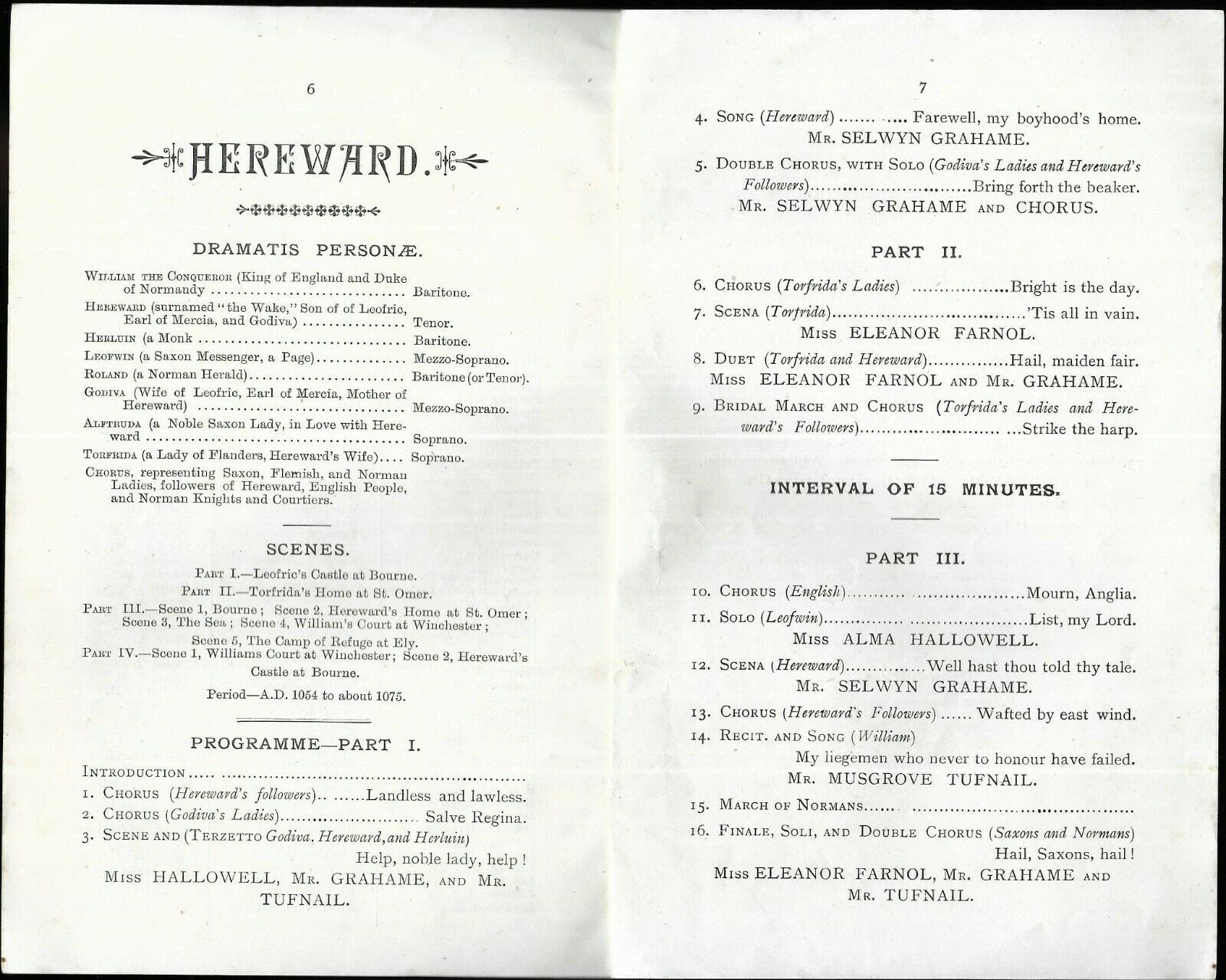
Today, while as usual, looking for something else, I came upon a letter written by the contralto 'Helene Arnim' to Herbert. So I popped into the ebay shop of significant_signatures and ... oh, my! I have never collected autographs, but letters are something else, if they contain an insight into -- in my case -- the musical and concert life of Victorian times. And Mr Significant-S has managed to get hold of at least a part of the in-box of Herbert Thorndike, a large enough part to keep me reading for the last three hours ... We get a fascinating first-hand insight into the world of Benefit concerts, hurried engagements, song-plugging and so forth ...
So, first, I will paste here my Herbert article, and then I shall see if I can fit the letters into the timeline of his professional life.
THORNDIKE, Herbert E[lliot] (b Liverpool 7 April 1851; d Millefleurs, Penmere, Falmouth 18 February 1940)
Herbert Thorndike led a two-coloured career in music. His abilities as a baritone vocalist provided him with a thoroughly respectable professional career as, basically, a concert vocalist; his social position gave him a full quasi-amateur one, in the concerts and charities of the rich and ranked.
Thorndike was bred into an army family. His grandfather was Lieutenant-General Daniel Thorndike, his grandmother, Frances Christiana Faunce, the daughter of a Lieutenant-Colonel, his father Charles Faunce Thorndike was, at his birth, a Captain in the Royal Artillery, his mother, Mary Ann Vinnicombe (d 33 Norland Square 1 April 1912), ‘the granddaughter of the late General Vinnicombe’, his uncle, Francis Henry, was an Indian army major … I won’t delve into the family records and scandals, as Herbert’s relation, Miss Sybil Thorndike, has caused them to be well written about. And his father published a memoir Some memories of Ninety years ‘the recollections of Charles Faunce Thorndike of Trieste, gunner and priest'. For Charles had given up the barracks to take on such posts as Chaplain to Moulsford Lunatic Asylum, curate of St Saviour’s Bath, and ultimately chaplain to the consulate at Trieste.
The aleas of a military career meant that Herbert was born in Liverpool with his father listed as ‘of Brynllwyd, Anglesey’, his eldest sister, Agnese Mary THORNDIKE (b Woolwich Common, 2 January 1846; d Camberley House, Gorodon Road, Camberley 1 February 1923) at the Woolwich barracks, and his other sister, Emily THORNDIKE (b Llanbeblig, Caernavon x 28 September 1849; d Bure Acre, Aylsham, Norfolk 17 April 1941) in Wales. Emily, too, married into the army as the wife of Captain Frederick Hotham Hart Dyke, ‘son of Colonel Dyke of Glovers, Sittingbourne’ and spent her not inconsiderable amateur career – for both sisters were fine vocalists -- singing as Mrs Dyke.

Herbert first came to public notice in 1873, when he entered the singing competition held at the Crystal Palace. He won the baritone/bass section (beating, in the process, the young Leslie Crotty) and the press commented ‘a baritone voice of power and good quality whose singing appeared to be untrammelled by the conventionalities of any special school; in fact he sang like one with a keen sense of what is good in taste derived from his own deductions rather then from any special master’. He seems to have been a natural. And to have remained natural always. For in his long career, Thorndike never, to my knowledge, attracted a bad review for his singing or his voice. He just wasn’t Santley. And I imagine he didn’t care. Wherever he sang, during the rest of the century, at St James’s Hall, Drury Lane or at an amateur soirée at the home of a Duchess, or in concerts for the people, full of unknown names, he was liked.
In the next five years, I barely spot Herbert. I suspect he went off to Italy, for he would (much) later call himself a pupil of Lamperti. But he made what he called a ‘first appearance in England’ at a concert mounted by Gustave and Linas Garcia, 16 June 1875. Thekla Friedlander, Alice Fairman, Santley, Foli and Werrenrath were the bill, and Agnese was billed as a ‘pupil of Garcia’. Gustave, that is.
The two girls are visible in 1877, singing in garrison concerts and for charity (Emily gave ‘Casta diva’ and Agnese ‘O mio Fernando’), but it is 1878 (28 May) in Dublin before I pick up Herbert again, performing Acis and Galatea, Der erste Walpurgisnacht et al with the Dublin Musical Society, alongside Jose Sherrington, Eliza Enriquez and Vernon Rigby. He followed up in such as Ganz’s concert at Dudley House, Urio’s concert at the home of the Wallace Carpenters, the Royal General Theatrical Fund’s annual and an appearance at the Crystal Palace – but also took time out to appear alongside Emily with the local amateurs at Colchester (‘Dio possente’, ‘Irish Eyes’, ‘Marie’, ‘To Anthea’) in what would be his habitual style.
In 1879, he made a first appearance at the St James’s Hall Saturday and Monday pops, to which he would return regularly over the years, appeared with the Bach Choir, joined Jose Sherrington to sing Harriet Young’s cantata The Queen of Hearts at Brighton and in London, and in 1880 Wilfred Bendall’s/Walter Austin's The Stepmother and Lovers' Knots at St George’s Hall. He sang Elijah at Tenbury, introduced Henschel’s Serbisches Liederspiel at St James’s Hall, and mounted a soiree of his own at the Steinway Hall (14 July 1880).
In September 1880, he took a tour to Germany to give concerts of Lieder, arias (Toreador, ‘Eri tu’) and English songs in Württemburg, Stuttgart et al, and was greeted favourably.
In the years that followed, he fulfilled a characteristic list of engagements. He sang at the Monday pops and at the Crystal Palace Ash Wednesday concert, and the next day teamed with his sisters in Mrs Dyke’s concert at Colchester, followed by a charity do at Kensington House in the company of society amateurs. He sang at the Victoria Coffee House concerts, for Ludwig and Daubert, Romano and Oberthür, at Steinway Hall for himself (21 June 1881) and others, and he also joined with the amateur London Musical Society in cantatas. Many of his engagements – especially the society events and charity and regimental concerts -- were in the company of the same artists, professionals such as Grace Damian, Marion McKenzie, Jose Sherrington, William Shakespeare or professional-standard amateurs such as George Power who frequented the same circles as he.
In 1882 he varied his society concerts with appearances with the Sacred Harmonic Society (3 February), with the Cambridge University Musical Society, singing Hercules with Anna Williams, and in 1883 he appeared at the German Athenaeum and with Carl Armbruster, performing the music of Wagner. In 1884, he sang Redemption at Liverpool, Wagner in London, and the role of Dionotus in the premiere of Cowen’s St Ursula at Prince’s Hall, before in October taking part in the Norwich Festival, sharing the baritone music with Santley.
He was well received (‘he sang the music allotted to him with artistic style and expression’), particularly in an Elegaic Ode by Stanford (‘remarkable vocal expression’), and the second half of The Messiah (‘made a marked impression by his careful and intelligent reading’). He also took part in the first performance of Mackenzie’s The Rose of Sharon alongside Emma Nevada, Janet Patey, Lloyd and Santley, repeating his role when the piece was given (7 November 1884) for the first time in London, at the Sacred Harmonic Society.
Three days later, at the Albert Hall, he took part in the first concert performance in Britain of Parsifal.
In March 1885, he sang Schumann’s The Minstrels Curse and Rheinberger’s St Christoforos with the London Musical Society, in June at the opening of the Albert Palace, with Alwina Valleria and Lloyd (Lobgesang), and in October, at the Crystal Palace in a Meistersingers excerpt as his repertoire became more and more axed towards German music.
 |
| Mackenzie |
In 1886 (29 June) he made a first stage appearance in comic opera, playing the role of the Count di Sarda in a grandiose production of Hervé’s unfortunate Frivoli at Drury Lane. It took but a month of his time, and Thorndike returned to the concert platform, and his usual round of charity and society concerts, interspersed with Monday pops, German concerts, a series of his own at Prince’s Hall, and appearing as professional or amateur, purveying the songs of Maude Valerie White (‘The devout lover’, ‘Love me sweet’) and Frances Allitsen (‘An Old English Love Song’, ‘A Song of Thanksgiving’, ‘Prince Ivan’s Song’).
In 1890-1, he joined Ganz and Cowen in promoting a series of concerts under the name of the Prince’s Concert Society, in 1892 he illustrated Mackenzie’s lectures on Falstaff, sang at the Covent Garden proms, and ventured again onto the stage as the Doge in the one-act A Venetian Singer at the Court Theatre. Again, it took little of his time.
At some stage, he began taking pupils (advertising himself as a pupil of Lamperti and Randegger). His advertisement appeared in the press next to similar ads posted by Charles Santley and Louisa Bodda Pyne. He also took part, as an examiner, in the work of the Royal Academy of Music.
But he did not retire from singing. He appeared at the Crystal Palace and the Queen’s Hall (Saint-Saëns’s The Heavens Declare), though more often at the Savage Cub or the Green Park Ladies Club, and he took part in another little operetta, Louisa Gray’s Trick and Honours (Sir Jasper Nabob), in concert.
But he was not done with the stage either. In 1901 he returned to the boards, at the Savoy Theatre, in the role of Old Henrik in Basil Hood’s operetta Ib and Little Christina.
His name still appeared on concert bills for another decade, and attached to projects such as ‘The Association for the promotion of English singing’ for even longer.
Thorndike married, in 1902, Constance Emily Simon (b 27 September 1862; d Hotel Edward VII, Biarritz, France 5 May 1931), daughter of Julius Simon of the Anglo-Californian Bank, and after her death – when 80 years of age – remarried (1 June 1933) the widowed 47 year-old Carolina Maria Ballif Gaudernak (d Millefleurs 23 June 1946).
Agnese, too, had a career as professional vocalist, appearing at St James’s Hall, in the Boosey Ballad concerts (12 January 1881) and in the Burns night and St Patrick's Day concerts, at the Albert Hall in the Lobgesang, and in the Covent Garden proms of 1882. After 1884, she seems to largely disappear, and is last spotted in Trieste, but she married later in life a gentleman named Bryce, and died, aged 77, in 1923.
Emily appeared at the Crystal Palace in 1890, and was still appearing in concert as late as 1899. Her daughter, Winifred Amy Dyke (Mrs Cyril Arthur Mileham, b Colchester 10 September 1881; d North Walsham 1976) appeared with the Savoy Theatre company as a principal dancer under the name Winifred Hart-Dyke.
***
So. There we are. And the first thing to say is that he did indeed go to Italy and study with Lamperti. And he had a letter to prove it... 'ha studiato con me molto tempo'. Oddly, the letter was written in 1880, so it seems as if Herbert had asked for this 'reference'
But he was 'carissimo' to the young Signora Hedwig (Edvige) Lamperti ...
so I guess we can take it for a fact.
I'll try to put these letters, as much as I can, in order. This one is from 5 May 1879, from Otto Goldschmidt.
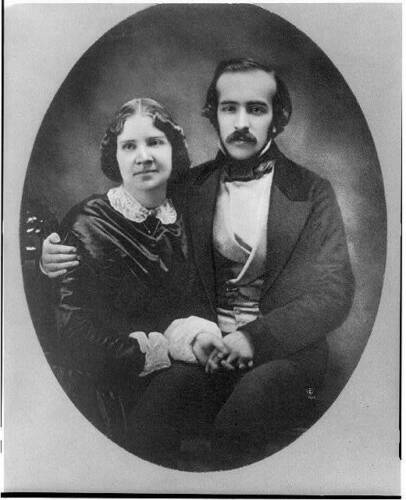 |
| Otto and Jenny (Lind) Goldschmidt |
Well, here is the concert referred to.
As we can see, Mme Lemmens and Mrs Patey sang the ladies' parts. I don't know anything about Mr Kempton, but neither do I see a review mentioning Herbert.
January 1880 brings forth this letter from Carl Hallé:
I don't think it happened. When Hallé performed Berlioz's Damnation of Faust on 5 February in Manchester and later in London, it was Robert Hilton who sang the one song of Brander. Herbert was at de Jong's concert ('his first appearance in Manchester') singing Marzials's 'Three Sailor Boys', Hatton's 'Fair is my love', and 'Dio possente' from the other Faust.
This one is undated. But I think it must be reasonably early. It is written to Mrs Thorndike mère by the composer, Walter Austin. Is Mama using her social standing to get her daughter and son an engagement? Agnese sang a new song, 'The Maiden and the Weathercock', by Austin in January 1884. But both the siblings were well enough established by then not to need parental plugging. Ah! I see Herbert as early as 1880 (5 May) singing at 'Walter Austin and Wilfred Bendall's operatic matinee' in Austin's The Stepmother, with Jose Sherrington, Elizabeth Purdy and George Power ... So is it 7 July 1881, which was a Thursday? Or 7 July 1887?
So let's find some dated ones. 1883 ...
Tito Mattei. Another songwriter. And, oh dear, he writes in Italian. Five guineas special low rate for a Charity Benefit in April.
I think this may have been it. Not a first-class field ... and not many Hungarians either!
Here's a fun one. From Boosey's. Six guineas for plugging a Théo Marzials song at twelve concerts! 10s6d a pop.
 |
| Marzials |
And here's a quasi-amateur event.
Musician George Gear writes to 'book' Herbert for a Charity Benefit for one of the hospital charities in London. Classy affair, though. The cast list is headed by Britain's two most outstanding lady amateur singers, the contralto Miss Wakefield and the soprano Mrs Lynedoch Moncrieff (ex-Nita Gaetano), as well as the professional Cecilia Hutchinson. Not to mention the very social Mr Colnaghi.
Later in 1883, another songwriter: Charles Salaman
I can't find him singing those specific songs anywhere, but in 1887 he sang something of Salaman's in his concert at Prince's Hall.
But 'matrimonially engaged'? Thorndike didn't marry until past the age of fifty. I assumed that such a stalwart, wealthy chap would have been snapped up by this, unless his propensities were all the other way. But it appears that he did have a 'girlfriend'. A lady who was also a splendid singer, a very much more professional singer than Herbert ...
1884 brings a letter from the 'Baroness Celli'. Emma Marie Celli (née Sullivan), the widow of the singing teacher Philippe Celli. Celli had, until his death in 1856, had the habit of hosting an annual concert. After that, the Baroness (I dont know what the title was about) carried on, and it seems that, in her seventies, Herbert gave her a helping hand in arranging her programmes ...
Sister Agnese sang too, but, best of all, he brought the girlfriend ... who would have been the star attraction.
Yes, it seems that the very considerable young contralto Grace Damian (eig Partridge) was Mr Thorndike's escort in these days. Here they are again in the same breath in a latter from pianist Paule Gayrard-Pacini ...
They don't seem to have done it, though. Diaz de Soria must have sung the Signor's songs. They were at Jean Avigliana's the previous week .. I suspect these engagements were unpaid ...
And here is the society string being pulled again .. by yet another songwriter. And a highly successful one. Jacques Blumenthal drops the name of Lionel Benson, one the foremost singing society amateurs ...
 |
| Blumenthal |
And one more songsmith, Joseph L Roeckel ..
'The Stormfiend' was not a new song. It had come out in 1880. But it was one of those rousing, dramatic songs which Herbert affectioned. Mr W Morley jr of 70 Upper Streert was the publisher. It don't seem to have been widely sung. Its words were by Frederic Weatherly ('The Holy City', 'Danny Boy') and there is a rather embarrassed letter from Weatherley from a few years later. It seems Herbert had gone to sing at his concert, but, in the manner of the time, the order of the programme wasn't adhered to and our baritone got sick of waiting his turn and went home.
Rehearsals for concerts were often non-existent. Here is Cecilia Hutchinson arranging to sing a duet with Herbert at a society do. You knew you were safe with 'Crudel, perchè'. It was the veriest chestnut of the bariton-soprano repertoire:
This next seems to come from 1885, when Herbert sang at Helene Arnim's concert (7 July). Obviously there was a bit of a mixup. But Herbert sang, alongside performances by Miss Arnim's brother, Carl Armbruster, and a couple of other Teutons. 'Helene' was touching on the end of her appreciable public career, during which she had sung a number of times alongside Herbert who, in spite of his Italian education, sang frequently in German music, from Bach to Wagner, and also in Germany.
This is dated May 1892. Templar Saxe, eh. Real name T S Edeveian. A slightly-society chap with a pleasant light baritone. Gentlemen's 'Bohemian' concert just his kind of thing ... but it really helps if, when asking someone a favour, that you spell his name correctly!
Here's a delighful note from Jose Sherrington, soprano sister to the more famous Helen Lemmens-Sherrington, and herself a skilled coloratura who sang anywhere and everywhere, seemingly sans complexe. This letter shows her at her norm: yeah, sure I'll sing at your concert. Anything you like. One of these?
I think this one may be 1901. The engagement which Herbert fulfilled at the Savoy was to play the part of Old Henrik in Ib and the Little Christina (14 November) ...
This one is clearly from 1901. And it is a no-can-do. Still, nice to know that the composer of 'Love Can I only tell thee' was known as 'Jack'
And on it goes ... a little note from Alberto Randegger
 |
| Alberto Randegger |
One from William Shakespeare
I wonder if there were more. And, if not, why these ones were kept ... and, finally, got rid off.
A fascinating little glimpse into the working life of Victorian Vocalist ...
PS Grace married, in 1893, a teenaged Irishman, 19 years her junior, had two daughters and outlived her husband comprehensively. She died eight months after I was born ...
Here she is, sharing a bill at the Covent Garden [Proms, with Lemmens-Sherrington, Sims Reeves and Santley in 1883 .. Haydn and Cowen. Very chaste.