A little selection of photographs from American musicals of the 1920s .... and occasionally 1910s ..
The first pair are from what might better be called an 'Americanised' musical, as it was a botched version of of a German piece:
RIQUETTE Operette in 3 acts by Rudolf Schanzer and Ernst Welisch. Music by Oscar Straus. Deutsches Künstlertheater, Berlin, 17 January 1925.
First produced by Heinz Saltenburg at the Berlin Deutsches Künstlertheater, Riquette starred Käthe Dorsch as the Parisian telephone-girl of the title. Riquette is a poor lass with a young brother to support, so when she gets a proposition from well-off young Gaston, she says `yes'. The proposition is, however, an odd one. Riquette is to be a ‘beard’, his mistress only in appearance, to cover up his affair with the married Clarisse. Clarisse sets off for a holiday in colourful parts (a second act must take place in colourful parts, and this time it is a spa in the Pyrénées) and Gaston and Riquette follow at an almost discreet distance, but the lady's husband is not wholly fooled. He hires the little telephone attendant Picasse to follow Madame. Picasse disguises himself as an Albanian Prince for the purpose, only to discover, as the fun starts to fizz, that there is a vengeful and real Albanian on his heels. Needless to say, by the end of the evening, Riquette has replaced Clarisse in Gaston's affections.
Riquette had a goodish Berlin run of three and a half months before giving over the Deutsches Künstlertheater stage to Hugo Hirsch's Monsieur Trulala and then to Straus's Teresina with the other major star of the Berlin musical stage, Fritzi Massary, at its head, but thereafter it had a rather curious career. It doesn't seem to have headed right away for Vienna, yet it was promptly produced in both Britain and in America, albeit with rather strange results.
The American version (ad Harry B Smith) was originally announced to star Britishers Stanley Lupino and June, but in the event it was Vivienne Segal who was in the title-rôle when the show opened at Detroit, only to be replaced by Mitzi as Riquette wended towards Broadway. It wended slowly, for E Ray Goetz was taking the same route with Naughty Cinderella (a version of the French musical comedy Pouche) and the two pieces were said (although it is difficult to see any more than the already well-used fake-girlfriend motif in common) to be based on the same original. Since the musical content of Naughty Cinderella was limited to Irene Bordoni's usual handful of songs, however, Goetz’s production was adjudged a play and the `musical' rights held by the Shuberts were apparently not infringed. The Shuberts retorted by making their Riquette into a Naughty Riquette (even though she didn’t seem to do anything naughty), but they kept her away from Broadway, playing lucrative dates such as Philadelphia, until more than a year had passed. Once the now `naughty' show arrived in New York, with Straus's score, by this stage, decorated with extra numbers by Al Goodman and Maurie Rubens, it was in a state to play for 11 weeks.
In Britain, Jimmy White produced the show (ad Gertrude Jennings, Harry Graham) with Annie Croft in the title-rôle and Jay Laurier heading the comedy, with a run at Daly's Theatre in view. Unconvinced by a pre-London Christmas season played in Scotland, he abandoned Riquette in the frozen north, but comedian Billy Merson picked it up, chopped it up, and put such pieces of it as he fancied into a show which he called My Son John (ad Graham John, Desmond Carter, Graham, add nos Vivien Ellis) which, with Miss Croft again featured, eventually played for 255 performances at the Shaftesbury Theatre (17 November 1926).
Hungary got a production at the Városi Színház (ad Jen*o* Hoppe) which seems to have been more faithful.
USA: Detroit 17 August 1925, Cosmopolitan Theater 13 September 1926; Hungary: Városi Színház Rikett 4 December 1925; UK: Kings Theatre, Glasgow 21 December 1925; Austria: Raimundtheater 1927
These photos show Stanley Lupino, and Mitzi, with juvenile man Alexander Grey and Audrey Maple as the other 'other woman'.
HAJOS, Mitzi [HAJÓS, Magdalena, aka Mizzi] (b Budapest, 27 April 1891; d New Preston, Conn, June 1970). A little, spitfiring soubrette who moved from Europe to America, and was there turned into a durable musical comedy star.
After attending drama school in Budapest, Mizzi Hajós made her earliest appearances on the stage at the local Magyar Színház (A Gyurkovics lányok 1908) and then in Vienna. She played in the Leo Ascher burlesque Hut ab! (1909, Lotte) at Venedig in Wien and starred as Mary Gibbs in the Viennese version of Our Miss Gibbs at the Établissement Ronacher before -- at the age of 19 -- being taken to America.. She appeared there at first in vaudeville in an adaptation of the Ronacher burlesque of Rostand’s Chantecler called A Barnyard Romeo (1910) playing a little white pheasant (‘in coagulated English’) to Stella Mayhew’s duck and William Morris’s rooster, and moved on to play Fifi Montmartre in the Shuberts' revusical La Belle Paree (1911) at the Winter Garden, and to tour in Christie MacDonald's star rôle of Princess Bozena in Werba and Luescher's Broadway hit The Spring Maid (Die Sprudelfee), and had her first Broadway lead rôle in the same producers' production of De Koven's Her Little Highness (1913, Anna Victoria). That show, and the reduction of it, Queen Ann, played by the little singer on the vaudeville stage, disappeared quickly, but her next appearance, in the title-rôle of the extremely Hungarian Sári (Der Zigeunerprimás, 1914) hoisted her briskly to star status. Over the following years, with the aid of Sári impresario Henry Savage, she staunchly maintained that status, billed as the `baby star', `the paprika primadonna' and finally, from 1916, simply as `Mitzi' (‘Americans don’t know how to pronounce either of my names..’) through a series of mostly unexceptional rôles and shows which nevertheless packed in the audiences in the long series of tour dates she trouped year after year.

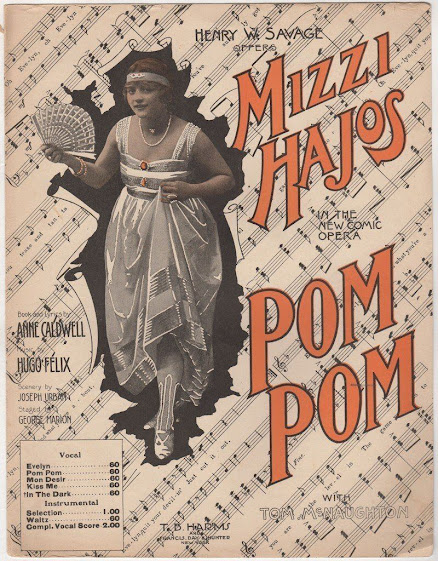
Anne Caldwell and Hugo Felix's Pom-Pom (1916, Paulette), a piece adapted for her benefit from the Hungarian operett Csibészkirály, had her cast as another Continental heroine, this time an actress mistaken for the pickpocket she plays on stage, Head Over Heels (1918, Mitzi Bambinetti) had her playing an acrobat to Jerome Kern music, while Zelda Sears and Harold Levey's Lady Billy (1920, Countess Antonio) cast her as an aristocrat disguised for much of the evening in boy's clothes. The same team of writers dipped into fantasy with a second vehicle for her in The Magic Ring (aka Minnie an' Me, 1923, Polly Church). A move to the Shubert management for Oscar Straus's Naughty Riquette (Riquette, 1926, Riquette Duval) gave her some worthwhile music and yet another long and successful tour, whilst The Madcap (1928, Chibi) cast the now 37-year-old star alongside Sidney Greenstreet as a teenager pretending to be 12 in a musical version of Régis Gignoux and Jacques Théry's Parisian play Le Fruit vert. She returned to Broadway for the last time as a star as Sári in a 1930 revival, and thereafter appeared only as a featured player on the non-musical stage. In her retirement she worked in the offices of the Shubert organisation, until she was firmly (and unwillingly) retired in 1952.
Mitzi was married to stage and screen actor Boyd Marshall (1885-1950) who played alongside her in Lady Billy (John Smith) and The Magic Ring (Tom Hammond).
LUPINO, Stanley [HOOK, Stanley] (b London, 15 May 1894; d London, 10 June 1942). Startled-looking little star comedian and author of two decades of British musicals.
The son of dancer George LUPINO [George Emanuel Samuel Lupino HOOK] and a member of a famous family of dancers and acrobats, Lupino worked as a child in an acrobatic act and in pantomime, and as a young man in revue, variety (his first musical comedy appearance being in the one-act Go to Jericho in a variety house) and at the Theatre Royal, Drury Lane, in animal rôles in pantomime. He had his first good musical-comedy rôle in 1917 at the age of 24 supplying the supporting comedy in the Gaby Deslys vehicle Suzette (Tibbs) and he made a notable success later the same year in the principal comic part of Arlette (Rono) in which he made the hit of the evening with his performance of Ivor Novello's song `On the Staff'.
Established as a leading comic, he mixed musicals and revues over the years that followed, appearing at the Gaiety in The Kiss Call (1919, Dr Pym), in Oh! Julie (1920, t/o Mumps), His Girl (1922, James Hicks) and Cochran's remade Phi-Phi (1923, Mercury), before making his American début alongside Vivienne Segal (pre-Broadway) and later Mitzi in the local version of Oscar Straus's (Naughty) Riquette (1925/6, Théophile Michu). He remained in America to play in the Jenny Lind biomusical The Nightingale (1927, Mr Carp). During this period he won his first West End credit as a writer when he supplied some material to C B Cochran's many-handed musical version of the famous comedy Turned Up.
Back in Britain, he was seen in the farcical Up with the Lark on the road before he teamed up with rising producer Laddie Cliff as co-librettist and co-star of the new style dance-and-laughter musical So This is Love (1928, Potiphar Griggs). The piece was a substantial success, and many of the team it created continued together over the following years, playing in a number of further shows in the same vein, written and directed by Lupino, produced by Cliff and starring the pair as chief comedians (Jerry Walker in Love Lies, Reggie Powley in The Love Race, Percy Brace in Sporting Love, Tommy Teacher in Over She Goes, Bertie Barnes in Crazy Days) with decided success.
Lupino also rewrote the already rewritten libretto of the American musical So Long, Letty! for Cliff, in an unsuccessful attempt to get it into shape for town; wrote, directed and starred in Hold My Hand (1931, Eddy Marston); wrote and then rewrote Paste/That's a Pretty Thing, which was ultimately played at Daly's Theatre without him in the cast and without equivalent success, and was credited with the `book' to the wartime revue Funny Side Up (1940) produced at His Majesty's Theatre with a score made up of a mass of songs mostly culled from the backlists of American publishers.
After his winning partnership with Cliff and their series of shows together was ended by the little producer-dancer's premature death, Lupino went on to star at the Hippodrome in The Fleet's Lit Up (1938, Horatio Roper) and took the leading comic rôle in his own Hollywood saga, Lady Behave (1941, Tony Meyrick, also director). But he himself was taken ill during the run of this last show, and died at the age of 48. He was represented posthumously as an author in two further shows, a remake of That's a Pretty Thing calledLa-di-da-di-da and The Love Racket, both successfully produced by his cousin, Lupino Lane, in 1943.
Lupino worked widely in early British musical films, both as an author and an actor, writing the screenplay with Arthur Rigby and Frank Miller for the cinema version of Love Lies and starring in that piece as well as in the screen versions of The Love Race, Hold My Hand and Over She Goes.
Lupino's wife Connie EMERALD [née O’SHEA] (b ?1889, d December 1959) appeared in supporting rôles in several musicals in the provinces (The Belle of New York, Our Miss Gibbs, Kathie in The King's Bride, Bon Bon in The Algerian Girl), in Australia (The Swiss Express), in London (The Prince of Pilsen, Nobody's Boy, and alongside her husband in the majority of his 1920s and 1930s shows) and in New York (Naughty Riquette).
MAPLE, Audrey [SCHROEDER, Elsie] (b Trenton, NJ 16 February 1888; d Greenwich, Conn 18 April 1971) played for thirty years on the musical-comedy stage in America. The daughter of musician cum restaurant manager, Robert Schroeder and his wife Malvina Lavinia née Maple, she began her career as understudy to Louise Gunning in Tom Jones, played on the Poli circuit (The Pianophiends 1907, A The Love Waltz, 1908) and then moved to New York featured as Chrysea ('I Like London') in the American production of The Arcadians in 1910, and as Geraldine in The Firefly, duetting 'Sympathy' with Melville Stewart. She played in Madame Sherry, Katinka, High Jinks, Peggy, The Dream Maiden and in 1914 she teamed with Fletcher Norton in vaudeville The Last Tango. Which makes it rather strange that one finds her in the New York census of 1915 listed as Mrs George E Griffths, wife of an English broker and a housewife! The housewiving (and Mr Griffiths, 'manager in investment securities' whom she sued for divorce for desertion in 1928) evidently didn't last long, for in the years that followed she featured in such shows as the vaudevile skit Miss Captain Kidd, the musicals Tonight's the Night, Molly O ('AEsop was a very moral man'), Goodnight Paul, Oh so Happy in Chicago, as leading lady of Her Regiment opposite Donald Brian, as Mercedes in the Winter Garden Monte Cristo jr, Tangerine, Hitchy Koo of 1922, Princess April, Naughty Riquette, My Princess, Sunny Days, Angela and The Street Singer around America, all the time shearing years of her age and apparently living the life of a good time girl. In 1924-5 she was raided by the police, and was cited as co-respondent in the divorces of two New York millionaires. The marriage to Griffiths produced a daughter, Audrey who died, aged 3, on 22 September 1919. Her second marriage, in her fifties, to Ernest Arthur Zadig (2 October 1842), engineer, was more enduring.
Of Alexander Grey, I can discover little. Of Mitzi's leading man in this tour of Lovely Lady rather more.
Jack SQUIRES [SQUIRES or SQUIER, John Joseph] (b Camden, New Jersey 26 February 1890; d 109 West 45th St, New York 21 June 1938) had a consistent career as a musical comedy and revue juvenile. He was voted always a pleasant performer who owed, perhaps, much of his success to his easy manner and his good looks.
I first spot him, through 1917-8, as the juvenile leading man in Poli's musical theatre stock company, and playing a double act with one Dorothy Arthur. Mr Squier-Squire was apparently a married man, so maybe Miss Arthur was Mrs Dorothy Squires. (Oh, dear!). He toured in the George White Scandals and was cast for his first New York (supporting) role as Bryce Forrester in Pitter-Patter. His credits over the next decade inlcuded The Naughty Diana with Ilse Marvenga, Marjorie, Happy go Lucky, Yours Truly, Artists and Models, Woof Woof and Simple Simon. Between these engagements, he toured in such pieces as The Chocolate Soldier, Very Good Eddie, Rio Rita and The Laugh Parade, as well as this Lovely Lady. He was later hired (1930) to support Mitzi and her husband in a revival of her biggest success, Sári.
In 1938, he found himself a new career as a player in short moving pictures (Pardon my Accident, Sing for Sweetie, The Candid Kid, The Miss They Missed, Getting an Eyeful, Dynamite Delaney), but it was not to develop. Jack died of a heart attack, aged 48, in that same year. He was buried in the Catholic Actors' Guild plot at Calvary.
A more familiar pair of pictures
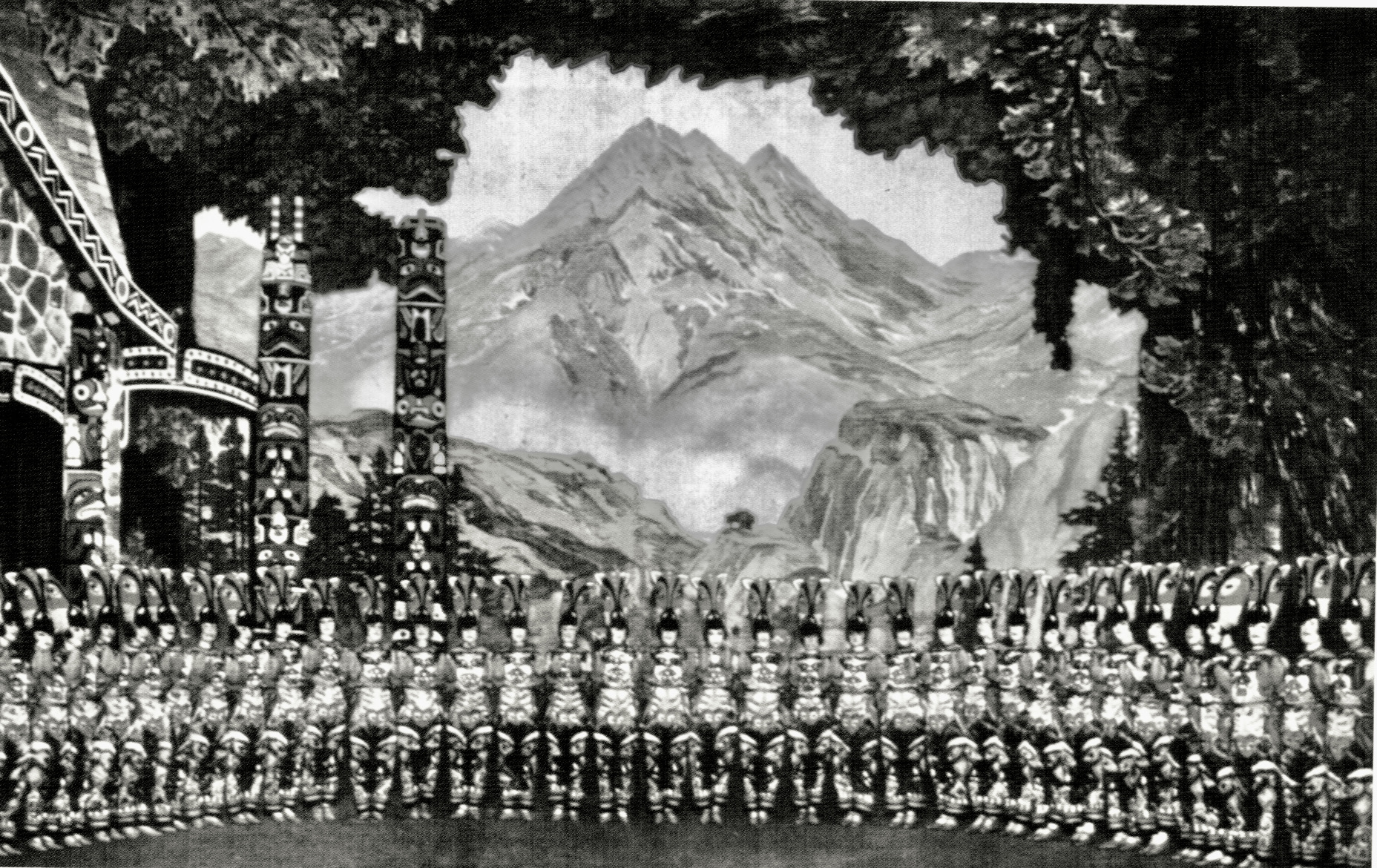
Rose Marie, and its famous Totem-Tom-Tom girls. One of the most spectacular moments in 1920s musical theatre. These photos ar'n't from the original production, but from a 1926 revival produced by Arthur Hammerstein out of town with Virginia Johnson Paul Donah, Houston Richards, Marcella Shields, Walter Lawrence, Dolores Suarez, Paul Porter and ... the only name that means owt to me ... June Roberts, as Wanda, the dancing murderess.
June ROBERTS (b 1899; d ?) was the daughter of performers Mr and Mrs (Louisa) Will H Roberts, and she began her career as a kiddie dancer, 'Dainty June Roberts', alongside her parents, in vaudeville, most notably performing a scena The Doll Maker's Dream in which she 'aged 7' featured as the doll. She quickly became the main attraction of the piece and 'June Roberts and company' toured for a good number of years, until June was no longer dollsized, and she moved into revue (Hitchy Koo, Town Gossip) and musical comedy (Up in the Clouds, touring in Listen Lester). In 1922 she featured in the Siegfeld Follies, from where she was hired by Hugh J Ward for his musical comedy company in Australia. She (and little sister Dorothy) appeared in Australia in The Honeymoon Girl, Listen Lester, Tangerine, Little Nellie Kelly and The O'Brien Girl, returning to America in 1925.

Then came Rose-Marie. Hammerstein mounted his revival out of town, and June was cast as Wanda. The production was brought to New York in January 1927, but June was no longer with it. She was still playing her role, but at the Mogador in Paris. The spectacular Paris production of Rose-Marie must be the only one where the Wanda got star billing. June's fan dance and Totem-Tom-Tom were key elements in the show's huge success. And, of course, June stayed in France. She gave dance recitals of 'modern American dances', she repeated her Wanda and also played in The Desert Song with the Tournées Baret, she choreographed such shows as Le Chanson de Bonheur at the Gaité-Lyrique ...
My last sighting of her is in 1938. Did she go home when the war came? There are a June Roberts and a Dorothy Roberts around filmland in the coming years ... I don't know.
The Daughter of Rosie O'Grady was a touring vehicle for Pat Rooney, wife Marion [Lawless] née Bent (b Bronx 23 December 1879; d Bronx 28 July 1940) and son Percy ('Pat III')...
Produced in Philadelphia, the show toured without visiting New York.
A genuine 'musical comedy', and a genuine hit, was My Girl by Harlan Thompson and Harry Archer (Little Jessie James, Merry Merry) produced at the Vanderbilt Theatre 24 November 1924. Unpretentious, book-based, a small principal cast with no star names (Marie Saxon, Russell Mack, Harry Puck, Helen Bolton, Edward H Wever), it ran for 291 performances before heading for the country.
The players here are Edna Morn, George Sweet and Roger Grey.Edna MORN [MEISCH, Edna May] (b Rochester 8 December 1891; d 14 July 1952), daughter of a hotelkeeper/carpenter, Charles Meisch, and his wife Josephine, began her working life as a stenographer, before taking to the stage in musical comedy (When Dreams Come True, Sári, Pom Pom. Flo Flo, Fiddlers Three, Three Showers). She toured for several seasons for George M Cohan and Sam H Harris in the title-role of Mary, and then played that same young lady opposite Eddie Dowling in the successful run of Sally, Irene and Mary (1922-3). Her tour in My Girl was, it seems, her last engagament. 25 August 1926 she married Harry J Martin, manager of the Louisville Brown's Theatre, and retired to motherhood.
I gave up on George Sweet, because there are several of them, but the tall Mr Grey or Gray is an interesting chap ..
Roger GREY or GRAY (b Omaha, Neb 26 May 1881; d Los Angeles 20 January 1959), son of a lumber merchant, and originally an express messenger, had a long and variegated career in showbusiness. He began doing a tramp act in vaudeville, moved into musical comedy and comic opera, and at one time toured his own little Roger Grey Opera Company with a large repertoire of musicals. He toured as 'Mutt' in the Mutt and Jeff musicals, in The Gay Musician, The Mayor of Tokio, Little Johnny Jones, A Royal Vagabond, So Long Letty, The Sun Dodgers, Little Jessie James played stock at Poli's, ran a little company and/or a double act in vaudeville, staged dances, and in 1925 'the amiable Roger Grey of the Oxford bags' took part in My Girl. I see him in Bye Bye Bonnie in 1927, touring in Hit the Deck in 1930... In the 1930s he voyaged to filmland and appeared in a number of moving pictures through into the 1940s. He authored a musical That's It played at Pittsburgh 18 July 1921. He married actress Marion Rudolph (1907), and subsequently Jessie Roberts.


This photo is from New York's Lyric Theatre production of
Kissing Time. Based on a German-language musical,
Mimi, by the father of the American 'intimate' 1920s musical comedy, Adolph Philipp, with a score by Ivan Caryll, the composer of the era, the piece had a disappointing run of less than two months, before hitting the road.
The featured dancers in the show were Carl Hyson and Evelyn Cavanaugh, who came with their own choreography, and the eleven chorus ladies were dignified with character names in the best modern fashion.
Not all shows, however, got this kind of production. I happed today on these two unidentified photos of pieces from the same period, which don't seem to have had the same dollars and design lavished on them ...
And one from the 1930s ...
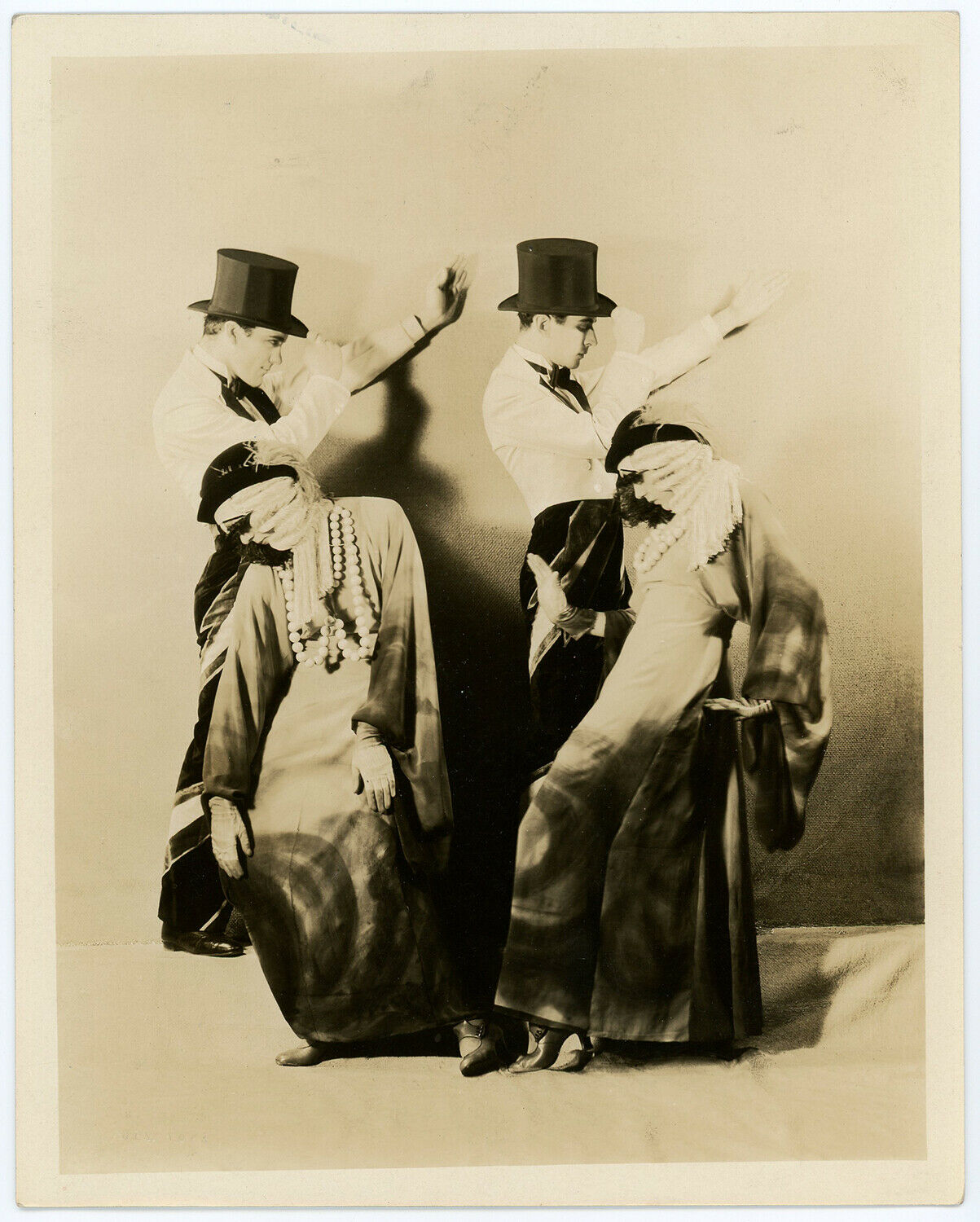
Two of the Albertina Rasch dancers (and two 'Boys') in the New Amsterdam Theatre production of Moss Hart and Irvng Berlin's
Face the Music. This doesn't look as if it is the routine to 'Dear Old Crinoline Days' (but who knows?). The other featured dance number was 'On a Roof in Manhattan'. Costumes by Kiviette.
And here is good ol' Joseph E HOWARD in his 1913 show A Broadway Honeymoon ...the lady is Mabel McKane. Leading lady was Emma Carus.
HOWARD, Joseph E[dgar] (b New York, 12 February 1867; d Chicago, 19 May 1961). Lifelong performer and songwriter who spent a while in the musical comedy spotlight in Chicago.
A vaudeville performer as a child soprano, then as a teenager, and later a burlesque-house player in a team with his wife, Ida Emerson (Howard and Emerson’s Own), Joe Howard began writing songs not only for his own use, but to supplement his uncertain stage income. He composed a rash of cheerfully rhythmic and down-to-earth numbers in the later years of the 19th century, from which `Goodbye, My Lady Love' (1904, initially heard in Howard’s Trocadero summer show and re-used by Jerome Kern as a period number in Show Boat) and `Hello, Ma Baby' (ly: Emerson) have survived the most strongly.
Howard entered the musical theatre in Chicago when he supplied first some additional songs for Raymond Hubbell's score to the burlesque Chow Chow (1902, also director) for the Orpheon Music Hall and then two full scores, written in collaboration with lyricist Raymond Peck, for The Paraders (1902, ‘Coney Isle’) and Tom Tom (1903, ‘The Ragtime Chinaman’) at the same house, now rechristened the La Salle. Howard and Emerson also appeared in the shows. Real success, however, came when he joined two young local writers, Will Hough and Frank Adams, to write the musical comedy His Highness the Bey (1904), for what was still then the quiescent Chicago theatre. The show was distinctly successful, the La Salle dropped its vaudeville-house tag and went theatre-straight, and the trio followed up with a whole series of lucrative hit musicals which were largely responsible for putting the city on the map as a producing centre. These shows toured long and extensively with popular road performers and some rising stars in the main rôles (the young John Barrymore played juvenile in A Stubborn Cinderella), but they were, not unexpectedly, sneered at by determinedly parochial New York, in spite of being as tuneful, as amiably foolish and, occasionally, more original than the bulk of east coast musicals of the time.
Howard, in the meanwhile, continued his own career as a performer, expending an attractive tenor voice and an appealing personality on a variety of vehicles, including several musical comedy-dramas of his own writing and/or composing (Jack Dunning in The District Leader, Jack Farnum in The Flower of the Ranch etc). At one stage, in 1907, when he was making his official début as a star (ie billed above the title) in Chicago, he had his name showing on the bills of three of the city's theatres at once -- for his appearance in his musical comedy melodrama The Flower of the Ranch, and for his scores for A Stubborn Cinderella (Princess Theater) and Honeymoon Trail (La Salle Theater). However, when he was declared bankruopt in Iowa Falls in 1912, the performer declared that he had lost $100,000 in producing his shows over the four years preceeding.
Although Howard's songs, topped by The Time, The Place and The Girl's `The Waning Honeymoon', were whistled for a decade throughout Chicago, the nearest thing to a single hit song, on a wider basis, which he produced during the years of his Chicago collaborations was `What's the Use of Dreaming?'. This did not, in fact, come from one of the team's shows, and when the Adams/Hough/Howard series finally did come up with a real hit, in The Prince of Tonight, the first of their shows not to be enthusiastically received by Chicago, it finally ended up as the subject of a lawsuit. It eventuated that Howard -- in a manner not uncommon at the time -- had bought the tune of `I Wonder Who's Kissing Her Now' from the penniless Harold Orlob and had put his name to it. Orlob was brought in as part of the writing team the following year and, soon after, Howard split away. After a couple of further Chicago successes with The Sweetest Girl in Paris and the 13-week run of Lower Berth Thirteen, he went back to writing and performing in his old style, both on the stage and in vaudeville. He did so for another 50 years, right up till his death in his nineties, and finished his days literally on the stage, collapsing and dying during a performance.
Howard was first married to performer-songwriter Ida Emerson, who after their burlesque years played in the early La Salle shows. His second wife was another musical-theatre player, Mabel BARRISON [Eva FARRANCE] (b Toronto c 1882; d Toronto, 31 October 1912), who played a small part in Broadway’s original Florodora (1900), in The Little Duchess (1901), suceeded Lotta Faust in The Wizard of Oz, was one of the original `babes' of Babes in Toyland, and starred alongside her husband in several of his stage shows (The Flower of the Ranch etc) and in vaudeville (My Big Sister’s Beau etc). A third Mrs Howard, Irma Kilgallen, daughter of a wealthy steel manufacturer and previously the Countess Mauritio de Beaufort, shot herself in Omaha four weeks and one meeting with her husband after their marriage.
A film of his life, rather unfortunately (given the facts) entitled I Wonder Who's Kissing Her Now, was produced in 1947. Mark Stevens played the part of Howard, with his singing voice being provided by Buddy Clark.
1899 An Alderman’s Election (Ida Emerson) burlesque Dewey Theater 2 January
1901 Fol-de-Rol (Emerson) burlesque Dewey Theater 30 September
1902 The Paraders (Raymond Peck) La Salle Theater, Chicago 21 December
1903 Tom Tom (Peck) La Salle Theater, Chicago 1 February
1904 His Highness the Bey (Hough, Adams) La Salle Theater, Chicago 21 November
1905 The Isle of Bong-Bong (Hough, Adams) La Salle Theater, Chicago 14 March
1905 The Land of Nod (Adams, Hough ad Hobart) Opera House, Chicago 17 June; New York Theater, New York 1 April 1907
1905 The Umpire (Hough, Adams) La Salle Theater, Chicago 2 December
1906 The Time, the Place and the Girl (Hough, Adams) La Salle Theater, Chicago 20 August; Wallack's Theater, New York 5 August 1907
1906 The District Leader (w George Collin Davis, Arthur Gillespie) Wallack's Theater 30 April
1907 The Flower of the Ranch Kansas City 15 September; Majestic Theater, New York, 20 April 1908
1907 The Girl Question (Hough, Adams) La Salle Theater, Chicago 24 August; Wallack's Theater, New York 3 August 1908
1908 Honeymoon Trail (Hough, Adams) La Salle Theater, Chicago 23 March
1908 A Stubborn Cinderella (Hough, Adams) Princess Theater, Chicago 31 May; Broadway Theater, New York 25 January 1909
1909 The Prince of Tonight (Hough, Adams) Princess Theater, Chicago 9 March
1909 The Golden Girl (Hough, Adams) La Salle Theater, Chicago 16 March
1909 The Goddess of Liberty (Hough, Adams) Princess Theater, Chicago 15 August; Weber's Theater, New York 22 December
1909 The Flirting Princess (w Orlob/Hough, Adams) Princess Theater, Chicago 1 November
1910 Miss Nobody from Starland (Hough, Adams/Howard Johnstone Mitchell) Princess Theater, Chicago 31 January
1910 The Sweetest Girl in Paris (w Gus Sohlke/Collin Davis, Addison Burkhart) La Salle Theater, Chicago 28 August
1910 Lower Berth Thirteen (w Gus Sohlke/Davis, Arthur Gillespie) Whitney Opera House, Chicago 16 October
1911 Love and Politics revised The District Leader Cort Theater, Chicago 3 April
1912 Frivolous Geraldine (w Herbert Stothart/Theodore Stempfel) Olympic Theater, Chicago 21 December
1913 A Broadway Honeymoon (w Stothart/Collin Davis/Collin Davis, Thomas T Reilley) Joe Howard's (Whitney) Theater, Chicago 3 October
1914 The Manicure Shop (ex-All for the Girl) (w Stothart/Stempfeldt) Suburban Garden, St Louis 29 June
1915 The Girl of Tomorrow (Stothart/w Joseph Knowles) La Salle Theater, Chicago 18 October
1917 What is Love? National Theater, Washington 2 July
1918 In and Out (Davis) Belasco Theater, Washington 22 July
1920 Chin Toy (Isidore Benjamin Kornblum) vaudeville piece Yonkers 6 January. Second edition, November.