Saturday, October 3, 2020

Redecorating Kurt ...


Well, I've pretty much done with the clearing out. No takers for some items, not even for ready money, so they've gone back into less folders and less drawers, where I imagine they will moulder until Wendy and Paul inherit them, and then maybe some more ... There seem to be, sadly, these days, no or few institutions interested in preserving the history of the heyday of the live theatre ...

I wonder where, for example, these thirty-four 1850s and 1860s London theatre-bills will find a home. In a decorator's stock, perhaps.


Maybe I should just say, bother the history, and take them out of their protective packaging and pin them on my walls as decoration.

I am prompted to that animadversion by the fact that, having disposed of most of my 'stuff', I am giving my office a make-over. Well, I spend 80% of my waking hours here, so ... Previously, the house pictorial arrangements have been fairly aligned. Derain, van Dongen, Sainthill in the dining room;


Procktor, Hiero and .. well, I know it's rotten to mix paintings and photos, but my favourite photo of Ian, in the living room. 


Bedroom: aboriginal art, Conrad Martens, Russell Drysdale, a great Norman Rubington, two of Nana's Austrian paintings and, above the bed, my newest purchase, a beautiful Carol Moffat.


Dressing room: a whole wall of paintings, from G Sutherland to Nicky Counsell. Even the loos are decorated. But with C19th theatre posters and bills. And my office?


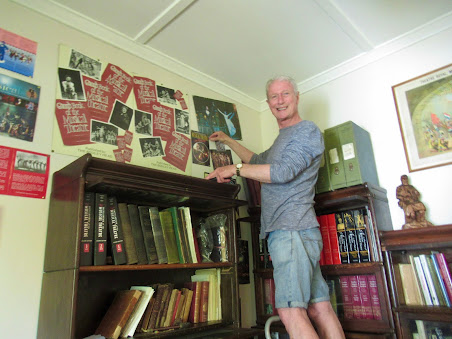
Until this month, its walls were the home for my favourite horsey pix. Seppl, Elena, Fritzy, Cliffy, Davey Crockett ... well, amongst them, they won me over fifty races. But those horsey days are gone, alas, thanks to the jiggery-pokery in New Zealand harness racing. So, I thought, it was time for a change in decor. The skiting on my 'skite-wall' needed to be about yours truly (and brother), rather than his pets ...


Being rather physically inept at the moment, I called for aid from an artistic pal of half-a-century who can still climb ladders


Damme, Bryan Aitken, fifty years ago *I* was slimmer than you .... and you can still climb a ladder and wield a hammer ...

A bottle of bubbly and some delicious Wendy-canapés got us through the exercise. No, it's not finished... think of all those books coming up next year! But, looking up at my wall-in-progress, I can see how the world, notably the publishing world, has changed. The lavish publicity printing of Macmillan, Basil Blackwell, and, especially, the wonderful Bodley Head is no more. Publishers shove your book on the Internet, put hunking excerpts on the ghastly google.books, and think that's enough.

Ah well, I lived the end of the good days ... and I'm still here ... still writing ... still publishing ... but I see that most of the printing on my under-construction 'skite wall' is from the twentieth century rather than the twenty-first. Oh, well, end of a wonderful era?


Chuckle. Anyone want to know what is on those shelves? Well, you can see my books, of course. Also Richard Norton's indispensable American Musical Theatre. The Kutsch & Riemann which is sadly outdated. A complete set of the British Who's Who in the Theatre/Green Book ... and off to the right, some of my friends' books, plus little favourites ... but who needs Collins Dictionary nowadays? Who needs Brewer or even Larousse? Do I really need Kobbé? Or three Hungarian dictionaries? I think Rotary is in for another haul next year, from the new-look Gänzlorium ...

Watch this space!


Friday, October 2, 2020

The Ages of an Author ...


 Forty years on ... looking back on my life in the profession that chose me ...


Upper left: The 1980s ... the seventh floor attic at Fielding House, Mayfair, opposite the Shah's London mansion and Cecil Beaton's flat, where, when things literary became seriously professional, I installed my tiny writer's eyrie. The draughty windows looked out over the rooftops of London, a row of ancient mews stables, and -- six floors down -- a chattering restaurant ... they also blew in a bout of Bell's Palsy.

Here, I began to collect the vast amount of material (hidden, off right) which was to become the British Musical Theatre Collection, and here I wrote the whole of the two volumes of The British Musical Theatre. On that little typewriter. I loved those Warners curtains. They later became cushions before they died of old age. I see my desk held its once pristine, now battered copy of Florian Bruyas, a postcard of Billee Taylor, a photo of my father on skis .. I see I had hair, a tiny waistline ...

Then, three stages of the 1990s. My shelf-lined study at the back of Les Arabanes, St Paul de Vence. Away from the stunning view of the perched village at the front of the house. Progress from Amstrad to Apple, arrival of Microfilm machine, vast enlargement of the source material shelves which latterly spilled over into the hallway, then the living room ...  here was written the bulk of The Encyclopaedia of the Musical Theatre. I remember the dreadful day when the floppy disc containing the whole of Letter "M" crashed. And the even more dreadful day when dear Ian had his first little stroke ...  It was time to go back to base. And there was no way those rows and rows and shelves and shelves and boxes, gathered from all round the world, could go too. I sold the whole huge collection, and our home, and we set out for Australasia. 'Home'.

The early 2000s were spent in our new home in Canterbury, NZ, where preoccupations other than writing took over. Well, writing for publication, anyway. But in between my times as a nurse and a horse farmer, I managed to complete my vast biography of Emily Soldene, and the less vast ones of Lydia Thompson and Willie B Gill. Then, after Ian's death in 2006, I set out to travel the world. I'd had my time as an author, hadn't I? I'd said all I had to say about the musical theatre, hadn't I? I was 'old hat'. Gone the days when the BBC called on me when they needed an 'expert', when Radio NZ promoted me in a 26-part series, when I got my photo in Woman's Weekly as a pin-up boy. Anyway, the world of publishing had sadly changed since the 1980s ... and the Internet? What was that ...?


The 2010s: It is probably because of the Internet that I have had a second coming. A boy has to do something when he's not travelling or reviewing or gallivanting or gourmandising. The Internet was rather like having a portable library, so I could spend my time dipping and delving into the past wherever I was, without my dear, (largely) departed library. My cosy 'Winter Palace' at the Cove, Yamba, New South Wales (above) doesn't have a book in sight: yet, I I can write just as I did in the '80s. 

My 'Summer Palace', on the farm at Gerolstein, New Zealand, is not totally bookless. I will never give up my complete Meilhac and Halévy, my complete Planché extravaganzas, my Gore Vidals, my Hungarian Theatre Encyclopaedia ... but that is largely because they are old, memory-filled friends. And they look nice around the walls of my seriously shrunken study where, nowadays, a bit incapacitated, I spend most of my days. Sans teeth, sans hair, sans waist-line, sans much hearing, but thankfully not sans wits. Forty years on from that photo in the Hill Street attic ...


And the result of the work (and play) of all those years?


No, it's not quite all mine, I'm the bottom two shelves. Shelf three is brother, John Gallas, on the left, late husband, Ian Bevan, on the right, plus father's wee mountaineering manuals, and a couple of the many books published by the great-uncles Rosenbaum in Vienna, something like a century ago.

One slight problem. John's prolificity and my renaissance mean that in the next 12-18 months there will be half a shelf's-worth of new books to fit in ... ah, well, I'll face that situation when I get to it!


Thursday, October 1, 2020

Ten Saints in a plastic folder


With the new book finished and delivered, I'm according myself a little 'time off', which inevitably means a bit of springcleaning ... I'm doing well. Caseloads of 'stuff' have walked out the doors recently, heading to all sorts of parts of the world ... and I'm getting down to what seem to be the last folders ... one of which contains these ...


They are engravings, the work of the well-known Parisian graveur Jean Chièze, and they seem to date from 1941-4: part of the series of Les Saints-Patrons des corporations. I guess Ian bought them when he was in France, being a war-correspondent. Alas, I see that there are supposed to be twelve in the set, and unless two are stuck together, I have ten, plus a duplicate of Saint Bernard-de-Menthon, the patron saint of mountain climbers ... oh, perhaps they are from my father's alpinistic family!


I have Saints Yves, Laurent, Nicolas (jolly sailor boys), Bernard de Menthon, Fiacre, Georges, Éloi, Jean de Porte Latine, Cécile and Honoré. So that means I'm missing Sainte Catherine, patron saint of needlewomen, Saint Hubert, patron saint of hunters and ... oh! there are obivously more than twelve .. Saints Crépin and Crépinien, patrons saints of shoemakers, Saints Come and Damien, patron sainst of doctors, Saint Vincent, patron saint of wine-makers...

I see that the whole thing was published by Aubanel in 1942 in black and white, and has been reprinted since. Black and white!


But the magical thing about these engravings is their miraculous, brilliant colours. Mine are fresh as a newborn buttercup: I would guess they have been in this same folio ... an impulse purchase in the rue Faubourg Saint-Honoré eighty years ago ... since they came from the press. They really ought to come out ... imagine all ten, en bloc, featured on the wall of a chic French restaurant ...

And now I suppose I ought to find out just how many go to make up the set ... before I put them back in the folio ... oh! there is a series of Patron-Saints of Métiers as well? Wait a moment. A Danish antiquarian lists them ...

Jean Chièze - Les saints patrons de Metiers des France. Douze images graées par Jean Chièze. Collection dirigée par Renée Moutard-Uldry. Originalkartonmappe mit einer Textseite und zwölf Holzschnitten, welche die Heiligen (französischen) Berufsgruppen darstellen. Sehr schöne und farbfrische Exemplare. Nummeriert, hier Exemplar 66 von 450 Exemplaren. Zustand: Die Mappe mit Gebrauchsspuren und lichtrandig, die Blätter gut erhalten und sehr farbfrisch - guter Zustand.

Edition originale. Tirée à 450 exemplaires sur Ingres des papeteries d'Arches. Les planches gravées représentent Saint Nicolas (marins, enfants et marchands de vin), Saint Yves (avocats), Saint Vincent (vignerons), Saint Come et Saint Damien (médecins, chirurgiens et pharmaciens), Saint Fiacre (jardiniers, horticulteurs et fleuristes), Saint Crépin et Saint Crépinien (cordonniers), Saint Eloi (orfèvres), Saint Hubert (chasseurs et forestiers), Sainte Catherine (couturières), Saint Honoré (boulangers), Saint Bernard de Menthon (alpinistes) et Saint Jean Porte Latine (imprimeurs).

On dear, thats 9 of my ten, but I have Sainte Cécile instead of Sainte-Catherine. Maybe it was a sort of supermarket mix-and-match thing. You picked the ten Saints you wanted? I got music, and gold, a double helping of mountains and even sailor-boys but oh ... I missed out on wine!  And I seem to have missed out on being numerotéd as well.

Well, back in the box boys. The web says you're worth about 35-75 euros apiece. I really think for that you ought to get out and show your colours to the world ...


Thursday, September 24, 2020

Cartesians: Back to the coal-front ... Walsh, Whitwell ...


I've taken seven weeks off from digging for the identities and stories of ancient D'Oyly Carte players. Why? Well, to write a little book. I think it is going to be called Gilbert and Sullivan: the plays and players. Cheekily known as Gänzl on G&S. 

This week, I bundled the MSS (or whatever you call as text written on a computer) off to the publisher in New York, took a 'what do I do now?' look around my study and thought, 'clean up time'. That lasted a day or two, then I did my back in ... those dusters weigh a ton! ... so I'm sitting amongst a pile a books, papers, shelves ... and the tree-trimmer arrived. Tree-trim day is the day we semi-professional farmers loathe. Noise, mess ... I unlocked my wallet, barricaded myself in ...  and hastened back to the safety of the C19th.

During my enforced absence, in a different part of D'Oyly Carte-land, a few of the usual queries had piled up in my in-box. Who was ...?  I chose to go for Minnie Walsh. Who was Minnie Walsh? She was the soprano who stepped in for Blanche Roosevelt, as Mabel in The Pirates of Penzance, when that lady couldn't or wouldn't. And scored a hit. Blanche hurried back. But the management had noticed Miss W, and when Sallie Reber, shortly after, took a sickie as well, Miss Walsh was sent out as a deputy Mabel again. The next season, she was simply given the role. But ... the only follow up I can find thereafter is when she was cast in the lead role of Hebe (sic) in a third-rate company purveying what it pretended was Billee Taylor. Then, nothing ...

Challenge. Who was Minnie Walsh? From where did she come? Where did she go? Challenge accepted.

Mary Ann or 'Minnie' Walsh wasn't American. She was English. Born in Bury, Lancashire, where the Bellringers come from. Date 29 May 1853. Father Richard Walsh, an engraver, mother Mary Ann née Parkinson. The Walshes had two children in Bury (I wonder why the first-born was named Alonzo Gustivaous) before they upped and emigrated, in 1855, to Providence, and then to Brooklyn. 


Minnie began by singing in the local church choirs. I see her at St John's Church in 1874, and at the Brooklyn Teachers' Association in 1878 ... then, suddenly, there she is hoisted to brief primadonna-dom! Why did she not follow up? It seems she married a certain Dr Ashton of Cincinnati. But by 1885 she is boarding, alone, in Providence, 'operatic singer' and back singing in church choirs and local concerts. She divorced Dr Ashton in 1890, ceased being Mrs Minnie Walsh Ashton, and the following year (28 July 1891) married a fellow chorister, Edward C Towne (tenor). And they apparently lived happily ever after.

Edward died 13 March 1922, and Minnie followed him 16 April 1923.

That was my lot. But. On the index page for letter "W" I noticed a tiny entry for a Mr Whitwell. A short (?) stint in the touring chorus at the age of nearly sixty. Whitwell. Hmmmm. I know a Mr Whitwell. But a quarter of a century earlier. Wonder if it is ...  And blow me down, it is!

John WHITWELL (b Sedbergh bapt 12 November 1822; d Lambeth 3 November 1882). Eldest child of William Whitwell, sawyer, and his wife, Effie née Blackey. The other three siblings went to work in the cotton industry, but John became a carpenter. At 22, he married Miss Hannah Kershaw of Preston, and they duly started a family .. William, James, Rose ... and then everything changed. In 1854, Rose was born in Preston. By June 1855, the family has emigrated to Islington, and John is sawing and nailing no more. He is featured baritone soloist at the New Music Hall in Euston Square. The tenor is Harry de Brenner, no less. Morris Abrahams. And 'Miss Waylett, ballad singer'. 

He stayed at Euston Square for a couple of years, then moved up to the Winchester Hall as vocal director. Tiens! and according to her advertising Miss Melrose had been prima donna at La Scala!


And look who is pianist! 'Mr Joel'. Pretty surely Mr von Joel ... who moved on 'the eminent whistler' to Evans's Supper Rooms, where we see him in the early 1860s alongside ... Mr Whitwell! And Aeneas Dymott. And James McDavitt, father of the beauteous Cissie Durrant ..  Evans's didn't often advertise, so I have no idea how long Mr Whitwell stayed there. Folk were inclined to stay a while. 

Well, John says that he's a musician/vocalist in the 1871 census, but I haven't managed to yet discover where, but he certainly is in 1881. He's on tour as a chorister with the D'Oyly Carte Opera Co. I wonder since when. Alas, it was not for much longer. He died in late 1882.

But the story doesn't wholly end here. Music and theatre blood trickles down insidiously ... John Whitwell has a descendant who is active in the London musical theatre to this day ... take a bow, the splendid Graham Hoadly!


Monday, September 21, 2020

I was on the front page of the Workers Press.


Goodness, how a clear-out turns up bits of paper that bring memories micturating back ...

This was one of the funniest days of my life.

I'll bet the good old Victoria Palace hasn't seen such primping, parading and screeching comedy in all its years. And I went there with the best of intentions.

What happened was ...

Britain was in a state of 'compulsory unionism'. I know, now, that that's the most frightful impingement on personal liberty, but then I wasn't into politics anymore than am I now. If that was the rule, then I followed the rule. And I followed that rule so carefully, that I got elected as Equity Deputy for the Palladium. And as such, I attended the meeting of the so-called West End Deputies Committee, and put myself up for election to the Equity Committee. No one can say I wasn't taking the thing seriously.

Witness, this photo. Look who is there in the 'critic's seats. Row H on the aisle. Gänzl, K with his 20-something-year-old widow's peak, and Normareena Dunbar alongside me.


What a day! I soon gave up attempting to be heard, or wishing to be heard. Normareena and I dissolved in giggles at the Vanity of it all .. Corin Redgrave was the star comedian, how dull and ineffective he was. All the big boys of the Equity Committee held the floor, did their act, preached to the converted, talked about Human Rights in Chile (but what about the lack of showers at the Palladium?) hugged their applause, supported by youpis from various writers of the left-wing press ...  had I not seen it, I would not have believed that this sort of thing existed! And we were paying membership fees, out of our L20 per week chorus salary, for this ... wank!

Well, I made it to the front page of the Workers (no apostrophe) Press. Whoever Stephen Johns is/was, I think he wrote his report from the bar. 'Twin Victory for Actors' Basic Rights'?  Shriiiiiiiek! It was a fiasco of the vanities.

I resigned as Equity Deputy. If this was what unions were about ... I marched straight to the right and the blessed Margaret, and Normareena (a lifelong red voter) came with me ... and I have remained there ever since. But I have this to remember I WAS ON THE FRONT PAGE OF THE WORKERS (no apostrophe) PRESS!


Tuesday, August 18, 2020

A tiny painting ...

 .

When my dear mother died, a number of years ago, a few days before her 90th birthday, I was on my way from New Zealand to Europe. 'You must go back', folk said. Why? She was no longer there, so why? Wonderful friends looked after the formalities, and cousin Nerole headed the team which had the foul job of emptying the little house in which 'Auntie Nancy' had spent her widowed years. Mother had been getting rid of 'stuff' for years ('so you won't have to do it, darling'), sometimes to the despair of brother John and myself. John 'rescued' some favourite bits, full of childhood memories ...  So the little house didn't, seemingly, hold an awful lot of 'stuff' when the day came. Seemingly.

When Nerole had organised the rehoming of the largest pieces -- notably a huge, daily-polished, dining table -- the movers came in, and everything that was left headed for .. you've guessed it! .. Gerolstein, Sefton. Wendy coped heroically. When I got back, months later, from the other side of the world, much of mother's nachlasse had been absorbed into the texture of our houses and the attached sleepout ...

And I got on with life.

But, in the years since, bits of my family's 'past', which I didn't know were here, have occasionally surfaced. Bits, especially, from the Austrian side of the family, which had probably been in a cupboard for years. Today, one of those came (back) into my life. I don't remember it in our 1950s house, so I guess it belonged to Rudolfine Gänzl née Stojetz, my grandmother ...

A tiny, beautiful painting of ... where?


and by whom?  Well, it's not signed BUT I turned it over, and ...


Clear enough? E Hehn. Can't be too many of those! Pinxit 1931. I wonder what Rab (or is it 'Rats'!) means. Is it a place? Ach! it is!!!! Once Austria, now Croatia ...

On to the Internet. Something by 'Eduard Hehn' for sale for peanuts at the Dorotheum. And much more prolific 'Emil Hehn' ... the style seems similar. And charming. But ... who then is Eduard? A scribal error? No real joy from Google ... so on to the Austrian newspaper site, and bingo!  Only six hits, but 'der Maler' .. Emanuel Hehn ...


Does that say 'Halstatt' there ... that would explain much. One of Rudi's other paintings -- rather less accomplished -- is of Halstatt. But what explains more is the fact of Hehn's living? exhibiting? in Floridsdorf. Floridsdorf was where Rudi's father and mother had their high-street shop ...

And, now I know he was 'Emanuel' I go back to Google ... Emanuel Hehn .. 'of St Wolfgang'. But ... that was Emil ...! Wasn't it? Are they the same painter-person ...?

I can live without knowing. I just love the wee picture. But it would be marvellous to know. 


Thursday, August 13, 2020

Hunting down Helen: or, how to divest a Cartesian of her disguise

 .

Helen Kinnaird. Recognise that name? I did: Mrs Shimmering Black, the strong woman, in The Earl and the Girl (1903), with the remnants of the once D'Oyly Carte company

Yes, a 'heavy lady', whether in drama, comedy or musical theatre. For, during her oddly segmented career, between 1885-1897, she played all three, on British, American and Australian stages. 

Shall we briefly look at the career before I get on the the cliff-hanging, breath-bating story of my 36-hour quest for her identity?  

She first appeared in the theatre in 1885, as a member of the D'Oyly Carte touring companies. Perhaps she was in the chorus originally, but I see her only, in May, playing the Fairy Queen in Iolanthe. Millie Vere, soon to be a longterm lead contralto played Iolanthe. Apparently, deeper than Helen you didn't go. But she didn't stay a Cartesian for long. She accepted a role in a loose-limbed variety musical named Capers, meant to star American soubrette, Bertie Crawford, and written by her husband, Richard Stahl. Capers was a flop de ridicule, the Stahls flounced back to America, and Helen turned to an antidote: the serious drama. Apparently under the tutelage of Hermann Vezin, she appeared with him and a Mr Beerbohm Tree in the attempt to set up a Greek (Ancient) Theatre in London. She was cast in the important role of the Leader of the Chorus in Helena in Troas (April 1886) for the time the experiment lasted. She plated in a showcase matinee of Old Sinners at the Gaiety, then went on the road playing the role of Miss Dyott, the headmistress, in Pinero's The Schoolmistress. In 1887, I spot her with the stock company at South Shields, playing Galatea in Gilbert's Pygmalion and Galatea, and at the Theatre Royal, Birmingham as King Gold in Goody Two Shoes, praised not for the first time, and definitely not for the last, for 'her superb stage presence'. In 1888, she played Lady Blair in the tryout of Mark Melford's Kleptomania, alongside W H Denny, Robert Courtneidge and William Lugg in a matinee of The Deputy Registrar, and brought out her contralto tones once more to play Cattarina in the vanBiene/Lingard tour of Pepita (La Princesse des Canaris).

In 1889, she was engaged to go to Australia. Billy Elton was starring there, which is how I lit on Helen to investigate. When he played his great role of the deaf boatman in The Guv'nor, Helen was Aurelia Butterscotch, when he played Perkyn Middlewick in Our Boys, she was Clarissa Champneys, when Janet Achurch starred in Two Nights in Rome she was Madame Sylvia de Montalant. You don't have to know the plays, to know by the character names what Helen's roles were like! At some stage (I must look it up) Billy and Helen appeared in Pepita, as well.

Then Mrs James Brown Potter arrived in town, under the Garner management, and Helen was put to playing support to the lady: Olimpe to her Camille, Madame Deschapelles to her Lady of Lyons, The Queen of Naples ('all massiveness and mouth') to her La Tosca, Aurelia to her Mdlle de Bressière, Mrs Rumbelow in David Garrick, Blanche d'Ereau in Our Bitterest Foe, Lady Capulet in Romeo and Juliet. And it is said that it was this last that caused trouble. I haven't found the notice, but apparently one paper said that Juliet was less attractive than her mother ... and Mrs Potter, already sullen over her critical and social reception, popped her cork. Helen was out.

So, she gallivanted off to New Zealand, supporting the less temperamental Janet Achurch, before returning to play another Australian season (Mrs Foley in Forget-me-Not, Masks and Faces, Kitty Clive in Devil's Carefoot, Elinor Rivers in Back from the Dead, Mrs Sternhold in Still Waters Run Deep &c) before, 13 July 1891 she took the Alameda to San Francisco. She played her first American season with John Stetson at the Boston Globe with venture into New York (Caroline Ricketts in Imagination, Lady Downe in The Crust of Society &c) and, after a brief trip back to England, returned to join Daniel Frohman (Americans Abroad, The Guardsman, Mrs Rennick in The New Boy &c). And then, after five years working in the colonies, she returned home.


In the next couple of years she played in The New Boy (1895) at the Vaudeville Theatre, took over as the booming Mrs Honeycombe in the hit musical The Gay Parisienne (1896) and was hired by Henry Irving to play the Queen in his Cymbeline ... then, April 1898, all went quiet. Her regular ads in the theatre press ceased and ...

Well, Helen hadn't entirely renounced the theatre, but she had renounced, it seems, travelling. She settled in Paddington with her mother ... and then, in 1903, returned to the stage as Mrs Shimmering Black. She made a veritable popular success in the role, and later went on the halls with an act based on the character. She later, after mother's death,  played a similar role in My Darling with Mr and Mrs Seymour Hicks but, in the 1911 census she is listed as a dealer in millinery and costumes. Fair enough. But that 1911 census entry proved a bloody mirage. Nearly everything in it, my first bit of documentary Helen, was a lie.

She did venture again on to the stage. Umpteen years on she was Mrs O'Dare in London's Irene, and umpteener years on she was, at 70 years of age, Renée de Montigny in The Vagabond King ...

A pretty good career, from D'Oyly Carte to Henry Irving to ...

But. Who was she? 'Helen Kinnaird' was swiftly revealed as a stage name. My only initial clue was that 1911 census, which she filled in as 'Helen Kinnaird' and truthfully (as it turned out) gave her birthplace as 'London' and her age as '55'. So, why did she say she had been married for 18 years and had no children? But it sent me off on a mirage hunt ..

Next document, her will. In which she kindly informed me that she was Alice [Mary?] Dempsey otherwise Helen Kinnaird. Eeeeeeasy. Flick to 1893 ... Alice Mary Buss married Dempsey .... and what? Had four children before her husband died aged 29? Is this toyboy time? Something is rotten in the state of Islington ..  and I see that  Mrs ex-Buss (b 1871) died in Canada in 1923. OK. Where to find the truth? Alice, where art thou?

So. Go searching for ANY Alice who married a Dempsey ... here's one in C81. Age is right, husband a physician. But she has a son. Search some more (I'm shrinking the time taken and the bottles consumed during this search). I keep coming back to the physician. Meldon Joseph Dempsey. But ... a son, then a daughter, and oh! Dr Dempsey died at the age 34, on 29 February 1884. Leap year. And in 1885 Mrs Dempsey goes on the stage! Yes. That's she. Married 1879, Holborn.

'Helen' was born Alice BORN (b Islington c1855; d Marylebone 21 January 1939)the daughter of German merchant Georg Theodore Born, who had emigrated to England in 1851, and his wife Emeline Mary née Fernell (d 7 Warrington Gardens 16 April 1905). All proven, because Helen Kinnaird gives her address in the early 1900s at exactly that address. Father bankrupted in 1875 and seemingly departed. By 1891 Emeline is 'widow' living with two of her sons in Stoke Newington.

So what about this 'no children' bit? Oh, indeed, not so! 'Helen' married Dr Dempsey in 1879, and subsequently gave birth to John Meldon Dempsey (2 November 1879) and Gladys Mary Dempsey (15 February 1882), both of whom I have followed up ... and who confirm Helen's identity. Mrs Gladys Mary Hardwicke (née Dempsey) was the executor of her mother's tiny will which was made out in both her legit and stage names ...

All sounds easy, put like that, yes? But it took a long time squeezing out ...

Now going in search of more pix of the 'stately' Helen. But, phew, now at least, she is identified!

Bed.


Sunday, August 9, 2020

Billy: the far-famed Cartesian Clown


Billy has been neglected. In the 117 years since his death, his celebrity has faded. And yet, he was an actor for more than thirty years, including one with D'Oyly Carte at the Savoy and on the road, and a star comedian on four Continents for twenty of them .. 

It wasn't ever the habit of the Carte organisation to 'borrow' established stars from other areas of the theatre. Very occasionally, from Mrs Howard Paul to Florence St John, but never -- in the company's heyday -- I think, in the roles of the leading comedian. Frank Wyatt was probably the closest. But in 1897, Mr Carte hired Billy Elton. The all-dancing, all-singing, leading low comedian of the Gaiety Theatre, London, of Wallack's Theatre, New York, and of unlimited colonial stages. Billy played Baron Puck in La Grande-Duchesse and the Duke of Plaza Toro in The Gondoliers and, then, returned to musical comedy and America and farce for the final years of his career. Yes, his Savoy experience had come, unlike so many, not at the beginning of his career, but at the age of fifty, with a huge career and thousands of delighted notices behind him.


William ELTON [SHUTTLEWORTH, William John] (b Salford 1 May 1847; d Blackheath, Kent 27 January 1903) was the son of William Shuttleworth (surgeon) and his wife, Eliza Anderton née Brown. 

In the course of the his much-interviewed life and career, Billy told his career story a good number of time to the press. It wasn't always quite the same story -- a good anecdote was not to be missed -- and, obviously, the interesting bits were included to the exclusion of the less jolly -- but I have checked it all with contemporary sources and it adds up reasonably accurately. Here's one of his summaries

And another

And here's mine. Which, of course, repeats some of the above.

But, firstly, I should say that it will be, almost all, about his professional life. His personal details have been decidedly difficult to winkle out. I see him, aged 3, with his mother 'annuitant', 'visiting' in a humble home in Manchester in 1851. But the only time I see any of them again is when Billy marries. His father is not marked 'deceased' but there are no Shuttleworths at the Everton wedding ..

Adding together all the interviews, we have him starting out in 1859, and/or 'as a 9 year-old' at the Liverpool Adelphi as the Old Man of the Sea in Sinbad, and/or at the Theatre Royal Bolton, or in Hop o'my Thumb ... I know it isn't life-threatening that those don't agree, but I do like to know, so...
The minor Liverpool Adelphi Theatre did Sinbad at Christmas 1853. In 1862, they did Hop o' my Thumb and the giant ogre of the seven league boots, in which is supposed to have played Hop. Fifteen years earlier 'Tom Thumb' had played the same role on the Adelphi boards. As for Bolton, well they did Sinbad there in 1855 ... only a programme would tell us for sure. Master Shuttleworth? Master Elton?

Liverpool's Adelphi in 1863

Then the fuzzy bit: 'an orchestral player' 'actor in fit ups' 'bones in a minstrel company', 'opéra-bouffe' .. a corrorobating ancedote when he tells of being plucked from among the extras when a cornet solo was needed ... and then Roebuck. Just when, is variously dated, but he was a member of the United Services Company before Christmas 1869, after which all is clear .. Mind, you, I do see a Mr John Shuttleworth singing at the Accrington White Horse Music Hall in 1866. But also a comical 'Mr Elton' at the Britannia as early as Whitsun 1862 (The Idolators, The Perilous Pass) and for years thereafter, another (I suspect) at Scarborough with Katharine Hickson, in 1863 and 1864, playing both The Honeymoon, The Lady of Lyons, The Lottery Ticket, The Marble Heart, Still Waters Run Deep and a burlesque Hamlet and Cinderella. There is a Mr Elton singing Hecate and playing Shecabac in Bluebeard ('deserves a far better part .. sings capitally') with the Bath and Bristol company in 1864-5, and probably the same one at Rosherville and at Bolton (ha!) in 1867-8 as Sebastian in The Tempest and Lodovico in Othello, and what! Here is 'Mr Elton Grayston' playing bones in a minstrel company at York. Mr Elton as Dame Nursery in the pantomime at the Queen's, Manchester who scored by 'the frequent and rapid use of the clogs' 'to the air of 'Skedaddle': this must be he (although there's a Mr Elton also at Exeter!), as, I suspect are many or most of the others, clearly excepting the Britannia one, and the Mr Elton 'motto vocalist' and the Mr Elton ... this multiplicity may be the reason that Billy decided to become 'Mr W Elton'.

'Mr W Elton' appears to my eyes for the first time in 1869, playing the Tyrant in Little Goody Two Shoes at Cheltenham 'with his customary excellence'. He was plain 'Mr Elton', shortly before, playing Abanazar in Aladdin 'with considerable ability' and Black-Eyed Susan alongside Lottie Venne and Emma Ritta. Roebuck's company was changing its identity from its Society Amateur origins, and among the professionals engaged for the pantomime was Pietro Carle, of the well-known dancing family, as Clown. But Mons Carle fell ill, and Billy took his place. His eccentric dancing brought down the house. 

Lottie Venne and Walter Fisher, two other stars en herbe, were also in the cast, and Billy told another tale: when Lottie was unable to play Black Eyed Susan (see above), he popped on a frock and depped for her.

Roebuck's troupe occupied much of Billy's time between 1869 and 1873, but between seasons he spent time at Newcastle as first low comedian with W H Swanborough, (Kind to a Fault, Cinderella, Rob Roy, The Pretty Horsebreaker) and even in the music-hall ('a gentlemanly comic'), with the Liverpool Prince of Wales opéra-bouffe company (Vanderprout in Geneviève de Brabant, pantomime), in Elliot Galer's play Alone in the World, et maybe al. The cast at the Prince of Wales included a young lady by the name of Fanny Eliza Lewis (b St Clement Danes x 17 April 1850) who swiftly became Mrs Shuttleworth-Elton: they would have two children, after which Fanny seemingly left the theatre.

Roebuck's company played a vast repertoire of every kind of play and burlesque, and Billy not only played in Lady Audley's Secret, Griffith Gaunt, Aurora Floyd, Spanker in London Assurance, John Chedd in Society, East Lynne, Masks and Faces, Siebel in Faust and Marguerite and the ilk, on a nightly-changing basis, but used his 'wonderfully elastic powers of dancing' as the Inspector in the burlesques Don Giovanni, Dick Whittington, Brown and the Brahmins or as Don Floriono Pomponio Disraelio in The Rows of Castille in which he indulged in the currently popular politician-parody imitation. In 1870, he was Clown for Roebuck in the Bath pantomime. He finally resigned from the Roebuck company in 1873, when the Captain decided to go on an extended African tour, and instead joined Sefton Parry's troupe at Hull. The fare offered there was similar (but less hectic) to that to which he was accustomed: I see him playing in drama and also as Minerva in Ixion, doing his Disraeli in The Happy Land and playing Buttoni ('exceedingly funny') and Harlequin in Cinderella.
He played with Charles Mathews in Dublin, giving Jenny Lind at Last with Agnes Markham as a forepiece; he toured (with Fanny) with L J Sefton's troupe in Pygmalion and Galatea and The Palace of Truth, accompanied by Richelieu Re-dressed, in which, this time, he played the Cardinal as Gladstone, then settled at Sefton's Sheffield Theatre for Christmas as the King of Spades in Twinkle Twinkle Little Star ('the life and soul of the pantomime'), The Octoroon (Pete), The Ticket of Leave Man (Melter Moss) et al, until it  was time to return to Liverpool for more of the same, including a Whitsun Special of a rewritten Black Crook, in which he played Dandelione alongside operatic mezzo, Jenny Pratt ('Mdlle Prati').

Fanny having been delivered of her second child, they now decided to go back to Africa with Roebuck, whose season down there had been stretched vastly by success. Billy went down a treat (and in local theatrical history) with his performances, and it was October 1877 before they returned to Liverpool and Frank Emery's Prince of Wales Theatre (Plot and Passion). Next stop was Brighton, where Billy played Dame and Harlequin in Jack and the Beanstalk ('displayed high-class talent as a singer, comedian and dancer'), Pierre in The Two Orphans ... and was spotted by capitalist Lionel Levy, who mentioned him to his partner, John Hollingshead: as a result, Billy was hired for a three-year stint in the London Gaiety company.


He seems to have made his first appearance there, alongside Kate Lawler, in the old Middy Ashore (equipped with his hornpipe), and went on to play in such as Stage Struck ('exciting incessant merriment'), The Serious Family (Aminadab Sleek), Boulogne (Count Navariski) but, most notably, in burlesque, frequently in a team with Nellie Farren and Edward Terry (Mephistopheles in Little Doctor Faust. Tremolini in Jack the Giant Killer, Beppo in Young Fra Diavolo, Pretty Esmeralda, Rashleigh in Robbing Roy. When a vocally undercast version of Leccoq's Le Grand Casimir was staged, he played the Clown. When they visited Brighton, he starred as Conn in The Shaughraun.


He took a hitch in his Gaiety engagement, in 1880, to voyage to America as chief comedian at Wallack's Theatre. Here, it was all comedy and comedy drama -- and outstanding success. Theodore Macclesfield in The Guv'nor, Mo Jewell in The World ... The Upper Crust, Forget-me-Not, The Money Spinners, The School for Scandal (Moses), The Parvenu et al, from East Coast to West, before a quick trip home to the Gaiety, where he appeared as Ben Barnacle in Billee Taylor. He returned to Wallack's (The Queen's Shilling &c) and toured with Wallack into 1883, and then it was time for London and the Gaiety again ... Nubbles in Virginia, Barnacle in Billee Taylor, Whiskerandos in The Critic, Mr Galatea in Galatea and Pygmalion Reversed, the Shah in Camaralzaman, The Goose with the Golden Eggs, Ali Baba in The Forty Thieves, more Young Fra Diavolo, Chinkible in A Wet Day, Old Sinnery in Called There and Back. He visited the Prince's Manchester to give another Ali Baba in pantomime ...

Then, in 1885, Wallack called again, and Billy and his family were off across the Atlantic. They would be away for six years, but only the first months were spent in New York... Edward Walker in In His Power, Marplot in The Busybody, Ben Chibbles in Hoodman Blind, a repeat of his triumph in The Guv'nor .. and then, in May 1886, they arrived in San Francisco and boarded the Mariposa, direction Australia. Under contract to Williamson, Garner and Musgrove.


Unlike Wallack, Messrs W, G & M produced comic opera, so Billy put on his dancing shoes and tootled up his tenorish tones and made his first appearance in Australia an Ben Barnacle in Billee Taylor, with Alice Barnett as his Eliza, and as Joe in Charity Begins at Home. He 'carried local playgoers by storm', reported the press, 'At one point, Miss Barnett lifts the clever little man up, puts him under her arm, and walks easily off stage with him, amidst shrieks of laughter from the audience'. Billy made as big a hit in Australia as he had elsewhere, but playing now in thoroughly mainstream musical theatre -- Pataques in Pepita, Poupart in The Old Guard, Jack Point in The Yeomen of the Guard, Plaza Toro in The Gondoliers, King Gama in Princess Ida, Lurcher in Dorothy, Laurent in La Mascotte -- through Australia and New Zealand.

This is the last time I see Fanny. I can't find her death anywhere in the British records ... but I'm pretty sure she left Australia 3 October 1891 with husband and children. She has got mislaid ..

Back in London, Billy took the part of the Seneschal in The Wedding Eve at the Trafalgar Square Theatre, and when it was replaced by a revival of Dorothy, repeated his Lurcher. A third short run was that of La Rosière at the Shaftesbury, before he joined Augustus Harris at Drury Lane to play the Jew money-lender, Scasi, in A Life of Pleasure. That one was a hit, tranferring eventually to the Princess's Theatre, where it was followed by a revival of The World ...
But Billy decided to return to Australia. He bought the rights of the hit musical comedy Morocco Bound, and, with a cast including Wilfred Shine, Elsie Cameron, Nannie Harding and Aggie Kelton, produced it down under. It wasn't a total flop, but it lost money steadily as it headed doggedly round Australia. Billy ended up in court later, sued by a lady who had 'loaned' him money to keep the ship afloat. 
He took a job at the Melbourne Bijou (Esther Sandraz, The Judge, The Foundling, The Wife's Ordeal, The Thoroughbred), at the Sydney Criterion (The Guv'nor), he returned to musical comedy to play Hooley in The Shop Girl and, next, in the local musical Djin Djin ... and then he went home. 'He is resting in his cottage in Blackheath, Kent' reported the press. But rest was not for long. In February 1897, he headed back to South Africa, for Ernest Searelle. He didn't stay long, and by April he was booked to play Major Treherne in Osmond Carr's new London comic opera The Maid of Athens (3 June 1897). It ran 27 performances. Next, he gave a grand performance as Adam Pembleton in Shadows on the Blind, but it tardied coming from Liverpool to London and when it did, manager Edward Terry took to star role ..

My WC wall ...

And then someone thought to hire him for the Savoy. So, 4 December 1897, Billy became a Cartesian. The wonder is that nobody had thought of 'the gentlemanly comic' with his superior dance skills before. If the Act I finale from the original Grande-Duchesse were retained ... was it? Billy Elton (Baron Puck) in a can-can ...! He followed up by repeating his Plaza Toro ... but he didn't stay. I see him next witnessing daughter Fanny Eliza's marriage (1898), taking over from John Le Hay in the role of Christopher Potter in Little Miss Nobody (1899), playing in Lydia Thompson's Benefit ... and then he was off again. Back to America. And the non-musical theatre.

He starred in W S Penley's role in A Little Ray of Sunshine at Wallack's, in Naughty Anthony at the Herald Square, in My Daughter in Law, with Ada Rehan in Klaw & Erlanger's Nell of Old Drury and as Triplet to the Peg Woffington of Rose Coghlan (1901) and in 1902, he was playing Jimmie Noonan in Robert Emmett at the 14th Street Theatre. All was going well. Except it wasn't.

Billy had stomach cancer. He went home to die.

Papers on four continents recorded his death, and recalled his career (more, or less, accurately) ... for it had been a marvellous one. But now, forgotten. I suppose he didn't create that one outstanding role, which was the lot, for example, of Penley. But, as the Australian obituarist said 'There were quite a lot of ham-fat comedians we could have better spared'.

As I said, I lose Fanny. But daughter Fanny (b Liverpool 1873) married bank-clerk John Triston Barnard and had a son who was killed, aged 19, in the war. Son, George William (b Sheffield 22 March 1875) became a durable performer as 'George Elton'. He played the chorus role of 'Time' in The Arcadians and, apparently, never missed a performance in all the show's vast run. In 1936, he appeared at Drury Lane, as the Chinese priest, Lao-Lin, in Careless Rapture.



Friday, August 7, 2020

Cartesians: Who WAS Janet Edmondson ...?


Back a bit, before I became (temporarily!) a rabid exhumer of ancient D'Oyly Carte players, and was just a nice, ordinary musical historian, I used to pass by the occasional baritone or soprano and think 'hey, where did he/she suddenly spring from'. You know, a name you've never seen before, and bang! playing leading roles in good productions to fine reviews and then re-bang! Gone again. Name changed? Dead? But where did they COME from? I have, this week, re-bumped into a couple of these, in D'Oyly Carteland. So, I thought ... well, my grand bit of teckery on the Beauty Stone boyos is going to be a hard act to follow! .. I'd have one ... more ... last ... try ...

And bingo! I caught a fish!

Janet EDMONDSON. Springs to life in the 1880s, plays Leonora Braham's roles in a great chunk of the Carte repertoire, mostly in Boston, alongside folk such as Brocolini, Tom Karl, Henry Dixey, Arthur Wilkinson, Alice Carle ... then switches to starring herself in Canada, writing ... and by the end of the decade is gone again. Married? Name changed? Dead? Damme, it's too bad: who was she?  All I had were these delicious notices, David Stone's summary of her G&S career, and this photo ... such a sweet little Arcadian shepherdess .. a year on so into her career, and all of, doubtless, twenty years old.
Like Hell. Madame was thirty-four, a wife and the mother of six ... but it's taken me half a day to find that out. First, I had to work out where 'Miss Edmondson' came from. Scotland? America? England? Ah, yes! She advertises 'pupil of Randegger'..
And there she is, June 1880, at St James's Hall, London: singing Elizabeth Philps's 'Forget-me-not' at that lady's very elegant concert. Mrs Edmondson. No, no. That can't be. She's always 'Miss' in America. See: in August a snippet in the US trade press saying that MISS Edmondson 'studying for the operatic stage and singing in concerts in London' has arrived back in America? Back? Slowly, as I worked through the career, little tips surfaced: she had a daughter ... she had a sister, Mrs Lillie ...  mentioned in a surviving letter ..
Signed Janet Edmondon Walker. Yes, around 1900 she becomes Mrs Walker. But the daughter ...?
Plod on.


1881 playing Petrita in Donna Juanita with H B Mahn and Jeannie Winston. 1882, with the Boston Ideals, no less, as Angela to the Patience of Marie Stone, with Lillian Russell in the same role (and, I doubt not, understudying in each case)

Then off to Boston, as leading lady of the troupe which was to baptise the new Bijou (ex-Gaiety/Melodeon) Theatre. 'Sweet-voiced' Janet took the role of Phyllis in Iolanthe ....
Dixey, Poole, Temple, Brocolini, Edmonson, Kammerlee, Sanger, Fessenden


The Bijou followed up with the new musical Pounce, with Janet again as ingenue, then mounted The Sorcerer in which she scored as Aline. When she missed a couple of performances, she was depped by ... Geraldine Ulmar. Next up was the Edward Solomon piece Virginia, with Janet in the title-role, which was then taken on the road ...  Back in Boston, in February 1884, she took the title-role in Princess Ida, for John Stetson, and she scored again while, down south in New York, in Carte's own production, Cora Tanner was doing rather poorly. 


Finally came the news: Miss Edmonson was to put together her own company, and had taken the Chrystal Opera House in uptown Montreal for the summer. Janet opened 8 June 1885 with a good company -- Fessenden, Arthur Wilkinson, Joseph Greensfelder, Alice Carle, Percy Cooper -- and a new musical: J C Robinson and C J Bush's A Very Odd Trick. It was far too tricky -- a clever but rather University Common Room piece based on the game of whist, in which Janet played the Queen of Hearts -- and was swiftly replaced by The Sorcerer, The Pirates of Penzance, Princess Ida, Iolanthe, Patience, Neuendorff's The Rat Charmer of Hamelin ... Janet quickly got out of the Chrystal and moved to the Theatre Royal, but it was no use. She closed her season, and headed home to Boston.

Back home, she sang in concert with the Boston Pops Orchestra and the Boston Symphony Orchestra. she took part with the old pals, headed by the Wilkinsons, in a season at Oakland Garden, she penned pieces for the papers, and in 1889 she joined the Wilkinsons one more time, playing Bettina in La Mascotte in Portland ('a fine singer and actress'. And that was pretty well it. But now she is referred to as 'Mrs Edmondson Walker'. Hah! I thought. She has married, and retired.

Wrong. She had been married 20 years, She would be officially married for another ten. And she was really Mrs Edmondson Walker. Though she had never been Miss Edmondson. Her birth name was Janette Eldridge White, known as Nettie, and she had been married, in 1866, at nineteen, to a young lawyer named George Edmondson Walker...
So we can now write Janet EDMONDSON [WHITE, Janette Eldridge, Mrs WALKER] (b Binghampton, NY 5 October 1846; d ....). Well, it's an improvement with space for more improvement.  
Father, James E White, was a Judge of the NY Supreme Court, mamma was Rhoda Elizabeth Waterman, daughter of a general. Her ten brothers and sisters included another judge, another general, a senator, a nun of the Sacred Heart, London, a writer of textbooks on mythology ... Mrs Lillie wrote too, so it was little wonder than Nettie, in later life, lifted a pen ...
She didn't have much time in her young days: she was busy with Llewellyn John (1867-1925), Gerald Griffin (1869-1909), Katharine Anne (1870-1900), Cecil Thomas (1872- ?), Rhoda Janet (1877-1970, Mrs Edwards) and Ellen Constance (1879-? Mrs Morse). But hey! What's this? Ellen says she was born in Austria ... so Janet was already on her travels, pregnant ... in 1879! I wonder where the other 5 babes were...
Here is Jeanette in Huntingdon Avenue, Boston in 1900 'vocal teacher', with Rhoda and Ellen, both 'teacher of languages', all chopping years off their ages ..  Nettie says she is a widow. She isn't of course.  Anymore than she is 46. Hubby is back over in Iowa, where he's been since before 1885, and they are in the process of getting divorced. And she is 53. Since she stopped performing, she rather oddly began calling herself Mrs Janet Edmondson Walker, but since it was, until 1900, correct, why not!
As well as writing (The New Governess, Fortune by Land and Sea), Nettie also took up directing amateurs, notably those of Harvard University for several years, but she would swap Universities in 1905, for the family removed to California. Alameda, it seems, for that is where Ellen married Captain Morse of the US Army in that year. And Nettie started directing the productions at Berkeley. I see them doing The Mikado and, goodness!, The Grand Duke ... 

I don't know what happened after that. My last sighting of Nettie Walker or White is crossing the Atlantic in 1912. She says she's a widow and chops ten years off her age. I thought I'd chase up the children to see if she was living with one of them... well, Llewellyn went to Iowa with his father and became a printer; Gerald too ended up in Iowa as a lawyer; Katharine died in Boston of a haemmorhaged gastric ulcer, presumably with her mother, aged 29; Cecil started off as a stenographer, but found his way into stocks and bonds and ended up as the C T Walker Guarantor Trust, a banker and a Who's Who chap: he was still going strong in Buffalo in 1940; Rhoda seems to have had a very jolly life skimming around Europe, and Ellen got to go to the Phillippines as an army wife. But what became of Nettie?


Well, I revisited this article some years on and .... thanks to Cecil's entry in an American Catholic Who's Who, a little more ...