.
Yesterday, I posted on my blog the sad tale of the American tenor Wallace McCreery, and in reponse I received, from David Stone of the G&S archive, this great photo ...
It came from the G&S archive, because it is a picture from the New York production of
Princess Ida. Hilarion, Cyril and Florian. Original cast? Well,
Princess Ida wasn't exactly a hit. It only played for 48 performances. So you wouldn't think the cast would have changed. But the leading lady was replaced, and, for reasons sufficiently explained in my McCreery article, (
http://kurtofgerolstein.blogspot.com/2020/07/cartesians-body-in-hudson-river.html)
he was also removed from the cast. Charles F Lang, who had been playing Florian was upped to Hilarion, and first Edward P Temple, then Arthur Wilkinson took over his part. Only W S Rising played his part through the run. But ... which one is he? Lockdown has closed temporarily my priceless American source for photos, and I have no idea.
However, David has labelled the shifty one in the middle as McCreery, and the one with the indecent hemline and the dimple as Lang. I know, I thought it was Marie Desclauzas in drag, too. Which makes the one with the skinniest legs and the dangerous elbow, by elimination, Rising (not too far, I hope). If anyone has photos of these guys from the 1880s (I have Lang and Rising in old age, and it's no help). I will hopefully be able to firm up this identification later.
So, three tenors. Only two to deal with today, as McCreery is already done and drowned. Both had fairly good careers in the comic opera theatre ... oh, and both were born to German fathers, in the state of Ohio.
Charles F LANG (b Canton, Ohio October 1847; d Saint Augustine, Florida 5 March 1914) was the son of Jacob or Jacques Lang and his wife Magdalena or Madeleine. The reason that they had alternative names is that they came from Schirrhofen, Alsace, so when they weren't being French they were being German, until they became American. They were married in Canton in 1840, and I see, in the 1850 census, that Jacob is a teacher and that in the past decade they have managed to produce half a dozen children, 4 boys and two girls. Then Magdalena died (1853). Jacob swiftly remarried, a younger wife, Caroline ?Bechel, and, by the 1860 census, all but one of the children are gone, replaced by Caroline, her mother and a new daughter. Where are they? Well, Charles is with the nuns, in their Cleveland orphanage. Is this a case of 'wicked stepmother'? A year later, he actually was an orphan, for Jacob died. His 1855 will left everything to Caroline, with nary a mention of the children.
Charles's fairly-approximate obituary skates over the next years, merely saying that his voice 'attracted attention' when he was young, and that he went 'abroad' to study 'when under twenty'. Nebulous. Under twenty? Before 1868? But there he is in Cleveland, an amateur performance of Fra Diavolo, with another striving local, Juliette Somerville (Cleveland 15 April 1872), and billed as 'the new American tenor' in 1874. Usually, when a young American (normally female) went to Italy in pursuit of operatic glory, the subject was given centimetres in the local press. There was usually a 'farewell concert' and the subject's progress (even if there were none) was thereafter charted in exaggerated detail. But I see nothing. At all. The obituary claims for him a debut at La Scala, performances in 'prominent companies' in Europe, a concert for Queen Victoria ... to all of which I, having combed the concert and opera notices of that period, say 'bunkum'. Unless he was calling himself 'Mario' or 'Rubini'. Oh, I'm pretty sure he went overseas, maybe even to the Milan Conservatoire (perhaps the nuns paid?), for when he returned and played his 'first appearance since ..' it was announced as such. It was a concert at the Cleveland Opera House (1 June 1877) .. tiens! after La Scala! ... and the press commented that his voice 'possesses a peculiar sweetness and evenness of tone that is more notable than any great power, and his articulation is especially clear and distinct'. In other words, small, light tenorino voice. He wasn't going to sing anything heftier than Fra Diavolo, and he wisely didn't try.
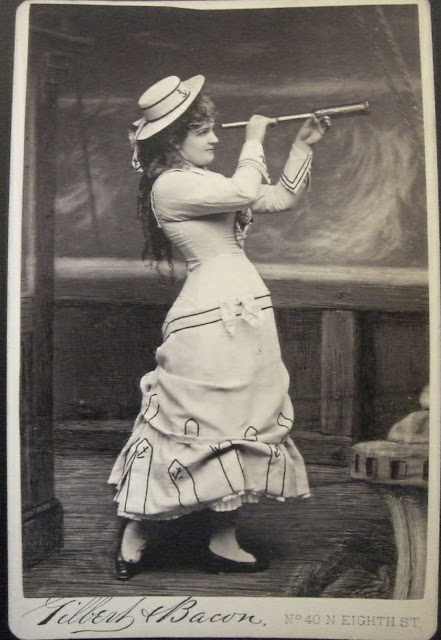 |
Annie Pixley as Josephine
|
His first job, soon after, was with Catherine Lewis, touring in Titus Tracy's Comic Opera Company (Les Cloches de Corneville). The French tenor music suited this German tenor admirably, but Miss Lewis was pregnant and the tour folded. However, thereafter, light and comic opera jobs followed in succession: I see him playing 'The Prosecutor' in Trial by Jury and Rackstraw in Philadelphia, The Bohemian Girl with the Rubens Opera Company, an HMS Pinafore with Annie Pixley, The Contrabandista and The First Life Guards at Brighton at Philadelphia et al. In 1880, he spent time with Alice Oates's comic opera company and played in Dudley Buck's Deseret, and in 1881 he appeared as Valentin in Olivette at the Park Theatre. His notices had been fairly satisfactory till now, but not this time: 'there is but little merit in Charles Lang's performance of the soldier-lover ... his diminutive tenor voice appears at times in danger of cracking as he attempts more than it is capable of'. Washington didn't agree and found that 'the new tenor' had a fine sympathetic voice and is a very clever actor'.

Over the next years he spent much time with Charles E Ford's good touring troupe (Patience, Billee Taylor, The Sorcerer, Iolanthe, La Mascotte, Manola) and with Madeleine Lucette (Les Mousquetaires au covent, Patience, Madame Boniface, Niniche), played at Uhrig's Cave (Claude Duval) and took part in the attempt to float Alfred Robyn's musical Manette, as well as his experience in Princess Ida.
But, after that, it was back to the touring circuits with Lillian Conway (La Fille de Madame Angot), Adelaide Randall (Fra Diavolo, Le Serment, La Princesse de Trébizonde, Giroflé-Giroflà, Billee Taylor, HMS Pianfore as Corcoran), or for Hans Conried (Der Zigeunerbaron, Der Hofnarr) until their ship ran aground at Norfolk, Va ...
 |
Rosa
|
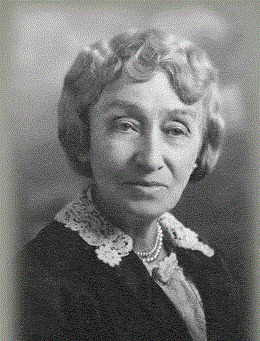
I don't think that was the cause of Lang's ending his performing career, but he went back to Ohio, to his littlest sister, Rosa Clara Klorer, and took a job in her husband's Berger Manufacturing Co. Rosa, who became a decidedly prominent local figure in Catholic, charitable and hospital affairs as well as an adept at business, can be seen sharing her home ('manufacturer') with Charles ('manufacturer') and elder brother Edward ('labourer') in North Cleveland Avenue, Canton in 1900.
In his mid sixties, he developed motor ataxia, and he died in Florida, where he had gone for his health, aged 66.
Our third tenor, I have a feeling, was probably the best performer of the three. But, after a grand start to his career, he rather faded away into less resounding projects. Because he was one of those people who had a lot of fingers, and found a lot of plumpuddings into which to plunge them: usually with at least some success: singer, actor, comedian, producer, playwright, lyricist, investor, film scenarist ....
William S RISING [REISING, William Starling] (b Lancaster, Ohio 11 August 1852; d NYC 5 October 1930) was the son of Bavarian-born American immigrant Philip Reising (later Rising). Philip arrived in America in 1845, joined the army in 1846 to fight in the Mexican war, married an Irish lass, Susan Starling, in 1848, began a family, and went into the drygood business, at MacCracken Room, High Street, Lancaster, making a speciality of the newfangled ready-to-wear clothing. In quick time, he lost his wife, took over the next-door business, remarried (Caroline McBride), re-bred ... and was on a determined 'rocket to the moon'. He would end up President of the Fairfield County Bank ...
Will was another who went to Italy to study. His teacher was Tito Palmieri, the tenor husband of prima donna Mary Ann Croft, who was indeed based in Milan, and he seems to have studied from 1878 -- after a 'farewell' concert at Chickering Hall (6 May, hugely puffed by Frank Leslie's Illustrated Paper, alas, without an illustration) until early 1882, when he turned up in England. England welcomed 'the American tenor' enthusiastically and his 1882 credits -- Fritellini to the La Mascotte of Violet Cameron, Pietro to her Boccaccio, Hans van Slous in Rip van Winkle -- immediately propelled to him to a place among London's favourite comic opera tenors. His next engagements, however, were less strong -- a feeble production of Prince Methusalem, the dogged Estrella, a couple of indifferent operettas -- and 'after two years', he returned to America, under contract to the Casino Theatre to play in The Beggar Student. The Casino production was cast to the hilt -- Fred Leslie, Rose Leighton, William T Carleton, Mathilde Cottrelly, Bertha Ricci -- and Will played Janitsky, teamed with Madame Cottrelly. He took time out to repeat his role in Estrella at the Standard, but the theatre burned down after three nights, and John Chatterson got the tenor part in the Casino's Merry War, while Rising was cast in Princess Ida and the local fairytale piece Madame Piper (1884). At the same time, he began to indulge his liking for management, and, in tandem with Signor Brocolini organised comic opera performances in Montreal.

Later the same year, he appeared for Augustus Pitou in a boneless musical comedy Off to Egypt, or An Arab Abduction (Arch Street, Philadelphia 17 November). The music was said to be by George LeJeune, but Will sang Tosti's 'Goodbye'. For a few weeks. He was recalled to the Casino to play Nitschano in Apajune, the Water Sprite, and then cast in the title-role of the Philadelphia musical The Little Tycoon (4 Janury 1886, Temple Theatre). The piece proved popular on the touring circuits, and avidly promoted by its author, played 91 performances in New York. It would be a wee while, oddly, before 'one of the most popular tenors and one of the best fellow in town' would be seen there again.
It appears that, at some stage, Will had married, for, in 1888, the trade press announced the birth of a 'twelve-pound son'. The babe would die aged four. I have searched for mother and child in New York's documentation with no luck, but when this article was done, I did manage to more or less identify her.
He also had no luck with his next projects. He went to St Louis to play HMS Pinafore on the lake (Loie Fuller, for heaven's sake, as Josephine), and in the Pompeian Amphitheatre, and announced his plans to produce two new America comic operas at Atlantic City. He also got involved with Miss Vernona Jarbeau (Mrs Jeff D Bernstein) and her husband, and invested $1500 in their production of Starlight. Starlight was to be the lady's vehicle for many years, but Will had to go to court to get any sort of accounting ... or a return on his investment.
 |
Miss Jarbeau
|
 |
| Jarbeau: mode demure |
He took the theatre at Howard's Pier, Atlantic City for a summer season and there produced, with the similarly inclined William Hamilton, the first of his new musicals. Florette (Thomas P Westendorf/J N Fort, 19 July 1888) was set in Virginia, in colonial times (please note, those parrots who give the date of 'the first recognisably American musical' half a century later!), and Rising, Hamilton and Miss Fuller played the leads for the short term of its existence. The promised 'new Planquette opera' didn't appear, but 19 December Will and his 'Columbua Opera Company' tried again, at the Academy of Music Philadelphia, with a piece called America (Ernest Peilor/William Augustus Smith). Philadelphia was offended: 'a melange of music rot and literary drivel ... the plot is inexplicable, the situations absurd, and the lines put in the actors' mouths ridiculous. A large but bored audience watched it'.
Will retreated to John Mackay's company, and then got involved with another amateurish musical. The two ladies who wrote, and effectively produced, Dovetta clearly had cash, for they inveigled not only Will but Emily Soldene to play their piece. Briefly.
In the 1890s, I see Will touring a foreign comedy, Tangled Up adapted Rising, starring Rising, with Loie Fuller and a repertoire of small pieces including Charity Begins at Home, I see 'Will Rising's Entertainers' travelling a Percy Gaunt operetta Love on Wheels and a programme of the 'Illustrated Songs' he favoured. In 1897 the press wrote '[he] sings high class descriptive and classical songs in a very capable manner for a salary of $125 a week. His clear tenor voice is always in demand and he is never out of an engagement.
He took over the comedy lead in Miss Philadelphia, sent out tours of The Strange Adventures of Miss Brown, played in vaudeville with a Miss Lilian Kemble, staged summer seasons at Koerner's Park, St Louis, produced and played in a drama At Valley Forge, mounted 'the Rising Stock Co' star: Miss L Kemble ... The press said they were married. Maybe. Maybe she's the 'Jennie Rising' from Wisconsin (age 22) 'married 1898' with him, in Salt Lake City, in 1900. Well, if they were wed, it didn't last. Will writes a firm 'divorced', in the 1920s census. Of course, he may mean his first wife ...
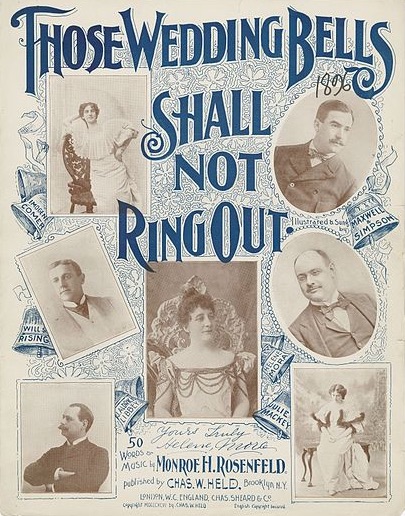
In the early twentieth century, Will -- ever chasing something new -- became active in in the motion picture world. I see him referred to as chief scenario-writer for the Edison Film Company. He would act in some films, too, and, as his links with the theatre loosened, I see him in 1911 directing a production of HMS Pinafore at Asbury Park (and filiming 'the Asbury Park Baby Parade' ... as well as 'in Bermuda producing films for the Yankee Film Co' ..
The advertising departments of the various film companies had him 'formerly ataché to the American ambassador in Paris', 'of the Bostonians' ... as he turned out patriotic one-reelers during the war ...
Footnote: bloody minded persistence pays. I have come upon this article in The Moving Picture World of July 1915.
The maternal side ....? Back to the drawing board ... Omigod! Philip Rising son of W S Rising and Elizabeth born 22 October 1879 ... Italy! During the Palmieri years! Died 29 December 1933. Retired salesman .. why is he listed as 'Philip Rising Gardner' and living with the Gardner family in 1900. Mother: Eliza J Badgely or Mother: Elizabeth Conner. Along with William Gardner aged 10. That's William Starling Rising. Born 1 February 1890. Stock clerk for underware company. Mrs Eliza J Gardner is obviously ex-Rising ... but she says she has been Gardner since 1880 ... enough! VSE!
Will collapsed and died in the street in 1930.
He left behind him a colourful tale. And just a few little mysteries ... Did he ever get his money from the bloodsucking Bernsteins ...? Ah, well, I have to leave something for the next generation of researchers to research ... right now, I gotta let go!
Hoping the tenors in the Ida photo are identified correctly ..
Bye-bye, Ohio!
Postscriptum: the G&S world has supplied me with these photos of our Ohio tenors, so the identification looks confirmed
 |
Rising
|
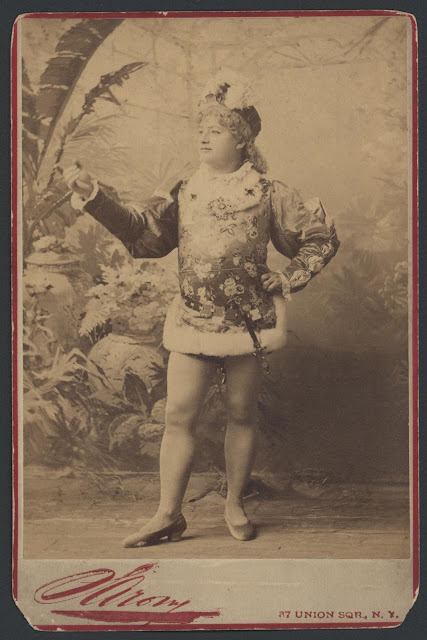 |
Lang
|