Sidney Nelson is a nearly forgotten man today. But in the 1830s and 1840s he supplied songs for Eliza Vestris, Kitty Stephens, Mary Ann Wood and husband, Miss Inverarity, Miss Rainforth, Charles Incledon, John Wilson, John Bennett, Henry Phillips, John Braham, Nathan Sporle, George Robinson, John Binge, John Frazer and others among the most popular of British vocalists. His name appeared on countless music sheets, many ephemeral, but some of his songs, such as the two already mentioned, ended up by being so long-lived as to have become regarded as folk music.
Sidney (sic, not Sydney) has duly been granted a brief entry in The Dictionary of National Biography and also in that most fallible of ‘reference’ works, Brown and Stratton. This tells us that he was born 1 January 1800, the son of one Solomon Nelson. Which I beg leave to doubt, but who knows?. ‘Evincing musical ability when quite young, he was adopted by a gentleman who gave him a good musical and general education. He was for some time a pupil of Sir George Smart, and eventually became a teacher in London’.
Adopted, eh? Wonder why. Apparently this woolly information came from his son (d 1894). Well, it was enough to start with. First of all, I wondered what Sidney had been doing during his twenties, before his first successful song appeared. Then, I found an 1829 report of a dinner given to composer John Barnett, by music publishers Thomas Mayhew and Louis Leoni Lee. Mr Nelson was there, he sang ‘Fill up the winecup’ and was ‘loudly encored’.
So he’s ‘in’ with the big boys by 1829. Why? How long? George Smart? A clue? And yes, there he is, as early as 1819, singing ‘O, Lord Have Mercy on me’ at the Drury Lane oratorios: conductor, Smart. So he was a singing pupil of the string-pulling Smart, and that alone was enough qualification for him to appear, until 1823, as a supporting baritone at the Drury Lane and Covent Garden concerts, of which his teacher was in charge, alongside such gents as William Hawes, Henry Goulden, Terrail, W H Cutler, Pyne, Tinney and the odd Italian. But, in 1823, it stopped. I imagine he stopped being a pupil. He appears in the Philharmonic Concerts of 1824, but I don’t pick him up again until 1827. And, by then, he is writing rather than singing.

The first published Sidney Nelson song that I have found is a setting of Byron’s Bride of Abydos ‘The Winds are high on Helle’s Wave’, which he had written, and sung at the Apollicon, as long ago as 8 March 1821. It was published by Chappell in 1827 (by this time ‘sung by Mr Phillips’ no less), along with an ‘O, dear to me’ (‘possesses a great deal of merit’). In 1828 came ‘The Persian Maiden’s Song’ (ly: Mrs Walter Turnbull formerly Ann Charlotte Fayerman) and a ‘Love’s Escape’ ‘sung by Miss Love’ and published by E Dale. His first real success came in 1829, when Mayhew published ‘The Vintagers’ Evening Hymn’. Music by Nelson, lyrics uncredited. Some copies of the song ‘for one, two, or three voices’ credit Charles [James] Jefferys, who would later become Sidney’s most important poet, with the words. At this stage he was but 22 years of age, but it seems that it was indeed he. The song was judged ‘an interesting and pleasing trifle’ (Athenaeum) but I have searched in vain for a record of a concert performance. Mayhew promptly brought out ‘The Vintager’s Morning Hymn’, as Nelson supplied a song for Harriet Cawse to sing in the burletta The Middle Temple, or Which is my son? (‘Maidens, try and keep your hearts’) and moved into an upper gear.
In the same year, Nelson teamed with the writer Thomas Haynes Bayly to produce an indifferent piece called ‘The Carrier Dove’ and then on a major hit in the nautical song ‘The Pilot’. The piece was introduced by John Morley (‘pupil of George Smart’) but was smartly snapped up by the most important bass of the time and place, Henry Phillips. ‘The Pilot’ would remain a concert standard as long as the melodramatic sea-song lived. Bayly, however, was a playwright (most famously of
Lord Tom Noddy’s Secret) and he compiled a little 4-handed burletta,
The Grenadier, as a vehicle for Eliza Vestris to play alongside her successful extravaganza
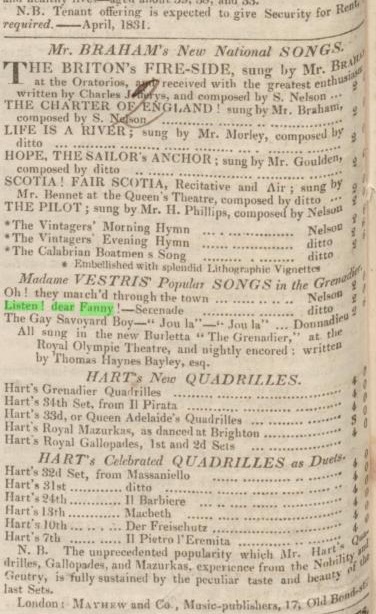
Olympic Revels. Burletta + Vestris meant songs, so what more natural than to bring in the composer of ‘The Pilot’. Nelson provided two songs, to add to the Savoyard ditty by A Donnadieu ('The gay savoyarde'), which the heroine, Miss Fanny Bolton, sang in her Savoyarde disguise, a military ‘Oh, they marched through the town’ and the serenade ‘Listen, dear Fanny’. And, here, they made another big success. ‘Fanny’ stayed around for some years, and a way down the line the number was interpolated, by Vestris’s sister, into the classic burletta
Midas. Vestris herself also introduced Nelson’s ‘Come to my orange bower’ but seemingly not in the play.
Nelson never became a theatrical composer. His handful of attempts at dramatic writing (including an unproduced opera) consisted simply of interpolating his own style of ballads and/or duets into a text. He was purely and simply a songwriter and, following ‘The Pilot’ and ‘Listen, dear Fanny’, a decidedly prolific one.
I have collected a long list of song titles, from, in particular, 1831-2. Sometimes they are credited to the poet, sometimes to the musician. Sometimes the musician is credited with ‘symphonies and accompaniments’ sometimes the same song is ‘composed by’. I imagine they mean the same thing. The year of publication is not shown, so I have listed the songs under the year in which I have found them advertised (and few songs of the hundreds and hundreds printed in these years survived into a second season) or performed. I’ll put the list at the end. It is doubtless pretty incomplete, but it’s a start.
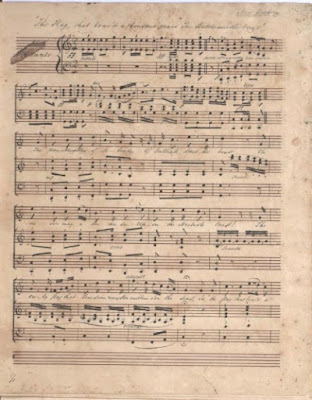
In his early days of songwriting, Sidney Nelson, as was the general habit, spread his writings around amongst a number of publishers and worked with a variegated lot of ‘poets’, some decidedly better (or worse) than others. Payne and Hopkins published two collaborations with a certain Mrs C H Huxley which were criticised as ‘not very inspiring’, and other wordsmiths did not much better, but W H Bellamy supplied the heroic words for ‘The Flag that Braved a Thousand Years, the battle and the breeze’ (1831) which was a distinct success, and then there was Charles Jefferys. Jefferys is a story in himself. Seven years younger than Nelson, he became in his turn a prolific lyricist for stage and platform, ran his own publishing house, and even if he were not hugely imaginative in either his turn of phrase or his subject matter, he turned out neat, tidy songwords on the established national, occasional and sentimental themes, which were largely better than most others such of the period.
Of the 1831 songs, ‘The Briton’s Fireside’ was sung by Braham at the oratorios, ‘Life is a River’ was introduced by Morley, later sung by Machin and survived many years as a basso favourite,
‘Hope, the sailor’s anchor’ first sung by Henry Goulden, also stayed more than two decades in the repertoire …


1832 brought a whole set of ‘Gipsy’ songs, which were not at that stage the cliché they were to become, and which seem to have included a ‘Let me tell your fortune’ which was taken up by the great Miss Birch; a ‘Napoleon’s Grave’ as rendered by John Parry, a set of songs with Felicia Hemans words, a triumph with ‘The Hunter of Tyrol’ in the hands of Mrs Waylett, another with ‘The Bride’ sung by Mary Ann Wood, others as sung by Vestris, Sporle, Wood, Miss Inverarity, but most of all, on the stage of the Theatre Royal, Covent Garden, interpolated into the movable score of Rob Roy, ‘The Rose of Allandale’, as tenorised by the future doyen of Scots entertainers, John Wilson. 32-year-old Sidney Nelson was truly songsmith to the stars.


I don’t quite know why at this point his output seems to have somewhat shrunk rather than bulged. In 1833, I can find little but a memorial song for a dead clergyman and a song written to words by a curious gent by the name of Robert Folkestone Williams, who who wote royal and Shakespearian biography and whose poetry was, nevertheless, set by such as Alexander Lee and Henry Bishop. In 1834 there was a rather embarrasing topical elegy to ‘The Emancipated Negro’ (words: Jefferys), plus a much better-liked ‘The Guitar of Spain’ which got sung by Jane Shirreff and Clara Novello, and a 'Hunter of the Savoy', sung by Mrs Keeley. In 1835 he musicked six ‘Lays of Byron’, in 1836 he published ‘Nelson’s Singing Tutor’ and turned out the successful duet ‘By the gentle Guadalquivir’, a castanet song for Vestris and the well-liked ‘The Lowlands Bride’ for counter-tenor George Robinson, of ‘My pretty Jane’ fame. It had a range of eight tones. But that was Sidney’s style. Easy to sing, easy to play = many sheet music sales!
1838 finally saw the arrival of another major hit: Monroe and May published his ‘Mary of Argyle’. With her ‘bonny’ before her name, Mary gave Nelson another ‘trad’ song that wasn’t ‘trad’ at all. I can’t find where it was first performed … it seems to have snuck out rather modestly. Robinson took it up. But once out … it was here to stay!


In the following years, it seems that Sidney just churned out the usual run of characteristic songs (‘The Rover’s Flag’, ‘The Lass o’ Gowrie’, ‘[Victoria], Our bonny English Rose’ et al) and opportunistic material – an arrangement of Strauss music to Jefferys’ words got the thumbs down, a memorial song to poor, silly Flora Hastings can’t have endeared them to the Queen – as he took on a new career. Sidney joined Jefferys in his music publishing business at the famous address of 21a Soho Square. The year was 1841. And the collaboration ended effectively in 1843, when Nelson went solo at 61 Greek Street, then in the Mori and Lavenu premises in Bond Street, and officially in 1846. When Sidney went bankrupt.

But the songs kept coming, and eldest daughter Eliza, whose performing career was just beginning, plugged the new and not-so-new songs loyally, until finally another hit emerged. I first see ‘Madoline’ (words: Edward Joseph Gill) being advertised in January 1849 as ‘Mr Sims Reeves’ New Song’. It was sung in Worcester by budding bass Henry Whitehouse in October, and later by Gustavus Geary and by George Tedder and, I am sure, many others. Tedder also interpolated ‘Mary of Argyle’ into
The Slave at the Surrey Theatre in 1850, and gave it at the famous London Wednesday concerts, where Braham could also be heard in Nelson’s recent ‘Live and let live’. He might not have been on the crest of that early 1830s wave, but he still attracted the cream, and could still turn out a neat ballad.
The emergence of Eliza gave Sidney a target, and in 1851 (27 January) when she appeared at Drury Lane it was in an ‘operetta’ entitled
The Cadi’s Daughter, with music by father. Eliza was well-liked, the music was dismissed as ‘ad captandum’ ballad material. Father was out of his Fach. But the piece was played for a month, as an afterpiece to the pantomime. He tried again, when Eliza was featured in another like piece,
The Village Nightingale, at the Strand Theatre. He was advertised as the composer of two incidental ballads. When the piece was revived in 1855, for Rebecca Isaacs, the musical content was given as: ‘I’ll wander alone’, ‘Little Kathleen [was wooed by a score]’, ‘What joy is mine’ and ‘Happy the maid’. All Sidney’s? Two and four were, at least. I think the other two might have been replacements.

But by the time ‘his’ burletta was revived, Sidney was gone. To Australia. With his wife and the younger children … It was the effective end of Sidney the songwriter. Oh, he didn’t just stop: in 1857 he even composed a song for Anna Bishop. But, in Australia, he would become more of an entrepreneur, promoting – and with no little success – his children’s performing careers.
But that’s a second chapter. And this one is long enough!
Songs:
1827: ‘The Winds are high on Helle’s Shore’ (Byron), ‘O dear to me’ (Mrs Walter Turnbull) ‘The Persian Maiden’s Song’ (Mrs Turnbull)
1828: ‘Love’s Escape’ (F Thornhill)
1829: ‘Ye cliffs, ye lonely shores’, ‘Maidens try to keep your hearts’ (T Hudson), 'The Vintager’s Evening Hymn’('Song') (Jefferys), ‘The Carrier Dove’ (Bayly), ‘The Pilot’ (Bayly), ‘Our Queen is the Wife of a Sailor’ (Captain Mitford RN)
1830: The Vintager’s Morning Hymn’ (Jefferys), ‘Our Native Homes’, ‘A Moment With Thee’ (David Barlin)’, ‘O sing again the Melody’ (Jefferys), ‘The Hour of Meeting’, ‘O steer my bark to Erin’s Isle’ (Bayly), 'The Deep, Deep Ocean' (Jeffreys)
1831: ‘See dear Louise, thy captive bird’, ‘Young love, a sly urchin’ (both Mrs Huxley), ‘The British Wanderer’ (J Churchill), ‘I have sought the Forest’s Glen’ (Jefferys), ‘Listen, dear Fanny’ (Bayly in
The Grenadier), ‘Oh, they marched through the town (Bayly in
The Grenadier), ‘Come to my Orange Bower’ (Jefferys), ‘The Monarch Oak’, ‘The Briton’s Fireside’ (Jefferys), ‘The Charter of England’ (Jefferys), ‘Our Patriot King’ (Jefferys)), ‘The Flag of Reform’ (Jefferys) , 'Life is a River' (Jefferys), ‘Scotia! Fair Scotia’ (recit & air), ‘Hope, the sailor’s anchor’ (Jefferys), The Calabrian Boatman’s Song, ‘Farewell, my gentle Mary’, 'The Smuggler’s Adieu' (Jefferys), ‘The Flag that braved a thousand years, the Battle and the Breeze’ (W H Bellamy), The Mother's Prayer' (Jefferys), ‘Oh, why has he forgot?’ (Frederick Walter Drennan)
1832: Songs of the Gipsies inc 'The Gipsy King', 'The Gipsy Queen' et al (W T Moncrieff), ‘The Sunset Hour (Jefferys), ‘The Hunter of Tyrol’ (Jefferys), ‘Napoleon’s Grave’ (W Ball), The Evil Eye (Moncrieff), ‘The Spanish Wanderer: ‘O Pilgrim, Say'’, ‘Come to me, gentle sleep’ (both Felicia Hemans), ‘Another Hour’ (William Frederick Collard), ‘The Rose of Allandale’ (Jefferys), ‘The Pastor’s Fireside’ (Jefferys), ‘The Village Chimes’ (Jefferys), ‘That Friendship which fades not’ (Jefferys), ‘The Bride’ (‘O Take her, but be faithful still’) (Jefferys), ‘The Wife’, ‘The Life of the Saviour’(Jefferys), ‘Donald and his Bride’ (Jefferys), ‘Come o’er the Moonlit sea’ (duet) (Jefferys), ‘Sicilian Vespers’ (Jefferys), ‘My Fatherland’
1833: ‘The Glory of thy Smile’ (Robert Folkestone Williams), ‘His Pilgrimage is Ended’, ‘Lays of Waverley’, ‘My harp of happier days’ (Jefferys)
1834: ‘The Emancipated Negro’ (Jeffreys), ‘The Guitar of Spain’ (Jeffreys),‘Twas in an English valley’ (Bayly), ‘My Heart is still with thee’ (Jefferys), 'The Hunter of Savoy (Jefferys), ‘The Light Castanet’, 'The Parting and Meeting of Friends' (Jefferys)
1835: ‘Day is gently breaking’ (duet, Jefferys), ‘Love only laughs at the old’ (Folkestone Williams), ‘The Star Spirit’ (John Graham), The Sea Nymph’s Answer Over the Waves (Graham), ‘The Hunter’s Horn is Sounding' (Folkestone Williams), The Lays of Byron (‘I would I were a careless child’, ‘Maids of Athens’, ‘The Emperor’s Farewell to France’, ‘Bird of Beauty’s Song’, ‘Newstead Abbey’, ‘When we two parted’). Victoria the toast we give to thee (glee) (Jefferys), 'Goodbye, Sweetheart' (Folkestone Williams)


1836: ‘The Lowland Bride’ (Jefferys), ‘By the gentle Guadalquivir’ (duet) (Jefferys), ‘The Snow Storm’ (glee)
1837: The Gondolier’s Good Night (duet) (Jefferys), ‘Wellington’ (‘The Hero of a hundred fights’), ‘The British Maid’, ‘Beware thy smile, fair maid’ (B Miles), ‘The Fairest Bud Our Land Can Boast’ (glee) (Jefferys), ‘The Winds Are High, the Stars are up’ (Jefferys), 'Hail to the House of Brunswick' (glee), 'Moonbeams on the Sea' (Jefferys), Vestris’s Cachuca, 'Up and away o'er the fathomless deep' (Miss Way), 'The Rover's Flag', 'The Chieftain's Daughter'
1838: ‘I caught her tear at parting’ (Ernest Kollman), ‘O for one seraphic strain’ (Jeffreys), Five Sacred Lyrics: ‘The Better Land’, ‘The Hour of Prayer’ (both Hemans), ‘The Last Hour’ (Jeffreys), Missionary Hymn (Reginald Heber), ‘The Angel’s Call’ (J Young); ‘The Ploughshare of old England (Eliza Cook), ‘My mountain Pine’ (Cook), ‘My early home was there’ (Cook), ‘Queen of the Evening’, ‘Glory the Evening Star’ (T Hudson), The Greenwood Tree (Jefferys), ‘Mary of Argyle' (Jefferys), ‘The Red Cross Banner’ (Bellamy)


1
1839: ‘She is gone’(Jefferys) , Ariel’s Song, ‘[Victoria], Our bonny English rose’/’Old England’s Emblem is the Rose’, 'The Starry Banner' (C M King)
1840:
1841: ‘When night comes o’er the plain’ (Jefferys), ‘Merrily Goes the Mill’ (George Colman), 'The Prince of Wales' (Jefferys), 'Lays of the Palace' (Jefferys) 4 songs and 2 duets.
1842: ‘O God Preserve the Queen’, ‘The Pearly Deep’ (both Jefferys)
1843: ‘Lochlomond’s Young Lassie’ (Jefferys), ‘Away! Away! to the greenwood shades’ (Jeffreys), 'My Heart is my compass' (Moncrieff), 'Tis sweet to see the blooming rose' (Jeffreys)
1844: ‘Come to my fairy home’ (Edward J Gill), ‘My Father dear’ (Young)
1845: ‘Beautiful Sunshine’ (Emily Elizabeth Willement), ‘The Happy Gipsy’ (Linley), ‘The Old Hawthorn Tree’ (Mrs Maria Smith Abdy), ‘ Oh! Come to the forest’, ‘When the White Cliffs of Albion’ (‘to an existing air’) (Mrs Crawford), ‘Music at Nightfall' (duet) CJ
1846:
1847: ‘The Wind’ (Willement), ‘Dear home beloved’ (duet), ‘Bold Robin Hood’ (Gill), ‘Italia will be free’ (J W Lake), 'In the joyous spring' (Gill)
1848: ‘The Chieftain and his bride’, ‘The Exile’s Farewell’, ‘The Forest Maid’, ‘Thy will be done’, ‘When this frail world’, ‘The Gifts of former years’, Six Mountain Lays for the Sabbath (?Mrs George Linaeus Banks), 'Beautiful Night' (Gill), ‘Victoria and our Native Land’, ‘Live and let live’ (both by J W Lake)
1849: ‘I’m going for a soldier, Jenny’ (Bellamy)

‘Madoline’ (Gill), ‘The Rose of Spring’ (Carpenter)
1850: ‘Gem of the Ocean – beautiful isle’, ‘The Busy Streets I paced each day’, ‘Why did my trusting heart believe’, ‘Queen of the Waves’ (Gill), ‘Annie of the Mill’ (Gill), 'The Birth of Spring' (Gill), Beautiful Summer' (Gill), 'Farewell, I'll Think of Thee' (Gill), 'Beautiful Night', 'I'm the joyous spring'
1851 ‘Let him that the cap fits wear it’, ‘Love within my heart is glowing’, ‘From Minaret Tower’, 'I saw not her face', There are gownsmen, (Fitzball, all in
The Cadi's Daughter), ‘Little Kathleen’, [‘I’ll wander alone’, ‘What joy is mine’], ‘Happy the maid whose heart is free’, ‘Let us be as sisters, dearest', ‘Come, come to me’ (all in
The Village Nightingale), ‘Blame me, mother’ (H T Craven, in
My Daughter's Debut), ‘The Home Song’, ‘My Dream’ (Gill), ‘The Friendship of Hope’ (Gill), ‘Fairy Flowers, Sunny Showers’ (Gill), ‘The Crystal Queen’ (Gill), ‘The Merry Minstrels’ (Gill)
1852: ‘Keep the Heart Light as you can’ (Charles Swain), ‘Sweet is a summer’s night’ (Gill), The Prodigal’s Departure (Craven), ‘Barney, the Tight Lad of Derry’ (Craven), ‘Buy my oranges’ (Fanny E Lacy), Song of the Cornish Fishwife (R Marsh), ‘The May Queen’s Wreath’ (Gill), ‘Remember your promise’ (Craven), ‘Oh the days of laughing childhood’ (Gill), ‘The Pretty Girls of Derry’ (Gill), 'Little Goody Gay' (Gill),

1853: ‘In the hedge, in the wood’ (Our Nelly’s Song) (Craven), 'Mr and Mrs Bell' (buffo duet)
The following titles are culled from publishers’ advertisements, catalogues, including the strangely incomplete British Library, a delicious bundle at the University of Michigan, from where most of my sheet cover illustrations come, the Ali Baba cave that is the Sheet Music Warehouse et al (CJ = words by Jefferys)
'Time, speed thy wings' (Folkestone Williams)
'The Red Sea’ CJ
‘The Mother’ CJ
‘Thy voice is music to mine ear, my Leonore’ CJ
‘We Shall soon meet again’ CJ
‘The Patchwork Song’ (‘As I walked down the street’) (W Dexter Smith)
 |
| Dexter Smith |
‘Where are now the hopes I cherished?' CJ
'The Merry Days of Old' CJ
'The Return of the Spirit' (from The Devotional Melodist) (J E Carpenter)
‘The Mariner’s Evening Hymn' (from The Devotional Melodist) (Carpenter)
‘Mountain Prayer' (from The Devotional Melodist) (Carpenter)
‘The Sister’s Recall' (Carpenter)
'Old English Hospitality'
‘Erin’s Daughter' CJ (no 1 of Jeffreys’ ‘Erin’s Harp’ collection)
‘My father’s home' CJ
‘Come wander with me (for the moonbeams are bright)' (duet) CJ
‘Strike the Harp in Praise of God' (
Lays of Sabbath) CJ
'The Hunter of St Bernard' CJ
‘I will be happy too' CJ
‘All Hail my Native Shore' (R S Jones)
‘My Darling'
‘Sweet is the prayer' (Bayly)
‘His Paths are Peace' (Bayly)
'Around our Blazing Fires' (S Arnold)
'If thou wert by my side' (Reginald Heber)
'My only daughter' (Gill)
'Human Life' (Bayly)
'The World of Changes' (Bayly)
'Sad is my heart when I watch for thee late' (Bayly)
'The Merry Breeze'
'Highland Mary' ('Ye banks and braes') (Burns ad)
'Our Happy Home' (duet)
"Home of my happy hours' (F Williams)
'Away, bonny Bark'
'The Maiden's Prayer' (Young)
'If thou wert by my side' (Heber)
'Evening' and 'Morning' (
Songs of Palestine) CJ
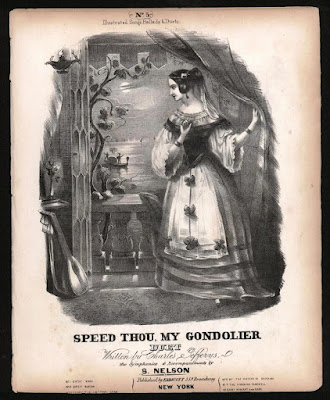
'Speed Thou, my Gondolier' CJ
'Zulima' CJ
'The Persian Rose' CJ
'The Highland Widow' CJ
'The Muleteer’s Return' CJ
'There is Music in the Midnight Breeze' CJ
'Soft be thy slumbers' CJ
‘Sleep, daughter of Zion’ (Mrs Crawford)
‘Thy Will be done’ (J Young)
'Paradise Lost' (Eve's Lamentation) (Milton ad)
‘Wishes' ?1842
‘When I saw thee in youth' 1845
'Do a Good Turn when you can' (Swain) 1852?
'The Leafless Tree' (W Bartholomew)
'Good Bye Sweete Heart' (Folkstone Williams) 1836?
Merrily, Merrily, Now We Ride (Gill)
'Beautiful Islands of Light' (Gill)
'Sweet spring buds' (Gill)
'Blondel' CJ
'I Knew Her' CJ
'Speak no ill'
‘Christ stilling the tempest’ (Hemans)
‘Why do the flowers bloom, mother’ (Carpenter)
‘The Men of Merry England’ (Carpenter)
‘England’s Volunteers’ (Carpenter)
‘Joy to the bridegroom’
'Tis Sweet to see the blooming rose' CJ
I have not included Nelson’s arrangements of such songs as ‘God Save the Queen’, ‘Auld Robin Gray’, ‘Savourn Deelish’, ‘The Lass o’ Gowrie’, ‘John Anderson, my Jo’ etc etc nor his pot pourri arrangements from the opera, and other arrangements of Italian and French music to English words by the intarissable Gill and his ilk.
But you think that’s all? Oh no! I happed upon an old catalogue, which listed – beyond some of the above – the following titles, some of which may be alternatives but, all the same! However, it is shrinking daily as I explore and identify ...
 |
| 'Sung by Mrs Wood' was an arrangement of Bellini |
‘The Banks of the Clyde’, ‘Beautiful Florence’, ‘Bluebell, Myrtle and Rose’ , ‘Bird who on the joyous wing’, ‘Dove of the ark’, ‘Fare thee well, my Fanny’, ‘The Forest Queen’, ‘Hour of Prayer’ , ‘I know her’ , ‘The Indian Maid’, The Midshipman’s Farewell, ‘Music of Angels’, Spanish Vesper Chant , 'Thy Voice is Music to my ear', ‘Twas a dream full of beauty’, ‘Wake, daughter of the ocean’, ‘Welcome again sweet Sabbath’, 'When from thee parting' duet, 'Wreath of Chivalry', 'Beautiful Summer' …

OK, enough. Lots of ephemeral songs, which nevertheless turned up occasionally in later provincial, colonial and amateur concerts. But then, there were the big hits…
Work in progress …
PS I know that my dates will disagree with the guesstimates on various Collection sites. But I think I’m mostly nearer than they. One library dates the piece about Queen Victoria’s assassination attempt to 1834. Er. She didn’t even become Queen until 1837. And the engraving on the cover features Prince Albert .. so … eight years out? And that’s just that one … !!

Postscriptum March 2019: Dr Skinner has subsequently squirreled away further and come up with some splendid addenda:
[Advertisement], Kentish gazette [Canterbury] (9 August 1811), 4
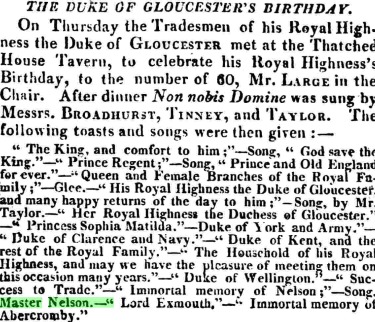
NEW ASSEMBLY ROOM, AT THE FOUNTAIN INN, MARGATE. IN honour of the Prince Regent's Birth-day, Monday, the 12th of August, 1811, will given a GRAND CONCERT AND BALL, and to be continued every Monday evening during the season. VOCAL PERFORMERS, MASTER NELSON and the rest of Mr. Nathan's Pupils . . .
[News], The morning chronicle [London] (21 September 1812), 2
On Saturday night, Master Nelson, who we understand to be a pupil of Mr. Nathan, was introduced to the public at the Lyceum Theatre. He sang Mr. Braham's celebrated Death of Abercrombie, between the Opera and the After-piece. Although he is only between twelve and thirteen years of age, his voice is a counter tenor. His action and expression were good, the cadences were well executed, and he displayed great taste, promising, as far as we can form a judgment by this first experiment, to be a considerable acquisition to the stage.
"JEWS' HOSPITAL, MILE END, FOR THE SUPPORT OF THE AGED POOR, AND THE EDUCATION AND EMPLOYMENT OF YOUTH", The morning post [London] (14 May 1813), 4
On Thursday, the 6th of May last, the Governors and Friends of this Institution held their Anniversary Dinner, at the City of London Tavern . . . Messrs. INCLEDON, TAYLOR, PYNE, BAYLIS, SMITH, And Master NELSON, contributed, by their vocal exertions, to the entertainment of the company, who consisted of near 300 persons, and departed at a late hour, highly gratified by a scene which reflects the highest honour on Christian and Jewish benevolence.
[Advertisement], The morning post (20 April 1816), 2
NEW MUSIC . . . "O Ella dear, those eyes of light!" the admired Song as sung at the Nobilities' Concerts, the maiden production of Master S. Nelson, Pupil of D. Corri, 1s. 6d. . . . Published at Williams's Music Warehouse, No. 29, Tavistock-street, Covent-garden . . .
[Advertisement], The Kentish gazette (29 November 1816), 4
ASSEMBLY ROOMS, THEATRE, DOVER,
On TUESDAY, December 3d, 1816, there will be
A CONCERT and BALL.
THE CONCERT will, in part, consist of the HEBREW MELODIES, composed by Messrs. BRAHAM and NATHAN,
the Poetry by the Right Honourable LORD BYRON.
Principal Vocal Performers, Miss NELSON (Pupil of Mr. Nathan), Miss COPELAND.
Messrs. VILLARS, BELLAMY, BARTLEY, JEPTHSON, COPELAND, MARSHALL, WYOTT, And SHEEPPHARD.
After the CONCERT A BALL. Admission 4s. each.
The Rooms to opened at seven o'clock, and Concert begin precisely at eight.
Progress is being made!!! My turn, again, now!!
20 March 1813
9 January 1818
An undated (1832?) companion to 'The Bride' ...
Another undated ..
And another little PS .. an example of Sidney's attempts at music publishing ..