Monday, June 25, 2018

THE AUTOBIOGRAPHY OF 'LE PÈRE DE L'OPÉRETTE'


It has been a splendid winter. Three new musical-theatre works – one English, two French – have crossed my desk, and I can scarcely believe it: each one of the three has been a winner. Each one of the three has added to the world’s knowledge (and mine) of an important part of musical and theatrical history. And each one has been a delight to read.

First, came Anne Stanyon Lee’s survey of Arthur Sullivan’s conducting career, exposing the politics of the fashionable British Festival system and giving great insight into the ‘other life’ of the Savoy hero. This was written as a thesis for Dr Stanyon’s (as she now, deservedly, is) degree and is not yet published in the planned ‘unthesified’ version. I got a preview because … well, I’m me!

Then came the outstanding biography of André Messager, concerning which I have already dilated at length, and which led me to inquire ‘what else has this publisher – Palazzetto Bru Zane -- put out’? ‘A book on Hervé’, came the reply. Um. I adore Hervé’s work unconditionally. I’ll even allow him the rather glib title of ‘père de l’opérette’. Or, shall we say ‘opéra-bouffe’? Which is my favourite kind of ‘opérette’ anyhow. But anotherHervé biog? I didn’t buy the last two. Louis Schneider’s old volume is still on my bookshelf. Surely, I know everything I need to about Mons Florimond Ronger. Wanna bet?


It’s always fun to read a work which starts mezzo piano and rises to the heights part way through. Dr Stanyon’s ‘book’ was one of those. Pascal Blanchet’s Hervé par lui-même is another. Mons Blanchet has quite simply let Hervé, as the title says, speak for himself. Who knew that all those letters, all that documentation was out there? We see the inside workings of the Paris musical-theatre world (and, boy, were there ‘workings’) where composers such as Hervé and Offenbach had to go on their knees to theatre-managers to get their works produced, even after their biggest hits. We see it all, first hand, in the very words of the interested parties … and Mons Blanchet deftly joins up the dots. What a splendid idea for a book. Not ‘just another biography’ but a living picture of an era …


The mezzo piano bit is the opening portion, which sets the scene for the main action. An umpteenth summary of the state of musical theatre in France (which, then, meant the world) at the time Florimond and Jacques, Henri and Ludovic, and all their spiritual pals came along to stick a pin in its derrière. We’ve all read that stuff – some of us have written it, several times. When I re-read this delightful work – which I shall – I shall skip that bit and go straight to the meat course. But, naturally, I understand that for someone who doesn’t live in 19th century France, it is probably necessary to a proper comprehension of what is to come.


Anyway, the heart of this book is pure gold, and I can only say thank you Pascal Blanchet and Palazzetto Bru Zane for a thoroughly enjoyable and ‘educational’ read…

What’s coming up next?


Sunday, June 24, 2018

A Pretty Lady in a Pretty Photo ...

.
Photographs. Old photographs. Other people's old photographs. Often unlabelled.

As I look through the thousands of 1860s and 1870s photos that used to be found in musty boxes in delicious little 'antique' shops, and which now flood the web via e-bay and other like sites, I have more than once wondered 'who were these people?'. Many will remain mysteries, but some have scribbled names on the back. So, this morning, I decided to take one with a legible inscription and see if I could discover anything about the person.

This was the one that I picked. Taken by Mr W W Winter of Midland Road, Derby 'patronised by the Queen', and labelled 'Jane Cooper, née Bannister'.


Well, with that much information, Jane was easy to find. She was the daughter of Mr James Bannister, jeweller, and she became the wife of another jeweller, John Owen Cooper, 2 August 1869 at Normanton.


Mr Bannister lived in Litchurch, next the grocer's shop in Strutt Street, with his large brood of children -- Ann, Susannah, Mary, Fanny, James, John, Jane, Frederic and Clara -- and, so the 1861 census tells us, employed one man and one boy in his silversmithery. His wife Ann, who is with the family in 1851 (32, Siddal's Lane, Derby) had died in the interim.

The regulation time after their marriage, Jane gave birth to Lillian Jenny Cooper (Lyndhurst Road, Camberwell 20 May 1870) and now my tale turns short. For pretty Jane died in Lower Broughton, Manchester, aged 24, 4 April 1874. John seemingly remarried, but himself died in 1883.

Lillian was luckier. She was brought up by Uncle Arthur and his unmarried sister, Ellen, married another uncle, Gurth Cooper (only a year older then she), a paint and colour merchant at 15 Cheapside, Derby, and they bred and lived happily into my lifetime ... He died 3 October 1948 and she 2 March 1954 ... and they lie together in Mickleover Churchyard.


I suppose it must have been the heirs of their seemingly childless daughter, Norah (Mrs William Alfred Welch, b 8 June 1907; d 1995), who got rid of the family photos. Sad, because the handwriting on the back of the photo is surely more recent than the photo itself, someone must have cared for it not too long ago ...

Ah, well ...

PS The sweetest moment is this search was when I found Mr Gurth Cooper, the artists' supplies merchant, as chief judge of the 'Eggs' section at the local Show. He was an avid fowl fancier, I see.

STOP PRESS: I turn the page and there is Lillian! I was right! Someone IS throwing out the family album!


Friday, June 22, 2018

The famous Ernestine Esclozas: what a secret stunner!

.
The trouble with writing big, factual books, and living to tell the tale, is that when the work has been published and is, so to speak, graven in stone, you find something you want to add. Or, even, fate worse than bad breath, correct. It is over twenty years now since I put out my Encyclopaedia of the Musical Theatre. The world has changed and research facilities have changed with it. I could do it a little better now. But only a little. I was pretty fastidious with my checking. However … just today … 

If I could choose to see in action, today, one single performer from the world of the C19th French musical theatre, I know exactly whom I would select. It has always been Madame Desclauzas. So you would think that I would have covered her life and career minutely. I find that I didn’t.


For me, ‘Marie’s’ career pretty much began when she and the equally unknown (to me) Rose Bell headed to America as the stars of an opéra-bouffe troupe, in 1868. Well, I eventually sussed out the truth about ‘Miss Bell’ of the many stage-names, but I just accepted Marie’s story as given. I couldn’t find any evidence …. Until today …


Here’s my Encylopaedia entry. 

 
DESCLAUZAS, Marie [ARMAND, Malvina Caroline Ernestine] (b Paris, 13 July 1841; d Nogent-sur-Marne 25 March 1912). 

Buxom and eventually hefty star of the opérette stage who became the most admired musical character comedienne of her era.
 Marie Desclauzas began her stage career as a child, touring and -- in her mid-teens -- appearing in Paris at the Ambigu, the Cirque and the Châtelet under Hostein in dramas and in féeries where her attractively rounded figure earned her a series of leggy travesty rôles. She then turned to the world of opéra-bouffe and there made herself a solid career as leading lady. This seems to have been initiated by a co-starring season (with the young Rose Bell) under the management of Jacob Grau and James Fisk in 1868-9 in America, where she appeared alternatively as Geneviève and Drogan in Geneviève de Brabant, as Boulotte, as Fleur de Noblesse (L'Oeil crevé), Piquillo (La Périchole), Césarine (Fleur de thé), Galswinthe (Chilpéric) and in La Vie parisienne. She followed up with seasons in Nantes, Marseille, Bordeaux, Toulouse and Alexandria before being appointed prima donna of the fine company at the Brussels Théâtre des Fantaisies-Parisiennes. 


When that theatre's director, Eugène Humbert, produced the latest opéra-comique by the young Charles Lecocq, whose Les Cent Vierges had done so well for them earlier in the year, 32-year-old Desclauzas was duly given the leading rôle. She made such a success as Madame Lange, the luscious, plotting merveilleuse of La Fille de Madame Angot that, when the piece was taken to Paris and scheduled to be recast with metropolitan performers, Lecocq himself insisted that the Belgian creatrice of Lange be retained. Humbert released his star to the management of the Folies-Dramatiques and Desclauzas triumphed all over again in the capital. After a long stretch playing Lange, she appeared as Manon in Auguste Coèdes's La Belle Bourbonnaise, as La Belle Cousine in Hervé's Alice de Nevers, and as Heloïse in a revival of Litolff’s Heloïse et Abélard (1874), but her now rather considerable bulk, especially when not hidden under the useful lines of Angot's empire gowns, barred her from most leading rôles and she tactfully changed direction, at 35, to make a speciality of character rôles which required a strong singing voice and a powerful personality rather than a shapely leg.


In the 20 years that followed Desclauzas created rôles of this kind in a whole line of opérettes and plays, many at the Théâtre de la Renaissance and for Lecocq, and many written especially to suit her now thoroughly uncovered comic talents. These included the spectacle La Mère Gigogne at the Château d’Eau (1875 ‘she is given an opportunity for a repetition of nearly every favourite air in her repertoire’), the Parisian production of Le Roi d'Yvetot (1876) which she had created in Brussels three years earlier, Le Petit Duc (1878, Diane de Lansac, Directrice of the Académie pour Demoiselles Nobles), La Camargo (1878, Donna Juana de Rio-Negra), La Petite Mademoiselle (1879, Madelon), La Jolie Persane (1879, Babouche), Les Voltigeurs de la 32ème (1880, Dorothée), which she played along with Le Petit Duc, La Petite Mariée (Lucrézia) and Giroflé-Girofla (Aurore) in London in 1881, Janot (1881, Alexina), Mademoiselle Moucheron (1881, Mme Boulinard), the disastrous Le Saïs (1881), Madame la Diable (1882, Baronne Paméla), La Bonne Aventure (1882, Beppa), Ninette (1882, Countess Kouçi-Kouça), Les Trois Devins (1884, Christine), Les Petits Mousquetaires (1885, Armide de Tréville), Il était une fois (1886, La Reine Virginie), L'Amour mouillé (1887, Catarina), Le Petit Moujik (1896, Mme Picou), Les Fêtard(1896, Madame Maréchale) and La Petite Tache (1898). She also appeared in such repertoire rôles as the Marquise d’Enface of L’Oeil crevé, Aurore (Giroflé-Girofla), Lucrézia (La Petite Mariée), Marcelline (Belle Lurette), Marguerite (Le Canard à trois becs) and Fanfreluche (La Poule aux oeufs d'or), in Bisson’s military Mam’selle Piou-Piou (1889, Madame Papillon) at the Porte Saint-Martin, and took time off to appear, with equal success, in comedy for Koning at the Gymnase (Mme Baudoin in Les Amants légitimes, Deborah in L'Homme à l'oreille cassée, Comtesse Gypsy in Autour du mariage etc), at the Porte St-Martin in the fantastical La Montagne enchantée (1897, Fatima) and elsewhere. She officially retired from the stage in 1910, just two years before her death at the age of 71.


Her most famous creations were the irresistibly comical rôle of the Directrice in Le Petit Duc, a part to which she returned again and again over a period of 20 years, and the vast, blowsy wardrobe mistress of the farcical Les Fêtards, with her memories of her days as a tight-waisted circus rider and her royal romance, but such was the artist's emprise over this kind of rôle in her time that, for decades thereafter, such character parts, in old and new opérettes, were known in France as `les rôles de Desclauzas'.”

From 1868 and America onwards, I wouldn’t change a word. But before that …


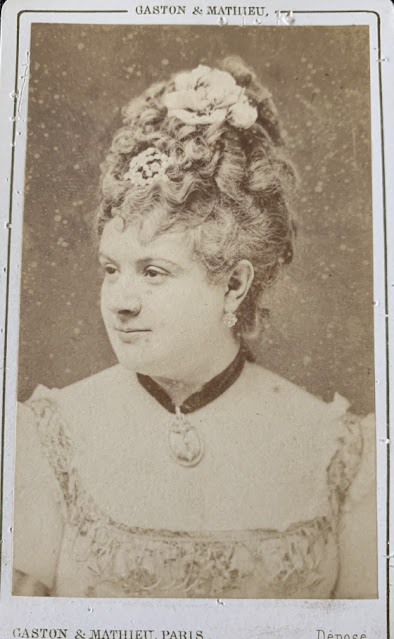
It happened thus. While netting the for-sale picture of Mlle Géraldine on French e-bay (see yesterday’s article) I chanced on the photo of a stunning young woman. She caught my eye because I thought she looked amazingly like a taller version of my Austrian grandmother as a teen-aged Mädchen.

Rudolfine Gänzl

Who was she? Mdlle Esclozos. Haha. Come to think of it, she looked like a young, slim version of Marie D, too. Could someone have misspelled her? Seemed not. A second, third and fourth photo surfaced with the same name … But, damme, it WAS her. Illiterate Frenchmen! 


So I began a check. And out it all came. Well, a lot of it. The reason I couldn’t formerly find Marie D before 1868 was that she, too, had played the name changing game. For some eight years she had, previously, been Esclozas, or Esclauzas. So I started again. 


There she is at the Cirque Impérial from 1860-2, playing Heloise in the 5-act drama Heloïse et Abélard, and taking part in the féeries La Poule aux oeufs d’or as the little heroine, Florine (‘Madame Esclozas s’est fait remarquer par une jolie voix’) and Rothomago (Bruyère), alongside Coralie Geoffroy and the dwarfish Judith Ferreyra.


The operation moved to the new Châtelet Theatre in 1862, and Ernestine Esclozas ‘maigre comme un clou’ was seen there over the next four years in pieces such as Le Secret de Miss Aurore (Lucy), Don Caesar de Bazan (Maritana), Aladin (Neréo,alongside Lise Tautin), La Prise de Pékin (Yang-Fo), La Jeunesse du roi Henri (Margot, ‘la plus jolie, la plus souriante, la plus coquette Marguerite [de Valois] qu’un puisse rêver’), Les Sept Châteaux du diable with her ‘Couplets de la mouche’, Les Mystères du vieux Paris (Odette Sorel), Bonaparte (Joséphine), La Lanterne magique (Progrès), Le Déluge universal (Eva, ‘La belle Madame Esclauzas joue le role d’Eva, qui lui est extrèmement avantageux sous la rapport du costume’), Cendrillon (Prince Charmant to the Cinders of Irma Marié), Fanfan la Tulipe (Mme de Pompadour), Le Diable Boîteux 


I can’t find her at the Ambigu, but that’s back to age nineteen … which must be about when the first of all these lovely photos were taken ... which are the excuse and reason for this ‘improved’ article…


As la Directrice in Le Petit Duc


 One of these is labelled Ernestine in LE ROI D'YVETOT (1876), the other LA CAMARGO (1878)!


La Camargo


Ernestine at home


Géraldine or Every Picture Hides a Story

.

PROLOGUE

Many years ago, when I was collecting illustrations for my musico-theatrical books, I haunted e-bay. Bought something weekly. But then they changed. Got more ‘professional’. To make a purchase, you had to have a credit card (I don’t) or belong to that thing called Paypal (I won’t, and they refused me anyway) ... so for the last 15 years I haven’t been an e-buyer. And won’t be.

However, my friend A*** is a devotee. So I started looking at the listings again. Mainly to give him information on ‘who was who’. Because e-bay vendors are merely merchants: how can they be expected to know that the millionth Adelina Patti or Christine Nilsson ain’t worth tuppence, but that a plain-looking Mlle Géraldine, an Edward Connell or a Herbert Bond (especially when wrongly identified or labelled) is a wee treasure to we who KNOW … 

FAST FORWARD

Last night. I can’t remember which bit of teckery got me to ebay France. Ah, yes, an unidentified (but known to me!) photo of an original Parisian Offenbach cast member…  Well, I hadn’t been on French e-bay for ages, so I poured another glass and browsed. The French are MUCH more knowledgeable, by and large, than the anglophones as to what and who actors and actresses are. And much better spellers. But their prices are ludicrous. Gone are the days when I bought CdVs for 50p. Now they ask 50 euros. So I wasn’t shopping: just window-shopping.


Nice things. Really nice things. I’d like the Dupuis, the Pradeau, the splendid Marie Cico which must have been taken just before her death of sexual misbehaviour …

Cico

 and good heavens, is that Mlle Géraldine ..  I alerted A****.  Ebay alert! Rarity!


Mlle Géraldine was the creator of Offenbach’s Paméla in Le Voyage de MM Dunanan. Never had I seen a photo of her! 


 So I went looking on the web. Well, there are three photos of her (but not this one) in French museums. But with very little information on her life and/or career attached. So … I dug.

WHO WAS MLLE GÉRALDINE?

It appears that the lady was born Clémentine Boudin. Well, you wouldn’t lie about that, would you? Orange Pudding? Nothing is ever ventured in the nosy French press of the mid-C19th as to her parentage or her family life, except that she bore a son in 1852 and married (before or, I suspect, much after) a ‘music publisher’.

Her early career, too, is misty. I see her in 1846 making a nervous wreck of La Part du Diable, before being hired to play in Les Chansons populaires de France at the Vaudeville. The press was not impressed: ‘a pretty enough voice … with practice, she might make a good understudy’. They weren’t about to find out. Someone died – father? mother? – and the young actress gave up her part ..

The three-line entries in French ‘biographical dictionaries’ then tell us that she ‘went to the Opéra-Comique’. 1847. Wow. What they don’t tell us is that, after three well-received performances as Betly in Le Châlet, her 3-year contract was terminated. She sued, the employer, Basset (state-subsidised, so what did he care?) didn’t even turn up in court … she got three years' wages.

For a number of years, France didn’t see ‘Mlle Géraldine’. She was in Russia. I know no more. But she got sued later, in France, for unpaid bills for expensive gowns which she claimed were bought for her by a Russian Prince … well, we all know about ‘Russian Princes’ and French actresses .. I guess this is where the son occurred ... 


In 1856, she returned to France, where she became ‘première chanteuse’ at the adventurous little Folies-Nouvelles. The Folies-Nouvelles existed, as the law at the time insisted, on a diet of spectacles-coupés, and Géraldine created a mass of the little one-act, three-handed pieces that made up the programmes of the day, teamed with such famous-to-be players as José Dupuis, Joseph Kelm, Camille Michel and Tissier, singing the music of Montaubry, Laurent de Rillé ...


The first seems to have been Fréluchette and afterwards I spy … Une Devinette, Le Revanche de Vulcaine (‘une ravissante Venus qui joue aussi bien qu’elle chante’), Aimé pour lui-même, La Mauresque, Achille à Scyros, L’Île de Calypso, Le Sultan Myapouf, Le Pacha, Le Souper de Mezzatin, Le Moulin de Catherine, Les Chansons populaires, Le Jugement de Paris, Vendredi (L’Ile Robinson) … and, doubtless, many others I have not spotted.


From the Folies-Nouvelles she moved to the Déjazet (Fanchette) and thence to the Bouffes-Parisiens. I won’t detail her career at the Bouffes, except to say that it was there that, between performances in pieces such as Une Fin de Bail and Daphnis et Chloe, she created the role of Paméla in Le Voyage de MM Dunanan et fils, and took a trip as leading lady of the Bouffes to Vienna, Amsterdam et al in loco Lise Tautin (Croquefer, Le Pont des Soupirs, Orphée aux enfers, MM Dunanan, et al).


She continued at the Bouffes, while taking summers at such as Baden or Vichy (Les Désespérés, La Marquise de Sabots, Les Noces de Jeannette with Berthelier 'aussi bonne cantatrice que charmante dugazon'), and in 1866 took part in the major revival of Orphée aux enfers, Playing Diana to the Eurydice of Tautin. Then she took to the provinces: playing the Schneider-Tautin roles with huge success to Rouen, Nice, Dieppe et al, before, in 1869, she took a longer step and headed for South America. Valparaiso and Lima, it appears, got their first taste of opéra-bouffe from ‘Géraldine’. And they were bowled over …


When she returned to France, she continued to work. I see her at Nice in 1875, playing Lange in La Fille de Madame Angot. After which … 

I’ll chase up her ‘whatever happened to’ some day. But it’s nice to have a story to go with the photo, which is heading its way, as I write, to Australia …