Saturday, February 24, 2018

A musical mystery ... or fraud.

.
I plunge on through the pages of my volume of aged music …


 I am a little worried about the musical knowledge of some of those involved in the music publishing game of the times ... the other day it was Mozzart … or is there a trick involved? Is the misspelling intentional ..?


And these two. The Portuguese and the Sicilian. In Latin. Though we know them today as ‘O Come all ye faithful’ (which it is posited was written by a King of Portugal) and ‘Lord Dismiss us with thy blessing’.


 But the next one is more than a trick. It is a puzzle. Or a fraud. It is all very well attributing an ancient melody to a Lusitanian monarch, but what do you do when a contemporary song is said to have been written and/or composed by a number of different people?

‘Adieu, my native land, adieu’.


Well, it was a sentiment and an expression used often enough in song and story at the turn of the 18th century, most famously by Lord Byron in Childe Harold (1812). But this song was in existence a number of years prior to that. My copy is no help. It has no date, no writer’s nor composer’s name. Just the probably pirated music and words. But there seem to be a good few copies of this melody combined with these words, put out by various publishers, in libraries on both sides of the Atlantic. Some, like mine, have no author’s name. The earliest advertisement I have found for the piece is 1804. ‘New songs, sung at Vauxhall Gardens, Theatres and other places of amusement’. The Bodleian catalogue includes an uncredited copy which is recorded as dated 1797.


 Well, putting aside those American editions dubiously credited to folk such as C K Moran, of whom I have never heard, and a Scots one rechristened Farewell to Albion’s Heather Hills, we come down to two probable claimants to the words and music of what was undoubtedly a reasonably popular song. One is John Westbrooke Chandler, Esq, the other is ‘the author of ‘Over the mountain and over the moor’’. 

A pirated version. No green ink.

This latter piece, officially entitled ‘The Beggar Girl’ was an ultra-sentimental little ballad, of which a trio version ‘sung by Mrs Bland, Miss Tyrer and Mr Sedgewick in the new pantomime Love and Magic or Harlequin’s Holiday … at Drury Lane’ (1802) was the work of one H Piercy (sic) of no5 Windmill Street, from where self-published, autographed copies signed in green ink could be purchased. Mr Piercy was a small time musician and teacher (‘piano, harp and singing taught at schools of respectability’) who published one or two other pieces under his own name, but his ‘Adieu’ apparently (I have not seen a copy) appeared just credited to the writer of ‘The Beggar Girl’.


 Mr Chandler was an altogether more colourful character. He even got in to the Dictionary of National Biography. But his history is full of holes and contradictions. The DNB tells us he was the illegitimate son of the second Earl of Warwick (but not who his mother was), made his name as a painter and died in an Edinburgh insane asylum before the age of thirty. Well, the painter bit was true, and is the reason that he has been potted for dictionaries. But Mr Chandler, as well as being seemingly depressive and somewhat deranged, is also undocumented. His birth date (understandably) and death date (understandably) are given widely differently, and the only obituary I can find for him – in the Athenaeum of 1807 – says he was 45 at his death. In Stafford. And that means his alleged father would have been a teenaged university student at his birth.


So, words and music for a song? Perfectly possible. Mr Chandler, when not painting, not only wrote a vast piece of heroic poetry, Sir Hubert, but also tinkled. But how strange to write one extremely popular song, and never again? Still, most copies of ‘Adieu’ bear the legend ‘written and composed by J Westbrooke Chandler’. Some affirm ‘sung by Mr Lee at Drury Lane’. Mrs Mountain and Dignum also get mentioned … Mr Lee? Which Mr Lee? You see what I mean about a puzzle.


So, did Piercy or Chandler write our song? Or neither of them? Or were they the same person? I think not. Because in 1802-3 Piercy is at Windmill Street with his green ink, and Chandler is allegedly in Scotland painting the local aristocracy. But American academia throws a spanner in the works. Mr T L Philbrick attributes a woodcut entitled ‘The Beggar Girl’, published in York of all places, to Chandler. It is decorated with the verse ‘Over the Mountain and over the moor’, which we know was the work of … Mr Piercy!

Sigh.


Thursday, February 22, 2018

Auld lang syne


Over the page… a song and a 200 year old dried fern ...


 ‘Auld lang syne’ is somehow one of those songs that you don’t think of anybody actually writing. But, if pressed, folk are inclined to attribute it to the buzzword Scot of the eighteenth century, Robert Burns. They’d be half right. The version of the song that has become a New Year’s Eve classic chorus was arranged by Burns, who never pretended that it was anything else but a version of a much older song, and he registered it as such in 1788.


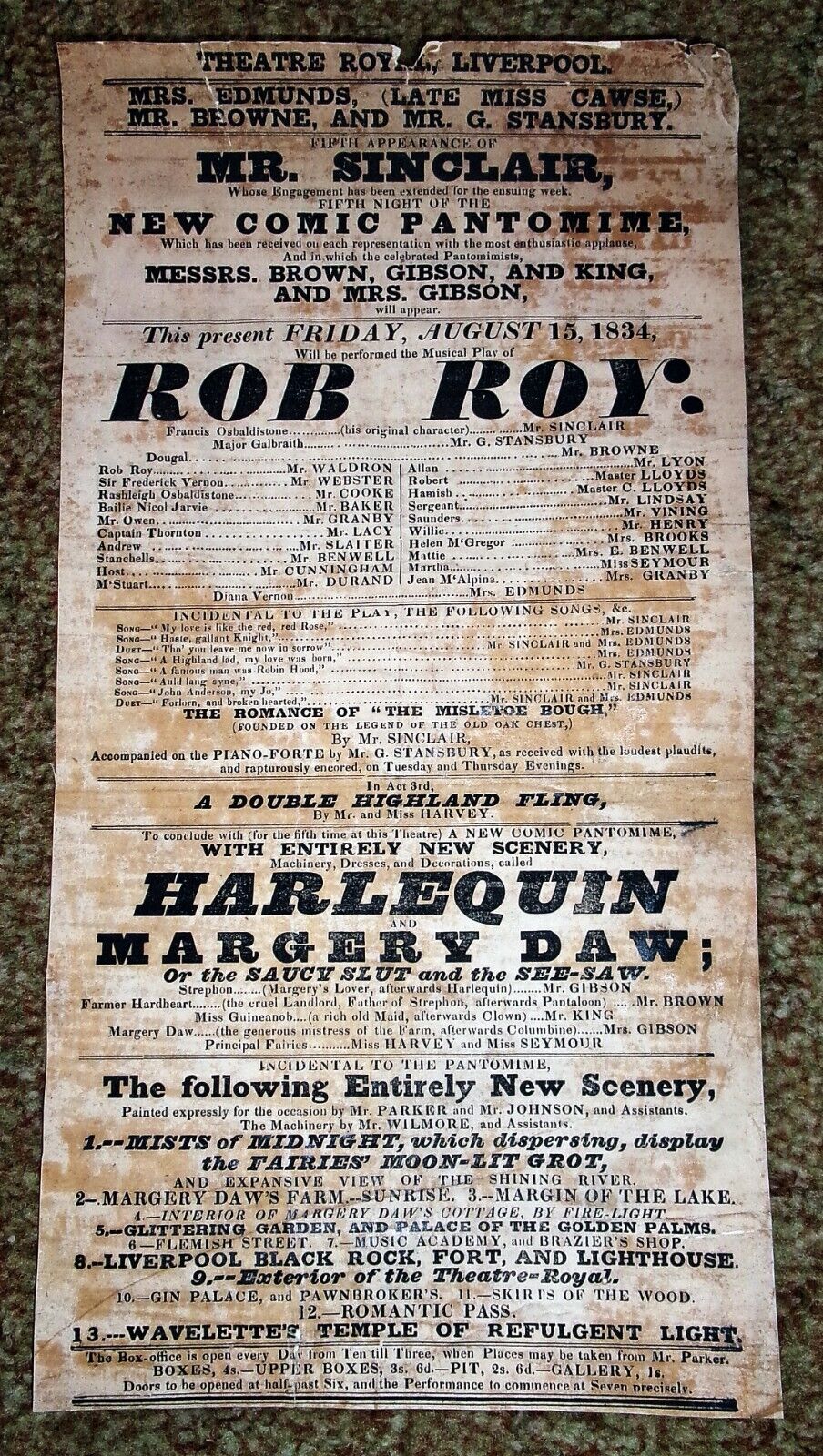
 I see it sung in concert in Edinburgh in 1806 by a Miss G Jones, and in 1807 by Mrs Kemble and, in 1813, an arrangement for four voices was sung at the London Vocal Concerts by Mr and Mrs Vaughan, William Knyvett and J B Sale. In the same year, Penson, Robertson & Co published ‘Auld Lang Syne, with the additions, as sung with unbounded applause at the Theatre Royal, Edinburgh by Mr Sinclair’. I wonder what the additions were.


In 1813, Sinclair, ‘the only Caledonian melodist on the British stage’ was already a fixture at the Theatre Royal, Covent Garden, and he gave such national songs as ‘Scots wha hae’ ‘Roy’s Wife of Aldivalloch’ at Benefit concerts alongside the inevitable ‘Pray goody’, ‘The Death of Abercrombie’. ‘The Death of Nelson’ and the ilk. In 1816 I see he gave them ‘Auld lang syne’. He would sing it many, many times more, on that same stage.

A romanticised Rob Roy Macgregor
In 1817, Walter Scott published his novel Rob Roy, his version of the tale of a Scots murderer, rapist and thief, alias Campbell, whose deeds ‘protected by several great men to whom he was useful’ had become the stuff of sweetened-up heroic legend.


The theatres were close behind where Scott led, and less than three months later (12 March 1818) Isaac Pocock’s dramatized version of Rob Roy MacGregor opened at Covent Garden. I imagine that the fact of having Sinclair and his songs on the staff may have had something to do with the drama becoming a musical drama (which some critics objected to).

The Devon composer John Davy had composed, selected and arranged a score, largely from popular Scottish songs, and principally for the characters of Francis Osbaldistone (Sinclair, tenor), who was actually the main character of the story, and his sweetheart Diana Vernon (Kitty Stephens, soprano). Among them were ‘My love is like the red, red rose’, ‘Scots wha hae’, ‘A Highland lad my love was born’ (also included in this volume), ‘Roy’s Wife of Aldivalloch’ and, most prominently, ‘Auld lang syne’ which did duty as a title-song, for the play of Rob Roy was subtitled ‘or Auld Lang Syne’. Mr Macready, in the role of MacGregor did not sing. Apart from the two stars, only Taylor as Major Galbraith had a song: a version of Wordsworth’s ‘A famous man was Robin Hood’.


Rob Roy went on to become a staple of the British stage. Other versions quickly sprouted – George Soane’s was hastened on to the stage at Drury Lane while the Pocock play was still at Covent Garden – but it was the Garden’s one which proved to have the staying power. And stay it did, doing its bit to ensure that ‘Auld lang syne’ was sung in multiple productions, all round the English speaking world, for a century, eventually proving a popular warhorse in which slightly clapped-out star tenors could give what was a virtual recital of Scots songs.


But ‘Auld lang syne’ is the one which became an institution.


Monday, February 19, 2018

The Cherokee

.
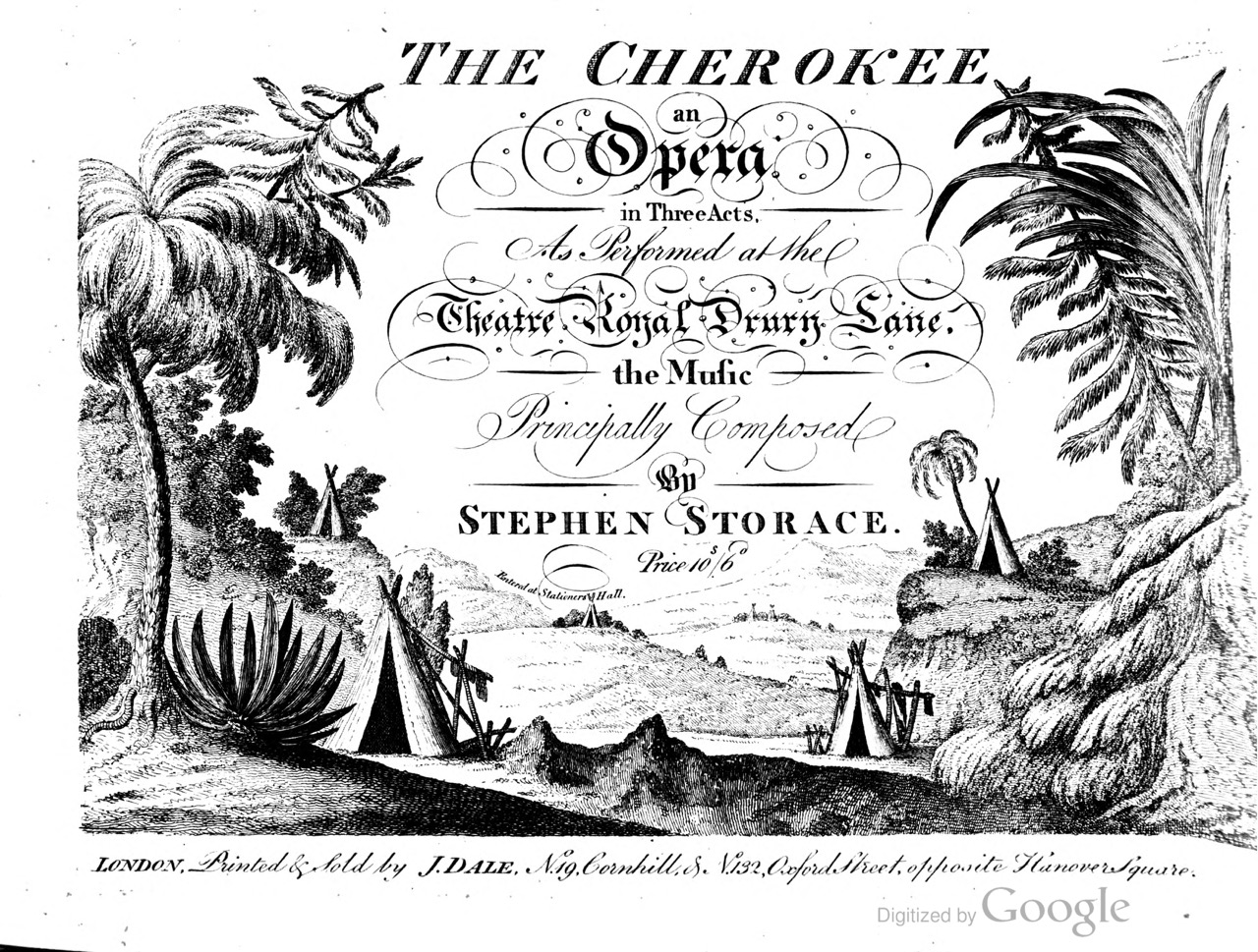
Turn the page. Item two in my volume is a 1794 show tune. And there’s another from the same musical, The Cherokee, a few pages further on. After mixed reviews, the piece played sixteen nights at Drury Lane, had a flop revival, in a revised version by its leading tenor, in 1802, and would doubtless have disappeared, but for a couple of cute ballads and … its title.


In the 20th century, when it became fashionable to be ‘indigenous’, on one side of the world or the other, a work entitled The Cherokee was ripe for rediscovery, re-publication (Belwin Mills, 1977) and even performance. ‘One of the first representations of Native Americans in music was in Stephen Storace's opera The Cherokee (1794)’ tells us academia. Nonsense. And I imagine that what were then called Red Indians wouldn’t have been very happy with their ‘representation’. The Indians of The Cherokee might not be as hilarious as the dancing murderess of Rose-Marie and her ‘Totem Tom-Tom’, or those of a hundred Hollywooden ‘cowboys and itchybums’ films, but they are quite simply Ruritanians. Nothing else. Standard baddies (except for one) with, this time, painted faces. And splenditious and exotic scenery and costumes representing an 18th century Englishman’s idea of the Ruritania that was outback America.


The Red Indian had been portrayed on the British stage for decades previously, notably in 1762, when three ‘Chiefs’ visited London to look at the King, the Tower of London and the might of the British army, and got drunk in the public gardens. The Drury Lane pantomime that year was titled The Witches, or Harlequin Cherokee, a book of ‘convivial’ (men only) songs included one on ‘Cherokee Chiefs’ … just like the Maoris a century later, or the Shah of Persia in his turn, the Cherokees were the exotic curiosity of the day.

Their turn in the limelight came once again in the 1790s on the occasion of another visit. A racehorse was named Cherokee, Cherokee sauce was bottled, a breed of strawberries was christened Cherokee, and James Cobb, who had recently had such a huge success with The Haunted Tower, penned a libretto for Stephen Storace and Drury Lane and its company in which the nasty lubricious villain who kidnaps the heroine was a Red Indian chieftain (Mr Barrymore) instead of a haremic Sultan or a wax-moustachioed gent in spats.


The Cherokee was a large piece. It had its dramatic plot – the capture and ultimate rescue and return to her husband (Michael Kelly) of the heroine (Mrs Crouch) and her son (Master Welsh) after some Perils of Pauline adventures, ending in the murder of the unassuaged villain – it had a standard ‘soubret’ plot about two cousins (English) determined to dislike each other who finally decide that of course they don’t, and it had roles and numbers for the other principal members of the company, which were more or less attached to the plot. The Times found ‘Action and character, with the serio-comic, happily and forcibly blended create a strong interest and excite attention and mirth seldom to be found united’. And judged it just needed some curtailment to the dialogue. Others found it all far too complex.


The Cherokee also had a large score, of more than thirty songs and ensembles, ‘principally composed by Storace’ which was published in what was said to be its entirety. Pieces by Mozart, Bianchi, Ditters von Dittersdorf, Sarti and Anfossi were said to have been used, but the Mozart (‘Sweet as summer’s fragrant vale’) sounds like ersatz Mozart (maybe it was by one Mozzart?) and only the Ditters song (‘The fields there wonted hues resume’) is identifiable.


About the music there was no quarrel. It was well liked throughout. The Times picked out the revenge solo and chorus ‘Oh Power unknown’ (known as the War Whoop chorus), sung by Sedgewick as the ‘good’ Indian of the story and the ensemble, and the second act finale as the gems of the score. Jack Bannister, who played the boy cousin, Jack Average, later wrote in his memoirs ‘The Cherokee chorus was one of the grandest ever composed; the effect was sublime…’. The ‘fine choruses and finales’ were indeed the backbone of the score, but it was the solo songs and the duets which were going to make their way on to the nation’s pianofortes and into family volumes like mine.


The Times picked Jack’s song ‘Glory Firing’, the ‘Constitutional sea song’ ‘Our country is our ship’, given by Dignum in the role of Ramble, and ‘a beautiful little Welch air’ sung by Maria Teresa Bland as a beautiful little Welsh Winifred, who somehow wandered into the proceedings, if not the plot. The music of the piece was apparently a familiar Welsh air arranged by Storace, and variously known as ‘Fal Lal La’, ‘The Shepherd and the Bird’, ‘A little bird sat on a spray’, ‘The Little Bird’ or, as in my copy, ‘A Shepherd Once Had Lost His Love’.


If Winifred seemed to be in the piece mainly to sing her incidental songs, even more pronounced was the case of Fanny, a minor role played by Elizabeth Leak. Fanny got to sing the conventional ditty ‘A Sailor lov’d a lass’ and it, too, proved to be drawing-room material.


My favourite among the minor characters’ moments, though, is Dicky Suett’s patter song, with its Indian chorus:
Oh what a fight it was to see
What a din, what a glorious rattle!
And I so snug, perch’s up in a tree,
Had a birds-eye view of the battle
There were Chicksaws and Cherokees and Mohawks and Miamis
Schenectaws and Catabaws, Algonquins and Iroquois …

When the piece was revived by Kelly for Mrs Billington, The Times grumbled that ‘The music is very fine, particularly the choruses; but we have again to lament that more endeavour has not been made to please the ear by simple melody … Mrs Bland ran away with almost all of the applause by singing the old ballad of ‘A Shepherd once had lost his love’. The ‘old ballad’? Well, it certainly predates The Cherokee, for I see the lyric in a song book of 1790. Roger Fiske in Scotland in Music, while giving the melody as the source of Beethoven’s Op105 I (Scottish air), denies its Welsh (or Scottish) origins. I don’t know why, but he may be right. Ersatz Mozart? Fake Welsh?

The song remained popular for a number of years. It would be nice to know if the eighteenth century commentator who wrote of one arrangement ‘An arrangement for the domestic musician of a traditional Welsh air made popular recently by Storace's use in his comic opera The Cherokee’ was right or not.


One little, two little, three little ... even Friml!