.
In my odds and sods folder, next to Lena Ashwell, was this. A sod, I think, rather than particularly odd. And far from a glowing example of the designer's art.
It dates from forty-four years later than the beautiful Wilhelm drawing. 1954. And the work it was part of was a flop production by that churner-out of inconsiderable trifles, Eric Maschwitz, aided and abetted by producer Emile Littler. It was an alleged adaptation of the popular play The Ghost Train, which was produced at Oxford and brought to the Palace Theatre for Christmas. Unloved, it staggered past twelfth night and sank forever leaving little trace. And Marie Burke and the very young Sheila Bernette out of a job.
The flung-together nature of the whole affair can be seen in this unsigned stock (can it really be by Berkeley Sutcliffe?) design for principal dancer Ian Stuart...
Ah well, some play at theatre, some work at it. And there's quality and ... the other stuff.
Friday, November 24, 2017
My cupboard: when the rubbish folder yields up an historical bomb!
.
My father did his PhD thesis on George Bernard Shaw. At Vienna University, in the 1930s, when said gentleman was still living, writing and proseltysing. In consequence, I grew up with a blotch of, not quite all of, Shaw's plays on my bedroom-study bookcase. Yes, father had progressed to sterner stuff after college days, and they had come down to me. I, being an avid lad, read them all. And I, being even aged ten, a laddie of mine own mind, influenced not at all by 'fame', only really enjoyed two. Androcles and the Lion and Arms and the Man. Pygmalion was OK, I came round for a while to St Joan, but Major Barbara was just silly, Man and Superman pompous, Caesar and Cleopatra dull, The Doctor's Dilemma and Candida quick closes, John Bull's Other Island incomprehensible, and even though A Black Girl in Search of God was a pretty cellophane-covered edition, I gave it up after just a few pages. I went back to the less talky Bronte, Scott, Ainsworth and Hoofbeats.
I avoided all things Shavian, thereafter, through my education (apart from Singing 'Wouldn't It be loverly' in a school concert), and I have got on very nicely with very small doses of his works since. Penelope Keith made Captain Brassbound's Conversion into a fun evening (of which I remember nothing else), Oscar Straus made a delightful musical out of Arms and the Man, just as Fritz Loewe did of Pygmalion ... but that was more or less it, except in the line of duty. So I had barely heard of Misalliance. Apparently with reason. It was produced at the Duke of York's Theatre in February 1910, labelled 'three hours of talk' and vanished into the repertoires of a few of the more pretentious houses in double quick time.
Change of topic. When I bought some designs, some time in the 1980s, there were a few oddities which clearly didn't belong in the box, interleaved with my purchases. Some unlabelled, some unsigned, but one -- to my delight -- autographed 'Wilhelm'. The great designer. And I didn't have a Wilhelm. It was an odd piece, though. A chap in an airman's suit and goggles. The Arcadians maybe? Never mind. It was a Wilhelm. Back in the box.
Today I pulled it out again, and noticed a pencilled inscription on the back. Misalliance. Shaw? So I looked in the 1910 newspapers ... yes, Misalliance, starring Florence Haydon, produced by .. who? Granville Barker? with whom? Why can I barely find a mention of this play and its production? I have merely managed to find that the person who did the most talking during the three acts played the role of -- yes! -- a Ruritanian circus acrobat who arrives in a plane. So it's not a man. This is the design for the costume for the Repertory Theatre's original Lina Szczepanowka. Which, I finally discover, was played by no less than Lena Ashwell.
Oh well, its a delicious drawing. And I suppose to Shaw groupies (I see they still exist) and devotees of the Barker system and all that swam in it, it has more than a little interest and significance. So I am putting it on the worldwide web so that anyone who wishes may copy it, and use or publish it. And it would be nice, if they did so, if they said the original belongs to me. Well, for now, anyhow. Tenders are open.
My father did his PhD thesis on George Bernard Shaw. At Vienna University, in the 1930s, when said gentleman was still living, writing and proseltysing. In consequence, I grew up with a blotch of, not quite all of, Shaw's plays on my bedroom-study bookcase. Yes, father had progressed to sterner stuff after college days, and they had come down to me. I, being an avid lad, read them all. And I, being even aged ten, a laddie of mine own mind, influenced not at all by 'fame', only really enjoyed two. Androcles and the Lion and Arms and the Man. Pygmalion was OK, I came round for a while to St Joan, but Major Barbara was just silly, Man and Superman pompous, Caesar and Cleopatra dull, The Doctor's Dilemma and Candida quick closes, John Bull's Other Island incomprehensible, and even though A Black Girl in Search of God was a pretty cellophane-covered edition, I gave it up after just a few pages. I went back to the less talky Bronte, Scott, Ainsworth and Hoofbeats.
I avoided all things Shavian, thereafter, through my education (apart from Singing 'Wouldn't It be loverly' in a school concert), and I have got on very nicely with very small doses of his works since. Penelope Keith made Captain Brassbound's Conversion into a fun evening (of which I remember nothing else), Oscar Straus made a delightful musical out of Arms and the Man, just as Fritz Loewe did of Pygmalion ... but that was more or less it, except in the line of duty. So I had barely heard of Misalliance. Apparently with reason. It was produced at the Duke of York's Theatre in February 1910, labelled 'three hours of talk' and vanished into the repertoires of a few of the more pretentious houses in double quick time.
Change of topic. When I bought some designs, some time in the 1980s, there were a few oddities which clearly didn't belong in the box, interleaved with my purchases. Some unlabelled, some unsigned, but one -- to my delight -- autographed 'Wilhelm'. The great designer. And I didn't have a Wilhelm. It was an odd piece, though. A chap in an airman's suit and goggles. The Arcadians maybe? Never mind. It was a Wilhelm. Back in the box.
Today I pulled it out again, and noticed a pencilled inscription on the back. Misalliance. Shaw? So I looked in the 1910 newspapers ... yes, Misalliance, starring Florence Haydon, produced by .. who? Granville Barker? with whom? Why can I barely find a mention of this play and its production? I have merely managed to find that the person who did the most talking during the three acts played the role of -- yes! -- a Ruritanian circus acrobat who arrives in a plane. So it's not a man. This is the design for the costume for the Repertory Theatre's original Lina Szczepanowka. Which, I finally discover, was played by no less than Lena Ashwell.
Oh well, its a delicious drawing. And I suppose to Shaw groupies (I see they still exist) and devotees of the Barker system and all that swam in it, it has more than a little interest and significance. So I am putting it on the worldwide web so that anyone who wishes may copy it, and use or publish it. And it would be nice, if they did so, if they said the original belongs to me. Well, for now, anyhow. Tenders are open.
When Musical Comedy Was Queen!
.
One hundred and one years ago, in the days when musical comedy was Queen, Frank Curzon produced a new piece at London's Wyndham's Theatre under the title The Girl Behind the Counter. It was praised as a model of its kind, ran from April to September, toured, was exported to America (where it was remade as a vehicle for Lew Fields) and so forth ...
![]() |
| Hayden Coffin as Charlie Chetwynd |
The London version starred the statuesque baritone Charles Hayden Coffin as the principal 'boy' of the affair, the sweet-voiced Isabel Jay as the shop-girl heroine, accused of stealing a ten-pound note, and Horace Mills and Coralie Blythe as the little soubrets in the affair ...
![]() |
| Adolphus Dudd (Mills) and his Susie (Blythe) at the costume ball |
![]() |
| Horace Mills |
Julian Hicks designed the scenery and the costumes were designed by the ubiquitous 'Karl'.
And those costume designs have found their way into -- yes -- the bottom of my cupboard. Well, today they have been dragged out. They have been there for at least fifteen years. And I don't want them to go back. I bought them years and years ago. When I was earning 135 pounds a week. I remember I had to run back to the office, at the end of the sale, and beg our accountant for a sub on my wages. But I knew what was going to happen if I didn't buy them. The main buyers at the sale included David Drummond, Richard McNutt and David Wood. Knowledgeable dealers in theatrical ephemera. The sets would be broken up and sold one 'picture' at a time, to maximise revenue.
I had come for one set in particular. The designs for Edward Solomon's The Nautch Girl. I had to fight, but I got them. The complete Savoy Theatre set. For something more than a month's wages. I cared for them, used them in my books, and finally passed them on to a Savoy Theatre specialist via whom I know they will end up in a museum or library. Mission accomplished!
I watched Percy Anderson's designs for Merrie England go for 750L, the original Peter Pan sketches fetched 1200L, Oliver Messel's Helen! 520L. 40 Anderson designs for Covent Garden's flop Joan of Arc brought 420L, his The Emerald Isle 520L and his Chu Chin Chow 500L. David Drummond paid 700L for the 47 designs for Cavalcade... while 22 Mister Cinders sketches only fetched 300L. But with all these memorable goodies on sale, there were, naturally, some lots which didn't attract so much attention. And so, having heart-achedly watched wonderful historical stuff go out of the auction room, destined for the 'decorators' market, I finally cracked ...
I had come for one set in particular. The designs for Edward Solomon's The Nautch Girl. I had to fight, but I got them. The complete Savoy Theatre set. For something more than a month's wages. I cared for them, used them in my books, and finally passed them on to a Savoy Theatre specialist via whom I know they will end up in a museum or library. Mission accomplished!
I watched Percy Anderson's designs for Merrie England go for 750L, the original Peter Pan sketches fetched 1200L, Oliver Messel's Helen! 520L. 40 Anderson designs for Covent Garden's flop Joan of Arc brought 420L, his The Emerald Isle 520L and his Chu Chin Chow 500L. David Drummond paid 700L for the 47 designs for Cavalcade... while 22 Mister Cinders sketches only fetched 300L. But with all these memorable goodies on sale, there were, naturally, some lots which didn't attract so much attention. And so, having heart-achedly watched wonderful historical stuff go out of the auction room, destined for the 'decorators' market, I finally cracked ...
![]() |
| Soubrette Susie (Blythe) |
And that is how the 'rescued' designs for The Girl Behind the Counter and Dear Little Denmark ended up in a farmhouse cupboard in New Zealand...
Until now ....
Until now ....
Thursday, November 23, 2017
Gone with the little girl up the horse's arse
Next out of the pile. Costume design for India Wilkes in the Drury Lane production of the musical made from the famous novel and film, Gone with the Wind. An umpteenth example of a great story, play or piece of cinema trivialised as a musical.
This show was produced by my beloved Harold Fielding in 1972. Well, we all make mistakes. I didn't see it. I was not yet a member of the clan. But, of course, Ian was involved. He didn't talk about it much in after days. No one around the office did. Harold spluttered (as he was inclined to) when it was mentioned. I got the feeling it was deeply unloved by all. As was its apparently objectionable composer. Anyway, I didn't find anything much concerning it in my prowls through the firms' archives, except this design. I thought I had thrown it out. But the show lives on in anecdote thanks to Noel Coward's famous line to Ian on opening night concerning the child over-actress and the defecating horse... "If they'd shoved the little girl up the horse's arse, it would have solved both problems".
So, here is this trophy of a flop, for google to gobble up, and now can I chuck it?
Post scriptum. This design is the work of and signed by the late Patton Campbell, which I am told means that I should be careful where I chuck it.
Singin' in the Hungarian Rain
.
This little item will just help to set history straight. It is the programme for the original Hungarian production of Singing' in the Rain. See the credit at the top? Harold Fielding [in association with] Maurice and Lois (we're not Jewish) Rosenfield.
Oh! that they had been disassociated. Mrs Rosenfeld did nothing, during the whole process of creating the show, except scare the Fielding office staff (me, included) out of their wits with her towering concrete hairdo. Mr Rosenfeld did nothing but get the stage-rights for about half the songs from the film and then just talk. Of course, we were all glad when he brought the project to us ... but then he disappeared off to go a-perverting the law in Chicago. Great. Let the professionals get on with creating the stage production. And as far as I know he did. And we did.
Tommy Steele arranged an excellent libretto (surprising, after the pig's ear he had made of Hans Andersen), Ian Bevan chased round, to excellent effect, to find songs to replace the all-important ones Mr Rosenblum had 'lost', and -- with Tommy cast, and dear Roy Castle as his suitably non-scenestealing oppo -- the boy round the office, who had shown an unexpected talent for casting, was set to find a Debbie Reynolds who could really sing, dance and act, a Jean Hagen for the 20th century, and a host of minor characters ... go for it, Kurt.
And legal papers were, of course, drawn up. The first lot. Binding the Rosenkranzes in with HF for the future life of the stage show.
As history tells, the London/Steele/Fielding edition of Singin' in the Rain was a very, very big and lucrative hit and made lots of money for all concerned. And we began to plan the American production, only to find we'd been forestalled. Honest Mr Rosendingle had gone ahead and had a new version written (by Comden and Green, no less) and was planning, against all agreements, to go it alone on Broadway. And just to give his erstwhile 'partners' something to think about he slapped expensive lawsuits on everyone in sight. Yes, Ian and I included. Of course, just to answer his legal papers cost tens of thousands of pounds ... getting mixed up with Chicago lawyers of even a degree of honesty doesn't come cheap. We were out of our depth. We had to give in and let him go.
As history salutorialy tells, the Rosenfield/Comden and Green/New York Singin' in the Rain (feebly cast!) was a full-scale flop, had to be re-financed to keep afloat, and sank in a mess of pottage somewhere on the provincial road.
And so, a new agreement was arranged. The 'American' version would have the right to be played henceforth anywhere in America. The Tommy Steele version would be licensed by Fielding in the rest of the world. Well, it started that way, but it didn't quite turn out that way. Hungary did the proper version, in 1989, as the above playbill testifies. But then?
Some years later I was asked to look at an amateur production, of fair standard, in New Zealand. What had they done to the show? It was, to be polite, pretty dire. And then I realised. They were doing the 'American' version. But hang on, this was New Zealand. New Zealand, when I was a lad, was part of the 'rest of the world'. Who had 'licensed' this sad version to Christchurch am drams? Guess. Do the words 'rip off' and 'broken contract' and 'illegal' ring in your ears. They sure rang in mine.
Is there something I don't know. Huh! Unlikely.
Well, Harold is dead, Ian is dead, I suppose the Rosenfelds are dead, Comden and Green are dead, but I'm not dead yet and neither is Tommy Steele! If I were he, I'd have my agent or my lawyers coming down on Music Theatre International with a multi-million dollar bill. Royalties for every time the show has been played in its 'American' version outside America. Me, I can only make a noise.
Now, where ARE those contracts? Have I already given them to Harvard or are they in one of my cupboards with the Jesus Christ Superstar ones ... ah me! contracts are strange things, they have a way of appearing and disappearing ...
Anyway, thus was killed the goose that was busy laying golden eggs. By greed and vanity. And thus was a merry, unpretentious, lively show squeezed out of the world repertoire. Oh, well, it's not the first time and it won't be the last that lawyers and other conniving men decide the fate of a theatrical piece. Remind me to tell you sometime the true story of Robert and Elizabeth ...

This little item will just help to set history straight. It is the programme for the original Hungarian production of Singing' in the Rain. See the credit at the top? Harold Fielding [in association with] Maurice and Lois (we're not Jewish) Rosenfield.
Oh! that they had been disassociated. Mrs Rosenfeld did nothing, during the whole process of creating the show, except scare the Fielding office staff (me, included) out of their wits with her towering concrete hairdo. Mr Rosenfeld did nothing but get the stage-rights for about half the songs from the film and then just talk. Of course, we were all glad when he brought the project to us ... but then he disappeared off to go a-perverting the law in Chicago. Great. Let the professionals get on with creating the stage production. And as far as I know he did. And we did.
Tommy Steele arranged an excellent libretto (surprising, after the pig's ear he had made of Hans Andersen), Ian Bevan chased round, to excellent effect, to find songs to replace the all-important ones Mr Rosenblum had 'lost', and -- with Tommy cast, and dear Roy Castle as his suitably non-scenestealing oppo -- the boy round the office, who had shown an unexpected talent for casting, was set to find a Debbie Reynolds who could really sing, dance and act, a Jean Hagen for the 20th century, and a host of minor characters ... go for it, Kurt.
And legal papers were, of course, drawn up. The first lot. Binding the Rosenkranzes in with HF for the future life of the stage show.
As history tells, the London/Steele/Fielding edition of Singin' in the Rain was a very, very big and lucrative hit and made lots of money for all concerned. And we began to plan the American production, only to find we'd been forestalled. Honest Mr Rosendingle had gone ahead and had a new version written (by Comden and Green, no less) and was planning, against all agreements, to go it alone on Broadway. And just to give his erstwhile 'partners' something to think about he slapped expensive lawsuits on everyone in sight. Yes, Ian and I included. Of course, just to answer his legal papers cost tens of thousands of pounds ... getting mixed up with Chicago lawyers of even a degree of honesty doesn't come cheap. We were out of our depth. We had to give in and let him go.
As history salutorialy tells, the Rosenfield/Comden and Green/New York Singin' in the Rain (feebly cast!) was a full-scale flop, had to be re-financed to keep afloat, and sank in a mess of pottage somewhere on the provincial road.
And so, a new agreement was arranged. The 'American' version would have the right to be played henceforth anywhere in America. The Tommy Steele version would be licensed by Fielding in the rest of the world. Well, it started that way, but it didn't quite turn out that way. Hungary did the proper version, in 1989, as the above playbill testifies. But then?
Some years later I was asked to look at an amateur production, of fair standard, in New Zealand. What had they done to the show? It was, to be polite, pretty dire. And then I realised. They were doing the 'American' version. But hang on, this was New Zealand. New Zealand, when I was a lad, was part of the 'rest of the world'. Who had 'licensed' this sad version to Christchurch am drams? Guess. Do the words 'rip off' and 'broken contract' and 'illegal' ring in your ears. They sure rang in mine.
Is there something I don't know. Huh! Unlikely.
Well, Harold is dead, Ian is dead, I suppose the Rosenfelds are dead, Comden and Green are dead, but I'm not dead yet and neither is Tommy Steele! If I were he, I'd have my agent or my lawyers coming down on Music Theatre International with a multi-million dollar bill. Royalties for every time the show has been played in its 'American' version outside America. Me, I can only make a noise.
Now, where ARE those contracts? Have I already given them to Harvard or are they in one of my cupboards with the Jesus Christ Superstar ones ... ah me! contracts are strange things, they have a way of appearing and disappearing ...
Anyway, thus was killed the goose that was busy laying golden eggs. By greed and vanity. And thus was a merry, unpretentious, lively show squeezed out of the world repertoire. Oh, well, it's not the first time and it won't be the last that lawyers and other conniving men decide the fate of a theatrical piece. Remind me to tell you sometime the true story of Robert and Elizabeth ...
Wednesday, November 22, 2017
A delicious heap of old musical-theatre music!
.
Goodness, I wonder where I got these from. France it seems. Well, I'll put them up on here, and then I'll find a home for them ...
The first one is from 1845. Its a quadrille, composed by Oscar Commetant, written on the themes of Nicolo Isouard's fairy opera Cendrillon. Now, Cendrillon was first staged in 1810, and very successful it was, but things like Napoléon and the Battle of Waterloo got in its way and when it was revived it flopped. But in 1845, the Opéra-Comique decided to revive it. Of course as revivers do they fiddled with it, and the critical result was muted, but it did all right. This engraving shows us what I presume is Cinderella (Mme Darcier) doing a tambourine routine before the Prince (Audran, father the composer), Dandini (Sainte-Foy) and sisters Clorinda (Mme Casimir, with an interpolated frilly air by Adolphe Adam) and Tisbe (Mme Révilly).
The next engraving is from 1863. It is a grandiose production of the old faérie, Peau d'âne, mounted by Harmant at the Théâtre de la Gaïté. The old libretto was given a smarten-up by the spiritual Clairville, the all-important decors were by Cambon, Fromont and ... Jules Chéret. The less important music seems to have been credited to the conductor Louis Fossey, Edmond L'Huillier and Victor Chéri. It was Fossey who got the traditional conductor's perk of arranging the show tunes in dance music such as this quadrille. And the illustration was Chéret's design for an 'Aquarium' scene.
Goodness, I wonder where I got these from. France it seems. Well, I'll put them up on here, and then I'll find a home for them ...
The first one is from 1845. Its a quadrille, composed by Oscar Commetant, written on the themes of Nicolo Isouard's fairy opera Cendrillon. Now, Cendrillon was first staged in 1810, and very successful it was, but things like Napoléon and the Battle of Waterloo got in its way and when it was revived it flopped. But in 1845, the Opéra-Comique decided to revive it. Of course as revivers do they fiddled with it, and the critical result was muted, but it did all right. This engraving shows us what I presume is Cinderella (Mme Darcier) doing a tambourine routine before the Prince (Audran, father the composer), Dandini (Sainte-Foy) and sisters Clorinda (Mme Casimir, with an interpolated frilly air by Adolphe Adam) and Tisbe (Mme Révilly).
The next engraving is from 1863. It is a grandiose production of the old faérie, Peau d'âne, mounted by Harmant at the Théâtre de la Gaïté. The old libretto was given a smarten-up by the spiritual Clairville, the all-important decors were by Cambon, Fromont and ... Jules Chéret. The less important music seems to have been credited to the conductor Louis Fossey, Edmond L'Huillier and Victor Chéri. It was Fossey who got the traditional conductor's perk of arranging the show tunes in dance music such as this quadrille. And the illustration was Chéret's design for an 'Aquarium' scene.
This one is a slight puzzle. La Famille Benoîton, by Victorian Sardou, produced at the Vaudeville 4 November 1865, was not a musical. It was a straight comedy. But comedies in the good old days had an orchestra, and even odd songs, so maybe this one did too. Anyway, Adolphe de Groot was the theatre's conductor, and he is credited for the, probably arranged and selected, music for this highly successful play. And, with the addition of a nice 'cast photo' litho by Léon Loire, the score of incidental music seems to have been made up into a saleable quadrille by inveterate dance-music arranger Henri Marx.
Cocktail time ... then I'll see what else is in that pile!
1865. Christmas is a coming... with its seasonal entertainments ...
.
Looking for some old designs for Michael Green, I dug in the bottom pile of stuff in the cupboard ...
This is nice...
Fantasia by Olivier Métra on the melodies from the Folies Marigny (formerly Offenbach's Bouffes-Parisiens) seasonal revue of 1865 (15 December). Ah! Those were the days when a 'revue' could really be called a 'revue'. A meet tongue-in-cheek, end-of-term show 'reviewing' the events of the year. The star of this one was the splendid Montrouge, the theatre's manager, and its title was BU... QUI S'AVANCE in reference to the year's huge hit opera-bouffe LA BELLE HÉLÈNE ...
The engraving seems to be of the more 'picturesque' members of the cast: the typical quartets of 'boys' and 'girls' danced by the chorines of the company. But, goodness, who is the pretty fellow in the middle? Most unusual.
It just might be the dance of the little boatmen, music by Henri Cellot ...
Anyway, this what Parisians got for their Christmastide entertainment 150 years ago. I feel things have not improved in a century and a half ...
I think I shall dig a little further into this pile. Can you wait a bit, Michael?
Looking for some old designs for Michael Green, I dug in the bottom pile of stuff in the cupboard ...
This is nice...
Fantasia by Olivier Métra on the melodies from the Folies Marigny (formerly Offenbach's Bouffes-Parisiens) seasonal revue of 1865 (15 December). Ah! Those were the days when a 'revue' could really be called a 'revue'. A meet tongue-in-cheek, end-of-term show 'reviewing' the events of the year. The star of this one was the splendid Montrouge, the theatre's manager, and its title was BU... QUI S'AVANCE in reference to the year's huge hit opera-bouffe LA BELLE HÉLÈNE ...
The engraving seems to be of the more 'picturesque' members of the cast: the typical quartets of 'boys' and 'girls' danced by the chorines of the company. But, goodness, who is the pretty fellow in the middle? Most unusual.
It just might be the dance of the little boatmen, music by Henri Cellot ...
Anyway, this what Parisians got for their Christmastide entertainment 150 years ago. I feel things have not improved in a century and a half ...
I think I shall dig a little further into this pile. Can you wait a bit, Michael?
Monday, November 20, 2017
Summer is icumen in ...
.
I arrived back at Gerolstein in late September. And it rained. And rained. Big, soggy puddles all over the place. Muddy paddocks. Slush. Please, please may we have some warmth and sunshine so that little things can grow?
It's now late November. And the sun is powering down. The two-week forecast says no rain in the next fortnight. Please, please may we have some cool and rain, so that little things can grow?
Who'd be a farmer?
But it's summer. It's the time to start the clean-up, and the planting ... so here we go. Off to the delicious country nursery 'Roses at Cust' to stock up the flower garden, replacing the plants chewed by the flock of 40 peacocks *thus, standard roses ONLY), drowned in the flooding, died inexplicably, and so forth.
![]() |
| Roses at Cust |
![]() |
| Loading up a few beauties |
This year, we've revamped the gardens. We started with mine ... When we arrived 15 years ago, it was a formal rose patch with a flowering cherry tree in the middle. Colourful. Also labour intensive. Then the cherry tree gave up the ghost. But it was still pretty enough that we chose to bury Ian's ashes there, with some lovely golden lilies around the grave.
But roses don't last forever and now there is just one of the originals left. So we've chosen to make it an informal garden instead. Just a few roses, here and there, with Ian's golden lilies, which have come back staunchly for eleven years, yellow irises, tropicannae, an azalea bushlet, lobeliae and so forth ...
What was a decrepit orchard with a tin shed, alongside the river, has been cleaned up bit by bit. The old plum tree still yields a few fruit, but the scraggy grapevines and ivy-strangled apple trees are gone, every touch of antique shadecloth has been consigned to the fire, miles of old wire and fencing and polythene piping to the tip ... instead we have a brightly growing little walnut tree and drapes of honeysuckle ...
Next it will be Wendy's gardens ...
2017 is a turn-around year for Gerolstein! And the peacock menace has been averted somewhat. Last week, Wendy and Nigel tricked eight peahens and one young cock into a closed horse float, and down the drive they bumped off to a new life somewhere ... anywhere! ... else.
This means of course that the Gerolsteiner population has become rather patriarchally balanced. As near as we could count, for the last three years we have had circa 21 boys and 21 girls. We lost two or three to 'natural causes', destroyed all the eggs, and, up till now (when I have discovered that peafowl eggs are mega-delicious) only one young lad escaped our Herodical rampage. But now, that young lad plus eight females have been white-slaved to places beyond the county line. So we have, at last count, a dozen hens and over twenty males. Some cocks are looking rather bewildered. 'Hey, where've all the chicks gone?'.
In just a week the power balance has gone crazy. The boys have redoubled their displays and howls, and also started fighting. One large male is injured in the foot. We feed 'Hoppy' inside because the others bully him.
And this morning two of the young men measured up to each other. Tails up. Feathers shimmering. Was this romance, I wondered, or war? Given the anatomy of a peacock, I'm pretty sure it was war.
Well girls and guys, the Big Bad Horsefloat is coming back tomorrow. So let's see what the totals are at eventide. I can see another half-dozen overworked girls rushing for it!
In the meanwhile ... well, while Wendy's been all day doing vast things in the garden, I did the fire (big needing-to-be-overseen bonfires in hot weather are NOT fun), so I think it's time for a wee whisky and some armchair... yes?
But roses don't last forever and now there is just one of the originals left. So we've chosen to make it an informal garden instead. Just a few roses, here and there, with Ian's golden lilies, which have come back staunchly for eleven years, yellow irises, tropicannae, an azalea bushlet, lobeliae and so forth ...
![]() |
| The veteran white and last year's 'Hamilton Gardens' |
![]() |
| 'Crimson Glory' originally bought for LITE GASP's first win |
![]() |
| Into the ex-orchard |
![]() |
| You are my honey-honeysuckle... |
![]() |
| I had a little nut tree ... |
Next it will be Wendy's gardens ...
2017 is a turn-around year for Gerolstein! And the peacock menace has been averted somewhat. Last week, Wendy and Nigel tricked eight peahens and one young cock into a closed horse float, and down the drive they bumped off to a new life somewhere ... anywhere! ... else.
| Bye, girls! |
![]() |
| Sorry, mate! |
![]() |
| Hoppy knocks on the door for his feed |
Well girls and guys, the Big Bad Horsefloat is coming back tomorrow. So let's see what the totals are at eventide. I can see another half-dozen overworked girls rushing for it!
![]() |
| Last year's tree-toppings ... wow! heat! |
Thursday, November 16, 2017
Our lovely "ordinary" Grandad ...
.
His name was Edwin Welsh (b Gowanbrae 5 January 1887; ) and he was the youngest of the three
children of James Welsh, tailor (d Gowanbrae 21 February 1910) and his wife
Jane Steel Hudgston (b Arbroath 15 July 1847).
Miss Hudgston’s family I can trace back, on the female side, to the
early 18th century, but father James? I couldn’t find him. My best
candidate was a James Welch, by Robert out of Mary, born in Scone 20 March
1853. And yes! There he is, Welch, in the 1871 census, in the Cupar Angus Rd,
Scone, with mother Mary, siblings Mary Ann, Helen, Alexander and John, and listed
as a seventeen year-old tailor! And in 1861, in Front Road, Scone with no less
than 8 siblings, father having seemingly given up the ghost after John in 1857.
Robert Welch (and its staunchly Welch) is there in the 1851 census, with
his wife Mary (née Taylor) and the first six of his brood. He is listed as
being 33 and a handloom weaver (cotton). And there is another Robert (b 1775
Kilspindie) down the street, also a handloom weaver (cotton) with a wife also
named Mary whom I suspect strongly is his father. And he is. OK, the tree is
growing.
As for the other Hudgstons, the only times that they seem to have made
the news was when Jane’s brother Alexander Paterson Hudgston, of 40 Rossie Street,
retired after 54 years working as a fitter in the Dens Iron Works, and when
sixteen-year-old deaf-and-dumb David, the son of youngest brother John Boath Hudgston
(also deaf and dumb) found a lost wallet.
Grandad. Our dear, lovable little grandfather (decisively shorter than
Grandma, also a little younger). But that’s what he was … ‘grandad’ … and as
children we were so culpably uncurious about his past and his family. He was just
lovely grandad. I knew solely that he came from Scone in Scotland, and that he
had been a tailor. I knew that, because my main memory – the main mind picture
I have of him, still – is a little man in his 60s leaning over the big dining
table at their gloomy clapboard house in Miramar, with a piece of tailor’s
chalk, marking out a length of tweed to make mother a coat…
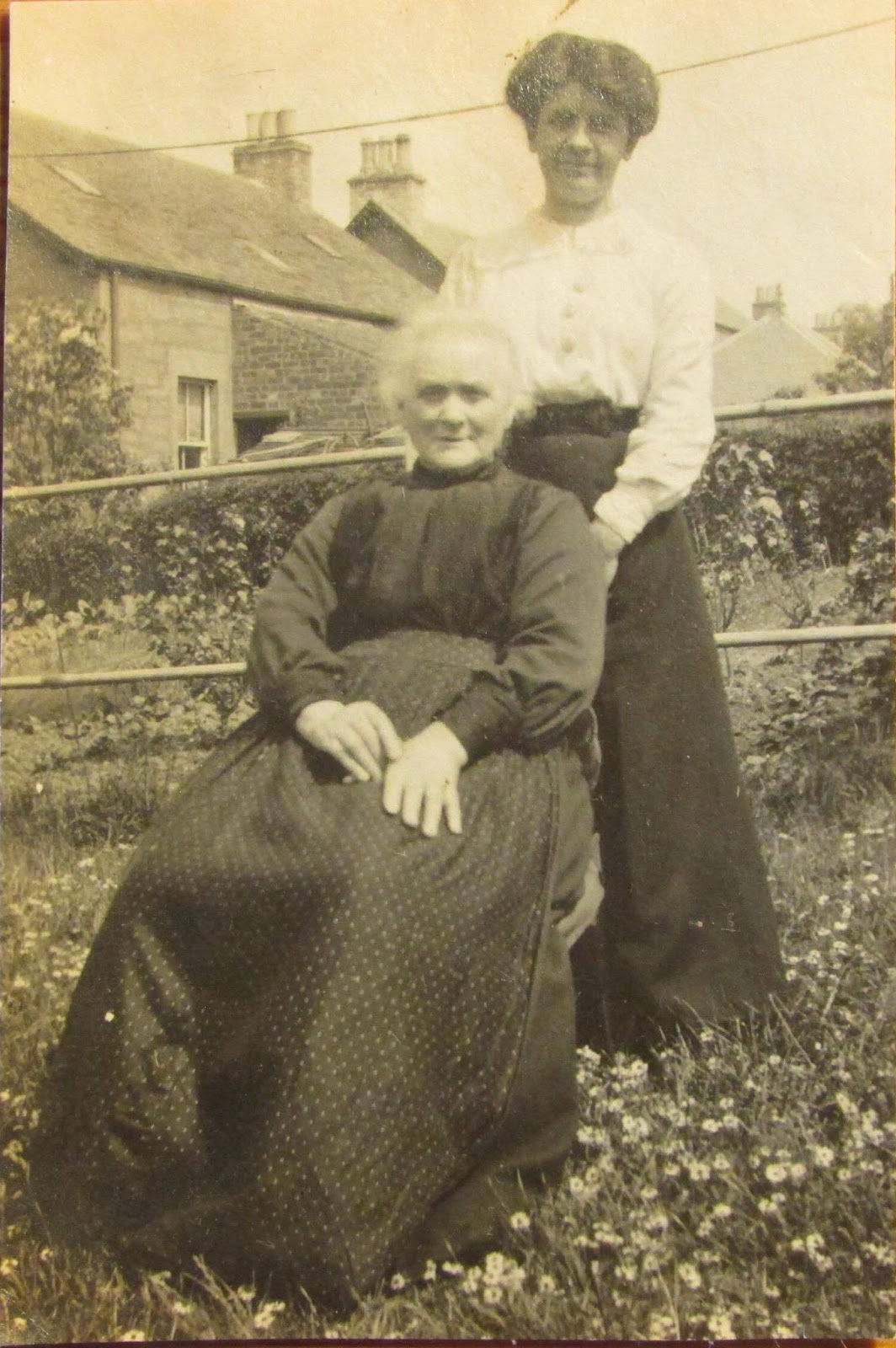
![]() |
| Grandpa and Grandma Welsh c1951 with Kurt and John |
![]() |
| James and Jane Welsh, Gowanbrae c 1890, with David, Maggie Jane and Edward |
![]() |
| Jane Welsh and daughter Maggie Jane |
Robert Welch born Scone 16 June 1817 to Robert Welch and Mary née Boyd …
and, oh dear, that looks like him in 1861, not dead at all, but confined to
James Murray Royal Lunatic Asylum … too many children …
But surely this father is the elder Robert, son of William Welsh (sic)
and Catharine née McGlashan baptised Kilspindie 12 November 1775 …
Enough. So Kilspindie it is … it seems there is more there than the golf
course.
Now, Jane née Hudgston (b 11 West
Mill Wynd, St Vigeans 15 July 1847). Great-grandma number 4. Daughter of David
Hudgston (b Arbroath, 1819; d St Vigeans, 18 November 1882), flax-dresser, and
later foreman at Green’s Mills, of St Vigeans, and Jane Steel Cram(m)ond (b Arbroath,
22 February 1822; d 15 August 1890) who
were
married 31 December 1844.
I can follow the Cram(m)ond family, in Arbroath and St Vigeans, back to
the beginning of the 18th century, but the Scots, true to their
reputation, make you pay to see the records, so I’ll do without. I’ll be
satisfied with knowing that all the families came from Arbroath and, most
particularly, the adjacent village of St Vigeans, and leave it at that.
![]() |
| Arbroath |
![]() |
| East Mill Wynd, St Vigeans |
Jane is censussed, aged 13, as a servant at the seat of the Earl of
Northesk, Ethie House, but a decade later she is, like so many others in the
area, a flax-spinner.
![]() |
| Ethie House |
The family, however, were installed first in Perth Rd, Scone, then in
Gowanbrae’s Murray Hall Road, and, by the turn of the century, in Queens Rd,
Gowanbrae, where grandad was preparing to join his father’s firm. Brother David
had become a plumber (always a useful thing to have in a family) and sister
Maggie Jane was a teenage dressmaker.
James died in 1910, and Edwin took over his place in the firm. Then he
married Maggie Anderson, the infants’ schoolteacher at Blairgowrie High School,
emigrated twice … and the bit of the story that we know began.
Well, it’s a pretty ordinary Scottish story of the 19th century.
No brilliant men hidden in there, as there were in the Jewish and Austrian forbears
of my family. Just hard-working, hard-breeding folk of the Scottish mill and
factory towns.
At least, in this day of digging, I’ve at least learned who they were
and from whence they came … maybe, one day, I’ll fill in the gaps. But I’ve got
the picture…
Subscribe to:
Posts (Atom)


