Monday, December 19, 2016

A family in a Box: Stojetz

.
This little box of cards is what really started me off on my flourish of genealogical time travel. One or two of them were, from the start, quite clear. Josef Ganzl of Neubaugasse 57 was my grandfather. Marie Baumgartner (Fr Stojetz) was his mother-in-law. Eduard Stogetz (later Stojetz) was his father-in-law. Franz Stogetz would have been his uncle-in-law, had he lived a few years longer.


But, if those ones seem straightforward, they are not, all, quite thus. First, of course, there is the curious change of name. It seems to run in our family – I am only the latest, of many, to go deed-polling. But that’s another story.

It was Eduard who had me a little puzzled. His card has been pencilled ‘1882’ on the back. So, twenty-twoish and a bachelor. And a k k Unterjäger! A corporal in the army? I thought my father’s memories had the odd hole in them. Eduard is supposed to have been apprenticed to a compositor, done his OE wandering round Switzerland, Italy, Austria as a farm hand and printer’s journeyman, and then opened a shop in Floridsdorf. All doubtless correct. But, hey Dad, there’s a fifteen years gap between the OE and the shop! How to investigate that? Perhaps, I thought, go back as far as I can?


 ‘As far as I can’ is the little painted Stammbaum, and Rudi’s birth certificate, which tells us that Eduard’s parents were Joseph (sic) Stogetz (1817-1880), machinschlosser or locksmith (‘for the National Bank’), and his wife Margarethe née Böhm. Great-greats to me. I have found only one or two traces of each of them, anywhere, beyond that piece of legal paper. Joseph is, in 1856, named as a ‘sämmtliche Schlosser’ in a press listing. Margarethe is listed in the Death Notices of 1865.

They must have been married circa 1851, after which they began a voluminous family. As the Stammbaum shows, Ernestine (1852), Aloisa (1856-7), Josef (1862) and Ludwig (1865) died as infants. So, also, did Adolph, at the age of one, at Alsergrund 41. Two of the three children who survived their 35 year-old mother’s death, did not do so by very long. Marie (1853-1877) died, at 23, of Gehirntuberculose (brain tuberculosis) at what became the family’s longterm home at Josefstadt’s Florianigasse 46, and it was tuberculosis, too, that took Franz in 1883. It seemed that only Eduard remained. And who..? Hermine.

But, actually, that was not quite so. I couldn’t work out why some of the birthdates of the children on the tree were duplicated. And why Mutter Margarethe was on one side and Mutter Theresia on the other. Two mothers? Sometimes, the most obvious things … After Margarethe’s death, Josef remarried. The lady was Theresia, née Friedl. But on the tree we see three children ..

Of Barbara I know nothing. But I do know Karl. Karl Josef Stogetz died at Florianigasse in 1870 aged 1 of ‘lungenentzündung’. Stogetz. So Joseph and Theresia must have been married by then. And Hermine? Well, I stumbled upon a Hermine, seamstressing at Florianigasse 46. But she wasn’t Stojetz. She was Hermine Hecher. I’ve found out, amazingly, that Hermine wasn’t just a ‘song of the shirt’ seamstress, she was a ‘tüchtiger Kleidernäherin’ and a wedding dress from her hand was sold some years ago at the Dorotheum (‘around 1900, cream-coloured silk, rich net lace decoration, top with pleated application, net lace trimming, silk lining, reinforcements, hook and push button fastener, floral elements made of wax pearls and wax leaves mounted on wire, train, good used condition, small parts missing’.)  Alas, it is not as simple as that!


But the last bit of evidence came, as so often, from a graveyard. The Vienna Zentralfriedhof. Buried in the one grave are Theresia Stojetz (d 20 January 1918 aged 88), Max Hecher (d 1957 aged 83) and Hermine Hecher (d April 1940).

The memorial in the middle?

I should add that Max Hecher ('Bernsteindrechsler') was a witness at the marriage of Rudi with Josef Ganzl, and that Rudi, seemingly, notes his passing ‘Onkel Max Hecher’ (there was an Onkel Max Ganzl too) in the baby book. Oberjäger Max Hecher of the 4th Jägerregiment, beim 2 Armee. But, no!  Prisoner of War in Siberia 1915. 
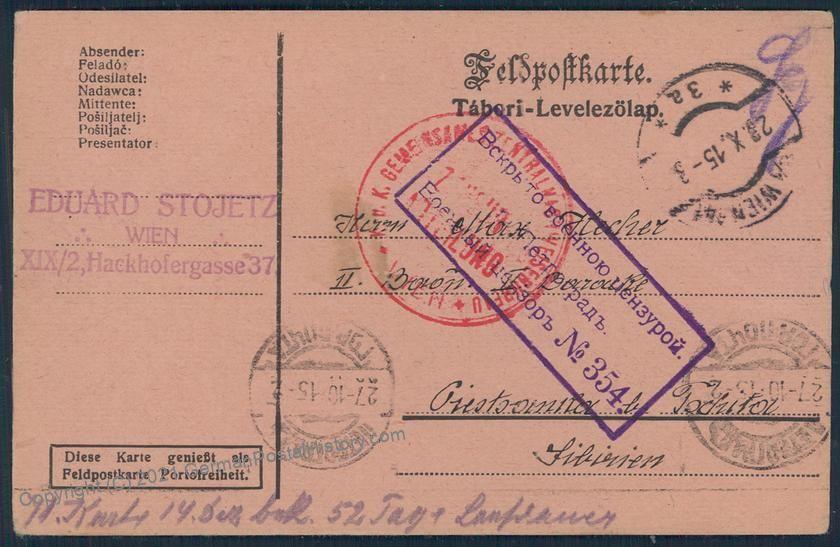

His gravestone apparently bears his birth-date. 28 December 1873. Now
hang on … whose baby are YOU!? And who is the Max Hecher in Eduard Stojetz’s Naturfreund group in the mid 20th century? And to whom he refers as 'Schwager' (brother-in-law) in 1915. But Eduard didn't have any brothers-in-law. Loose terminology?  Like Hermine’s dress, there are ‘small parts missing’ here. But I’m pressing on. Max was part of the family.

OH YE OF LITTLE FAITH. ONE BIG ERROR. I had assumed .. why? .. that Hermine was a spinster! Not a bit of it! Frln Hermine STOJETZ was Frau HECHER!  Frau Max HECHER. That's where he fits in! I may have to scrap everything and start over. And omigod! Are the family photos featuring 'Max'  not Max Ganzl, but Max Hecher ??? Of course they are ...

So, back to Eduard for some tidying up. 1882, in the army. Next sighting 1884, getting wed to Marie … Edward R? R for Rudolph, I think. No, it's Eduard Josef ... 


And, oh dear! Died. 19 Februar 1887: Stojetz Rudolphine, Buchbindergehilfen’s Tochter, 1 year VIII Florianigasse 46 Nierenentzündung. Nephritis. But four months later they had another daughter, christened Rudolphine again, who proved very, very, very much more durable. Nana.

Next sighting: Alsergrund. March 1889: Ed Stojetz Papierverschleisser, IX Nussdorferstrasse 25, für Gratulationskarten Wunschpapiere, chromolith, Bilder, Merkantil-Druckforten, Stick, Schreib Zeichen und Laubsägevorlagen ….  OK, he’s working as a stationer … I wonder how long that went on for. 


It isn’t until 1896, that I finally see Eduard and Marie showing up in the Hauptstrasse in Floridsdorf, eventually in the shop in my photo (no 7, now a hideous 1960s glass and tin 'Schauraum'), offering ‘Teppiche, Pferdedecken, Bettdecken, Kotzen’ ‘Solide Waare, Billigste Preise’. They were agents for the Haas firm of rug manufacturers and the Böhmische Heller firm of Horse Cover-makers. They seem to have stayed in the Floridsdorf area till 1916, when they sold up the shop and shifted temporarily to Nussdorf, where my father remembers growing the wartime potatoes …

They clearly moved back, for the Vienna addressbuch for 1920 has him listed at Mallygasser 8 ... 'Kassier der Bez. Krankenkasse i Floridsdorf ...'. 

The later life of Eduard Stojetz and his (so my dad said) adorable, wise, kind wife was centred around the Floridsdorf Naturfreund group, a tramping, mountain-climbing and –rescue society in which not only the parents, but the children and eventually the grandchildren enthusiastically joined, 


and around the so-called ‘Social Democrat Party’, where ‘Genosse Stojetz’ (Comrade Stojetz), his wife, and little nana Rudi, who seems to have been quite the poetic demagogue, were tireless workers.


And then, in 1932, Marie died (the left-wing press obituaried her), Josef Ganzl died, father emigrated to New Zealand, and then there was war. And me.

 And I have to find out who those two remaining cards are ... Georg WHO? Eduard WHO?


Here we go a digging some more ...

Footnote: Thanks to Jörg Wassmer from the Jüdisches Museum, Berlin, I think I have identified 'Eduard'. Eduard Bürgel (with wife) schumachermeister of Lederergasse 23, practically next-door neighbours of the Stojetz family ... and that same building would, later, house Max and Hermine Hecher! ...

Georg Würl .... hmmm.


And here's the key!. Found 2025  Hermine [Maria] HECHER born 1 September 1900 46 Floriangasse daughter of Max Josef HECHER bernsteindrechsler, son of Carl Hecher, drechsler, and Johanna LAUSCH, and his wife (15 November 1899) Hermine née STOJETZ (b 12 December 1866) daughter of Josef STOJETZ werkführer and Theresia née FEIGL.  Her godmother was Marie STOJETZ, merchant's daughter, of Floridsdorf ... my great grandma!


 So Hermine of the weddingdress wasn't a spinster! She was Hecher because she was Mrs Hecher ..  and Theresia was not the widow Hecher, she was née FEIGL ..ach!!!!!!! And Hermine was my real, kosher blood-relative great-aunt!!  I am related to the Dorotheum!

Now. About the Maxes ... how many of them were THERE? 

Yes. I think I had better start over.


Saturday, December 17, 2016

Found ... a family?

.


Szikossy. Franz Sikossy ... Who was he? And why did he leave a Herzliche Glückswunsch 1879 card for my great-grandmother which she saved for long enough for it to be sitting here, on my desk, today 137 years later?


I didn't really think I'd find out. But I think I have. How? For some reason, tucked in the pages of Nana Rudi's home-made baby book (re: my father), I found a concert programme, dated 1894.


Szt Margitsziget? Hungary. What were they doing there in 1894? Well, I guess it was a trainride or a boatride from Vienna. I've done it several times. Nana Rudi would have been seven, her younger sister, Minna about four. And they were there. Because Mutter Marie wrote on the back ...


Well, at least its not in Hungarian. But it's apparently in what my friend Geerd tells me is sütterlin, a state-imposed handwriting style, which is as bad as the old printed German text. So I can't read half of it. But I can read the half that says 'Onkel Szikossy und Tante .. and Sohn Jozsi. Mutter, Vater, Rudi und Minna.' A jolly party for a concert! Onkel, Tante. We all know that 'Uncle' and 'Aunt' can be honorary endearments ...  But ...

Onkel Szikossy must be Franz the card leaver. He had a son called Jozsef, just about Rudi's age. I have no doubt of the identification. It's just the Onkel. In Nana's book, there are a few 'Onkels' mentioned, but I think I have more or less sorted them out (PS I hadn't) and they seem kosher. So this one ..

So I dove a little more into the Szikossy family. Franz was an Inspector on the Royal Hungarian State Railways. His elder brother Aladar seems to have been a legal man, but he diversified in potatoes


and got into trouble before his death in 1917.


Franz and Aladar (and their siblings) kindly turned up on the IGI, so I was sure I was on the right track. It was a little confusing, though, because Franz's wife was given as ... Maria Baumgartner. But Mutter Marie Baumgartner was Madame Stojetz, Rudi's mother! The nice plump lady mountaineer. Anyway, 'Baumgartner' seemed to be the family connection with the Szikossys. Even though father's story of the motherless Marie being fostered by the Tesars didn't wholly seem to fit. It seemed Franz was a real Onkel. So I plunged on.

Well, Franz Sikossy of the Royal Hungarian State Railways is the forefather of a remarkable family. So far, I have come upon Gizella (1906-1987) singer and musician and her daughter Melinda Szabó (1928-1999), a seriously remarkable musician and teacher, Dr Ferenc Szikossy (1937-2011) famous curator of the Magyar Nemzeti Museum and his equally notable anthropologist daughter, Idlikó Szikossy, with whom, last night, I excitedly became face book friends.


It just remains to confirm that Baumgartner link. I know (?) now that Franz's wife was not named Maria Baumgartner, but Irma Baumgartner (someone clearly has as much trouble with transliterating Hungarian as I do) ... and, wait! ... that concert programme! Surely the last words are 'Tante Irma'?

If so, my mother led us up the garden path. John and I are not the last survivors of the Stojetz-Baumgartner Stammbaum ... little Eduard put his step-mother on the tree, but the paper wasn't wide enough for the Onkels and the Tantes ...

The stepmother. Another story. My next bit of exploration.

So ... what is this? Yes. It's Eduard's marriage entry in the Vienna registers. Bride: Maria BAUMGARTNER .. born 5 January 1862.  Does that say 'born Wien, parish of Alser Vorstadt ... daughter of ?Josef Baumgartner ... where's mother's name?  PS:  Oh!  Is that 'daughter of Josefa Baumgartner'. Yes. Unehelich. A little basket .. that explains the Tesar ...

And what's all that other stuff? (4) must be the posting of the banns ... and is that Rudolf Kriwan(n)ek ... I know that name ..

Yes! Nana's childhood autograph book is inscribed by Rudolf and Thomas Skriwanek ... maybe!?

Oddlly, no mention of Tesar ...


Is this she? Registered as unehelich. And this her mother Josefa?


Does that say 'witwe'? daughter of Leopold what? and Anna geb Holzer ...   oh dear!


Friday, December 16, 2016

Meine Grossmutter

.

.

My non-existent family is sprouting in all corners ..  the surnames Hecher and Szikossy have just surfaced ... and here is nana's birth certificate, which maddeningly has creases just where the C19th script gets awkward ...  is Eduard Stojetz a Buchbinderin? I think so. And his father? 'I have him as a 'Werkführer des kk National Bank'. And what about mother. She wasn't Baumgarten, she was Baumgartner, and what does it say under the crease? Something's Tochter. And mother Josefa? Or is the Jozsef, father?

Ah! I think the creased word is 'katholisch'! But ... why does Marie not have two parents, like Eduard?

(PS it eventually became plain. Illegitimate.)

Sunday, December 11, 2016

GÄNZL, Ganzl, Gansl or Gánsl: the other side

Some time ago, I glanced into the big pile of family papers which had descended to me and I found, to my surprise, a bit about my forbears of which I and brother John hadn't really known much. The Ganzl side. With its generational change of name or spelling ... and a whole heap of C19th photos. And diaries. Written in German shorthand. So I didn't really investigate further.

I never thought to look into the Other Side. The grandmotherly family. But, today, I promised John to try and find some nice photos to go with an article where the subject of our ancestry is to be evoked, so I opened the packages ...

The first thing I found was this. The Stojetz or Stogetz or Stogec Stammbaum. It remember seeing it as a child, but it wasn't of great interest because mother assured me that all the branches were dead. John and I were the sole budlets remaining on the sole living twig. And to prove it, she biro-ed us in. Ouch.


So, who were these people?  Well, nana was Rudolfine Josefine ('Rudi') Stojetz. Daughter of Eduard Stojetz (1860-1942), son of Josef Stojetz and Margarethe née Böhm, and Marie née Baumgartner (1862-1932), daughter of Josef Baumgartner  ... I know that, because her birth certificate (19 July 1887) is here in the package.

Well, I've got Eduard and Marie ...


Our great-grandparents.

Again, I have always known only a shadowy amount about them. They had a shop in Floridsdorf which apparently sold furniture (why did I think it was prams and bicycles, that must have been someone else). Here it is, at the turn of the century. I wish I could read what is over the door ...  but am I not right about the bikes, that definitely says 'kinderwagen' over ... oh, maybe its the next-door window. But all those carpets ... yes, it was carpets. Tablecloths, horse-rugs, bedcovers ...


Next to the photo.. what this? Father's handwriting ... 'Maria Baumgartner came from Switzerland (Engadin and Vierwaldstätter See), but she was brought up by a Mrs Tesar ... Eduard Stogetz came from a family of small tradesemen and farmers including blacksmiths, somewhere in Upper Austria. He was apprenticed to a typesetter/printer. When he had finished his apprenticeship he wandered through Austria, Italy and Switzerland taking work with printers in towns and labouring on farms when the money ran out. He settled in Floridsdorf and got himself a shop (carpets, horse-covers etc). I remember a garden, behind the house, full of fruit trees, and kite-flying on the nearby banks of the Danube. Early during the war, he sold the shop and joined the Savings Bank... He bought a beautiful house near Nussdorf, overlooking Vienna and the Danube .. (we grew potatoes on the section behind the house during the war) ... He walked daily across the Danube Bridge, with his lunch hamper, to work in the bank at Floridsdorf ...'

Nussdorf: 'overlooking the Danube'

Unfortunately, they sold Nussdorf, to move back to a rented flat on home ground, and their investments were lost in the post-war inflation. I have an envelope of bankbills, on which great-grandfather has written the history of this disaster. In 2016, it rings oh-so-truly, as the world's bwankers wreak havoc with ordinary people's lives...


But alongside his working life, and alongside his affiliation to the Social Democratic party ('as a child, he had witnessed the cavalry charge against 'the workers' in Vienna, which he never forgot'), Eduard had one abiding passion. The mountains and tramping. If you look for him on the internet, he is there. Vice-president of the Naturfreund association, which he helped to found and in which his family took a willing part. Here are Eduard and Marie, with daughters Rudi (right) and Minna in 1904 ..  Marie looks a bit puffed!


My package includes the scripts of a number of articles he wrote for the Naturfreund magazines. It also includes Nana's citation and medal as a fifty-year member of the association. 


She also followed her father into the Soc Dems where, she told me, she worked as a secretary. They gave her, many years later, an obituary notice. After she'd been years in New Zealand.

Eduard lived with his daughters, after Marie's death ... and he survived until 1942. Just four years before I was born..


By which time the world that his daughters had known, young, was a thing of the past (nana is extreme left) ..


So, can I extend our Stammbaum any further? ... Here is a little bunch of new year's cards ... from (oh, this old German script is impossible to read!) .. Franz Stogetz, 'Leder-galanterie-Arbeiter'. Eduard's brother, I guess. The tree says he died before the year was out. Then Eduard Stogetz 'k und k Unterjäger' on the occasion of the 'Namensfeste meine lieben Mizzi 2 February 1882'.  Surely not our Eduard. An army corporal? 1879: Happy New Year from Franz Szikossy. And here is the Tesar connection. Adalbert Tesar, and someone has written on the back 'meiner liebe Mutter Ziehfather ...'. One dated 1862, but I can't read it ...

And the little set of place-cards dated 1908... Mother, Father, Rudi, Minna ... Pepi is seemingly grandfather Josef Ganzl ... Fritz? His brother? but who is Beppo?

Well, once again I've found more than I bargained for. And I suppose that will set me off delving into the past all over again. I notice on the web a Genealogie of a family Leininger featuring a Josef Stojetz at its head, and featuring a Barbara, a Theresia, and Aloisa .. and a lady from Nussdorf ...  but no Beppo nor Mizzi or Eduard (b 1860) ...

Well, brother John, there you are. I thought this would tidy up the family ends rather better than the blighted Tree ... but maybe I've only opened a can of Stogetsez or Stojetses or Stogecses ...


Postscriptum: Who is the Adalbert Tesar, locksmith born 18 October 1859 Wels, Oberösterreich. Österreichicher Staats-angehöriger ...

Wednesday, November 9, 2016

FIRST CATCH YOUR MABEL

.
The Welsh Musical Theatre Orchestra (conductor: Andrew Hopkins) gave a concert version of The Pirates of Penzance on 6 November 2016. They wanted something a bit different for their programme, so they asked me. Of course. This is what they got.


FIRST CATCH YOUR MABEL

Kurt Gänzl glances behind the scenes at the casting problems that beset the original Pirates of Penzance, and how it all turned out.

Pirates has always been special for me. A glimpse of a rehearsal of my father’s 1951 high-school production was my first taste of musical theatre (‘Sir, I want to stand next to Marjorie’). Sadly, though I remember Ruth and Frederic and ‘A Policeman’s Lot’, I have only a vague picture of the Mabel. I think I later wore her dress in a school play. 


And a Pirates is the most recent G&S production that I have seen, as well. A couple of years ago in Ohio, deliciously staged and with a most perfect Mabel.


 But the part of Mabel threw up a few problems for the show’s producers in 1880. Carte and his writers had done pretty well in casting their first leading ladies -- Liverpool jewess ‘Alice May’ in The Sorcerer and Australian Emma Howson in HMS Pinafore -- but both those ladies – who straddled nicely the fence between opera-singer and light comic actress -- had gone their way, and the triumvirate had to start looking again. One or two of their Pinafore takeovers might have done nicely – the archetypal G&S soprano Fanny Holland (speciality: ‘The Jewel Song’), or the former Italian opera comprimaria Margaret Phillips (ka ‘Pauline Rita’) – but for the all-important American premiere they went for a real Italian Opera prima donna. The London jewess known as Helene Crosmond, RAM, daughter of the infamous Madame Rachel (‘beautiful forever’), a fine dramatic singer who had sung lead roles at Her Majesty’s Theatre and with whom Sullivan was acquainted. 


Alas, even though her career was tottering, Mrs Crosmond demanded operatic wages, so, with little time left, Carte looked again. And turned, at last, to his Josephines. Alas, he picked not Miss Rita nor Miss Holland but a certain Miss Tucker (‘Blanche Roosevelt’), who, most conveniently, was an American, a soprano and a nice looking woman. Inconveniently, she had a few faults, as well. Faults which had got her sacked on two continents, faults ranging from unprofessionalism to a penchant for press paragraphs, to singing out of tune. But she was pretty. Alas, America was not impressed with Miss Tucker: ‘[she has] a small soprano voice of limited register in which there is much of amateurish indecision and she was decidedly disappointing in a vocal way. She has a very handsome presence however and tried to act, although with little success’.


 Meanwhile, back in Britain, a rather approximate copyright performance of the show was staged simultaneously, at Paignton, and another ex-Josephine-takeover was put up as Mabel. Emilie Petrelli (‘the name is real … of Italian parentage’), who had taken over from the capable Elinor Loveday in the Pinafore tour, was to be England’s ‘first’ Mabel. Miss Emily Mary Jane Peters (yes, I’m afraid so) did much better. She went on to take over the role in the London production, and was slated for the title-role of Patience to follow. But she didn’t like the new part and left the company. And Carte went on to hire another London jewess, Leonora Braham, who would finally become the Savoy Theatre’s first long-term leading lady.


But the gentlemen had got it right before. When the time came to cast the role for London, they went outside the square. Mrs Sarah Ann Hunt née Isaac (yes, yet another Liverpool jewess) had been in the music business for nearly 15 years. But not in the theatre: since her pre-teens she had been singing soprano songs and arias on the music-halls. Speciality: ballads and coloratura. And she was now a very experienced performer. ‘Marion Hood’ made a splendid success of her first comic opera role, and although she left the show during the run, she went on to a fine career in the musical theatre.


The world of opéra-bouffe had already proven that casting ladies from the music-halls, from places such as Australia where unpretentious performance was the order of the day, and, as we have seen by example, from the Jewish community, was the road to success. Hiring the sexy, would-be-operatic Blanche Roosevelts of this world (and there were plenty of them) was not. And casting the role of Mabel showed the Savoy team that fact; just as the successes of ‘Australian’ Julia Mathews, the music-hall’s Emily Soldene (née Lambert) and jewish Selina Dolaro (née Simmonds’) had already shown John Russell and Charles Morton, the first great English opéra-bouffe producers.


Of course, since those days we have gone through many different kinds of Pirates productions, from the ineffably boring to the excruciatingly modernised, and many different kinds of Mabels – I remember particularly Miss Karen Lancaster as the Papp-ised Mabel, at Drury Lane, a gem! -- but I’m not going to see any more. After 65 years of Mabels, I’ve retired. And I’m happy to stay with the memory of my last-seen Mabel. Miss Chelsea Friedlander of New York seen here with Clark Sturdevant (Frederic) in the 2014 Ohio Light Opera production…


Post scriptum. Our ur-Mabels suffered different fates. Mrs Crosmond shot herself in a London cab, Miss Tucker-Roosevelt aka Countess Machetta became the mistress of Guy de Maupassant, ‘friend’ of Longfellow, and an aspiring author, and died penniless and young. Miss Peters became the wife of an orchid-collecting veterinary surgeon and a music teacher, still as ‘Madame Petrelli’, and died in Anerley, Kent in 1925, and Miss Isaac – she found success in the theatre, three (successive) husbands, and a comfortable later life.

© Gänzl 2016

 Pictured: Misses Roosevelt-Tucker, Miss Petrelli-Peters, Miss Hood-Isaac, Miss Soldene-Lambert and Miss Friedlander

Sunday, October 30, 2016

THE BOATSWAIN'S MATE and his 100th birthday

.
 Something splendid is happening in England. For many years, the nineteenth and early twentieth century operatic and strictly comic-operatic (excluding, thus, the opéras-bouffes of G&S et al) works of British composers have been all but ignored by producers and recording companies. Now, in the 21st century, such pieces seem to be being rediscovered by growing groups of enthusiasts, and gradually transferred on to disc in fresh (and often first) recordings. Cheshire’s Victorian Opera has been the leader in the field, with full recordings of such pieces as The Maid of Artois, Robin Hood and Lurline, but they are not alone in the field. The latest welcome addition to the ranks of operatic lifesavers is Retrospect Opera, whose 2015 recording of Ethel Smyth’s 1-acter The Boatswain’s Mate had somehow missed my net until now. This piece, premiered in 1916, is, of course, from a different era and in a different fach to that of brief nineteenth-century pieces such as Jessy Lea (Macfarren) or Ages Ago or the parlour operettas of Virginia Gabriel and her ilk, and, for me, falls somewhere between German’s Tom Jones and Britten’s Albert Herring in ambition and tone. Albeit on a smaller scale.


This afternoon, I have listened to The Boatswain’s Mate in toto for the first time. Because Retrospect, all power to them, have issued it in an in toto version. Dialogue and music.


It is an odd piece. Wiser than I have pontificated on its merits and shape (and the excellent booklet with the record, plus Smyth’s voluminous writings, will help one understand all that), all I need to say here is, I feel the original tale was as odd a choice for operaticisation as Albert Herring. I would have expected a jolly little tale like this to have been illustrated more in the Cox and Box or The Zoo style. But it has been handed half-an-operatic treatment. Only half, because the first part is music and dialogue (ie comic opera), the second part sung through. Personally, I much prefer the second part, even though Smyth’s libretto (or whoever’s, but that’s another story) is nicely colloquial and sparky in its dialogue, if super-conventional in action. The story is simple. The retired Mate of the title sets up a fake robbery to kid a widder inkeeperess into his arms. The plan backfires and the lady gets sweet on the bloke who ‘played’ the robber. You can imagine the original tale, dramatised, as a 20 minute curtain-raiser on a programme at a minor Victorian theatre. But Ms Smyth’s music shifts it into a different and more pretentious dimension. My problem with this is that you don’t quite know where you are. Opera? Musical comedy? Comic opera? It is definitely not necessary to fit a work such as this into a conventional box, but … well, whatever it is, it’s a lively little entertainment.

The recording has been carefully and lovingly done. The ‘reduced’ orchestrations are quite outstanding (I worry to think how overwhelming the ‘full’ ones must have been!) and delightfully played, and the performances of the three and a half players are all in keeping. I liked best the tenor, Edward Lee, who sang with open, English tones and natural-sounding words. Elsewhere we had a little bit of woof and incomprehensible lyrics.


But Retrospect has seen fit to let us hear, as a bonus, the original cast recordings. The sound, of course, is rather ‘archival’, but we hear exactly the ‘right’ voices. Courtice Pounds, somewhere between singing on the music-halls, and starring as Ali Baba in Chu Chin Chow and Schubert in Lilac Time is Benn, the Mate, the incomparably crisp-and-clear baritone Frederick Ranalow (who actually recorded a stunning Tom Jones) is the fake thief, and the New Zealand soprano Rosina Buckman – between an Isolde and a Musetta – who was a favourite recording artist, partly indeed because of her precise diction, was the widder. Like other archival recordings, these might not make easy listening, but they tell us definitively what this music was written to sound like.

The 2-disc set finishes triumphantly with a restored period recording of the overture to Smyth’s The Wreckers. All I can say is, can I please hear the rest of The Wreckers!

This is a grand project, well conceived and carried out. It brings a work, and a composer, which and who shouldn’t be forgotten or abandoned, back into the public eye. That is the kind of ‘retrospecting’ I like and admire, and I look forward eagerly to Retrospect Opera’s next offering.


PS: I discover that The Wreckers was recorded in 1994, by the same conductor. Hello, ebay...

The Boatswain's Mate can be got through www.retrospectopera.org.uk/CD_Sales.html