Sunday, June 16, 2013

Sunday in the Cemetery with Paul


A warm Sunday afternoon in Berlin. A little late Indian lunch – tasty linsen curry – at my local, a couple of streets away ..And then a small stroll… through the pretty little walled cemetery opposite. The Friedhof der Sophiengemeinde …
I really didn’t expect to find anyone I knew in my ‘local’ graveyard. But, suddenly, there I was standing opposite a large memorial to Walter Kollo. A stone bearing his name and his wife’s … and his musical and theatrical credits!


 Then, looking up, I saw an elegant, white gravestone, to the memory of … Albert Lortzing!  What was this?  Musical-theatre corner?


As un-famously musically illustrated ....


Not exactly. A nearby cross commemorated the last survivng grandson of Johann Sebastian Bach…


A mausoleum was the last resting place of Mr and Mrs Bechstein, of keyboard celebrity ….

But it wasn’t all music. A dramatic looking stele, with a brass relief, commemorates one Johanna Stegen. ‘The heroine of Lüneberg’. Born 1793. Which war was that? Who was she…
Well, turns out to be the Napoleonic wars, and Johanna was a sort of Grace Darling girl who brought the troops spent bullets in her apron.


What a trove of folk one finds on a Sunday in the cemetery with Paul.

Friday, June 14, 2013

Vienna by day, Vienna by night


We had arrived in a damp and grey Vienna. But when we awoke, the sun had got his hat on, and all was right with the world.

Old memories have to be cared for, so I led us down to the famous Café Museum for a Viennese breakfast of coffee, rolls and a nice soft-boiled egg in a felt fez. It was just the same as it used to be. All those impossible cakes and sweet things under glass. The smell of coffee. The newspapers. The waiters have got younger, I think, in 20 years… the newspaper headlines are much the same…


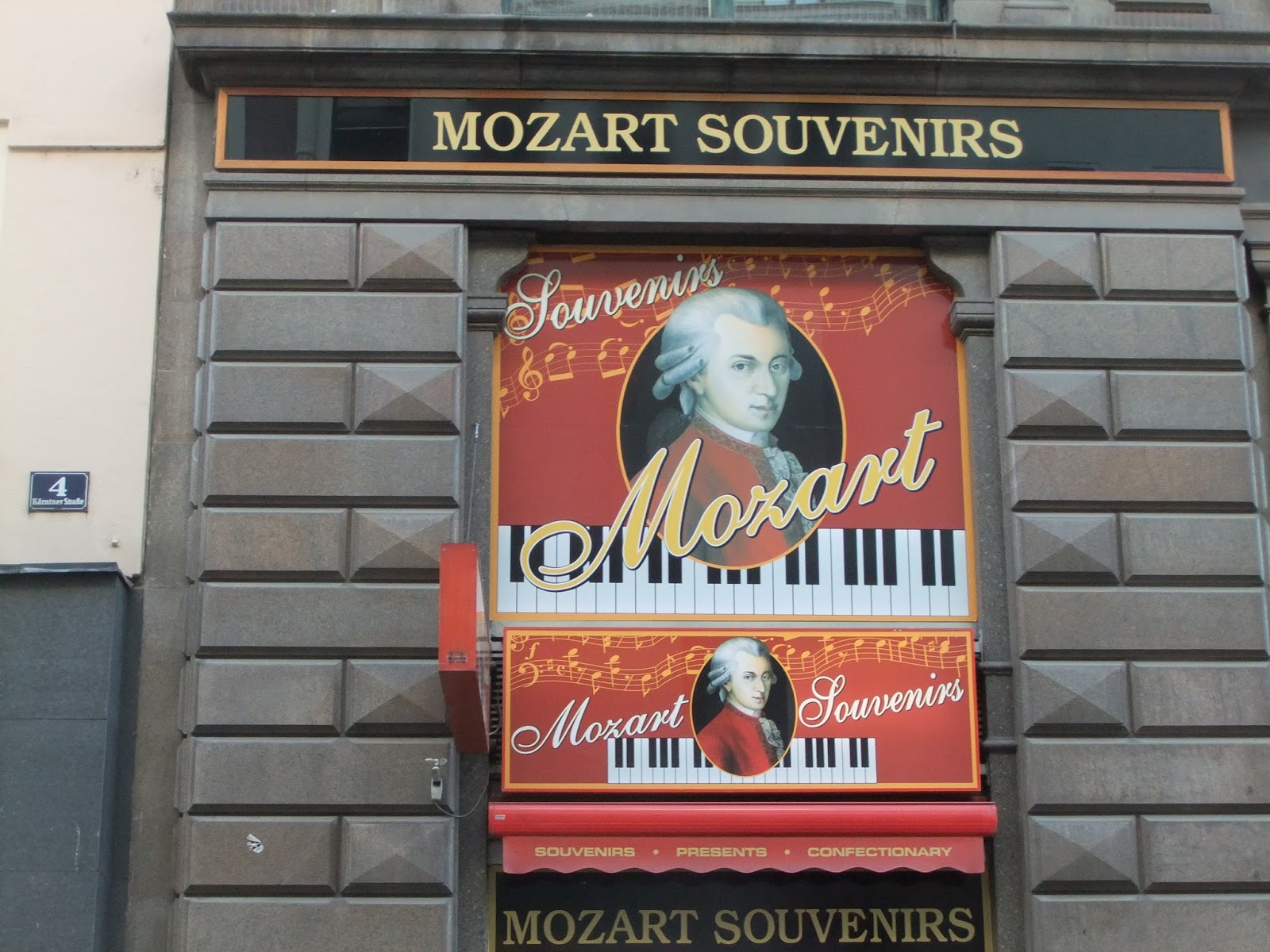
I’d scheduled the first stop on my hopelessly unguided tour of the Innere Stadt to be the ‘Mozarthaus’. Well, if you come to a musical capital with a musician, you have to be a bit musi-touristical. And our hotel room overlooked (just my luck!) the Robert Stolz Platz, so we needed a bit of upmarketing composer-wise.

So up the Kärtnerstrasse .. oh dear, Vienna is just like everywhere else. The beautiful old main streets and squares are just full of cheap and rubbishy shops. You have to go off the main drag and away from the main sights to get the real places.


 No Mozart Souvenirs wasn’t selling locks of Wolfgang’s true wig, it was selling the same sort of cheap nonsense sold in every tourist place in the world.

From Mozart Souvenirs to the Mozarthaus was but a short walk, but it takes one plumb past Vienna’s celebrated Stephansdom. I’m only 67 years old, so I’ve never seen this landmark church when it wasn’t dressed up in scaffold. But, my goodness, I might! They have made enormous progress in its restoration, and its roofs were twinkling beautifully in the sunlight


 I wasn’t going to go in to the Mozarthaus (5 euros) because I have looked at that bare suite of C18th rooms before and, frankly, there is little to see. But I wanted a loo, and the man said the attraction had been ‘done up’ in 2006, so I weakened. It has indeed been done up, and very smartly. And it is no longer empty, but filled with very fair Mozarty things. But none of it, as Paul remarked, actually ‘his’. So its still basically of interest for just standing where W.A.M once stood, slept and wrote.


You weren’t allowed to take pictures (why?) but P snapped the foto of the day just outside the door. Skyscraper apartments aren’t a 20th century invention!


 We wandered past the dear old Kammeroper (once my Vienna ‘base’) up to the Donau Canal to look at the very khaki-coloured Danube. I wonder if they still have the Sunday market on the quays. It looked rather sad and grubby, and was lined with commercial restaurant ships (and one Badeschiff), so we didn’t linger.


We turned on our heels (resisting Währing and great-grandfather Adolf’s grave) and headed back to the land of beautiful buildings and the not really over-commercialised Graben, in search of refreshment.
Needless to say, we ignored the large establishments round the place, and slipped down a sidestreet where we discovered the tiny Café Hawelka. With this plaque. I think we must have been in the Jewish quarter. But there seem to be several of those. Anyway it was a great little café and a pleasant spot…


The real refreshment of the day was pre-scheduled to be another musical stop. When alone and lonely in Vienna in the 1980s, I used to take a glass at a little Café Opera (muzak: suitable), and at the end of the street was what was said to be the place where Schubert and his friends used to have their nightly pint. You know, Das Dreimäderlhaus Act I scene I. So ‘Die drei Hacken’ in the aptly-named Singerstrasse was a natural for us. And Wiener Schnitzel and Tafelspitz an obligatory menu. With a little glass of beer…


Where the story is good, the food is almost always bad. Today was a joyful exception. Everything about the Drei Hacken was delightful, food most definitely included. It will be a must on any trip to Wien.


 After a little digestive pause, we started on the second part of our Highlights-of-Vienna-in-24-Hours. I mean, you have to go to the Hofburg. So off to Schillerplatz and .. what? Herr Schiller on his plinth with the rainbow flag fluttering behind him?


Was Schiller gay? I’ve no idea. But it turned out that we had hit Vienna in Gay Pride Week. Maria Theresia’s gardens were full of beflagged tents ... the rainbow flag decorated the posterior of a bronze horse … but I think we were the gayest thing there. A slightly forlorn girl worker obviously thought so. She pressed a rainbow package into my hand. A condom labelled Take the Test. Why me? Why not Paul? I suppose I should have been flattered.


The Hofburg and the Museum Quartier were in a large part of their glory. Since those years when I used to walk through them every morning, to work, the scaffolding and restoration have come on hugely. I looked for the little door that used to lead me to the Theater Archiv … I think it was that one … sigh.


Out into the Michaelerplatz, which was being archeologised last time I was here. All done now. Excellent. And, underneath the alarmingly homophiliac statues of the gate (Gay Pride should have shifted out there) was a line of the inevitable touristy horse-drawn landaus. And one poor horsey chewing on the metal of the vehicle. So bored. Just wanting to be somewhere in a meadow, and hoon. His partner was semi-comatosedly dozing. He didn’t want to. I scratched his neck and ears. And then he didn’t want to let me go… I felt like jumping in and driving him off. But instead we did a church.


Neither of us is really into church tourism. But the Michaelerkirche called. And look whom I found inside! Metastasio!


 And this fellow. Whoever he is. Who looks as if he would enjoy Gay Pride too. I left him my condom.


 We completed the transit of Wien, via the Freyburg of happy memories, to the Burgtheater – just because it’s a theatre – then turned for the return trip. Our show was at Ronacher, not far from the Drei Hacken, at 7.30, so time, first, for the odd aperitif or snack. Where?
I’m pretty good at picking winning little places, but Paul is a champion. We were nearly tempted by one called ’Vino’ (Riccardo?) but we pushed on till the theatre was in sight at the end of the somethingstrasse (Himmelspforter, it seems). There were several cafés along its length, some with flowers and pretties. Paul chose the plain and dark one. OK. And was he right!
We left ‘Number 13’, its wonderful folk and delightful atmosphere, seven hours later. Oh, we popped into Ronacher for a bit in the middle, for the show, which wasn’t our kind of show at all (extra-loud, subtle-as-a-stick, made-for-American-teenagers), but the kids who played it were our kind of kids. And No13 is the gypsies’ caff!
And it was in the company of an adorable bunch of talented young theatricals, Lord bless ‘em, that we finished our night…


Oh, Number 13 had its plaque and its famous ex-resident too. The famous Hungarian Rakocsi!


When youre booked to fly home in the mid-afternoon, after a late (for me) night out, the last day isn’t a day for plans and excursions. But we did have one highlight to come. After breakfast at the Museum, we wandered back to the hotel, past … the Steinway showroom. So – why not? – we went in. And Paul played on half a dozen 30,000 to 100,000 euro instruments. We liked the same one best. 29,000. But where would we put it…? J

And so to Berlin… after a delightful wee holiday …
Three days recovery time now needed…

Postscript. Just to make things absolutely perfect, on the other side of the world … well, our little Livia has been running very disappointingly since coming back from injury. I really thought she might be finished. Her race was 6am Berlin time .. but I made it, computer under the bedclothes so as not to wake my neighbour. But I did wake him … because she won!
Rah, Livia!  Rah, Wendy!  Rah, me!!


A Voyage to Vienna


It’s halfway through June … nearly the longest/shortest day (depending which hemisphere you are in) … and I have been two months back in Europe. Two months during which my activities have been decidedly ‘cultural’: opera, shows, concerts … and the good old blog, which used to chronicle my gallivants to colourful, far off places, has changed its character somewhat.

Of course, that’s because the new (old) Kurt can’t quite gallivant as before. But, with a little help, I can do very nicely, thank you. And this week, with the help and the strong right arm of my pal, Paul, I took my first trip back to Vienna for many, many years.

Where to stay? I looked up my dear little Pension Quisisana of years ago. Announcement. The old Qusisana is gone, replaced by a dashing new boutique… oh .. click … now, what was the other nice, wee place, I forget ... ah, well ... twenty years ago Le Meridien was dashing and new. It’s perfectly placed for walking about … go for the Meridien. Goodness! I rarely stay in big hotels: aren’t they expensive? That’s NOT expensive?

Our room at the Meridien was nice. Wonderful bathroom, comfy beds, unnecessarily complex wifi (when will hotels realise that free and easy-to-operate wifi is much more of a must than a TV set?), nice clean nineties décor, splendid staff … especially the lad who called us a cab and Doreen (!) at the desk…

Time for a wash and brush-down, and then a stroll to the Raimundtheater. Paul’s first glimpse at Wien. I, of course, know my father’s Geburtsort well. Ummm.
Why do I always go diametrically in the wrong direction?
The Meridien used to be on the upstage side of the Ring. It didn’t? Sigh.
Right. Find the Theater an der Wien .. ah! down the Linkzeile .. memories of the fleamarket in the 1980s … searching with Ian for European show-records …
Hmmm. I’d forgotten the Raimundtheater was in the suburbs. Probably because I’ve never been there. Just written about it. The Volksoper and the Theater an der Wien were my old haunts.


The lower Gumpendorfer is not the loveliest area of Wien, although some once proud buildings live there ….


and Herr Raimund gave his name to a rather stolid looking theatre, which looked rather unbecoming on a grey and drizzly night  … but all was well. 


Our friend Sandra had a delicious resto sorted, where we three dined on excellent Spargel and salmon. And then … of course, it doesn’t matter what a theatre is like outside. Its what is inside that counts. And what was inside was a treat.


We had a magnificent evening in the musical theatre (see previous blog), and since the theatre had had the wonderfully useful idea of a 6.30 curtain up, we were able to reach our fin de soirée Bloody Mary (me) and Margarita (Paul) in the hotel bar – exploring for our preferred sort of Beisl or Stube starts tomorrow! – and sink into those nice white beds at a sensible hour.

Tomorrow, we (re)make acquaintance with the beauties of Vienna


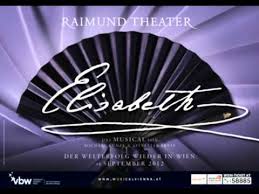
ELISABETH … an historic historical musical


 I have just flown in from Vienna, after a little visit of two days.
Two days. Why only two days?
Well, I went to see a musical. A musical which had already played Vienna last time I was there…  fifteen or twenty years ago. And which has been playing in the city and out of it ever since. But, somehow, I always managed, everywhere, to miss it. Which was distinctly unfortunate, for Elisabeth is the most successful central European piece of musical theatre of the modern era. Perhaps of any era.
What Jesus Christ Superstar, Evita or Les Misérables are to English-speaking parts of the world, in terms of success or in terms of historical importance, Elisabeth is to this part of the world. And as a writer on, and historian of, the musical theatre, it was pretty culpable of me not ever to have seen it. So on Tuesday I got on a plane, and headed for Vienna, for the show’s latest season at the Raimundtheater.
And now I know exactly why it has been so successful.


Like the three shows mentioned above, Elisabeth is based on history. The tale of the Empress known as ‘Sis[s]i’ is known everywhere – particularly, of course, in Austria and Hungary -- and she has been the subject of plays, films and of a number of previous vaguely historical musical stage works of the romantic kind, composed by musicians from Fritz Kreisler to Francis Lopez.
This one – words Michael Kunze, music Sylvester Levay -- is different. It follows the facts of Sisi’s personal and political life, in relation to four men: her husband, the Emperor Franz Josef, her ill-fated son, Rudolf, her assassin, Lucheni, the narrator of the tale … and ‘Der Tod’. Death ... personified by an attractive young man, who is at her shoulder, ever present, throughout her often unhappy life, until its end, and the end of the show.
A lush musical score sweeps this story on, through the panorama of court and country politics, until the show reaches it apotheosis in one of my favourite stage-pictures ever: the magnificent sinking of the old Europe and those who sailed in it, in the shadow of the new century.
The story is by nature episodic, but the show largely avoids a ‘and then she did’ flavour in its series of dramatic scenes and musical pieces. Since I have to find something to quibble about in a show which simply doesn’t permit too many quibbles, a whorehouse scene which reeked of the conventional and the Wildhorny was probably the only small portion of the show that left me less than staunchly enthusiastic.

I gather the production at the Raimundtheater is largely, in scenery and direction – and give or take a change of stage – much as the Harry Kupfer original. That must have been startling in 1992. It’s still pretty startling. But what is truly startling, is the casting. As I well know, from my casting years, when you are on to a fifth or fifteenth or twentieth cast change, where do you go? How many young women have played the large and difficult role of the Empress?  Well, I refuse utterly to believe that anyone, from Trier to Tokio, has played it as well as the present incumbent of the part, a young Dutch actress and singer, by name Annemieke van Dam.


Hers was one of the best performances, in any role in any show, that I have seen in a decade. Or two. Firstly, she is ‘wondrous fair’. Sisi was famously beautiful. This lady has a serene beauty which makes you gasp. Secondly, she is the most sympathetic and skilled actress imaginable. And third, she can sing. Oh, can she sing. Her singing of the show’s principal solo, ‘Ich gehör nur mir’, was simply golden.
The world has changed. I remember how amazed we all were when Elaine Paige took a E in chest voice on the first night of Evita. Elisabeth peaks on an F sharp. In what I am sure was pure chest. My friend Paul, who was my theatre companion on Tuesday, is a Proper Musician and a very good judge of theatre. I checked with him to be sure (a) my ear was right, and (b) that I wasn’t falling head over heels with an actress. He was with me, all the way.
Beautiful, beautiful performance. But please be careful Miss van Dam. Repeated chest F sharps come at a price…

The four men (all tending more or less to the tenor range) fufilled their parts splendidly. Lucheni (Kurosch Abbasi) rolled the narrative along with gleeful and (welcome) comical cynicism, Franz Josef (Jörn-Felix Alt) – in necessarily a dramatically ungrateful role – joined warmly in duet with his Empress, and with the blondely top-singing Death (Mark Seibert) in the fine first act final trio version of the hit number. Rudolf’s role is a short one, but Lukas Perman made a distinct impression in his distraught solos.
Daniela Ziegler was the ‘evil’ mother, who – in one of the show’s most effective scenes – showed herself to be not evil at all, just pragmatic, and there was a splendid cameo by Sonja Schatz as a madwoman who fancies herself to be Elisabeth.


But, in the end, the show revolves around Elisabeth herself. And with this radiant Elisabeth, nothing else is possible.

I went to see a show, and I saw a performance with a capital P.
But, of course, one can’t be radiant in an ordinary role, in an ordinary show.
So I saw a show as well. With a capital S. A major and important show, which I hope the English-speaking world will one day share.
I’m glad I didn’t wait any longer to see it.

FROM A PLUS TO C MINUS

The next night, we went to see the same management’s other Vienna production: a German version of the musical version of Legally Blonde (curiously retitled Natürlich Blonde) (songs: O’Keefe and Benjamin; book: Heather Hach).


At half time, I said ‘The English-speaking world is welcome to this one. And I’ll speak French’.
Loud, strident, brainless, charmless, loud, loud ... quite awful.
But someone found a sense of humour and half a tune in the interval, the orchestra and singers intermittently stopped blasting ff, the plot cheered up nicely, and this alarming representative of the Broadway musical 21st century (and of Hollywood) became quite bearable. Not the least because of the hectic efforts of the brave young cast.

So, it seems that the days are well and truly gone when America produced the quality shows, and central European works were an embarrassment.

I wonder where history will lead us next. And when. And if I’ll be around to see and hear it.


Sunday, June 9, 2013

OPERETTE LIVES or, Back to the Future


I have been shuddering under the memory of the appalling, amateurish Blume von Hawaii at the dreaded Halle Theater for a couple of years now. So I haven’t been to many Operette performances in Germany since. But the grand Toi c’est moi in Altenburg cheered me largely. And tonight’s premiere of Pál Ábrahám’s Ball im Savoy at the Komische Oper cheered me all over again.

Ball im Savoy is the third of Ábrahám’s trio of successful (in Germany) Operettes of the early 1930s. It’s also the least colourful and the most conventional as regards libretto, and the least original musically. Which is probably why tonight’s version fiddled with the book and introduced better-known music from his better shows. But, minor Ábrahám is better than major almost anyone else of the period … so, hey, thanks!

I didn’t know what to expect tonight. You see so many distorted, old-fashioned regietheater productions of all kinds of shows in German theatres. Or did. But I knew, from the moment the orchestra (md: Adam Benzwi) started, that I was going to enjoy myself. The overture was accompanied by a front-cloth screening of the most adorable, imaginative silhouettes … I’ve never seen anything so clever. If it was original, it was staggering. What a good start!

The show proper began less well. Music awry, leading man voiceless … but it soon came right, once the chorus came on. My goodness, that chorus! They sang and danced at full blast and full rate all evening!  It was actually 40 minutes into Act one before we got a slow, soft, solo-stage number without a huge dance-break … and, as good as the young dancers were, what a relief it was. It really had been rather frenetic and relentless.
And it would be again, as the stage filled with whirling dancers, joyous comical interaction (director: Barrie Kosky), marvellously silly costumes, first-class supporting players, an hilarious elevator ('Who's coming?') … oh yes! crazy, colourful, inconsequential, and fairly campy Operette! Yes!


By and large, design, direction and choreography were all gold star winners. Except when they mixed up vulgarity with fun. The poor lady who had to do a simulated orgasm (for no reason) on stage diminished her performance, and whoever made her do it, did ditto to the show. The same goes for the childish cock and twat business from the otherwise excellent choreographer (Otto Pichler). Grow up, little boys. When the rest of your work is so supremely good, why do that stuff? Yawn.

Which brings us to the principal players.

Here, honestly, I was a little disappointed.

This show has two leading ladies – which is supreme, depends on which version you do. We had more Gitta Alpár and less Marika Rökk, and almost no – alas - Rózsi Bársony. Originally, the pairing was singing prima donna and dancing soubrette. Not any more. Anyway, both players, tonight, were good, but imperfect.
Dagmar Manzel is a deliciously funny comedy actress – her Greta Garbo (or was it Zarah Leander) imitation was a hoot – and when she sings in the lower register she produces some splendid sounds. Alas, the soprano top is worn and unreliable. But she sang her two quiet solos – the blessed relief ones – delightfully, and didn’t go too far over the top in her Hello, Dolly bits of acting. So, all in all, a firm ‘yes’. How many actresses can do all that?
Katharine Mehrling, in the Bársony role, did go over the top. This young lady seems equipped to be a first-class Operette player. When she got a rare chance to sing properly, she was stunning. She has style too. Great style. But apparently doesn’t do the Bársony dancing. Instead, we had grotesque low comedy. Fair enough. We had enough dance elsewhere. The audience adored her. I liked her. But … she can do much better than this. When toned down a tad.
The third lady of the piece is Tangolita, the sultry Rita Hayworth seductress. This role was inspiredly cast with plunging contralto Agnes Zwierko, who played the temptress as the Italian lady from Nine, in a wholly and utterly successful way. Great idea, great performance, gorgeous singing, a treat!

So, the ladies, all scored a 'fine' or even better. I cannot say the same for the leading men. So I will pass by in silence. Singing in time and tune is a necessity for even the most striving of very-light-barihunks. And if you are going to play a charming, light-comedy, dance role, it helps if you have an ounce of charm, a touch of real as opposed to pasted-on comedy and some dance ability.

But there were compensations elsewhere! Grand ones. One of the big hits of the night was a rearrangement of the show’s best-known song ‘Toujours l’amour’, sung so wonderfully sweetly by Peter Renz and Christiane Oertel as to have me jumping from my seat. The other, was a cleverly arranged and splendidly sung rendition of Ábrahám’s Goodnight song (one of the borrowed bits from Viktoria und ihr Husar), sung as a curtain piece by the whole company.

There were so many great moments tonight. In a 3 ¼ hour show (too long! cut some dialogue, some dance-breaks and the cursed second verses) you can’t like everything. And if I’m sounding grumpy here, it’s just that ... well, I wanted it to be perfect … and, heck, what in this world is perfect?

It was a grand evening. And it reaffirmed my growing belief that Germany can still produce first class Operette in a joyous and adult style …

Bravo! Komische Oper! You are leading us (back) to the future.