Wednesday, January 9, 2019

PGB goes Jungle!


.
I’m repeating myself, I know. But I don’t very often go to the theatre now. I’ve hardly seen a new show (and not many remakes of old ones) in the last couple of decades that has given me anything like the sort of joy that I used to find in ‘musicals’ (by whatever designated name) in the previous half-century. Too electrified, too amplified, too stultified, too trendy, too imitative, too camp, too second-hand …

However, when I do make the effort, I often seem to be rewarded in inverse proportion to the pretentiousness of the production.

Britain went through a period like this in the 1950s. When Roger N Hammerstein ruled the waves. And the answer came from the smaller theatres. The musical went back into those more intimate venues, where words and music could be heard without amplification: The Boy Friend, Salad Days, Valmouth etc. Well, I’ve said it all before … so I’ll jump straight to the point. These days, almost inevitably (and yes, there have been one or three exceptions), when I have a really good time at the theatre, it is in a ‘small’ show …

Charlotte Sweet

GRIMM!
On Christmas Day 2018, alone with the twinkling lights and a gin, I chortled happily away listening to the delicious little Charlotte Sweet. I wanted an opera? Cavalleria rusticana is my all-time favourite. When in Berlin, I had a joyous time at the local music school with a really lively modern, burlesque fairystory musical Grimm!, far more beautiful than Disney’s Beauty and the Beast, and back home in New Zealand I got involved in a concert version of a superb small-cast musical entitled Fairystories. Which wasn’t a burlesque and had nothing to do with Perrault or the Comtesse d’Aulnoy, but ... Well, why Fairystories hasn’t had a full-scale professional production (I’m tempted to say ‘yet’, and I’m also tempted!) I do not know but … well, listen to this

Ali Harper sings
FAIRYSTORIES

I discovered Fairystories when I discovered its writer/composer. Paul Graham Brown. I went to sit in on a meeting at a gay caff off the Nollendorf-Strasse with a Dutch producer, and a Berlin entrepreneur who were planning a musical of Deep Throat. Well, it is no worse an idea than 75% of the musical 'adaptations' served up in the last 40 years. PGB was to be composer. Of course, it didn’t happen, but I got to know PGB and to listen to his produced (and a few unproduced) musicals. Notably a three-handed version of King Kong which is now into its eighteenth European production. I sat in on the auditions for his new piece Dynamite, and thought: why is this man’s stuff not produced outside central Europe? I voyaged into the German countryside to see a production of his many-years-before-Wildhorn Bonnie and Clyde. I voyaged to a place called Biedenkopf to see a musical written especially for the town’s festival and played on the ramparts of the local Schloss.


I still hum the secretively saucy song ‘Underneath’!. There have been annual new PGB pieces there, while he also had new, large-stage musicals played in Wiesbaden, in Hof … and our little show took place in Christchurch, NZ.


I read Fairystories for the first time, alone in a little beer garden in the Isle of Wight. I didn’t even notice my shandy was finished. At the big moment of the last scene I was horrified to find I was shivering and what … had a huge lump in my throat. If I were ever going to go into production … well, I didn’t, but our little showcase (featuring NZ’s top musical star) was a huge success with those folk … enough!


Needless to say, having discovered that rara avis, an outstanding young(ish) lyricist-composer (and even dramatist!), I wasn’t about to let go. So PGB and I have, since, become firm friends, and the little cottage at Gerolstein has, for the last few years, become the (Kurt) Gänzl and (Wendy) Williams Retreat for Productive Composers. Courtesy of Richard Marrett and his spare keyboard.


So, at midnight of the New Year 2019, Wendy ferried PGB from Christchurch airport to Gerolstein …

Yes, he’s here now. But after a day’s work at the keyboard, he’s down at the beach, so I can write this freely. I do NOT puff performers and writers who are friends. If I don’t like something they write, I tell them so and write nothing. This one, I'm writing about.

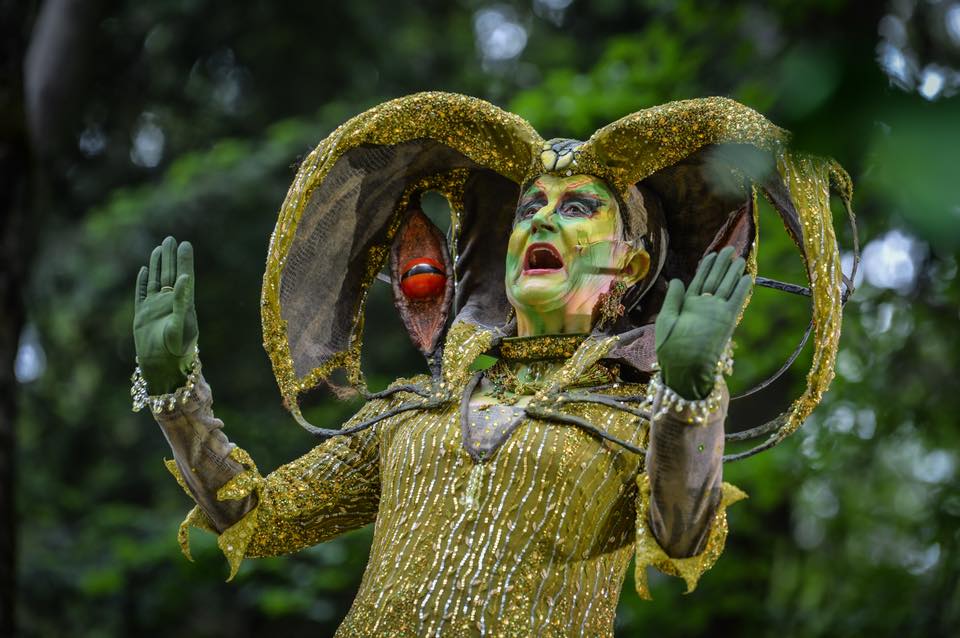
This year, CEO/librettist Birgit Simmler was headhunted from Biedenkopf to somewhere called Luisenburg. No, I don’t know more than approximately where it is. But, as in other German theatres the folk there are prolific in producing new works. PGB told me, last year, he was writing a new show for them. Like, what? A version of The Jungle Book. Not ANOTHER one? I have to admit, and I told him so stoutly, that yet another Disney remake was not at all what the world needed.

I should have known him, and Birgit, better. This morning he gave me a CD. OK, in the right mood now for a bit of Kipling… Well! this is NOT Disney….!!!! Yayy!!! Not even Lion King-type Disney. Which one might have feared. OK. It’s 70 minutes (today’s best attention length!) of stage show, with nine numbers and two tutti reprises, and it’s the most enormous fun! …

Firstly, the Luisenburg cast is quite superb. And the score, into which they dive with an enthusiasm wonderful to hear, gets yeoman service. 


Karsten Kenzel’s adorable Baloo, teaching babies and audience, is a joy … and rapping apes! … and on top of that they have a kosher Ravi Srinivasan on percussion … 


But my favourite, especially as sung by Inez Timmer, a mixture of Hermione Gingold and Kathleen Ferrier, is the snake’s song … much better than the Disney one ...


Damn. This is a grand, grand show! Five star fun for all ages.

I might even start going to the theatre again if they put up shows like this one.

He's home. OK, laddie, into that cottage and starting spinning straw into gold ..


Tuesday, January 1, 2019

Bigger watch ...

.
Why does someone need so many watches?

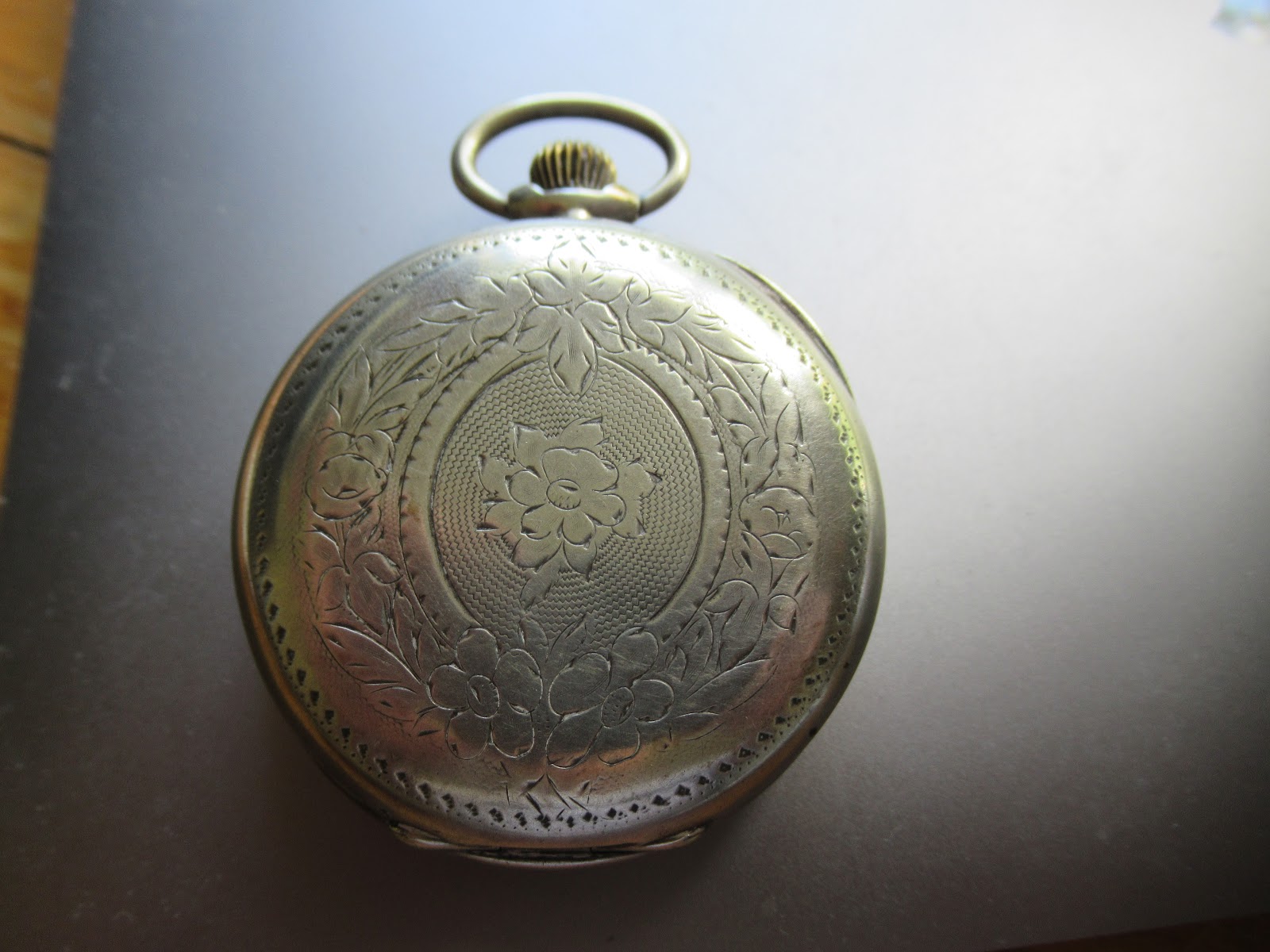
This is similar, but bigger. Nearly 2cm across. Same grey (silver?) metal. Same slightly clunky decoration, same bezel winder as Littler Watch


but the dial has, this time, a maker's name ... TERRASSE


Open the back, and there it is again: TERRASSE. 


International Exhibition Philadelphia 1876. 15 Jewels.  And those numbers again 147351.


And something else ...

a cartridge containing what looks like 0.800, and a tiny punched (assay?) mark ...

Well, I looked for Terrasse, and I found the Geneva watchmaker Mathey making very similar-looking watches, 

Mathey watch
and then I found this ..

Jacot, Gustave of Le Locle. This maker was born in 1864 and died in 1939. He was probably working prior to 1881 when he would have signed his watches in his own name. In 1881 he, with his brother, Bernard Jacot (1861-1898), set up La Terrasse, Maison, Le Locle. After Gustave died, Bernard took over running the company. In 1911, the company used the trademark Primax on their watches, parts 
and packaging. From about 1920 the company traded as Terrasse Watch Co. In 1939, after Bernards death, his wife Allice took over the company. She died in 1953. The company was still trading in 1986.

So ... if that is correct, this is a post-1920 watch. Could be. It somehow lacks the delicacy of its little brothers. But what about the Philadelphia Exhibition? 1876? Gustave was making watches aged twelve? And 'after Gustave died'? But he, so this says, survived Bernard by 40 years? But 'Jacot Frères' of Le Locle are there all right, at Philadelphia. Oh, I don't know ...

Antiques Road Show-watchers: Good, Better, Best?


Hay will be a little great this year ...

.
Hay.

It's either too hot or too cold. Either too dry or too wet. There are good years and bad years, and in the skimpy years, prices rocket. We, thus, have always attempted to grown our own. With all the hazards that involves. This year, the hazards included a month of November during which it hardly stopped raining. Our 4 acres of dedicated hay grass grew and grew ... the haymakers' diary got all his November work crammed into December, along with December's work .... and still it rained. And the grass began to (over)-ripen ...

New Year's day dawned bright and sunny, and hallelujah! mid-afternoon the haymaker rolled down our drive ... I was having my post-prandial snooze, so I missed the action ... by the time I emerged: acres of thickly mown hay!


Surely one of our most sizeable crops ever!


January 2nd: 30 degrees! A perfect hay-drying day ... now two or three more like this, then it can rain all like likes...  leaving us with only one problem ...

Will it all fit in the barn!


Postscriptum: It will. But only if we take EVERYTHING else out! Last midnight the sounds of the baler were heard, coming down the drive, and by 2am the baler-fairy had magicked the cut hay into ninety-six big, square bales. The monstrosity of that feat will be understood when I say that in seventeen years of haymaking, the most the those meadows have yielded was, I think, forty-eight! And that in the days when we had over thirty race horses. Now we have ten elderly munchers ...


And the end of the haystory ...

The apprentice haymaker carting hay


And there it is ... our all-time record crop. No hungry horsies this winter!!


Monday, December 31, 2018

Littler watch ...

.
I will not be getting a job on the Antiques Road Show.

But I am getting closer to the identity of the Little Watch.

When I put him back in the bureau, there was another one. Even smaller. About the size of a florin.


Sweet. Similar. But, alas, minus one aiguille. If it were supposed to have two.


Littler Watch -- which is more decorative -- does not seem to have what my friend Allister tells me are the assay marks stamped on Little Watch: just that tiny I (or is it a gamma) and a a very faint 5-digit number. I86152 or Z.


No chain, and no key, because this one winds from the bezel on the top.


And this is a lady's watch. Because it is engraved (in German), inside the case, to our dear Rudi 24 May 1901 from her parents. That's my great grandparents and my grandmother. She would have been rising fourteen years of age,


Young Rudi (extreme left)
Well, perhaps the multifaceted Allister (he knows so much about so many thing and he's only a youngster!) can decipher this one! One thing we know ... whether it began life in Vienna or not, it was there in 1901, came to New Zealand some half-century later, and snuck into my bureau a few years ago. How? Easy, that one. When Rudi died, her small all (and nothing of value) came to her only son, Fritz/Fred. When Fred died, to his wife, Nancy. When Nancy, my mother, died, I was in Europe and her belongings were brought to Gerolstein where, in my absence, the heroic Wendy stashed everything tidily away ... the diaries, the photo albums from Austria, the books, the trinkets ... I guess there are still little boxes to be opened ..

But, for now, lets find out about Rudi's watch(es)!

Sunday, December 30, 2018

Little watch ... what ARE you?

.
A few minutes ago I opened a drawer that I haven't opened in many ages, and there was this dear little pocket watch ... not much bigger than a half-a-crown piece


It seems to be made of base metal, it has a classic dial with no markings or name, a fine chain also seemingly of base metal and a weeny brass? and iron key. Now where in heaven's name did it come from. It seems so simple, so basic ... and so small. Is it a lady's watch, maybe? Which lady?


I am almost certain this is not from the Austro-Hungarian-Jewish part of my family. It looks ... well, much more like the practical Perthshire-Scotland side. But how to know? There are no marks.


Well, the man on the Antiques Road Show whips off the back to show wonders of mechanisms. So after a few megaminutes of probing to open the back without causing damage (a fingernail and a click did it, nothing fancy) I was presented with ... a blank iron back with two holes. This is so unfashionable as to be fashionable.


I took the tiny key and put it in the top hole. It wound up! And yes, 30 minutes later it is ticking away merrily. The middle hole changes the hands. And that's it.

But hang on. There ARE marks. But not a hope in hell that my bespectacled eyes can read them. There are marks on the key. It's a number 7. And I guess the 10 or so letters on the other side are a brand name ..


Is it QNS? ... no ..

And there are also marks on the case. Impossible. Oh! Quite by accident I have discovered that if I photograph the case with my trusty Canon ... the photo shows them up quite clearly!


Stamps of a buffalo (?) then an arrow or anchor, and what looks like a letter I or a windlass .. then a third row with what .. JT? ... and then a whole lot of numbers ... 69932 over ?34.  Well, that's about as  clear as linear B to me. I know. Bunny Campione would say straight off: 67th thousandth example of this watch made in 1934 in Puddlesby on the Marsh by Fred Schwarz ...

But why does a wee watch like this have so many marks on it?  It would be fascinating to know.

You know, I think it does come from England. And I don't have a single English ancestor. I think this comes from my godmother, Miss Ethel May Christie (d Nelson 6 December 1988), sometime Latin teacher at Nelson College for Girls and paying guest in the Gänzl-Gallas house when I was born. I have an inkling that it may have been her father's. Well, there's no one left alive who would know, so ...

But it's a darling, unpretentious wee watch and, hey, I only gave one tentative twist of the key and it's still going accurately 90 minutes later.

Any help delightedly received!

Saturday, December 29, 2018

A Cartesian chorine ... from a Pennsylvanian pub


.
As I flicked on to the facebook page of the Sir Arthur Sullivan Appreciation Group today I pulled up short.

Alan Durman has been posting a series of programmes from C19th productions of the Gilbert and Sullivan comic operas. Now, I am not a G&S specialist, like others in the group, but I flatter myself that my little foray into the Savoy (et al) world and its people has, this year, turned up quite a few trumps, and ‘outed’ a few shy players from behind their noms de théâtre. Anyway, when I glance at playbills of this kind and era, normally, I know who everyone is. 


Not today. The playbill was for Patience in New York, and there were two unfamiliar ladies in the roles of Angela and Ella. Sophie Hummel and Marie Hunter. Hmm. Probably picked-up locals rather than kosher Savoyards. I check out David Stone’s page. Yes. Their careers are totally on the left-hand side of the Atlantic. So, I decided to find out what I could about ... well, Sophie, first. And, look! I did pretty well. And she had a nice little career in the musical theatre, before quitting, aged 28, for married life as the wife of a New York shop-clerk.

Sophia Louisa Hummel(l) was born in Pennsylvania 19 January 1858. Her father, Gottlieb Hummell from Württemberg and her mother Katharine née Beckley, born Switzerland, had emigrated to America in 1851, and settled initially in Philadelphia, where the first of their eight children were born. However, before too many years, they moved to Elmira, NY, where Gottlieb became landlord of the Washington Hotel and where the couple lived out their lives. A selection of Hummells is buried in the local graveyard.


Sophie started work as a vocalist in 1879 when she joined Alice Oates’s touring English comic opera troupe, and from there she went on to chorus and mostly small parts with other good companies: at Wallack’s (The Grim Goblin), with Mahn’s company, supporting Jeannie Winston (Beatrice in Boccaccio), with John Duff’s companies (Olivette, Micaela), with the Carte/Rice Billee Taylor tour, again for Carte in Les Manteaux Noirs and Patience, and in productions of The Merry War, The Merry Duchess and in Alice May’s showcase Satanella.

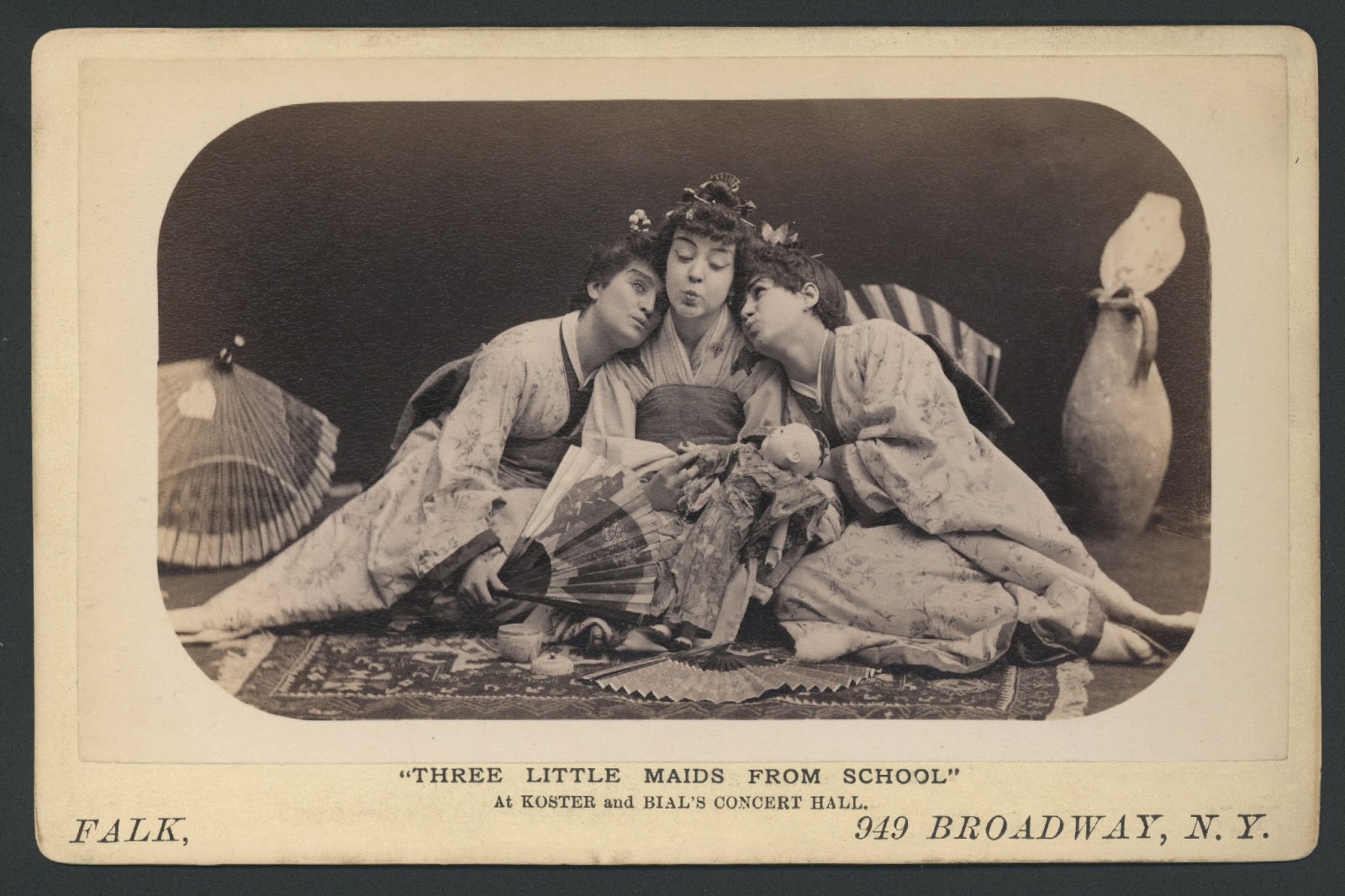
In 1884 she toured with the Barton comedy company, before joining the company at Koster and Bial’s Music Hall. There, she became installed as a principal lady, appearing as Sidonia in a mashup of Zehn Mädchen, kein Mann, opposite Fred Clifton in a remake of Carte’s Dr Ambrosias, credited to Wilfred Bendall and Cunningham Bridgman, in the burlesque Na-non, and as Pity-Sing in a burlesque of The Mikado. Happily, K&B photographed their production for souvenir merchandising, alas without credits! I plump for 'Braid the Raven Hair' which mean it is Yum Yum (Laura Burt) in the middle ... but which of the other two is Pity-Sing ...?


During her K&B engagement, she took time out to play with Edward Harrigan in Are You Insured? …
But Pity-Sing was apparently her last role. 28 March 1886 she wed German store-clerk, Charles Kalman, one of nine brothers of a Beekman Place, New York family who seemed to be mostly shop-clerks, and left the stage. I see them in 1900 living with Sophie’s young sister, Katherine Neville, and her husband ‘book publisher’ in New York. Charles is now a ‘silk merchant’. In 1910 they are in Brooklyn …
Sophie died in 1914. She is buried back in Elmira … Charles married again, but he died at 30 East 60th Street 18 January 1923, aged 74. 


And that is the story of Sophie Hummel(l) … 

That'll do for today ...

Wednesday, December 26, 2018

Peacock plus plate glass ... a smashing Christmas ...


It was to be a quiet Christmas period. On The day, Wendy visited her spread-out family, and Minnie and I sat quietly at home with my wonderful Christmas gift from Wendy (we don't 'do' Christmas, but she often cheats a delicious little!). Minnie had her newspapers to battle, and I lolled around the C19th with my new modem (the one from Noel Leeming had blown up on 23rd)..


What else could happen?

A delightful Boxing Day (no, Sean not THAT sort of boxing!), with a Wendy-made turkey lunch (all luscious local food) and the Westport races, which restore my love of harness racing after the garish froufrou of cupday and its like.

Then its 27th.

OK. That means I've got four days of blissful nothing before PGB arrives on his annual world tour (I don't know when he works!). I shall take the little green watering can and daintily water the pansies and snapdragons ...

Did I leave a door open? Most of our doors have bird nets on them. But I was THERE on the verandah. How did he get in.

So in I bowled to refill my watering can and AHHHH! There's a very large bird on the kitchen island. OK. Quietly, quietly ..  no use. With a squawk the monstrous creature took off. He should have gone to Specsavers (except they are loathed in this house). Not out the open door but straight into the picture window ...


Wendy rushed .. how's the peacock ...? I rushed .. wtf my window! ...

The peacock, slightly stunned, waddled off and out. Leaving only a little blood and a lot of shit on my 1980s London designer couch.  I called AMI. Five gold stars for AMI. They had a glass/window man here in a couple of hours. Wendy was feeding out, so I spent my time holding the ladder with my face far too close to a cute Sikh (I can't spell the name) backside.


The widow's in, but he needs to come back because the surrounds don't fit ... will he need a ladder-holder again?

Oyyyyyyyy. But big thumbs up to AMI Insurance and to Cranfield Glass for their prompt attention.


Friday, December 21, 2018

Wave that stick, Stan! A top conductor outed.


.
Oft have I bewailed the minginess of the moguls of Microsoft, who in their greediness have rendered all my old notes for British Musical Theatre and The Encyclopaedia of the Musical Theatre unreadable. But very oddly, today, I clicked despondently on a 'dead' document from 1999, and something called Text Edit leaped up and opened it! It was a list of all births and deaths of those of my 'encyclopaedia folk' (British department) which I had failed to find in those huge bound volumes which, in those days, one traipsed up the Strand to consult. In the last 20 years, I've sussed some of these tricky fibbing folk, such as Lionel Mackinder, and some of them got their truths squeezed into the 3-volume edition of the Encyclopaedia ... but I noted one or two or more that I hadn't followed up. It seemed like the moment to try.

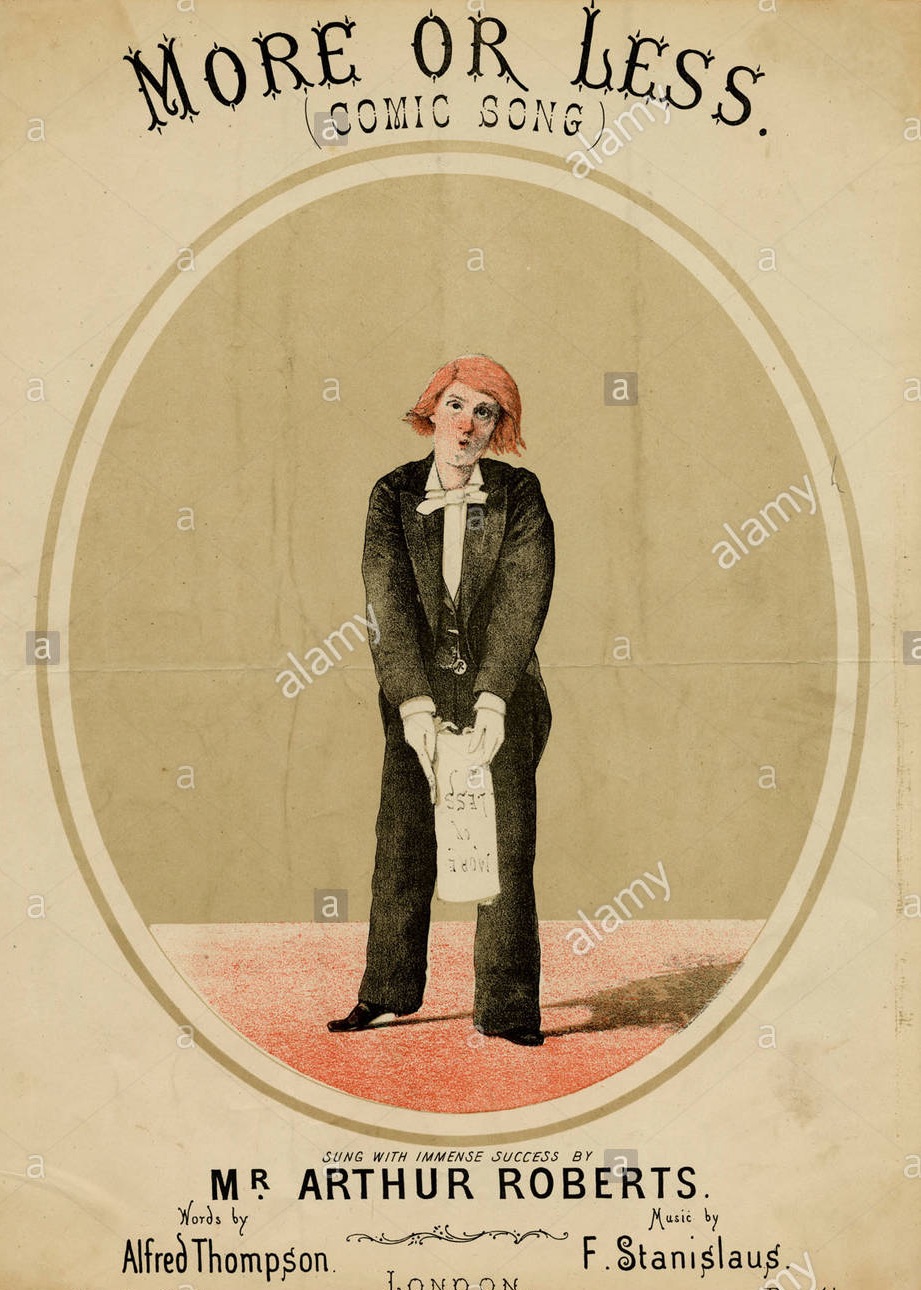
Fred Stanislaus was simply one of the best musical-theatre conductors of his sadly short era. That name! Did he come from Bulgaria or Khazakhstan? Nope, he was pure Worcestershire. And I got him!


STANISLAUS, Frederic [SMITH, Stanislaus] (b Kidderminster, December 1843; d Hammersmith, London, 22 November 1891).

Conductor and composer for the 19th-century British stage.

‘Stanislaus’ was born in Kidderminster, the son of carpet-weaver Henry Smith and his wife Hannah, who had the whimsy to christen their offspring Horatio, Stanislaus, Genevieve, Francesca, Helena and Vincent. I Worcestershire wonder why. Horatio went into designing carpets, but Stan from his teens, set to study music.


At first a member of the CCC Minstrels, later (1864-5) employed as ‘piano and harmonium’ with the Draytons in their Liverpool-based operatic entertainment, at London's Globe Theatre (1865) as conductor for Hollingshead’s La Fille de Madame Angot, on the road with the Corri/Thirlwall opera company (1866-7), and as accompanist for Louisa Pyne’s operetta group (1867-9),. He accompanied J M Bellew’s Shakespearian readings and appeared as a solo pianist at the Boosey Ballad Concerts and the Liverpool concerts (1870), returning to the West End as the conductor for the production of Barbe-bleue at the Alhambra (1871), and for the Criterion Theatre’s productions of Les Pres Saint-Gervais and Giroflé-Giroflà (1874-5). In a very full and top-flight career at the baton, he worked as a theatrical musical director in Dublin, Manchester and London, toured further as an operatic conductor in the British provinces, with Julia Mathews in Mrs Liston’s Giroflé-Girofla company (1875), and again in her fatal American season (1875). He was musical director at Sadler’s Wells in 1880, conducted Broadway's Pirates of Penzance and the first British tour of the show for the Carte organisation (1880-1) as well as London’s Princess Toto (1881) and Dick (1884) for Hollingshead, and fulfilled the same duties for Brough and Boucicault’s new burlesque productions in Australia (1886-7). He conducted for the Carl Rosa light opera company in Paul Jones (1889) and Marjorie (1890), and for George Edwardes for the burlesque Joan of Arc (1891), supplying such occasional songs and music as were needed along the way. He also ventured into production, putting out a tour of Little Jack Sheppard in 1890 with his third ?wife in the star rôle which she had played in Australia. His last job, before his premature death, was as musical director for the London production of Miss Decima (1891).


His one major stage work as a composer was the comic opera The Lancashire Witches, produced in Manchester to some considerable praise.


In spite of this success, however, Stanislaus did not follow it up with any further pieces of equal significance, and the bulk of his composing output consisted of ballads and dance arrangements in the popular style.


Stanislaus was ?married to burlesque actress and principal boy Fanny ROBINA [Fanny COOPER] (b London, 22 December 1861; d Nottingham, 13 February 1927), the daughter of top-flight music-hall duettists George Newman [George John COOPER d Southwark, 2 November 1871) and ‘Miss Mortimer’ (Margaret JONES, d London, 10 December 1874), who appeared in a number of musicals both in Britain (notably as the original Faust in the Gaiety's Faust Up-to-Date and on tour as Little Jack Sheppard) and in Australia (Young Fra Diavolo, Dick, Little Jack Sheppard, Ganem in The Forty Thieves) before continuing a career in the music-halls.


1867 The Lady Volunteers (Andrew Campbell) Saturday Evening Concerts, Glasgow November
1867 Poor as a Rat (Thomas Knight Summers) 1 act Kinnaird Hall, Dundee, 12 December. Originally attributed to 'Herr Wilhelm Kloss' a Birmingham pianist.
1872 How I found Crusoe (comp and arr /Alfred Thompson) Olympic Theatre 28 December
1873 LittleTom Tug, or The Freshwater Man( comp and arr/F C Burnand) Opera Comique 12 November
1879 The Lancashire Witches (R T Gunton) Theatre Royal, Manchester 20 October
1882 Vulcan, or the Hammerous Blacksmith (comp and arr/Augustus Harris, E C Rose) revised Venus Opera Comique March 23
1884 Called There and Back (comp and arr/Herman C Merivale) Gaiety Theatre 15 October
1884 Im-Patience(comp, sel & travestied/Walter Browne) 1 act Prince of Wales Theatre, Liverpool 25 August
1886 The Palace of Pearl (w Edward Jakobowski/Alfred Murray) Empire Theatre 12 June